The Ultimate UAE E-Invoicing Compliance Checklist for Retail & Restaurants (2026–2027)
Get ready for the UAE e-invoicing mandate with our step-by-step checklist for retail and restaurants — timelines, Peppol PINT-AE rules, and POS/ERP setup.
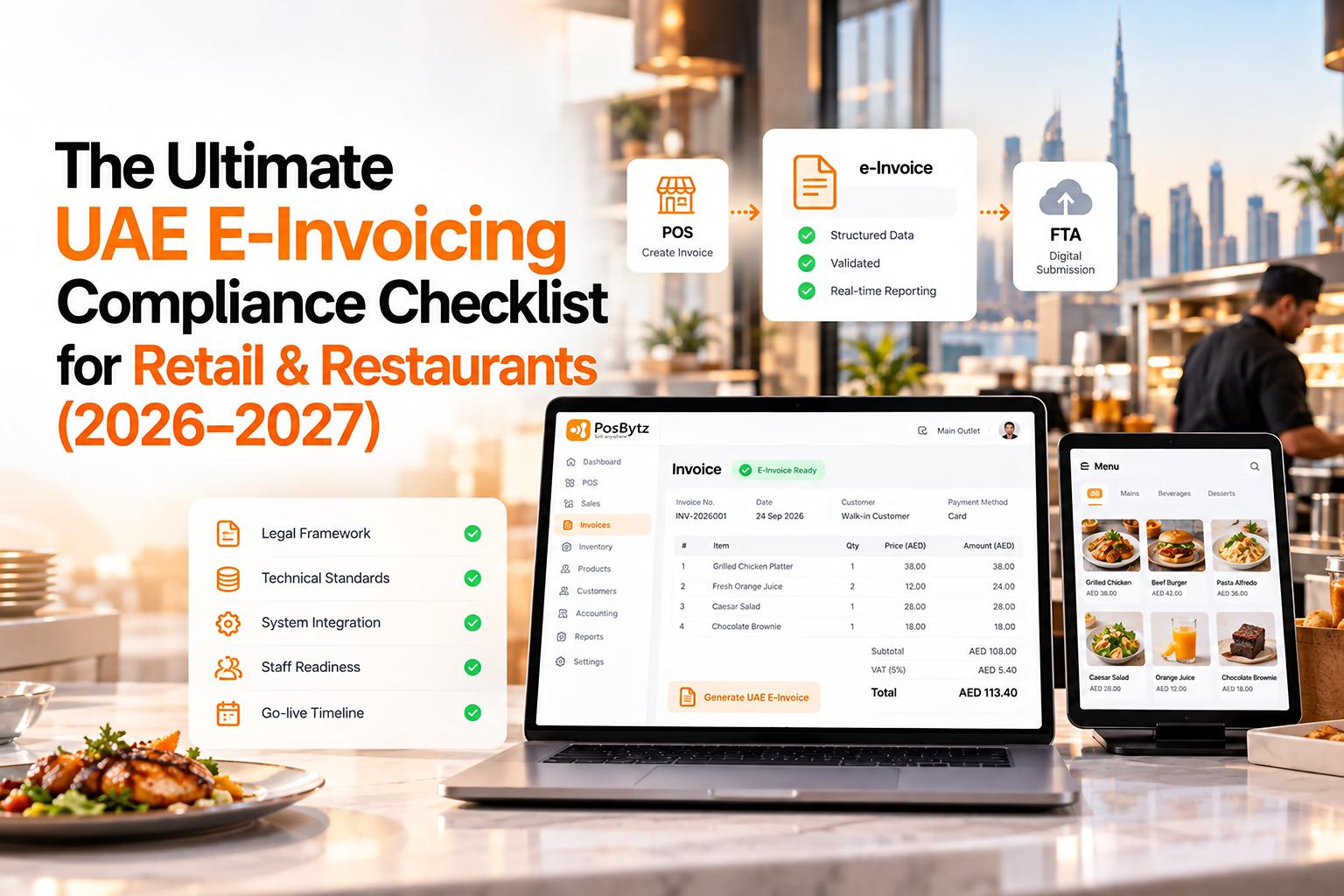


The UAE is rolling out one of its biggest digital tax reforms since VAT was introduced in 2018. Led jointly by the Ministry of Finance (MoF) and the Federal Tax Authority (FTA), the new e-invoicing mandate moves businesses away from paper and PDF invoices toward structured, real-time digital tax reporting.
For retail chains, restaurants, cloud kitchens, and hospitality groups, this UAE e-invoicing checklist covers more than sending a digital receipt. It requires technical alignment between your Point of Sale (POS) system, your Cloud ERP, and an Accredited Service Provider (ASP) — plus clean master data and staff readiness.
This guide breaks down the legal framework, official rollout timeline, technical data standards, and a step-by-step compliance checklist so your retail or restaurant business is ready well ahead of its go-live date.
Disclaimer: This article is provided for general informational purposes and reflects our understanding of UAE e-invoicing regulations as of the last updated date above. Requirements, deadlines, and penalty amounts are set by the Ministry of Finance and Federal Tax Authority and may be revised. This is not tax or legal advice — confirm your obligations with an FTA-accredited Service Provider or licensed tax advisor before acting.
Key Takeaways
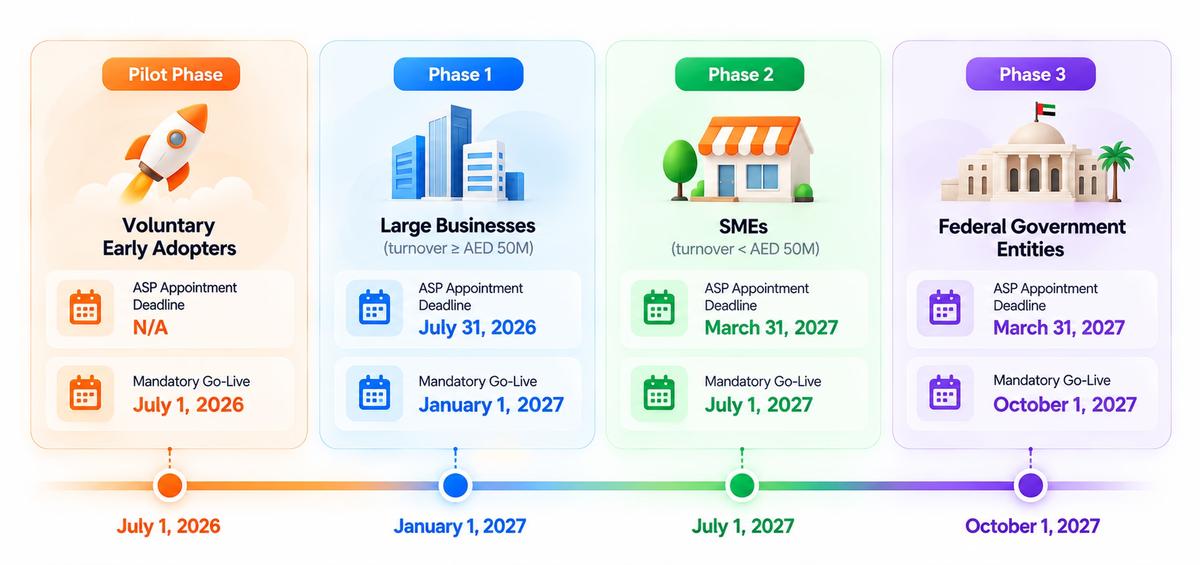
- Mandatory rollout is phased by turnover, starting with the voluntary pilot on July 1, 2026 and running through October 1, 2027 for federal government entities.
- B2C counter sales are currently out of scope — the mandate applies to B2B, B2G, G2B, and G2G transactions.
- Invoices must be issued as structured UBL 2.1 / Peppol PINT-AE XML — a signed PDF or scanned copy does not qualify.
- Non-compliance carries direct financial exposure: AED 5,000/month for missing your ASP appointment deadline and AED 100 per non-compliant invoice after go-live.
- Retail and restaurant operators should start with a transaction audit and master data cleanse now, regardless of their official deadline.
1. What Is the UAE E-Invoicing Mandate?
The UAE's e-invoicing system runs on a Decentralized Continuous Transaction Control and Exchange (DCTCE) model, using a 5-corner model built on the international Peppol network.
Under this model, invoice data moves through five checkpoints:
- The supplier generates structured invoice data from their POS or ERP.
- The supplier's Accredited Service Provider (ASP) validates the invoice format and applies a Qualified Electronic Signature (QES).
- The buyer's ASP receives and verifies the transmission.
- The buyer imports the structured record directly into their Accounts Payable or ERP system.
- The Federal Tax Authority (FTA) receives real-time tax data in parallel.
Crucial technical distinctions
- Structured XML is mandatory. E-invoices must be generated natively in UBL 2.1 / Peppol PINT-AE XML format.
- PDFs and scans are not compliant. Emailed invoices or scanned receipts, on their own, do not meet the schema requirement.
- Digital signatures are required. Every transmitted invoice needs a Qualified Electronic Signature (QES) issued by a UAE-accredited Trust Service Provider (TSP).
2. Official UAE E-Invoicing Timeline (2026–2027)
The mandate is anchored in Ministerial Decision No. 243 of 2025, Ministerial Decision No. 244 of 2025, and Cabinet Decision No. 106 of 2025. Rollout is staggered by business size and entity type:
3. Scope: B2B vs. B2C for Retail & Hospitality
Understanding which transactions are in scope prevents routing errors at the point of sale.
In scope (mandatory): B2B, B2G, G2B, and G2G transactions — including corporate catering contracts, wholesale retail distribution, commercial credit accounts, and vendor procurement.
Currently out of scope: Direct B2C transactions — everyday restaurant counter dining, takeaway orders, and retail walk-in sales — are excluded from the national Peppol exchange network for now.
What this means for your POS: Your front-of-house system needs to reliably distinguish standard consumer walk-ins (B2C) from corporate account sales (B2B). When a B2B sale happens, it must capture the buyer's Tax Registration Number (TRN) and legal address, and generate a structured e-invoice — while still applying correct VAT treatment to every transaction.
4. Technical Data Standards: Peppol, PINT-AE & Mandatory Fields
To pass ASP and FTA validation, every UBL 2.1 XML invoice needs these fields populated accurately:
- Document identifiers: A unique UUID per invoice, sequential invoice number, issue date, and date of supply.
- Party master data: Legal trade name, registered address, and TRN for both seller and buyer (for B2B).
- Line-level itemization: Description, quantity, unit price, discounts, and VAT breakdown per line.
- Tax classification: Clear tagging of standard-rated (5%), zero-rated, and exempt supplies.
- Monetary totals: Net taxable amount, total VAT, and gross payable total in AED.
- QR codes: Cryptographically verifiable QR codes on simplified tax invoices.
5. Non-Compliance Penalties & Financial Risk
Under Cabinet Decision No. 106 of 2025, non-compliance carries direct costs:
- AED 5,000 per month for failing to appoint an ASP by your mandatory phase deadline.
- AED 100 per invoice issued outside the compliant system after your go-live date.
- Input VAT disallowance — buyers may be unable to recover VAT on transactions that can't be verified through the official network.
Beyond the fines, unresolved invoice rejections can disrupt supplier payments and month-end reconciliation — a real operational risk for multi-outlet retailers and restaurant groups running tight margins.
6. Your Step-by-Step E-Invoicing Compliance Checklist
Use this checklist across finance, IT, and store operations teams to track readiness.
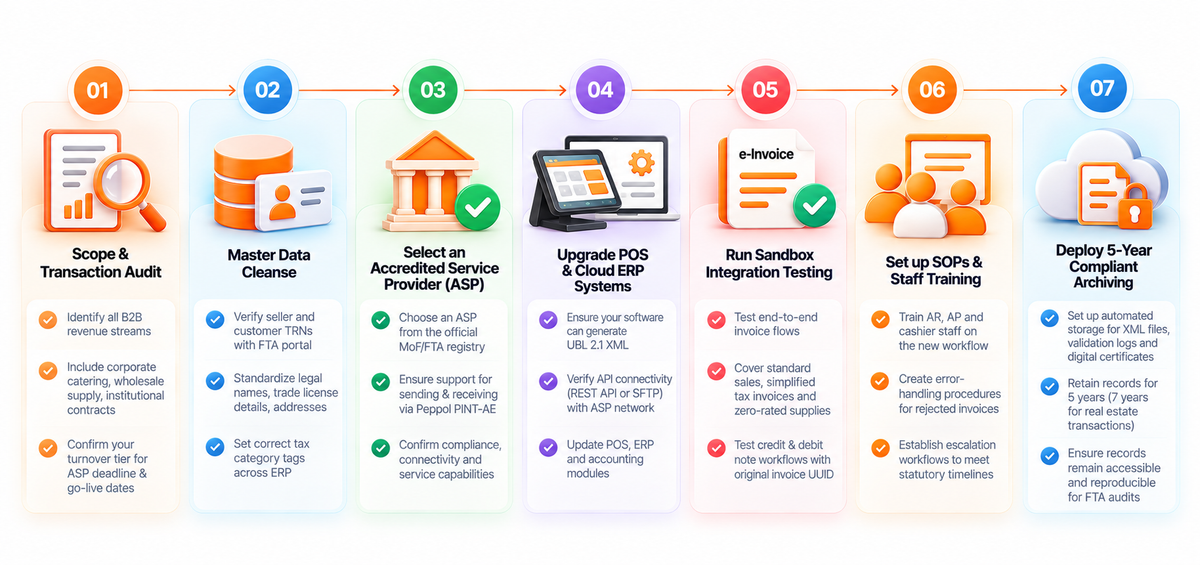
- Step 1: Conduct a scope and transaction audit
- Step 2: Perform a master data cleanse
- Step 3: Select an Accredited Service Provider (ASP)
- Step 4: Upgrade POS and Cloud ERP systems
- Step 5: Run sandbox integration testing
- Step 6: Set up SOPs and error-escalation workflows
- Step 7: Deploy 5-year compliant electronic archiving
Step 1: Scope & transaction audit
- Identify all B2B revenue streams — corporate catering, wholesale supply, institutional contracts.
- Confirm your turnover tier to determine your official ASP appointment and go-live dates.
Step 2: Master data cleanse
- Verify seller and customer TRNs against the official FTA verification portal.
- Standardize legal names, trade license details, addresses, and tax category tags across your ERP.
Step 3: ASP selection & onboarding
- Choose an ASP listed on the official MoF/FTA registry.
- Confirm the ASP supports both sending and receiving via Peppol PINT-AE.
Step 4: System & POS upgrades
- Confirm your POS and accounting software can natively generate UBL 2.1 XML.
- Verify API connectivity (REST API or SFTP) between your POS, ERP, and ASP network.
Step 5: Sandbox testing
- Run end-to-end simulations for standard sales, simplified tax invoices, and zero-rated supplies.
- Test credit and debit note workflows, confirming they correctly reference the original invoice UUID.
Step 6: Operations & staff training
- Train accounts receivable, accounts payable, and cashier staff on the new workflow.
- Document error-handling procedures so rejected invoices are corrected within statutory windows.
Step 7: Secure 5-year archiving
- Set up automated storage for XML files, validation logs, and digital certificates (5 years generally; 7 years for real estate transactions).
- Confirm archived records stay accessible and reproducible for FTA audits.
7. How PosBytz Supports UAE E-Invoicing for Retail & Restaurants
Running multi-outlet retail stores or high-volume restaurant chains means your compliance solution has to work at the point of sale, not just in the back office. PosBytz is built as a Cloud ERP and POS platform for the GCC market, with functionality designed around this kind of operational complexity:
- Unified Cloud ERP: POS, inventory, accounting, CRM, HR, and e-commerce on one platform, so tax data doesn't have to be reconciled across disconnected tools.
- Offline-capable POS with real-time sync: Counter operations continue during connectivity drops, with sales and tax records syncing once the connection is restored.
- Accounting integrations: Connects with platforms such as Zoho Books and QuickBooks to keep financial statements audit-ready.
- B2B/B2C-aware invoicing workflows: Built to classify transaction type at the point of sale and route B2B invoices toward the structured e-invoicing format they require.
If you're mapping out your ASP integration or POS/ERP upgrade path, our team can walk through what a Peppol PINT-AE-ready setup looks like for your specific outlets. - Book a free demo with PosBytz
Frequently Asked Questions
Is a digitally signed PDF compliant as a UAE e-invoice?
No. The FTA mandates structured UBL 2.1 XML transmitted through accredited access points on the Peppol network. A digitally signed PDF or email attachment doesn't meet the schema or real-time validation requirement.
Do restaurant credit notes need to comply with e-invoicing rules?
Yes. Electronic credit and debit notes follow the same UBL 2.1 XML schema, QES signing, and Peppol transmission rules as original invoices, and must reference the original invoice's UUID. Manually editing or deleting an issued invoice isn't permitted.
What happens if an e-invoice is rejected?
A rejected invoice isn't valid for VAT purposes. Your system needs to surface the specific error code, let staff correct the underlying master data or syntax issue, and resubmit through a documented approval log.
Do B2C sales need to be e-invoiced too?
Not currently. B2C transactions — walk-in retail sales, restaurant counter dining, takeaway — are outside the national Peppol exchange network scope. This may evolve, so it's worth confirming with your ASP as later phases roll out.
When do SMEs need to comply?
SMEs (turnover under AED 50M) need to appoint an ASP by March 31, 2027, with mandatory go-live by July 1, 2027 — based on the currently published phased timeline.
About the author

Thaniyeal
Technical Content Writer & SEO Specialist, PosBytz
Thaniyeal is a Technical Content Writer and SEO Specialist on the PosBytz Marketing team, focused on turning complex POS and ERP topics into clear, practical guides for restaurant and retail businesses.