The Complete UAE e-Invoicing Compliance Guide for Retail & Restaurants (2026–2027)
Master the UAE e-invoicing mandate for retail and restaurants. Learn PINT AE fields, FTA deadlines, penalties, and how PosBytz automates full compliance.
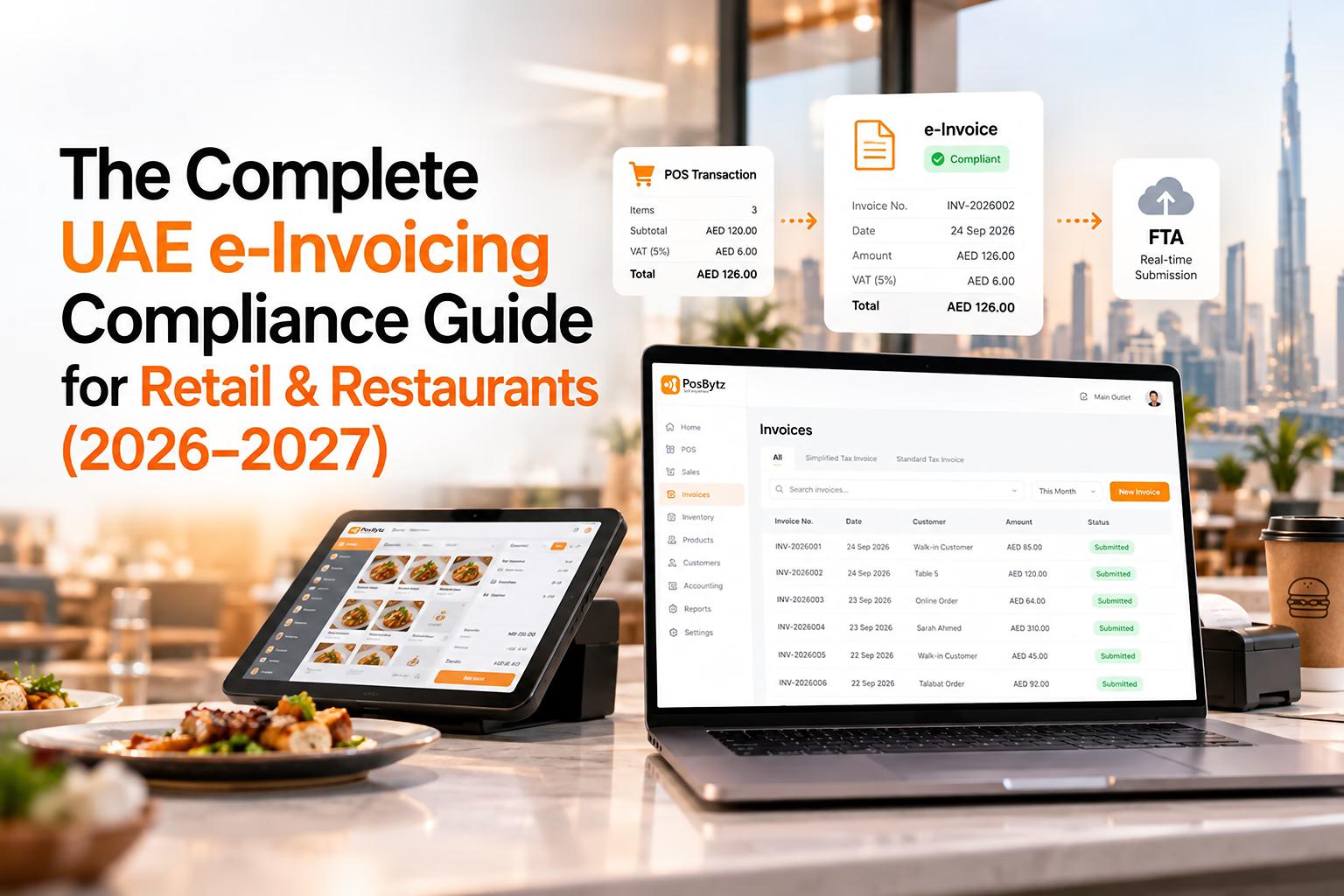


The UAE is executing a complete digital transformation of its commercial tax infrastructure. Traditional paper receipts, emailed PDF invoices, and spreadsheet-based billing are being permanently phased out. Under the nationwide Electronic Invoicing System established by the UAE Ministry of Finance (MoF) and the Federal Tax Authority (FTA), every business transaction must now be issued, transmitted, and validated in a structured, machine-readable digital format across a decentralized national network.
For retail store owners, restaurant operators, investors, and compliance officers across the UAE, this shift touches daily point-of-sale (POS) operations, billing workflows, inventory tracking, and tax accounting all at once. Compliance isn't a year-end accounting task anymore; it requires live data synchronization at the point of every transaction.
This guide walks through the legal framework, technical specifications, mandatory data fields, compliance deadlines, financial penalties, and the practical steps your retail or restaurant business needs to take to reach full FTA e-invoicing compliance, referencing the official ministerial and cabinet decisions that govern the mandate.
1. The Legal Framework Governing UAE e-Invoicing
The UAE e-invoicing system is built on Continuous Transaction Controls (CTC) and Digital Reporting Requirements (DRR). Instead of relying solely on periodic monthly or quarterly tax filings, the DRR architecture gives the Federal Tax Authority real-time visibility into commercial transactions across the country.
The mandate rests on four regulatory instruments:
- Ministerial Decision No. 243 of 2025 establishes the Electronic Invoicing System itself, setting its scope, operational exclusions, and the legal obligations of invoice issuers and recipients.
- Ministerial Decision No. 244 of 2025 defines the pilot program timeline, voluntary adoption rules, and the mandatory phased implementation dates by business sector.
- Ministerial Decision No. 64 of 2025 sets the technical criteria, capital requirements, ISO security certifications, and accreditation procedures for Accredited Service Providers (ASPs).
- Cabinet Decision No. 106 of 2025 outlines the administrative penalties for non-compliance, late ASP appointment, failure to issue e-invoices, and reporting delays.
These regulations sit alongside existing tax law, including the UAE VAT Law (Federal Decree-Law No. 8 of 2017), the Corporate Tax Law, and the Tax Procedures Law (Federal Decree-Law No. 28 of 2022).
2. Who Must Comply? Scope & Business Thresholds
A common misconception is that UAE e-invoicing only applies to large corporations or VAT-registered entities. In fact, the mandate applies broadly to any person or entity conducting business activities in the UAE.
VAT registration status doesn't exempt your business. Entities below the VAT registration threshold still have to comply. VAT-registered businesses issue Tax Electronic Invoices with 51 mandatory fields, while non-VAT registered businesses issue Commercial Electronic Invoices with 49 mandatory fields.
Free zone and mainland entities fall under the same rules across all Emirates.
Exemptions are narrow: sovereign government transactions, international passenger air transport ticketing, international air cargo (with a 24-month temporary window), and specific VAT-exempt financial services, as set out under Article 4 of Ministerial Decision No. 243 of 2025.
The B2C Retail & Restaurant Context
Business-to-consumer (B2C) retail sales and restaurant guest receipts are currently deferred from the initial B2B rollout. That said, retail chains, food distributors, caterers, and restaurants regularly run B2B transactions too, such as corporate catering orders, wholesale food supply sales, B2B event bookings, and commercial credit sales. All of those fall squarely within the mandatory compliance timeline, so most retail and restaurant operators need to prepare regardless of how "B2C" their business feels day to day.
3. Mandatory Implementation Timeline (2026–2027)
The Ministry of Finance has structured the rollout in phases based on annual business turnover:
- Pilot Phase
- Business Target Group: Selected taxpayer working group (by invitation)
- ASP Appointment Deadline: N/A
- Mandatory Go-Live: July 1, 2026
- Voluntary Adoption
- Business Target Group: Any UAE business opting in early
- ASP Appointment Deadline: Voluntary
- Mandatory Go-Live: Open since July 1, 2026
- Phase 1
- Business Target Group: Large taxpayers (annual revenue ≥ AED 50 million)
- ASP Appointment Deadline: October 30, 2026
- Mandatory Go-Live: January 1, 2027
- Phase 2
- Business Target Group: Medium & small businesses (annual revenue < AED 50 million)
- ASP Appointment Deadline: March 31, 2027
- Mandatory Go-Live: July 1, 2027
- Phase 3
- Business Target Group: Government entities (B2G)
- ASP Appointment Deadline: March 31, 2027
- Mandatory Go-Live: October 1, 2027
Annual revenue is assessed against gross income reported in financial statements prepared under UAE legal standards for the preceding financial year. Newly incorporated entities use projected revenue for the current financial year instead.
If you run a restaurant chain or multi-outlet retail business anywhere near the AED 50 million mark, it's worth confirming your phase now rather than assuming Phase 2 applies by default.
4. What Qualifies as a Valid e-Invoice (and What Fails Validation)
Under Ministerial Decision No. 243 of 2025, an electronic invoice is legally defined as one issued, transmitted, and received in a structured electronic format that allows automated, machine-to-machine processing without human intervention.
Formats that fail validation:
- PDF documents attached to emails
- Printed thermal paper receipts
- Word documents or Excel spreadsheets
- Scanned paper invoices or image files (PNG/JPG)
- Invoices typed directly into email bodies
None of these allow direct, automated parsing by recipient accounting software or FTA databases, so none of them satisfy the legal requirement, no matter how complete the information on them is.
The standard: Peppol PINT AE. Valid UAE e-invoices must be generated as structured XML or JSON data conforming strictly to the Peppol International Invoice UAE (PINT AE) specification.
The 5-Corner Decentralized Model
The UAE has adopted a Decentralized Continuous Transaction Control and Exchange (DCTCE) framework built on the international Peppol network. Businesses don't log into an FTA portal to manually type invoice details; transactions flow automatically through Accredited Service Providers acting as Peppol access points.
- Corner 1 – Supplier: The restaurant or retail POS/ERP system generates the transaction data.
- Corner 2 – Sending ASP: The supplier's ASP validates the data against PINT AE rules, converts it into compliant XML, and verifies the buyer's Peppol endpoint.
- Corner 3 – Receiving ASP: The buyer's ASP receives the invoice over the secure Peppol network, validates it, and converts it into the recipient's preferred format.
- Corner 4 – Buyer: The buyer's business software receives the structured data and auto-posts it to accounts payable.
- Corner 5 – Tax Authority Data Platform: In parallel, the supplier's ASP transmits the required tax reporting data directly to the MoF/FTA central database.
5. Mandatory Field Requirements & Where Legacy Billing Falls Short
Understanding the field requirements makes it easier to spot the gaps in a legacy billing setup. The 51 mandatory fields for a Tax Electronic Invoice break down across six categories:
- Invoice Details — 9 fields
- Covers: Invoice number, date, type code, transaction type code, currency, payment due date, and payment means code.
- Impact: Requires automated invoice numbering and standard payment method codes.
- Seller Details — 11 fields
- Covers: Legal name, electronic address/identifier, TIN, scheme code, address, city, and country.
- Impact: Requires accurate master registration data and fixed scheme identifiers.
- Buyer Details — 9 fields
- Covers: Legal buyer name, buyer electronic address/identifier, TRN/TIN, and address details.
- Impact: B2B orders require captured customer TRNs and Peppol endpoints.
- Document Totals — 5 fields
- Covers: Net amount, total excluding tax, total tax, total with tax, and amount due.
- Impact: Requires exact alignment between line items and document totals.
- Tax Breakdown — 4 fields
- Covers: Taxable amount, tax amount, tax category code, and tax rate.
- Impact: Items must map precisely to standard, zero-rated, or exempt VAT categories.
- Invoice Line Items — 13 fields
- Covers: Line ID, item description, quantity, unit of measure, unit price, VAT amount in AED, and net amount in AED.
- Impact: Requires standardized unit codes and line-level AED conversion.
Non-VAT registered businesses issue Commercial Electronic Invoices with 49 mandatory fields instead of 51.
Three data points worth getting right early
1. Tax Identification Number (TIN) and endpoint identifier. Your address on the e-invoicing network is built from the first 10 digits of your 15-digit Corporate Tax TRN, combined with the fixed UAE scheme identifier 0235. If you're already registered for Corporate Tax, your TIN already exists. Tax Group members use their own individual TIN on e-invoices, not the representative member's TRN.
2. Field 5, the transaction type code. Every invoice carries eight binary flags: free zone supply, deemed supply (samples, private use, promotional gifts), margin scheme, summary invoice, continuous supply (subscriptions, rentals, maintenance contracts), disclosed agent billing, e-commerce supply, and exports.
3. Line-item AED conversion. If a restaurant or retailer bills a B2B client in a foreign currency (USD, EUR, SAR), the PINT AE spec requires the tax amount and net amount to be calculated and stated in AED for every individual line, using official exchange rates.
There are also strict operational timelines to build into your workflow: invoices must be transmitted within 14 days of the transaction or payment date, system failures must be reported to the FTA within 2 business days, and all e-invoicing records must be stored on servers physically located in the UAE for at least 5 years.
6. Penalties for Non-Compliance Under Cabinet Decision No. 106 of 2025
- Failure to implement the system or appoint an ASP on time
- Penalty: AED 5,000 per month (or part thereof)
- Failure to issue and transmit an e-invoice on time
- Penalty: AED 100 per document, capped at AED 5,000 per month
- Failure to issue and transmit a credit note on time
- Penalty: AED 100 per document, capped at AED 5,000 per month
- Failure to report a system failure within 2 business days
- Penalty: AED 1,000 per day (or part thereof)
- Failure to notify the ASP of registered data changes within 5 days
- Penalty: AED 1,000 per day (or part thereof)
For a multi-outlet retail chain or a restaurant group processing hundreds of invoices a day, the per-document penalty caps out relatively fast, but the monthly non-implementation penalty and the daily reporting penalties can compound quickly if a system failure goes unreported. Budgeting for compliance upfront is considerably cheaper than absorbing these fines month over month.
7. Step-by-Step Action Plan for Retail & Restaurant Owners
- Confirm your revenue phase and deadline. Check your audited financial statements against the AED 50 million threshold to determine whether you fall under Phase 1 or Phase 2.
- Audit your master data. Collect and clean customer Corporate Tax TRNs, trade license details, legal entity names, and digital Peppol endpoints for every B2B client, corporate catering account, and wholesale buyer.
- Map your item catalog and tax categories. Assign ISO unit-of-measure codes (kg, pcs, box, etc.) and confirm VAT classification (5% standard, 0% zero-rated, or exempt) across every SKU or menu item.
- Evaluate your POS and ERP capability. Legacy offline cash registers or disconnected billing software that can't generate structured PINT AE XML data will need to be replaced with a modern Cloud POS & ERP platform built for automated API data exchange.
- Select an Accredited Service Provider (ASP). Partner with an MoF-accredited ASP authorized to validate PINT AE documents and transmit tax reporting data to Corner 5.
- Run end-to-end sandbox testing. Test live transactions, offline network resilience, credit note generation, and line-level AED tax calculations before your mandatory go-live date.
8. How PosBytz Cloud POS & ERP Solves UAE e-Invoicing for Retailers & Restaurants
Moving to mandatory e-invoicing doesn't have to mean bolting on fragmented add-ons or handling manual data entry. PosBytz is an all-in-one Cloud POS & ERP platform built specifically for restaurants, cafés, cloud kitchens, retail stores, and multi-outlet chains across the UAE.
- Native e-invoicing compliance. PosBytz automatically converts sales receipts, B2B invoices, and credit notes into audit-ready, structured PINT AE e-invoices, routing tax data through accredited ASP networks without extra manual entry, eliminating double entries and manual uploads.
- Device-agnostic with offline capability. PosBytz runs across iPad, Android, and Windows, and keeps taking orders during network drops, syncing everything automatically once the connection is restored.
- Omnichannel and multi-outlet management. Manage dine-in, takeaway, online delivery, and multi-location retail inventory from one centralized dashboard, including major delivery platform integrations.
- Integrated business ecosystem. Sales, inventory, and payment data connect directly to your accounting ledgers, stock reorder points, and regional payment gateways, so compliance doesn't sit in a silo separate from the rest of your operations.
Whether you're running a restaurant or a retail operation, PosBytz's accounting module and native e-invoicing engine are built to handle the UAE mandate without disrupting how your team already works.
Frequently Asked Questions
Does UAE e-invoicing replace monthly or quarterly VAT return filings?
No. E-invoicing changes how transactional data is transmitted to tax authorities. VAT returns, calculations, and payment obligations remain governed by the UAE VAT Law. Since e-invoice data is reported automatically, VAT return pre-population should streamline the filing process over time.
Can businesses continue issuing PDF invoices to commercial customers?
A PDF emailed to a customer no longer qualifies as a legal e-invoice under UAE law. You can still send a PDF as a courtesy copy, but legal compliance requires issuing and transmitting structured PINT AE XML data through an accredited ASP.
What happens if a retail store or restaurant's internet connection goes down?
Modern platforms like PosBytz include offline operational capability. Transactions recorded during an outage are queued locally, then validated, formatted, and transmitted to the ASP network once connectivity returns. A major technical failure still needs to be reported to the FTA within 2 business days.
Are small businesses below the AED 375,000 VAT threshold exempt?
No. The mandate applies to any entity doing business in the UAE, regardless of VAT status. Non-VAT registered businesses issue Commercial Electronic Invoices (49 mandatory fields) instead of Tax Electronic Invoices (51 mandatory fields).
Prepare Your Business for UAE e-Invoicing Today
The UAE e-invoicing system is a structural upgrade to how commercial operations run, not a paperwork formality. Delaying the system upgrade until your mandatory deadline risks operational disruption, validation failures, and recurring monthly penalties.
With a purpose-built Cloud POS & ERP platform like PosBytz, restaurant operators and retailers can automate tax compliance, streamline inventory management, and protect their margins at the same time.
Ready to automate UAE e-invoicing compliance for your business? Book a free PosBytz UAE e-invoicing today, or create your free account to get started.
About the author

Saravana Damodaram
Co-Founder & CEO, PosBytz
Saravana Damodaram is the Co-Founder & CEO of PosBytz, a cloud-based POS-ERP platform built for F&B and retail businesses since 2018. He focuses on unified commerce, inventory, and multi-location operations, and has helped over 5,000 merchants across 25+ countries move off fragmented, disconnected tools and run their entire operation, billing, inventory, kitchen, and accounting on one platform.