UAE E-Invoicing FAQ for Restaurant and Retail Businesses
Quick answers on UAE e-invoicing for restaurant and retail owners: who is in scope, ASP deadlines, penalties, invoice format, and retention rules.
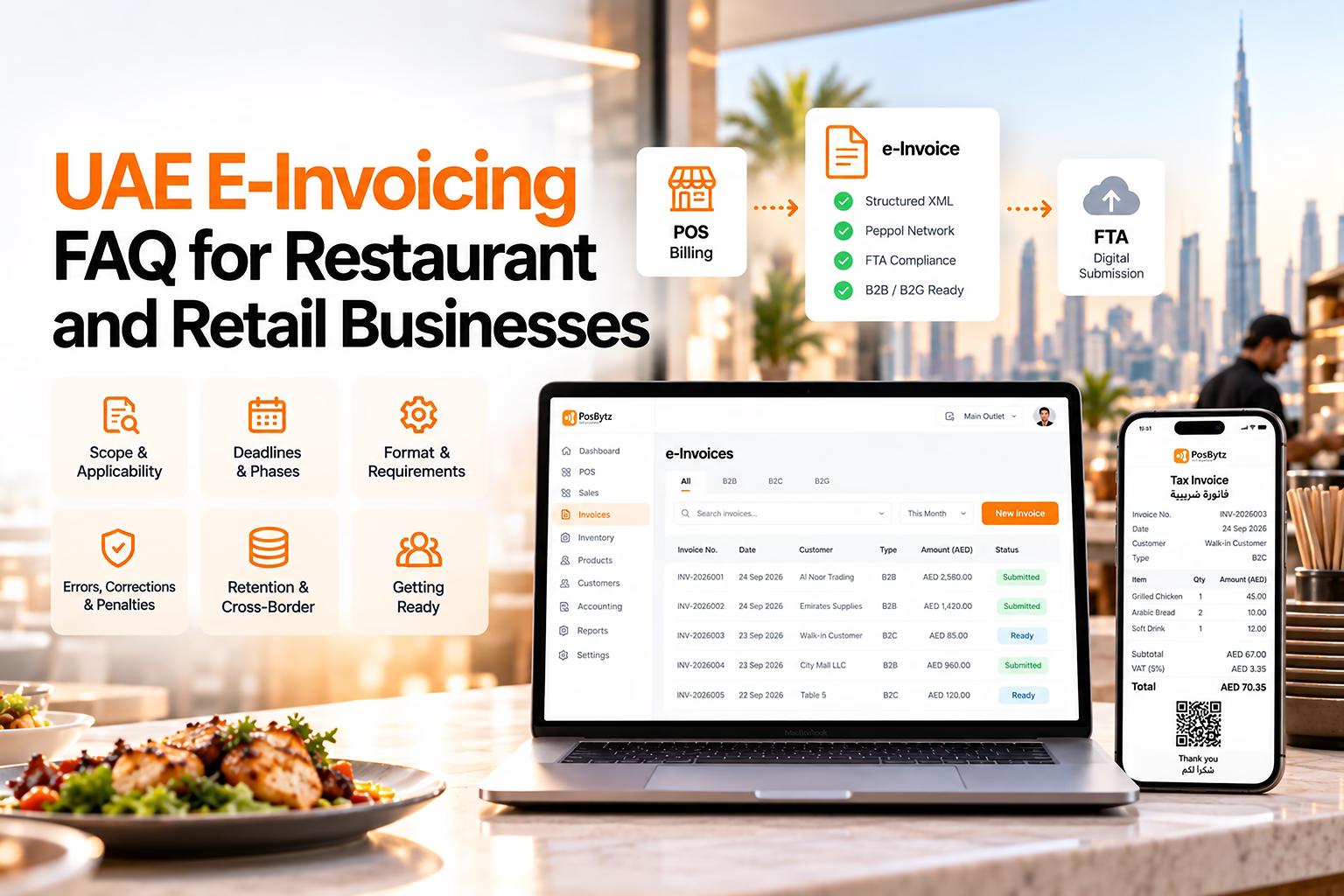


Straight answers to the questions restaurant and retail owners, CEOs, managers, investors, and founders are asking about the UAE's mandatory e-invoicing rollout, based on Ministry of Finance (MoF) and Federal Tax Authority (FTA) publications. For the full background on how the system works, see our guide to UAE e-invoicing for restaurants and retail.
Scope and Applicability
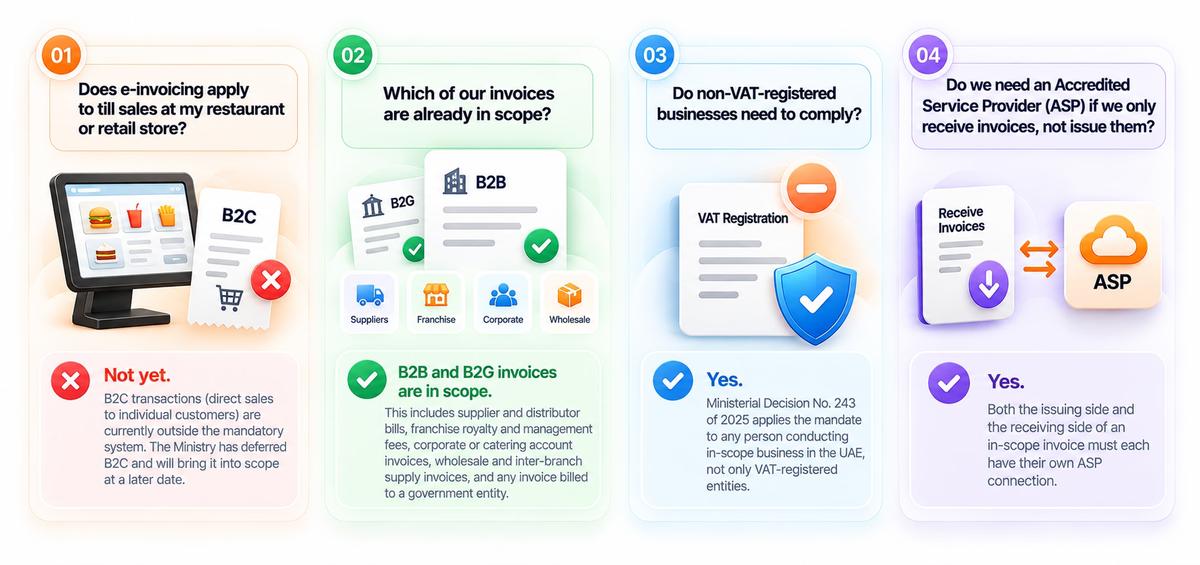
Does e-invoicing apply to till sales at my restaurant or retail store?
Not yet. Business-to-consumer (B2C) transactions, meaning direct sales to individual customers, are currently outside the mandatory system. The Ministry has deferred B2C rather than exempted it, and has said it will bring B2C into scope at a later date it has not yet announced.
Which of our invoices are already in scope?
Anything business-to-business (B2B) or business-to-government (B2G): supplier and distributor bills, franchise royalty and management fee invoices, corporate or catering account invoices, wholesale and inter-branch supply invoices, and any invoice billed to a government entity.
Do non-VAT-registered businesses need to comply?
Yes. Ministerial Decision No. 243 of 2025 applies the mandate to any person conducting in-scope business in the UAE, not only VAT-registered entities.
Do we need an Accredited Service Provider (ASP) if we only receive invoices, not issue them?
Yes. Both the issuing side and the receiving side of an in-scope invoice must each have their own ASP connection.
Deadlines and Phases
When does e-invoicing become mandatory?
1 January 2027 for businesses with annual revenue of AED 50 million or more, 1 July 2027 for businesses below that threshold, and 1 October 2027 for government entities. Voluntary participation has been open since 1 July 2026.
What is the ASP appointment deadline?
30 October 2026 for businesses at or above the AED 50 million threshold, and 31 March 2027 for everyone else, including government entities.
Did the ASP deadline actually change?
Yes. The original date for large businesses was 31 July 2026. The Ministry of Finance moved it to 30 October 2026 through Ministerial Resolution No. 66 of 2026, which amended Ministerial Decision No. 244 of 2025. The mandatory go-live date of 1 January 2027 was not affected.
How is the AED 50 million threshold assessed for a multi-outlet restaurant or retail group?
Generally at the level of the taxable entity that issues the invoices, not per individual branch. A group operating several outlets under one trade licence can cross the threshold, and land in Phase 1, well before a single-location business does.
Format and Technical Requirements
What invoice format does the UAE require?
Structured XML compliant with the PINT AE standard, exchanged through the Peppol network via an ASP.
Can we keep sending PDF invoices to business customers after our phase goes live?
No. A PDF, scanned copy, or emailed invoice does not meet the structured-format definition in Ministerial Decision No. 243 of 2025, regardless of how it's delivered.
Is a QR code or barcode required on the invoice?
No. The UAE format does not include a QR code or barcode requirement.
What master data should we prepare in advance?
Tax Registration Numbers, legal registration identifiers, and electronic addresses (endpoints) for every business customer and supplier you invoice or receive invoices from. This data cleanup is usually the slowest part of a rollout and can start before an ASP is appointed.
Errors, Corrections and Penalties
How are invoice errors corrected after issuance?
Through an electronic credit note. The original e-invoice cannot be edited or cancelled once issued; if an ASP catches an error during validation, it rejects and returns the invoice for correction before it goes further.
What are the penalties for missing a deadline?
Under Cabinet Decision No. 106 of 2025: AED 5,000 per month or part thereof for failing to appoint an ASP or implement the system by the deadline; AED 100 per invoice (capped at AED 5,000 per month) for failing to issue or transmit an e-invoice on time; and AED 100 per credit note (capped at AED 5,000 per month) for late electronic credit notes. Confirm the current figures against the published Cabinet Decision before using them for financial planning.
Is the implementation penalty capped by invoice volume?
No. The AED 5,000 per month penalty for not appointing an ASP applies as a flat recurring cost regardless of how many invoices a business issues that month.
Retention and Cross-Border Invoicing
How long must e-invoices be retained?
Generally 5 years, both for taxable persons (from the end of the relevant tax period) and other persons (from the end of the calendar year the document was created). Real estate-related records must be kept for 7 years.
Can invoice data be stored outside the UAE?
Yes, provided it remains accessible, readable, and retrievable by the FTA on request.
Do overseas suppliers need to join the UAE e-invoicing network?
Only if they're already registered on Peppol or specifically required to under UAE VAT or Corporate Tax law. Otherwise a dummy endpoint is used for FTA reporting, and the invoice itself can still be sent to the buyer outside the network.
Getting Ready
What should we check first?
Confirm which revenue phase applies to your entity, separate your B2B/B2G invoice flows from ordinary consumer receipts, and audit whether your POS or ERP system can produce the required invoice data and connect to an ASP through Peppol. The Ministry of Finance's accreditation portal is the only authoritative list of approved ASPs to choose from.
About the author

Saravana Damodaram
Co-Founder & CEO, PosBytz
Saravana Damodaram is the Co-Founder & CEO of PosBytz, a cloud-based POS-ERP platform built for F&B and retail businesses since 2018. He focuses on unified commerce, inventory, and multi-location operations, and has helped over 5,000 merchants across 25+ countries move off fragmented, disconnected tools and run their entire operation, billing, inventory, kitchen, and accounting on one platform.