Abu Dhabi Healthy Food Law Compliance Checklist for Hotels & Restaurants (2026)
Use this checklist to prepare your menu, recipes, and documentation before Abu Dhabi enforces its new SEHHI healthy food law on October 1, 2026.


From October 1, 2026, every hotel and independent food and beverage outlet holding a tourism licence in Abu Dhabi has to meet new menu rules set by the Department of Culture and Tourism (DCT). If you run a restaurant, hotel F&B outlet, café, or cloud kitchen in the emirate, this isn't a "nice to have"; it's a licensing requirement, and the clock is already running.
This guide breaks the regulation down into a working checklist: what the law covers, who's exempt, what you need to submit, and how to avoid the most common compliance gaps operators are running into right now.
What the Abu Dhabi Healthy Food Law Actually Requires
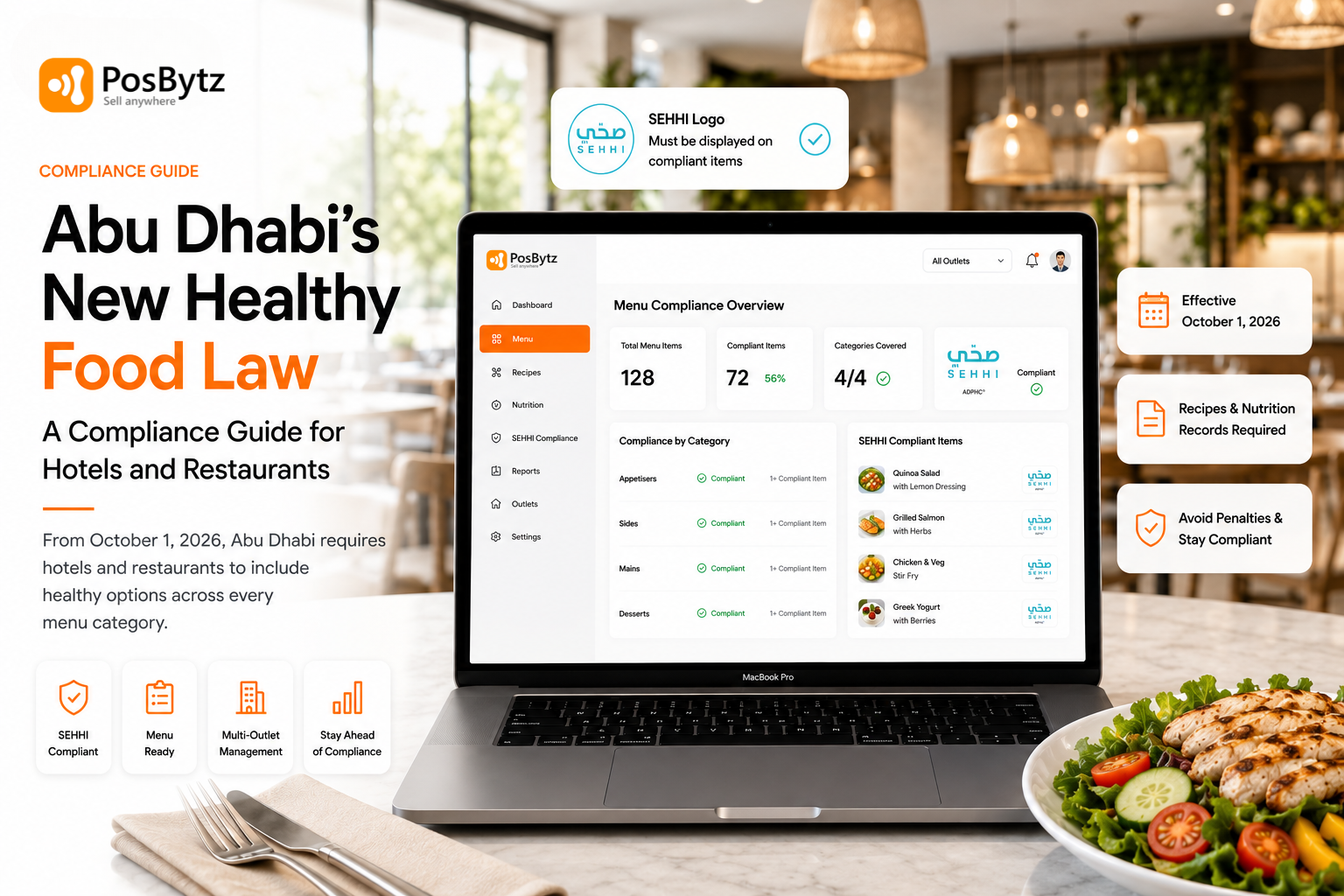
The rule is built around SEHHI, a nutritional classification that flags menu items lower in fat, sugar, and salt, and higher in overall nutritional value. Rather than banning anything, the mandate sets a minimum floor: every menu category has to carry at least one SEHHI-qualifying option, and that option has to be marked on the menu with the SEHHI logo so guests can spot it.
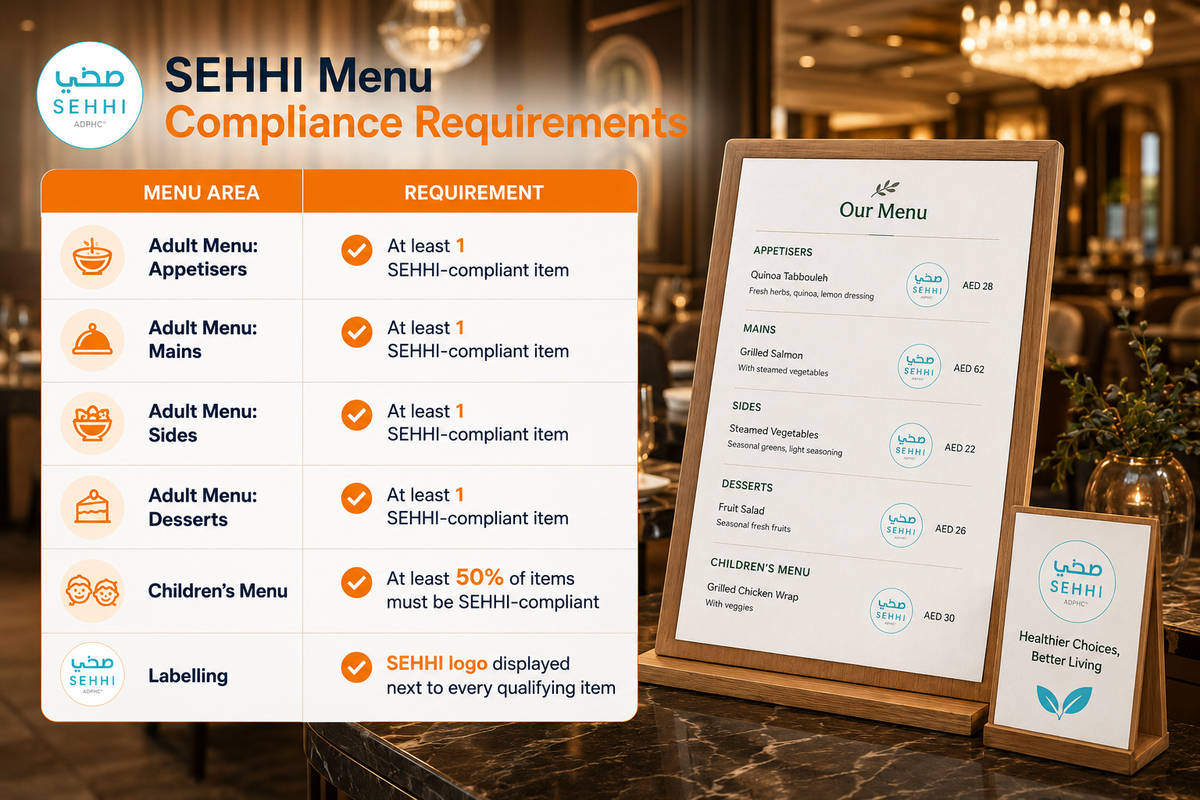
Operators can meet the children's menu threshold by scaling down existing SEHHI-compliant adult dishes into smaller, child-appropriate portions rather than building an entirely separate menu from scratch.
Who Has to Comply, and Who's Exempt
The law applies broadly, but three categories of venue sit outside its scope:
Covered under the mandate
- Hotel-operated restaurants, cafés, and bars with a tourism licence
- Independently run F&B outlets holding a tourism licence
- Any outlet offering a fixed, printed, or digital à la carte menu
Exempt from the mandate
- Buffets and other formats without a defined menu (though "reasonable" healthy choices are still expected)
- Tasting menus built from a fixed, curated selection
- Niche outlets that stick to three or fewer food categories, offer no seating, display no written menu beyond signage, or sell beverages only
If your venue straddles categories (say, a hotel with both a buffet and an à la carte dinner service), the à la carte side needs to comply even if the buffet doesn't.
The Compliance Checklist
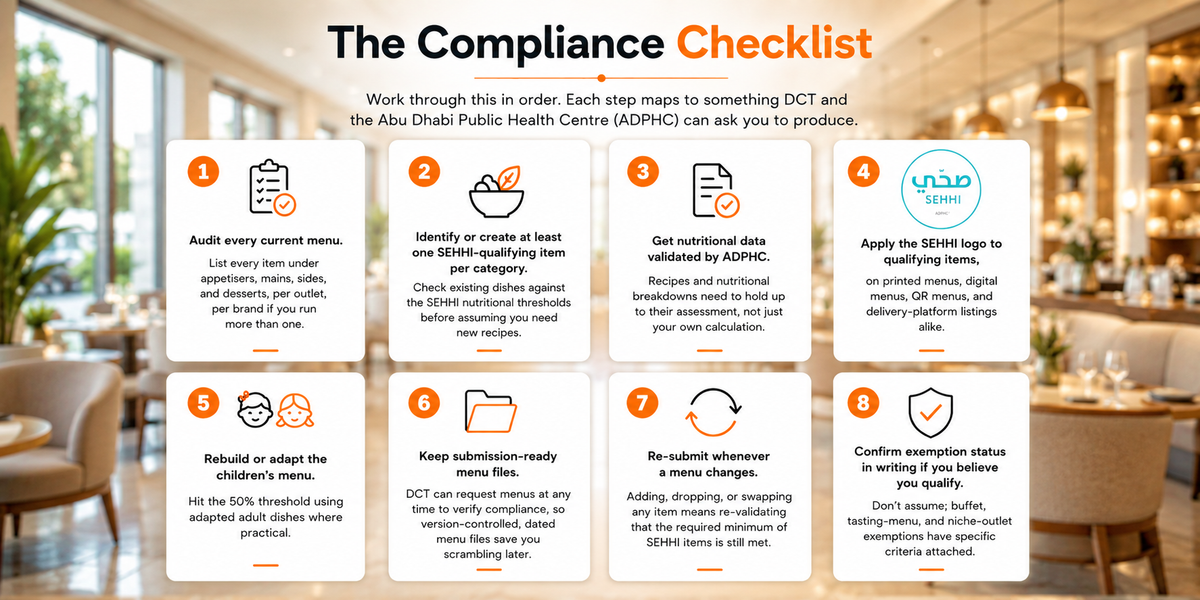
Work through this in order. Each step maps to something DCT and the Abu Dhabi Public Health Centre (ADPHC) can ask you to produce.
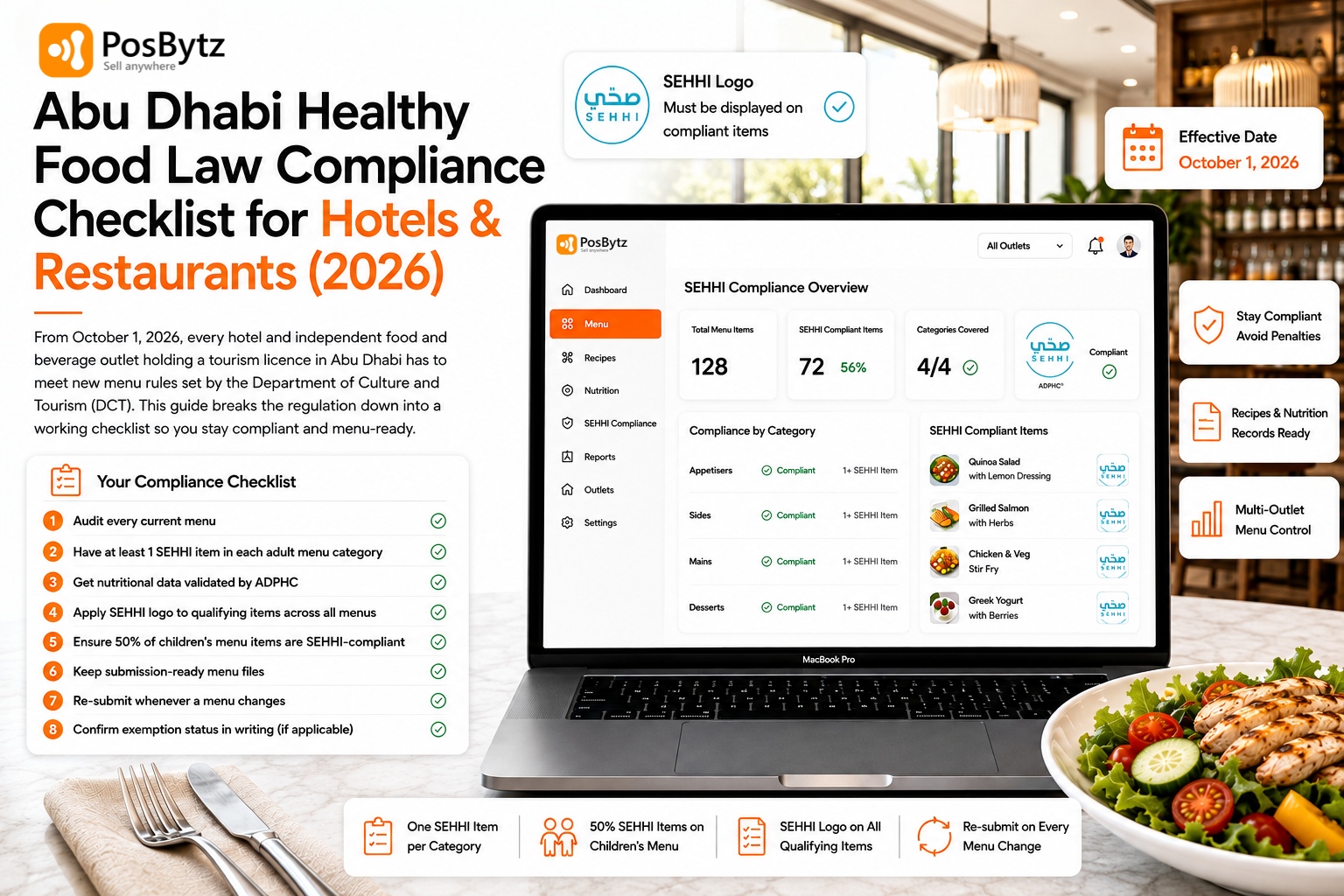
- Audit every current menu. List every item under appetisers, mains, sides, and desserts, per outlet, per brand if you run more than one.
- Identify or create at least one SEHHI-qualifying item per category. Check existing dishes against the SEHHI nutritional thresholds before assuming you need new recipes.
- Get nutritional data validated by ADPHC. Recipes and nutritional breakdowns need to hold up to their assessment, not just your own calculation.
- Apply the SEHHI logo to qualifying items, on printed menus, digital menus, QR menus, and delivery-platform listings alike.
- Rebuild or adapt the children's menu. Hit the 50% threshold using adapted adult dishes where practical.
- Keep submission-ready menu files. DCT can request menus at any time to verify compliance, so version-controlled, dated menu files save you scrambling later.
- Re-submit whenever a menu changes. Adding, dropping, or swapping any item means re-validating that the required minimum of SEHHI items is still met.
- Confirm exemption status in writing if you believe you qualify. Don't assume; buffet, tasting-menu, and niche-outlet exemptions have specific criteria attached.
Documentation ADPHC and DCT Can Request
Two things separate a smooth audit from a stressful one: recipe detail and paper trail.
Establishments already working with ADPHC to validate healthy menu items are treated as compliant during that process, provided they can show real progress, so starting the conversation with ADPHC before October 1 puts you ahead rather than behind. Be ready to hand over full recipe cards, nutrition breakdowns per dish, and the current live menu on request, not just a summary.
Keeping Menus Compliant as They Change
This is where most operators will slip. The regulation isn't a one-time checkbox: menus are expected to evolve, and every time they do, the SEHHI minimum has to still be met.
That means:
- New seasonal dishes get checked against SEHHI criteria before they launch, not after
- Any item swapped out gets replaced with an equivalent or better SEHHI-qualifying option if it was carrying that category's requirement
- Menu revisions go back to DCT for re-validation, not just internal sign-off
- Multi-outlet groups track compliance per branch, since menus often diverge by location
A restaurant POS and menu management system that ties recipes to live menu items makes this easier to police: every time an item is added or edited, it's visible against the category it sits in, which is exactly what this ongoing requirement demands.
Common Compliance Mistakes to Avoid
- Treating it as a one-off menu redesign. The law expects continuous compliance, not a single pre-October push.
- Skipping the children's menu. Adult menus get most of the attention, but the 50% children's-menu threshold is just as enforceable.
- Forgetting delivery and QR menus. SEHHI labelling needs to be consistent across every channel a guest sees your menu on, including dine-in, QR table ordering, and third-party delivery apps included.
- Assuming buffet exemption covers the whole outlet. If there's any printed or digital à la carte option alongside the buffet, that portion still needs to comply.
- Not re-submitting after minor menu tweaks. A single ingredient swap can knock a dish out of SEHHI qualification without anyone noticing until an audit flags it.
Why This Sits Inside a Bigger Abu Dhabi Health Push
This isn't an isolated rule. Abu Dhabi supermarkets have to move junk food away from high-visibility spots like entrances and checkout counters starting January 2027, including on their online platforms. Early Education Institutions across the emirate are working under a nutrition policy that restricts sugary drinks and high-fat items in lunch boxes. And by the end of 2025, public spaces in the capital had already stopped allowing junk-food advertising on billboards and outdoor media. Hotel and restaurant menus are simply the latest piece of a wider pattern, and enforcement to tighten rather than ease over the next few years.
How POS Software Simplifies SEHHI Menu Compliance
Manually tracking which items across every category, every outlet, and every channel carry the SEHHI logo gets unwieldy fast once you're running more than one venue. A cloud POS system built for restaurants centralizes menu, recipe, and category data in one place, so:
- Every menu category shows its SEHHI-qualifying items at a glance, across all outlets
- Menu edits sync instantly to POS, QR ordering, and delivery listings, so labelling never falls out of sync
- Multi-branch operators can check compliance status per location instead of per spreadsheet
- Recipe and nutrition data stays attached to the item, ready to hand over if DCT or ADPHC requests it
If you're running a bar or full-service restaurant with multiple menu formats, or a cloud kitchen juggling several delivery-only brands, getting this structure in place before October 1 is far less painful than retrofitting it after an audit.
FAQs
When does the Abu Dhabi healthy food law take effect?
October 1, 2026, for all hotel-operated and independent F&B outlets holding a tourism licence.
What is SEHHI?
A nutritional classification standard used to identify menu items lower in fat, sugar, and salt, and higher in nutritional value; that's the benchmark this law is built around.
Do buffets need to comply?
No, but venues offering buffets are still expected to make reasonable healthy options available, and any à la carte menu alongside the buffet must comply.
What happens if I change my menu after certifying it?
Any added or replaced item must be re-submitted for validation, and the required minimum of SEHHI-compliant items must be maintained at all times.
Does this apply to children's menus too?
Yes, at least 50% of children's menu items must meet SEHHI standards, and adapted adult dishes in smaller portions can count toward this.
About the author

Saravana Damodaram
Co-Founder & CEO, PosBytz
Saravana Damodaram is the Co-Founder & CEO of PosBytz, a cloud-based POS-ERP platform built for F&B and retail businesses since 2018. He focuses on unified commerce, inventory, and multi-location operations, and has helped over 5,000 merchants across 25+ countries move off fragmented, disconnected tools and run their entire operation, billing, inventory, kitchen, and accounting on one platform.