Beyond Compliance: How Fawtara E-Invoicing Improves VAT Filing and Stock Reconciliation
Fawtara is a mandate, but e-invoicing also improves VAT accuracy, inventory reconciliation, and audit readiness for Oman restaurants and retail stores.
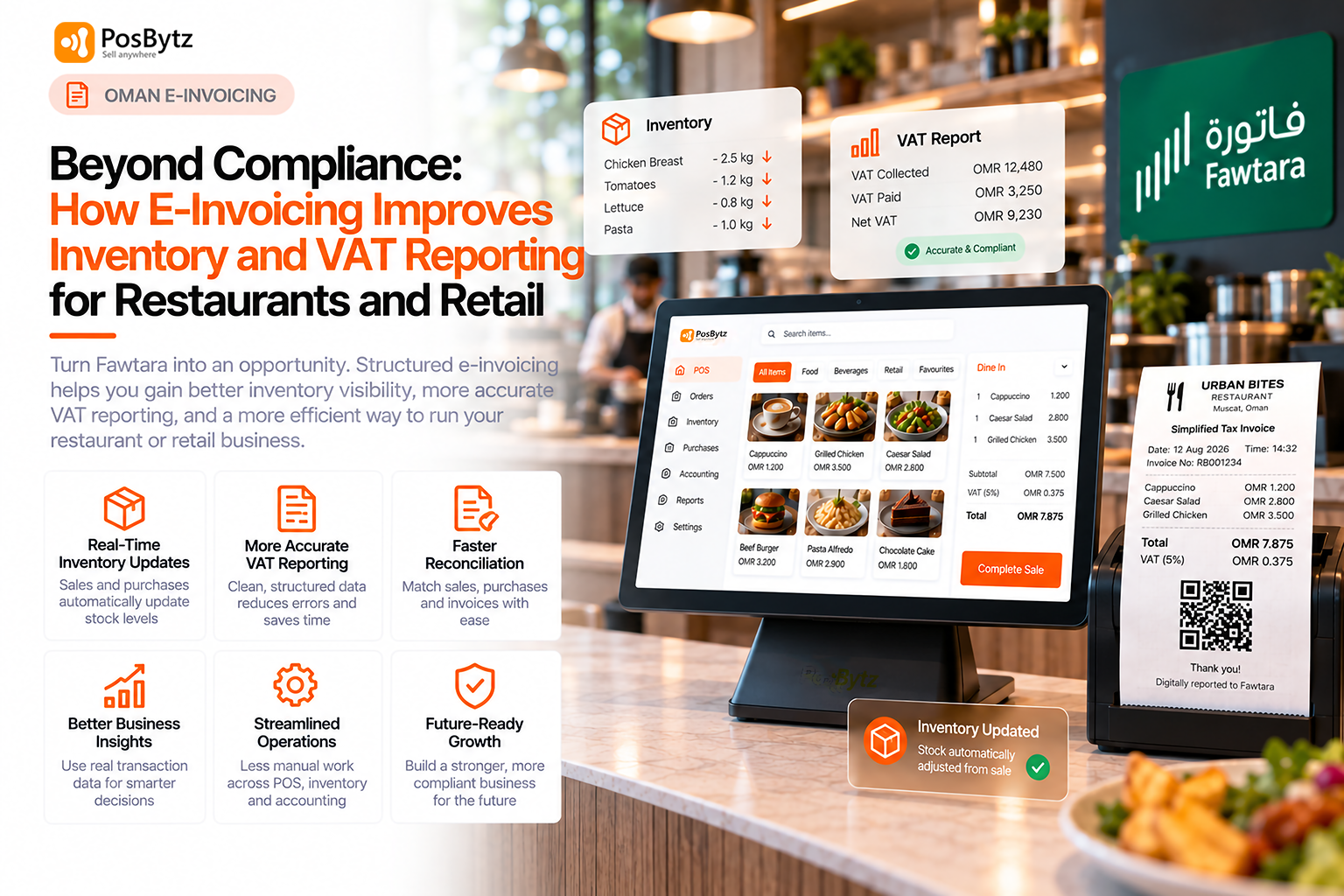


Most conversations about Fawtara focus on the compliance deadline, the QR code rule, or which invoice format to issue at checkout. That framing is not wrong, but it misses something important: businesses that treat structured e-invoicing as a genuine upgrade, not just a legal box to tick, tend to come away with cleaner VAT filings, better inventory visibility, and fewer end-of-month reconciliation headaches. This guide looks past the mandate itself to the operational benefits restaurant and retail owners can expect once structured invoice data becomes part of how their business runs.
It is worth being upfront about why this matters beyond the obvious. Compliance projects are usually treated as cost centres, something to get through with minimum disruption. Structured e-invoicing does not have to be that. Because every transaction now produces clean, machine-readable data by default, it creates a byproduct that finance and operations teams can actually use, not just a regulatory checkbox that satisfies an auditor once a year.
Why Structured Data Changes More Than Just Your Invoicing
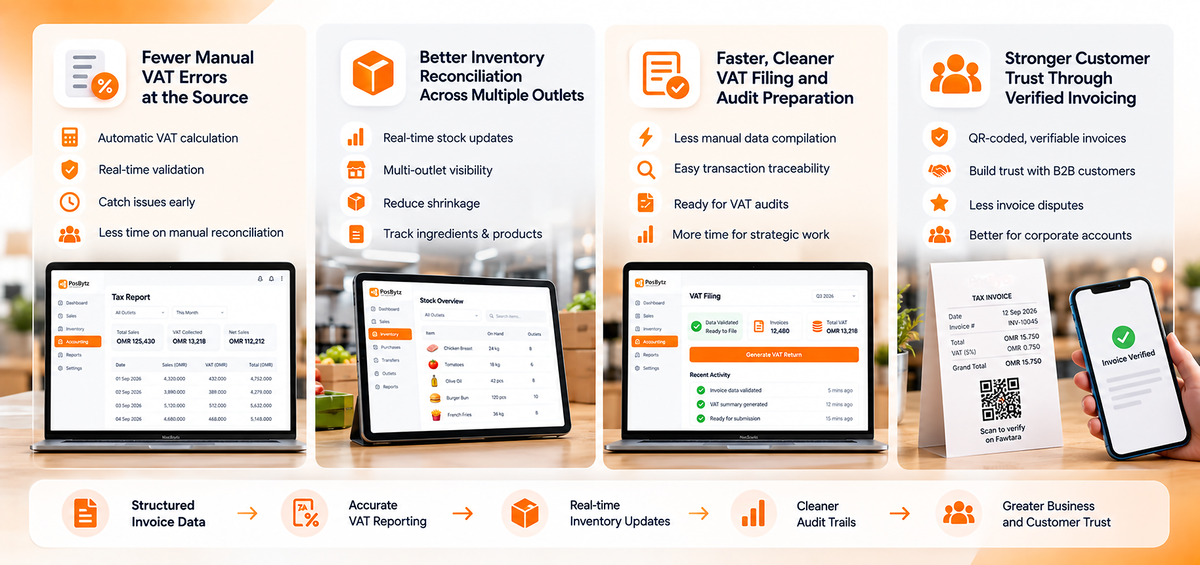
The core shift: from paper trails to structured records
Today, VAT reporting and inventory reconciliation in many restaurants and retail stores rely on a mix of POS reports, manual spreadsheets, and paper or PDF records that need to be manually reviewed and reconciled. Fawtara requires every invoice to exist as structured data validated through an accredited service provider. That same structured data, generated automatically at the point of sale, is what creates the secondary benefits covered in this guide.
Why this matters even if you already trust your current process
Many established restaurants and retail chains already have a working VAT and inventory process, built over years of manual review and experienced staff catching errors before they become problems. That process still works, but it depends on people noticing discrepancies. Structured, real-time data does not eliminate the need for good financial oversight, but it removes a layer of manual transcription where errors typically creep in unnoticed until filing time.
Fewer Manual VAT Errors at the Source
Where VAT errors usually start
VAT errors usually start at the point of data entry, not at the point of filing. A manually entered VAT amount, a misapplied rate, or a transposed figure on a paper record can sit undetected for weeks before it surfaces during a VAT return review. Structured e-invoicing calculates and captures VAT amounts automatically at the moment of sale, reducing the number of manual entry points where a mistake can happen.
Real-time structured data instead of after-the-fact correction
Because invoice data is validated and reported close to the moment of the transaction, rather than batch-entered later from receipts or paper trails, discrepancies surface faster and are easier to trace back to a specific sale, till, or outlet. This is a meaningful shift from the traditional model, where a VAT filing error might only be discovered weeks later during a periodic review, by which point the underlying cause is harder to pin down.
What this means for your accounting team
Your accounting or bookkeeping team spends less time chasing down where a discrepancy originated and more time on higher-value work, such as reviewing trends or preparing for a VAT audit with confidence rather than uncertainty. If you use a dedicated accounting module alongside your POS, structured invoice data flowing directly into it removes an entire manual reconciliation step that used to happen between your till reports and your books.
Better Inventory Reconciliation Across Multiple Outlets
The connection between invoicing and inventory that is easy to miss
It is easy to think of e-invoicing purely as a finance and tax concern, but every sale that generates a structured invoice also represents a stock movement. For restaurants tracking ingredient usage across multiple locations, or retail chains managing stock across several branches, structured, real-time transaction data makes it easier to reconcile what was sold against what was recorded in inventory, without waiting for an end-of-day or end-of-week manual count to catch discrepancies.
Multi-outlet consistency becomes visible, not assumed
A restaurant group running several branches, or a retail chain with multiple storefronts, often struggles to get a consistent, real-time view of stock and sales across every location at once. When every outlet generates structured invoice data the same way, head office gets a clearer, more consistent picture of what is actually happening at each branch, rather than relying on periodic manual reports that may be compiled differently outlet to outlet. Our guide on restaurant inventory management for multiple outlets covers this challenge in more depth for multi-branch operators.
Catching shrinkage and discrepancies sooner
Retail businesses in particular benefit from tighter reconciliation between sales data and stock levels, since discrepancies between what should be in stock and what is actually on the shelf, whether from shrinkage, miscounts, or process gaps, become easier to spot quickly when sales data is structured and timely rather than reconstructed later from paper receipts. Our guide on supermarket billing software benefits touches on how integrated billing and inventory data supports this kind of visibility.
Faster, Cleaner VAT Filing and Audit Preparation
What changes at filing time
Come VAT filing time, businesses with structured, validated invoice data spend less time manually compiling and cross-checking figures from multiple sources, since the underlying transaction data was already validated and reported through the Fawtara network as sales happened, rather than assembled retroactively from receipts, spreadsheets, and till reports.
Why this matters more during an audit than during routine filing
The benefit becomes even clearer during a VAT audit. Instead of digging through paper records or reconstructing a transaction history from multiple disconnected systems, a business with structured e-invoicing data can trace individual transactions, VAT amounts, and invoice types directly, since the data was captured in a consistent, structured format from day one. This is one of the more underappreciated benefits of e-invoicing beyond compliance, because it only becomes obvious the first time a business actually goes through an audit under the new system.
Building this into how you already manage VAT
If you are already using a dedicated accounting system, structured e-invoicing data feeding into it directly, rather than being re-entered from receipts, closes one more gap between your point of sale and your books, which tends to be exactly where reconciliation errors accumulate over a busy quarter.
Stronger Customer Trust Through Verified Invoicing
QR codes as a small but visible trust signal
There is also a customer-facing benefit that is easy to overlook. A QR-coded, verifiable invoice signals to business customers, in particular, that your invoicing is compliant and traceable, which matters more for B2B relationships and corporate accounts than for a quick walk-in coffee purchase. A business customer who can trust that every invoice they receive is properly validated has one less thing to worry about when it comes to their own tax records.
Why this matters more for repeat and corporate customers
For restaurants that regularly serve corporate accounts expensing meals, or retail businesses supplying other companies, consistent, verifiable invoicing reduces friction around disputed invoices or unclear documentation, since the invoice a customer receives is backed by structured data that has already been validated through the Fawtara network. This is a smaller benefit than the VAT and inventory gains, but it compounds over time as more of Oman's business community becomes accustomed to expecting verifiable e-invoices as standard practice.
Turning a Compliance Deadline Into a POS Upgrade Opportunity
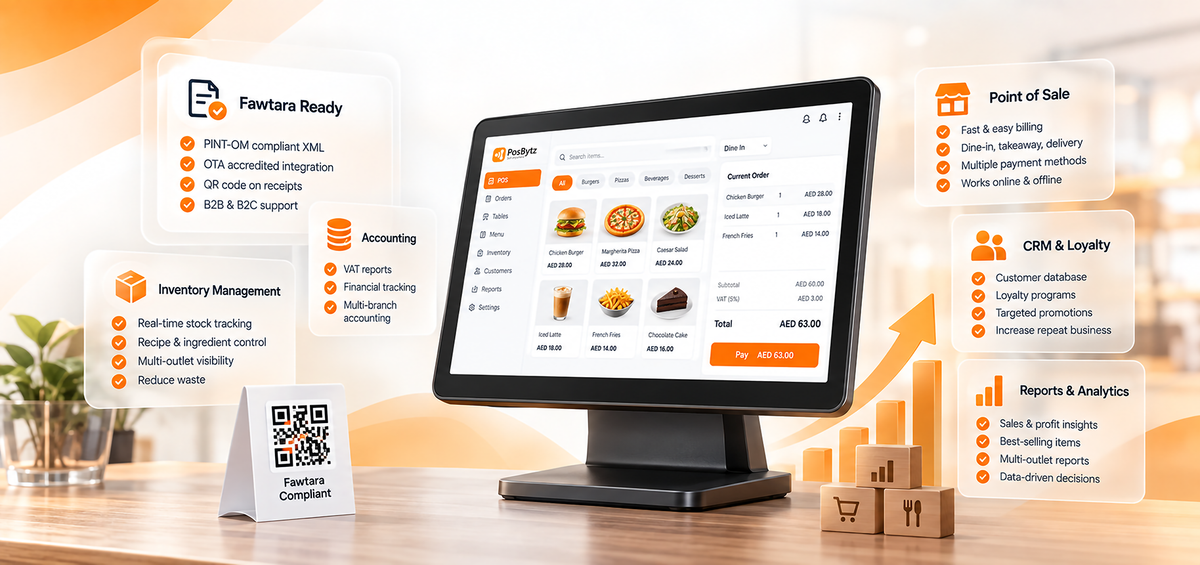
Why Fawtara is a reasonable trigger to modernise, not just comply
For restaurants and retail stores still relying on older POS or ERP systems, Fawtara can be the trigger to modernise more broadly, not just add an e-invoicing feature. A business already planning to invest in new till hardware, better inventory management, or a more capable back office has a natural reason to bundle that upgrade with Fawtara readiness, rather than treating them as two separate projects with two separate costs.
What to look for if you are upgrading anyway
If you are evaluating a new system as part of your Fawtara preparation, look beyond bare compliance. A platform that also strengthens your day-to-day inventory tracking, VAT reporting, and multi-outlet visibility delivers a return on that investment well beyond your rollout date. Our guide on advantages of billing software for supermarkets covers some of the wider operational gains worth considering alongside e-invoicing readiness itself.
A single platform instead of stitched-together tools
PosBytz is built for restaurants and retail businesses as a single platform covering point of sale, inventory, accounting, and Fawtara-ready e-invoicing together, so the structured data generated at checkout for compliance also feeds directly into stock reconciliation and VAT reporting, rather than living in a separate system that still needs manual reconciliation against your till.
Getting the Most Out of the Data You Are Already Generating
Do not treat structured invoice data as a one-way compliance export
Once your business is generating structured invoice data for Fawtara, it is worth asking your POS or ERP provider whether that same data can also feed your inventory and accounting reporting, rather than existing purely as a one-way export to your service provider. Many businesses implement e-invoicing narrowly, satisfying the mandate, without connecting the resulting data back into their own operational reporting, which leaves real value on the table.
A practical next step regardless of your rollout timeline
Whatever your exact rollout date, confirmed using the approach in our guide on whether Fawtara applies to your business, it is worth asking now whether your chosen POS or service provider treats structured invoice data as reusable business intelligence, not just a compliance requirement to satisfy and forget.
FAQs
Does e-invoicing actually reduce VAT errors, or just change how they are reported?
It reduces errors at the source, since VAT is calculated and validated automatically at the point of sale rather than compiled manually later, which removes a common point where transcription and calculation errors previously occurred.
Can e-invoicing data help with inventory management, or is that a separate system?
Structured invoice data can feed directly into inventory reconciliation if your POS or ERP connects the two, since every sale representing a stock movement is now captured in a consistent, structured format rather than reconstructed from separate reports.
Will e-invoicing make VAT audits easier or more difficult?
Generally easier, since auditors and businesses alike can trace individual transactions directly through structured, validated data rather than reconstructing a transaction history from paper receipts and disconnected systems.
Is it worth upgrading my whole POS system just for Fawtara compliance?
If your current system already meets the requirements, a narrow upgrade may be enough. If you were already considering a broader POS or inventory upgrade, bundling it with Fawtara readiness is often more efficient than treating them as separate projects.
Does better VAT and inventory reporting apply to small independent restaurants too, or only large chains?
Both benefit, though the impact is more visible for multi-outlet businesses managing reconciliation across several locations. A single independent restaurant still benefits from fewer manual VAT errors and cleaner records at filing time.
Do I need a separate accounting system to get these benefits, or does the POS handle it?
It depends on your setup. Some POS platforms include integrated accounting and inventory modules that use the same structured invoice data directly, while others require connecting a separate accounting system to capture the full benefit.
About the author

Saravana Damodaram
Co-Founder & CEO, PosBytz
Saravana Damodaram is the Co-Founder & CEO of PosBytz, a cloud-based POS-ERP platform built for F&B and retail businesses since 2018. He focuses on unified commerce, inventory, and multi-location operations, and has helped over 5,000 merchants across 25+ countries move off fragmented, disconnected tools and run their entire operation, billing, inventory, kitchen, and accounting on one platform.