Does Fawtara Apply to Your Restaurant or Retail Store in Oman?
Find out if and when Fawtara e-invoicing applies to your Oman restaurant or retail store, based on VAT registration, turnover, and rollout phase.
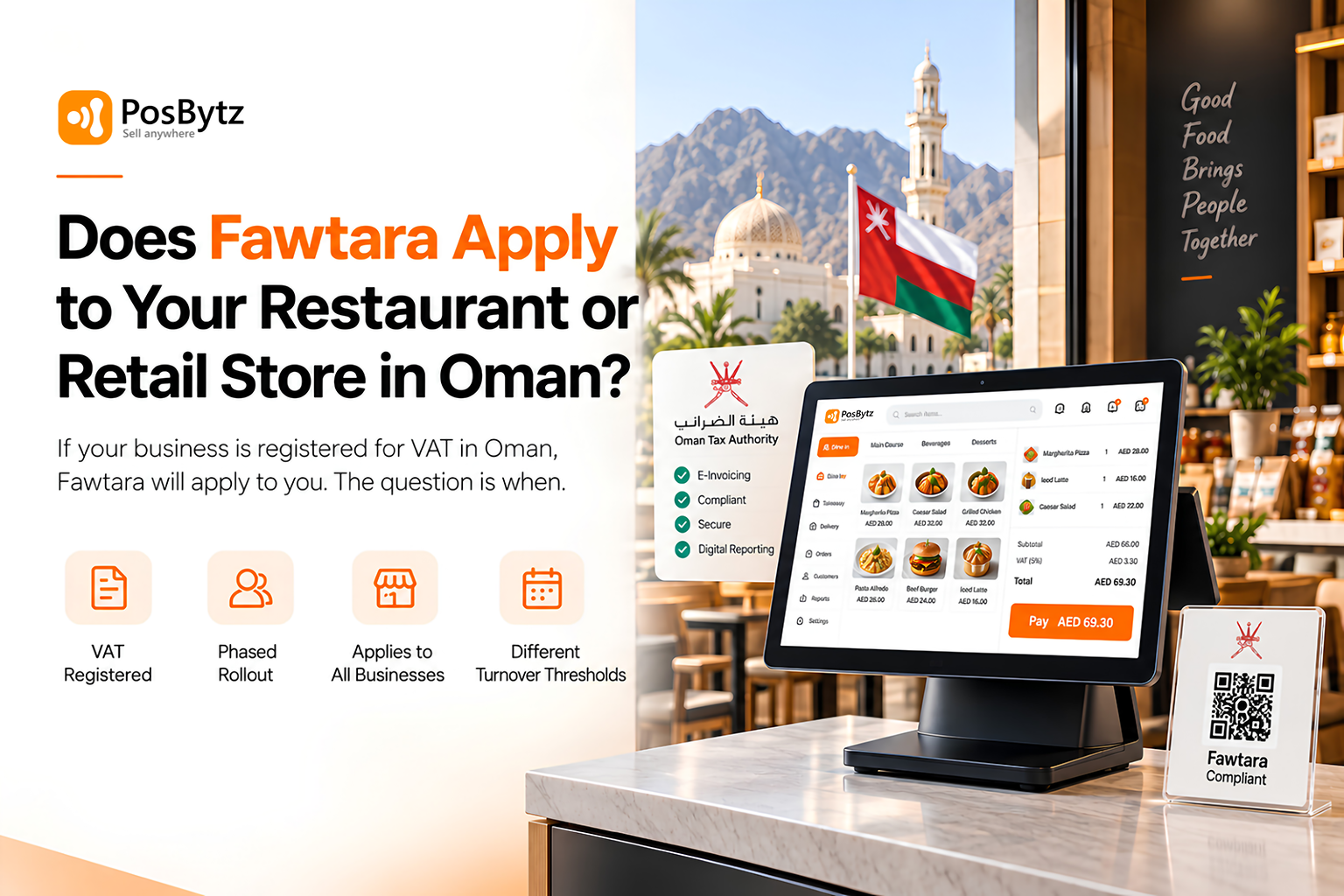


If your restaurant or retail business is registered for VAT in Oman, Fawtara will apply to you. The only real question is when. The Oman Tax Authority (OTA) is rolling out its Fawtara e-invoicing system in phases based on annual turnover, not business type, so a hotel restaurant chain and a neighbourhood grocery store follow the same rollout logic, just at different turnover thresholds and different dates.
This is usually the first question any restaurant or retail owner in Oman asks once they hear about Fawtara: does this actually apply to my one-outlet cafe, my boutique, my supermarket branch, or is it only a "big company" problem? The honest answer is that VAT registration, not business size in the everyday sense, is what pulls you into the mandate. This guide walks through exactly who is covered, when each rollout phase begins, and what a restaurant or retail owner in Oman should be doing right now, regardless of which phase applies to them.
What Is Fawtara?
The five-corner model in plain language
Fawtara is Oman's national electronic invoicing initiative, led by the Oman Tax Authority. It replaces paper and PDF invoices with structured, machine-readable invoices that move through a five-corner model: the seller, the seller's accredited service provider, the buyer's accredited service provider, the buyer, and OTA itself. Rather than a business emailing a PDF invoice and hoping the numbers add up on both sides, the invoice data is validated, exchanged, and reported automatically between systems.
Why Oman is doing this now
The stated objectives behind Fawtara are to strengthen tax compliance, reduce fraud, improve transparency in business transactions, support Oman's broader digital transformation goals, and align the country with international e-invoicing standards such as Peppol and PINT. For a government, real-time invoice data means faster fraud detection and better policy decisions. For a compliant business, it generally means less manual VAT work and fewer disputes over what was actually billed. You can read a fuller breakdown of how the system works, and how it compares with other GCC e-invoicing systems, on our dedicated e-invoicing software page.
Fawtara is not just "digital paperwork"
It is worth separating Fawtara from the idea of simply scanning receipts or emailing PDFs. A Fawtara-compliant invoice is structured XML data that a computer system, not just a human, can read, validate, and act on. That distinction is why POS and ERP readiness matters so much for restaurants and retail stores, which is a topic we cover in detail in our guide on whether your POS system is Fawtara-ready.
Who Actually Has to Comply With Fawtara
The legal basis: Decision No. 189/2026
Fawtara's legal basis is Decision No. 189/2026, which introduces mandatory electronic invoicing for taxable persons in Oman, meaning any business registered for VAT. Implementation happens in phases based on annual turnover rather than industry, so restaurants, cafes, supermarkets, boutiques, butcheries, and grocery stores are all covered by the same rules as any other VAT-registered business once their phase arrives.
VAT registration is the trigger, not your business category
There is no separate carve-out for hospitality or retail. A bar or restaurant, a cafe or coffee shop, a cloud kitchen, a supermarket, a boutique, or a liquor store all fall under the same Decision 189/2026 framework. What changes between them is turnover, and turnover is what decides the rollout phase, not the kind of goods or food being sold.
What happens if you are not VAT registered
If your business genuinely falls below Oman's VAT registration threshold, Fawtara's mandatory requirement does not apply to you yet, since the obligation is tied to VAT status. That said, thresholds and registration rules can change, and OTA has said it intends to bring SMEs and individual taxpayers into later rollout phases, so unregistered small businesses should not assume they are permanently outside scope.
The Fawtara Rollout Phases Explained
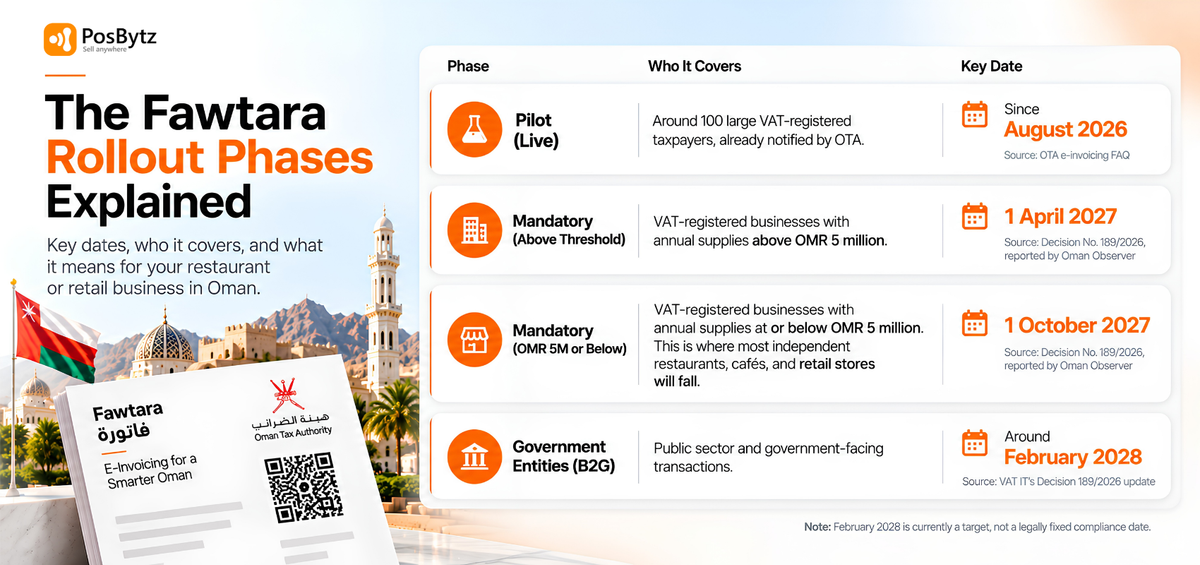
If your restaurant or retail store is VAT-registered in Oman, Fawtara applies to you under a legally fixed timeline, not a general four-phase outline anymore. On 9 August 2026, the Oman Tax Authority issued Decision No. 189/2026, which set two binding compliance dates based on annual turnover, replacing the earlier phase dates it had originally announced for medium and large businesses.
Why Rollout 2 matters most for independent restaurants and shops
For most independent restaurants, cafes, boutiques, and neighbourhood retail stores in Oman, Rollout 2 is the phase to plan around, since annual supplies below OMR 5 million is a common profile for single-outlet and small multi-outlet businesses. Larger chains, franchise groups, and hospitality operators with turnover above OMR 5 million fall under the earlier Rollout 1 date, which gives them less runway to prepare.
What Rollout 3 and Rollout 4 mean for the smallest businesses
If your restaurant or shop is genuinely small, SMEs and individual taxpayers are expected to be brought in under Rollout 3, with the exact date still to be confirmed by OTA. Rollout 4, targeted for 2028, closes the loop by bringing in every remaining VAT-registered entity, including transactions with government bodies. In other words, nearly every VAT-registered business in Oman will eventually be on Fawtara; the phases simply decide the order.
How to Check Your Exact Rollout Batch
Using the OTA VAT number lookup tool
OTA has published a self-check tool on the tax portal. You enter your full VAT registration number, which starts with OM, and the system displays which rollout batch your business has been assigned to. This is the most reliable way to confirm your own deadline rather than relying on general turnover bands, since OTA notifies businesses individually as each rollout phase is finalised.
Why you should not rely on turnover estimates alone
Annual turnover can shift year to year, especially for restaurant groups opening new outlets or retail chains scaling quickly. A business that estimates itself as "under OMR 5 million" one year could cross that line the next. Checking your actual assigned batch on the official portal, rather than assuming based on last year's numbers, avoids planning around the wrong deadline. Always verify your status directly on the official Oman Tax Authority e-invoicing page, since rollout batches and dates are periodically refined as the program progresses.
Why Restaurant and Retail Businesses Should Not Wait for the Deadline
B2C volume makes readiness harder, not easier
Restaurant and retail transactions are almost entirely business-to-consumer (B2C). Under Fawtara, B2C invoices need a QR code on the human-readable receipt and must be reported to your service provider within 24 hours of issuance. That means your point-of-sale system, receipt printer, and checkout workflow all need to be able to generate compliant invoices in real time, not just your back-office accounting. We cover the QR code requirement in full detail in our guide to QR codes on restaurant and retail receipts.
Service provider selection is not instant
Selecting and integrating with an accredited service provider, and testing your POS against the Oman PINT data dictionary, both take time. Businesses that raised timeline concerns during OTA's own public workshops were consistently told the same thing: start the conversation with a service provider early, since procurement, contracting, and integration testing are the parts most likely to run long.
Multi-outlet businesses face a bigger lift
If you run more than one branch, cafe location, or store, readiness is not a single POS terminal problem, it is a consistency problem across every till. A chain preparing for Fawtara needs every outlet generating invoices, QR codes, and reports the same way, which naturally takes longer to test and roll out than a single-location business. Our guide on restaurant inventory management for multiple outlets looks at a related side of the same multi-branch coordination challenge.
What to Do Now, Regardless of Your Rollout Phase
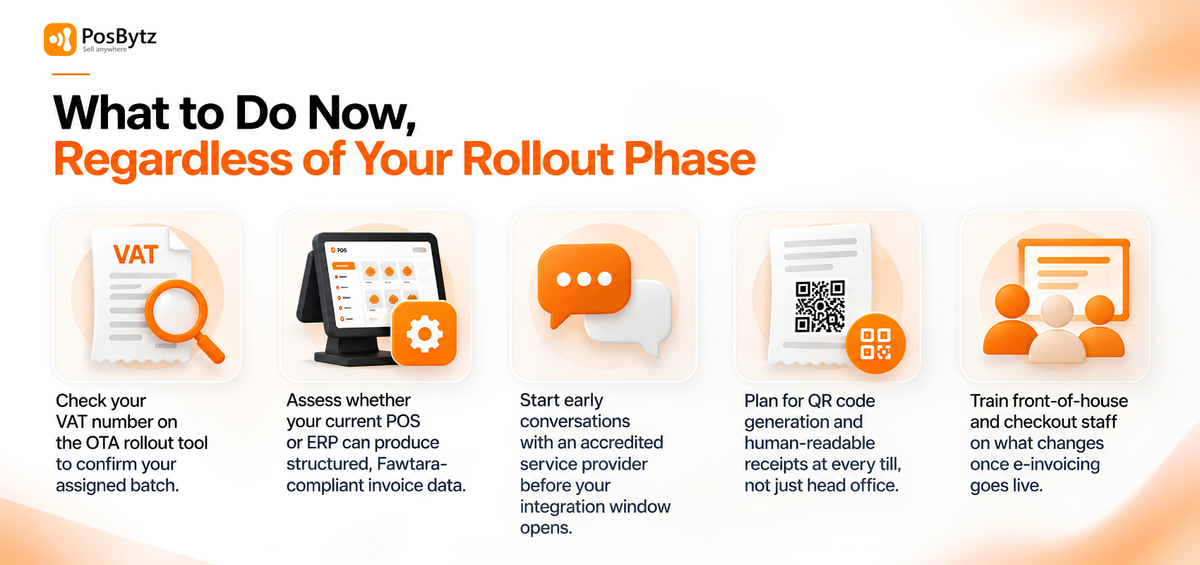
A short readiness checklist
- Check your VAT number on the OTA rollout tool to confirm your assigned batch
- Assess whether your current POS or ERP can produce structured, Fawtara-compliant invoice data
- Start early conversations with an accredited service provider before your integration window opens
- Plan for QR code generation and human-readable receipts at every till, not just head office
- Train front-of-house and checkout staff on what changes once e-invoicing goes live
Turning preparation into an advantage, not a burden
Businesses that treat this as a slow-burn project, rather than a deadline to react to, generally end up with fewer surprises. It also gives you time to evaluate whether your current POS system is actually serving your operations well, or simply printing receipts, which is a theme we return to in our guide on the benefits of e-invoicing beyond compliance.
A POS built for the region, such as PosBytz, can handle the structured invoicing, QR code generation, and service provider integration this mandate requires, so your restaurant or retail business is ready well before its rollout date arrives.
Not sure if your current POS can handle Fawtara's structured invoicing, QR codes, and service provider integration? Talk to the PosBytz team about a POS built for restaurants and retail across the GCC, region-ready compliance included, so you can confirm your readiness well before your rollout date arrives.
Frequently Asked Questions
Is Fawtara mandatory for small restaurants in Oman?
Yes. Fawtara applies to any VAT-registered restaurant or retail business regardless of size. Under Decision No. 189/2026, businesses with annual supplies at or below OMR 5 million, which covers most independent restaurants and shops, must comply from 1 October 2027. There is no separate, later SME-only phase, turnover is what decides your date. .
What is the difference between Rollout 1 and Rollout 2?
Decision No. 189/2026 set two dates based on annual turnover. Businesses with annual supplies above OMR 5 million comply from 1 April 2027. Businesses at or below that threshold, including most independent restaurants and retail stores, comply from 1 October 2027.
Can I start using e-invoicing voluntarily before my mandatory date?
Yes. OTA opened a voluntary adoption window from August through the end of October 2026, allowing businesses to test their systems and processes ahead of the mandatory phases.
Does Fawtara apply to cash-only shops?
If the shop is registered for VAT, yes. Fawtara's requirement is tied to VAT registration status, not to the payment methods a business accepts.
How do I find out which rollout batch my business is in?
Use the VAT number lookup tool on the Oman Tax Authority's tax portal. Enter your VAT registration number to see your assigned rollout batch and date.
Does my business need a new POS system to comply with Fawtara?
Not necessarily. What matters is whether your current system, or a system connected to an accredited service provider, can generate structured e-invoices. Our POS readiness checklist walks through how to test this.
About the author

Thaniyeal
Technical Content Writer & SEO Specialist, PosBytz
Thaniyeal is a Technical Content Writer and SEO Specialist on the PosBytz Marketing team, focused on turning complex POS and ERP topics into clear, practical guides for restaurant and retail businesses.