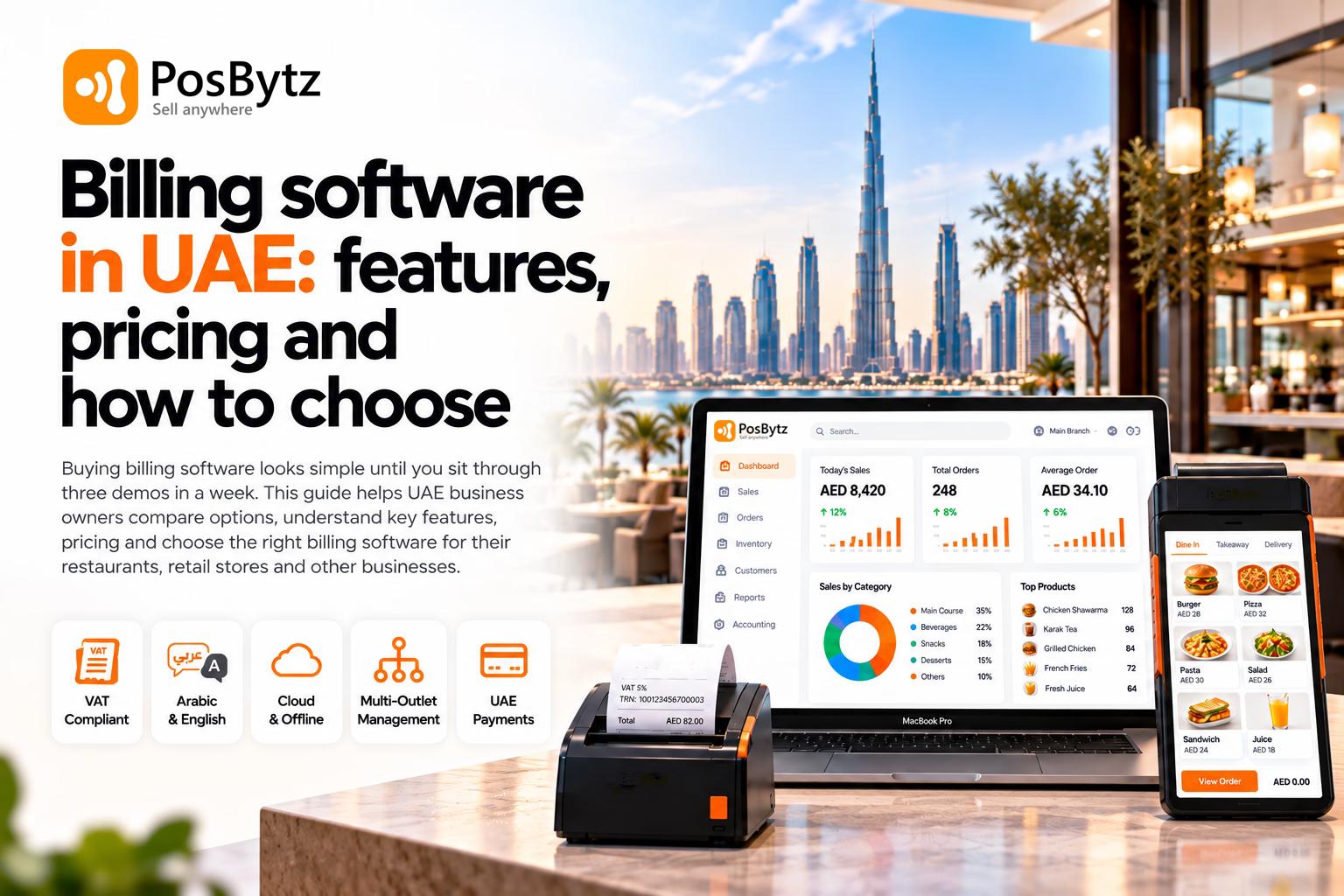
UAE VAT Rules 2026: Complete Guide to Every Change (Cabinet Decision 149)
New UAE VAT rules from 1 October 2026 change input VAT recovery for restaurants and retailers. See every change, what it means for you and a compliance checklist.
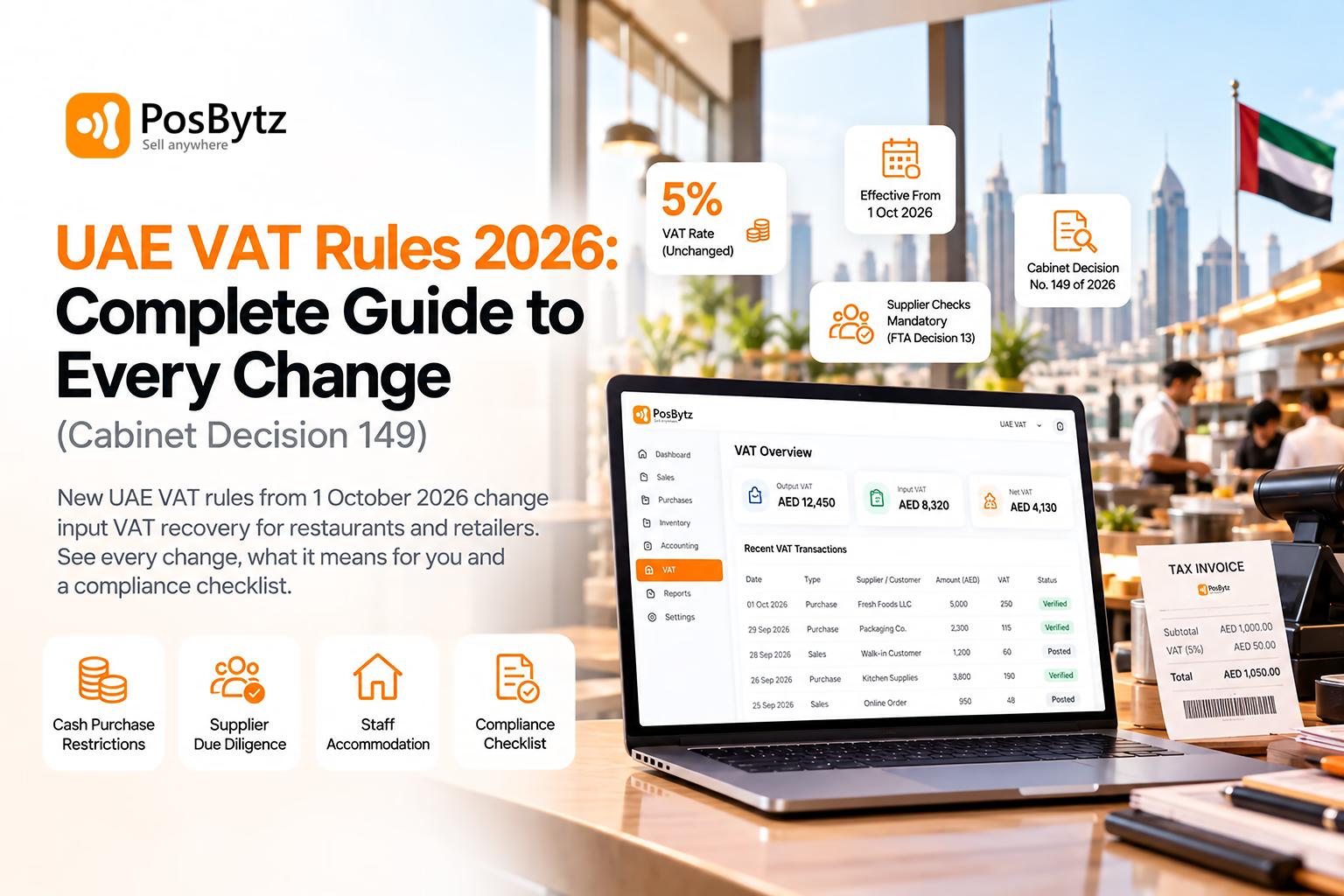


Quick Summary
New VAT rules in the UAE took effect on 1 October 2026. . For restaurants, cafés, cloud kitchens and retail stores, they change one thing above all: how you recover the input VAT you pay on purchases.
The UAE Cabinet issued Cabinet Decision No. 149 of 2026 on 1 September 2026. It amends the VAT Executive Regulation, the rulebook that explains how the UAE VAT Law works day to day. Separately, the Federal Tax Authority (FTA) issued Decision No. 13 of 2026, which makes supplier checks mandatory before you claim input VAT. Both start on the same date.
The VAT rate stays at 5%. What changes is the paperwork behind your VAT return. From October, a valid tax invoice may no longer be enough on its own. The FTA can deny your input VAT if you paid a large bill in cash, if you skipped supplier checks, or if you claimed VAT on staff housing that no longer qualifies.
If you run an F&B or retail business, this guide covers every change in plain language. It explains which rules affect you, which you can safely skip, and what to fix in your systems.
Every UAE VAT change at a glance
This table lists every change, when it starts, and how much it matters to a typical restaurant or retail business.
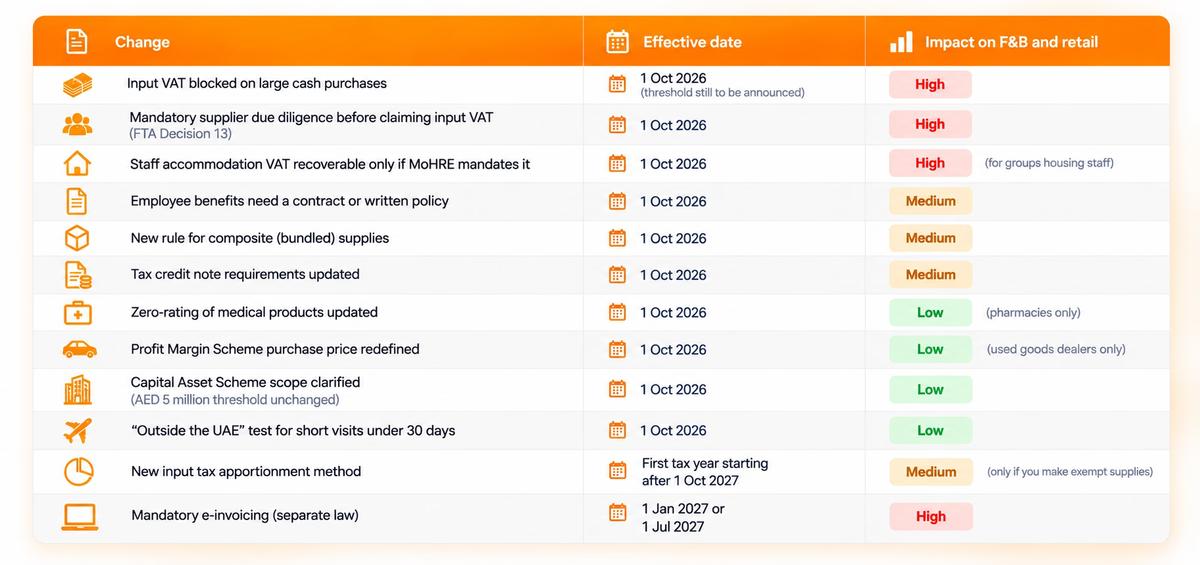
- Input VAT blocked on large cash purchases: From 1 October 2026, businesses will no longer be able to recover input VAT on large cash purchases above a threshold that is yet to be announced. Impact: High.
- Mandatory supplier due diligence: From 1 October 2026, businesses must complete supplier due diligence before claiming input VAT, following FTA Decision No. 13 of 2026. Impact: High.
- Staff accommodation VAT recovery: From 1 October 2026, VAT on staff accommodation will be recoverable only where the accommodation is mandated by MoHRE. Impact: High for groups housing staff.
- Employee benefits: From 1 October 2026, businesses must have a contract or written policy supporting employee benefits for which they claim input VAT. Impact: Medium.
- Composite (bundled) supplies: From 1 October 2026, new rules will determine how VAT applies to composite or bundled supplies. Impact: Medium.
- Tax credit notes: From 1 October 2026, updated requirements will apply to tax credit notes issued for transactions such as refunds, returns and discounts. Impact: Medium.
- Medical products: From 1 October 2026, the rules for zero-rating medical products will be updated. Impact: Low for most F&B and retail businesses, mainly affecting pharmacies.
- Profit Margin Scheme: From 1 October 2026, the purchase price used under the Profit Margin Scheme will be redefined. Impact: Low, mainly for used-goods dealers.
- Capital Asset Scheme: From 1 October 2026, It still covers business assets costing AED 5 million or more, excluding VAT, with a useful life of 10 years for buildings or 5 years for other assets. Few SMB assets reach this level. Impact: Low.
- “Outside the UAE” test: From 1 October 2026, a new test will apply to determine whether certain individuals spending fewer than 30 days in the UAE are treated as being outside the UAE. Impact: Low.
- Input tax apportionment: From the first tax year beginning after 1 October 2027, a new input tax apportionment method will apply to businesses making both taxable and exempt supplies. Impact: Medium for affected businesses.
- Mandatory e-invoicing: UAE mandatory e-invoicing will be introduced separately, with requirements beginning from 1 January 2027 or 1 July 2027 depending on the business phase. Impact: High.
The new UAE input VAT rules, explained for F&B and retail
1. Large cash payments can cost you your input VAT
This is the biggest change for cash-heavy businesses. A new Article 54(3) says you cannot recover input VAT when a supply is worth more than a set threshold and you pay, or intend to pay, in cash.
The Minister of Finance has not yet announced that threshold. A separate Ministerial Decision will set the amount and the controls. Until then, no one knows exactly where the line falls.
What this looks like in practice:
- A restaurant pays its meat wholesaler AED 40,000 in cash every month. If that is above the threshold, the 5% VAT on those bills (AED 2,000) could become a pure cost.
- A retailer pays a fit-out contractor partly in cash. The rule refers to the value of the supply, not the cash portion, so a partial cash payment may put VAT on the whole bill at risk.
- Site petty cash, subcontractor payments and cash-on-delivery purchases all need a second look.
What to do now: list every supplier you pay in cash and the typical bill size. Start moving large supplier payments to bank transfer or card, and make sure your system records the payment method against each purchase.
2. Supplier checks are now mandatory (FTA Decision No. 13 of 2026)
This rule comes from the FTA, not Cabinet Decision 149, but it starts on the same day and hits the same VAT line. The FTA can now deny input VAT if a purchase is linked to tax evasion anywhere in the supply chain, and you knew or should have known. Skipping the prescribed checks counts as "should have known."
The checks work in three layers:
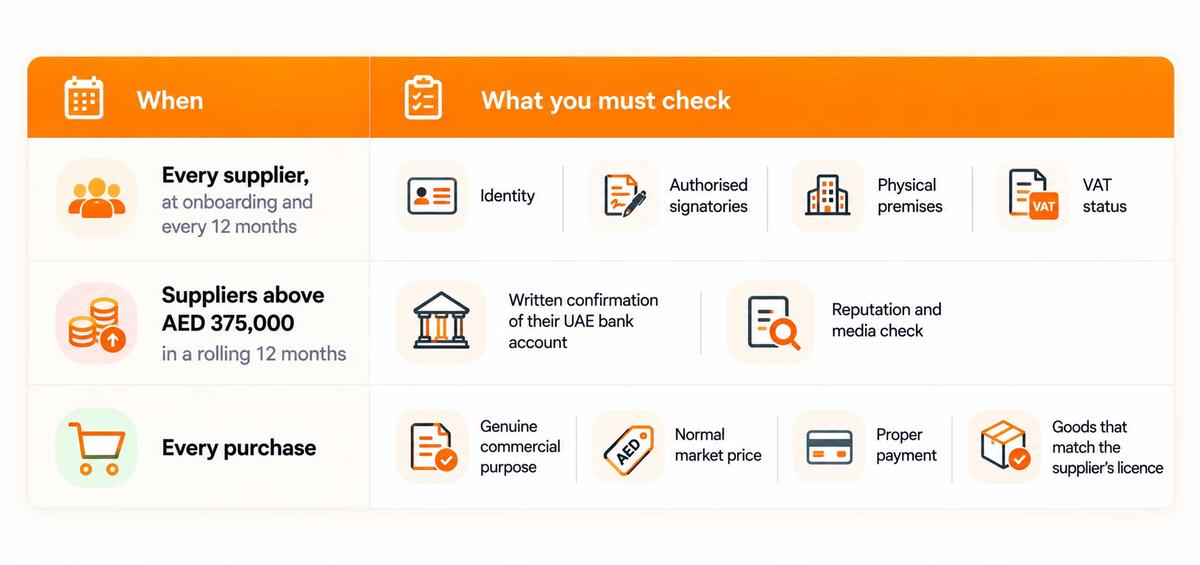
There is a small-purchase exception. Single supplies under AED 10,000 (excluding VAT) can skip verification, but only while your total spend with that supplier stays under AED 100,000 in 12 months. Many restaurants buy small, frequent orders from the same vegetable, dairy or packaging supplier. Those regular suppliers will usually cross AED 100,000 and lose the exception.
You also need a written verification policy that names who performs the checks and who is accountable.
3. Staff accommodation: VAT recovery only if MoHRE requires it
Many F&B and retail groups house their staff. Until now, businesses often recovered VAT on that housing under the general labour law route. From 1 October, employer-provided accommodation qualifies for input VAT recovery only where it is specifically mandated under decisions or directives of the Ministry of Human Resources and Emiratisation (MoHRE).
If you rent flats or a labour camp for kitchen and store staff, check whether a MoHRE mandate actually applies. If not, the VAT on that rent becomes a cost.
4. Other employee benefits need a contract or written policy
For staff benefits other than housing, such as medical insurance, you can still recover VAT where the benefit is a contractual obligation or a documented company policy. It must also meet cases and conditions the FTA will specify, which have not been published yet.
In practice, check that your employment contracts and HR policies actually list the benefits you claim VAT on. A benefit given informally is harder to defend.
5. Composite supplies: bundles follow the main item
The regulation now sets out a clear rule for bundles. Where the parts of a supply are interconnected and cannot realistically be separated, you must treat them as one supply. The VAT treatment then follows the principal component.
For most restaurants and shops, everything in a bundle is already standard-rated at 5%, so the rate does not change. The rule matters when a bundle mixes items with different VAT treatments, such as a pharmacy bundling zero-rated medical products with standard-rated cosmetics. Review any packages, combos or service bundles that mix treatments.
6. Tax credit notes
The amendments update the requirements for tax credit notes. Refunds, returns and discounts after the sale are everyday events in retail and delivery-heavy F&B. Confirm with your tax advisor that your credit notes meet the new requirements, and that your POS issues them correctly.
7. Changes most F&B and retail businesses can skip
These apply only to specific businesses:
- Medical products: zero-rating for medical products and healthcare-related goods is updated. Relevant to pharmacies and stores selling healthcare goods.
- Profit Margin Scheme: the purchase price now includes certain purchase-related costs and fees where their input VAT is not recoverable. Relevant to second-hand goods dealers.
- Capital Asset Scheme: it covers business assets costing AED 5 million or more, excluding VAT. Few SMB assets reach this level.
- "Outside the UAE" test: a person present in the UAE for fewer than 30 days, where the presence is not connected to the supply, can be treated as outside the UAE. This mostly affects services to foreign clients.
8. New input tax apportionment from 2027
This change starts later, from the first tax year beginning after 1 October 2027. It affects businesses that make both taxable and exempt supplies.
The new default method compares the value of supplies that allow VAT recovery with total supplies. The percentage is rounded to the nearest whole number and applied to your residual input VAT. Government entities and charities keep a separate method.
A restaurant or shop that only makes taxable sales is not affected. If you also earn exempt income, such as rent from residential property, model the new method before 2027.
Next on the UAE VAT compliance calendar: e-invoicing
E-invoicing is a separate law, but it sits right behind these VAT rules. Most independent restaurants, cafés and retail SMBs fall into Phase 2, with a July 2027 go-live.
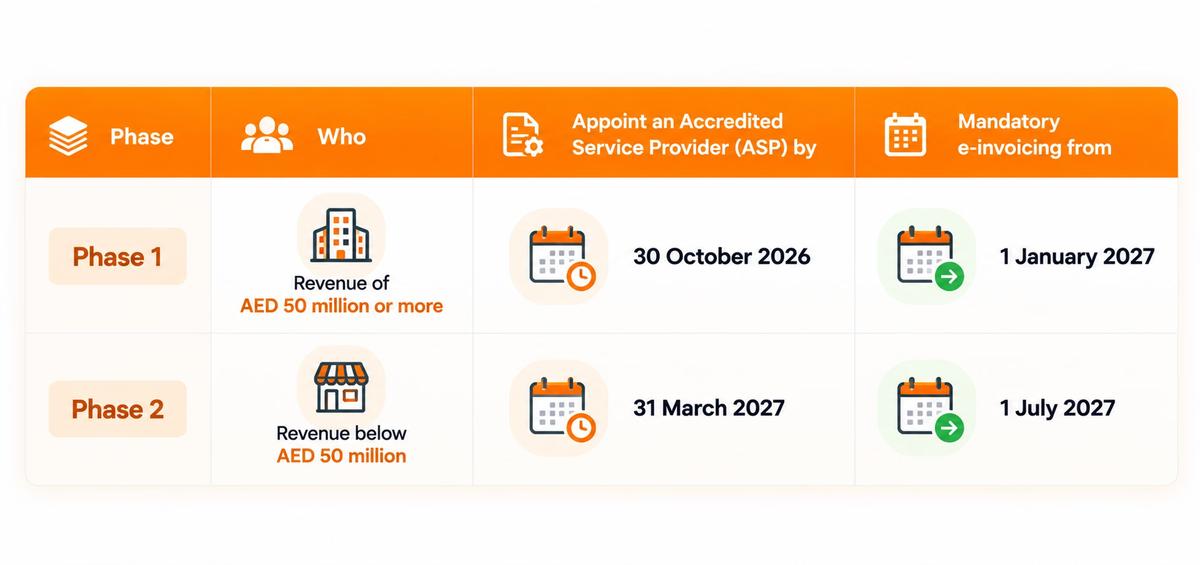
Under the new system, a PDF or emailed invoice does not count as an electronic invoice. Invoices move as structured data through the UAE's Peppol-based network. Businesses close to the AED 50 million line should confirm their revenue figure before assuming they are in Phase 2.
Your UAE VAT compliance checklist
Use this list to check your restaurant or store is compliant.. Tick off each item as you go.
- List every supplier you pay in cash, with typical bill sizes
- Move large supplier payments to bank transfer or card
- Record the payment method against every purchase in your system
- Build a supplier file: trade licence, signatories, address, TRN
- Flag suppliers above AED 100,000 and AED 375,000 in a rolling 12 months
- Get written bank account confirmation from suppliers above AED 375,000
- Set a 12-month review date for every supplier
- Write a verification policy that names who checks and who approves
- Check whether a MoHRE mandate covers your staff accommodation
- Confirm contracts or HR policies list every benefit you claim VAT on
- Review combos, packages and bundles that mix VAT treatments
- Check that refunds and returns generate compliant tax credit notes
- Confirm your e-invoicing phase and ASP deadline
How PosBytz helps you stay VAT compliant
The new rules reward businesses whose records are clean, complete and in one place. That is hard when sales sit in one tool, purchases in a spreadsheet and invoices in email.
PosBytz brings them together for F&B and retail businesses:
- VAT reports and FTA-compliant invoices: every sale produces a compliant tax invoice, and VAT reports are ready when you file your return.
- Built-in accounting: purchases, supplier bills and payments sit in the same system as your sales. When the FTA asks how a bill was paid, the answer is already on record.
- E-invoicing: get ready for the move to structured e-invoices before your phase deadline.
The VAT rules have changed. Your records should be ready before the FTA asks for them.
Book a free demo to see how PosBytz handles VAT for restaurants and retail stores in the UAE.
FAQs on the new UAE VAT rules
What are the new UAE tax VAT rules from October 2026?
Cabinet Decision No. 149 of 2026 amended the VAT Executive Regulation from 1 October 2026. It restricts input VAT on large cash payments, limits VAT recovery on staff housing, adds a rule for composite supplies and updates credit notes, medical products, the Profit Margin Scheme and the Capital Asset Scheme. FTA Decision No. 13 of 2026 adds mandatory supplier checks from the same date.
Has the VAT rate in the UAE changed in 2026?
No. VAT in UAE remains 5%. The 2026 changes affect how you recover input VAT and what records you keep, not the rate you charge customers.
What is the cash payment threshold for input VAT?
It has not been announced yet. The Minister of Finance will set the amount and controls in a separate Ministerial Decision. Until then, moving large supplier payments to traceable methods is the safest approach.
Do small purchases need supplier verification?
Single purchases under AED 10,000 (excluding VAT) are exempt only while your total spend with that supplier stays under AED 100,000 in 12 months. Regular suppliers usually cross that line.
Can I still recover VAT on staff accommodation?
Only where the accommodation is specifically mandated under MoHRE decisions or directives. Housing provided under general labour law obligations no longer qualifies.
Does the UAE VAT Law change affect small restaurants?
Yes, if you are VAT registered. The cash payment and supplier check rules apply to all taxable persons claiming input VAT, whatever their size.
When does e-invoicing become mandatory in the UAE?
From 1 January 2027 for businesses with revenue of AED 50 million or more, and from 1 July 2027 for businesses below that.
About the author

Saravana Damodaram
Co-Founder & CEO, PosBytz
Saravana Damodaram is the Co-Founder & CEO of PosBytz, a cloud-based POS-ERP platform built for F&B and retail businesses since 2018. He focuses on unified commerce, inventory, and multi-location operations, and has helped over 5,000 merchants across 25+ countries move off fragmented, disconnected tools and run their entire operation, billing, inventory, kitchen, and accounting on one platform.