Cash Doesn't Match at Shift Close? 8 Causes of Cash Discrepancy and How to Fix Them for Good
Cash drawer short or over at shift close? Learn the 8 real causes of cash discrepancy, a 10-minute closing routine, and how to fix it for good.
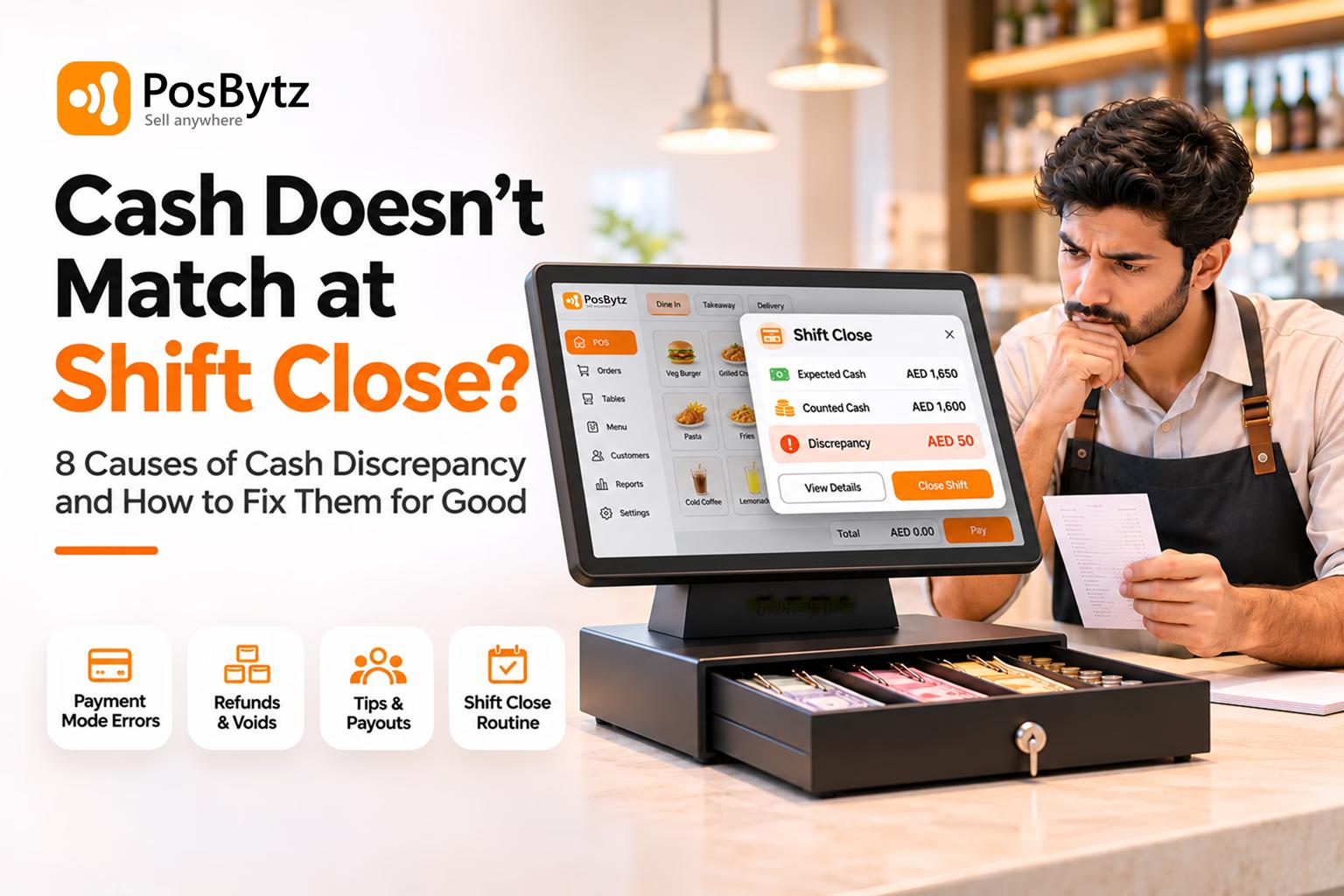


It is closing time. The POS says the drawer should hold ₹8,150 (or AED 1,650). Your cashier counts twice and gets less. Nobody saw anything go wrong, but nobody can explain the gap either. By tomorrow morning, nobody will remember the 8:15 pm rush when it most likely happened.
If this happens at your restaurant, café or store a few times a month, it is rarely a sign of dishonest staff. Most cash discrepancies come from a small set of process gaps that repeat every shift until someone closes them.
This guide covers what a cash discrepancy is, the 8 most common causes, a quick way to trace a gap, and a 10-minute shift-close routine that prevents it. It works whether you run one outlet in Chennai or five in Dubai.
Why cash still causes trouble in a digital-first market
India and the UAE are two of the most digital payment markets in the world, yet cash has not left the counter.
- India: digital payments made up about 92.6% of retail payment value in Q1 FY26, but cash still accounts for roughly half of private consumption spending, according to CareEdge Advisory.
- UAE: about 8 in 10 payments are now digital, but 58% of consumers still pay tips in cash, according to Visa's 2026 Where Cash Hides report.
That mix is the real problem. Your drawer now handles less cash but far more complexity: UPI, cards, Apple Pay, split bills, cash tips and cash-on-delivery, often on the same shift. When cash is a smaller share of sales, a missing ₹300 or AED 50 is easier to ignore, so the same mistake keeps repeating.
What is a cash discrepancy?
A cash discrepancy is the difference between the cash your POS says should be in the drawer and the cash you actually count at shift close. To find it, you first need the expected cash:
Expected cash = Opening float + Cash sales − Cash refunds − Cash payouts + Cash pay-ins − Cash drops to the safe
A drawer can be short (less cash than expected) or over (more cash than expected). Owners often relax when the drawer is over, but an overage is a warning sign too. It usually means a sale was not billed, a card or UPI payment was tagged as cash, or tips went into the till.
Why small gaps are a big problem
A small daily gap adds up fast. Over 26 working days a month:
- ₹300 short a day comes to about ₹93,600 a year for one outlet
- AED 50 short a day comes to about AED 15,600 a year for one outlet
Multiply that by your number of outlets. The money is only part of the cost. Managers lose time chasing gaps, staff feel suspected, and your sales records stop matching your bank deposits, which makes GST or VAT filing and your accountant's review harder.
The pattern matters more than any single day. An occasional small, random gap is normal in a busy business. A gap that keeps showing up in the same direction, on the same shift or under the same cashier, points to a process problem that needs fixing.
8 common causes of cash discrepancy at shift close
1. The wrong payment mode on the bill
This is the most common cause of a gap that is not a real loss. In India, a guest scans your UPI QR code but the cashier closes the bill as cash. In the UAE, a guest taps a card or Apple Pay on a standalone bank terminal, and the bill is still marked as cash in the POS. Split payments recorded as a single tender cause the same problem.
How to spot it: the drawer is short, but your UPI or card settlement for the day is higher than the POS shows, often by the exact same amount.
The fix: make choosing the payment mode a required step before a bill closes. Record split payments as split. Match UPI and card settlements against the POS every day, not at month-end.
2. Wrong change during a rush
Peak hours, large notes and a queue at the counter lead to change errors. A ₹500 note mistaken for ₹200, or AED 100 handed back as change for AED 50, can wipe out a shift's balance.
How to spot it: small, odd-numbered gaps that appear mostly on your busiest shifts.
The fix: train cashiers to say the note received out loud, keep it on top of the drawer until the change is handed over, and show the change due on a customer-facing display.
3. Cash payouts nobody recorded
The kitchen runs out of ice, a gas cylinder arrives, a courier needs paying or a staff member asks for a small advance. The money comes out of the drawer, and the entry never goes into the POS.
How to spot it: round, repeating shortages that match common expense amounts.
The fix: every cash payout gets a POS entry with a reason and a photo of the receipt. Better still, keep a separate petty cash float for regular purchases so the sales drawer stays clean.
4. Refunds, voids and discounts that were not entered or were misused
A guest returns an item and gets cash back, but the bill is never changed. Or, less often, a void or discount is used to remove a paid bill and keep the cash.
How to spot it: voids, refunds or discounts concentrated on one user, one shift or late in the evening.
The fix: require a manager PIN for voids and refunds after payment, ask for a reason on every one, and review the void and refund report daily.
5. An opening float that was never counted
If a shift starts with whatever was left in the drawer last night, the expected cash is wrong from the first bill.
How to spot it: the gap equals a round number, or it matches the previous shift's closing amount.
The fix: use a fixed standard float, count it at the start of every shift and enter it in the POS before the first sale.
6. A shared drawer with no handover count
Two cashiers using one drawer, or a mid-shift handover without a count, means nobody owns the gap at close.
How to spot it: nobody can say which person or which part of the day the shortage came from.
The fix: one cashier per drawer per shift, each logged in with their own PIN. If you must share, count and close the shift in the POS at every handover.
7. Sales outside the POS and 'no sale' drawer openings
Food served without a bill, items sold without being scanned, or a drawer opened with no sale attached are where real leakage tends to hide.
How to spot it: stock used is higher than stock sold, or the POS shows frequent drawer openings without a bill.
The fix: a firm 'no bill, no food' rule, kitchen tickets that only come from the POS, and limited access to the 'no sale' button.
8. Cash that lives outside the drawer's records
Some cash moves around the business without touching the shift: cash tips, money collected by your own delivery riders on cash-on-delivery orders, and cash moved to the safe. Tips matter more than most owners expect, especially in the UAE, where cash is still the most common way to tip.
How to spot it: the drawer is over before tips are paid out and short after; or a gap appears after riders return from deliveries.
The fix: record tips separately from sales cash, settle every rider's cash against their delivery bills before the shift closes, and log every safe drop in the POS.
Drawer short or over? Check these first
Use this table to go from the symptom to the most likely cause in a few minutes.
1. Short, and UPI or card settlement is higher by the same amount
- Most likely cause: Wrong payment mode on a bill
- Where to check: Shift payment summary vs bank or UPI settlement
2. Short by a round amount
- Most likely cause: Payout not recorded, or wrong opening float
- Where to check: Cash-out entries and the opening float
3. Small, odd gaps on busy shifts
- Most likely cause: Wrong change
- Where to check: Gaps by shift and time of day
4. Over
- Most likely cause: Unbilled sale, card or UPI bill marked as cash, or tips in the till
- Where to check: Bills for the shift and tip records
5. Same cashier short week after week
- Most likely cause: Training gap or misuse
- Where to check: Voids, refunds and discounts by user
6. Gap appears after riders return
- Most likely cause: Cash-on-delivery not settled
- Where to check: Delivery bills vs cash handed in
7. Shift closed the next morning
- Most likely cause: Sales and cash landing on different dates
- Where to check: Shift open and close times
When the drawer still does not match, work through these steps in order:
- Recount the cash by denomination, ideally with a second person.
- Confirm the opening float that was entered.
- Match UPI, card and wallet totals against their settlement reports.
- Check every cash-in and cash-out entry for the shift.
- Review voids, refunds and discounts.
- Record the final gap with a reason, even if the reason is 'unknown'. Never edit numbers just to make the drawer balance.
How to fix cash discrepancies for good: a 10-minute shift-close routine
Cash reconciliation at shift close is easy when the shift was run properly. This routine takes about 10 minutes at close and prevents most of the causes above.
At shift open
- Count the standard opening float and enter it in the POS.
- Each cashier logs in with their own PIN and works from their own drawer.
During the shift
- Select the correct payment mode on every bill, including split payments.
- Record every non-sale cash movement (payouts, pay-ins, advances) with a reason.
- Move excess cash to the safe above a set limit and record the drop. Pick a limit that fits your volume.
- Do a quick mid-shift check after the peak hour, so any gap is caught while people still remember what happened.
At shift close
- Do a blind count: the cashier counts and enters the cash before seeing the expected figure.
- Count only the cash. Reconcile UPI, cards and wallets against their settlement reports.
- Settle tips and delivery rider cash separately from sales cash.
- Close the shift in the POS, save or print the shift report, and note any gap with a reason.
Every week
Review the gap log by cashier, shift and outlet. You are looking for patterns, not one-off days.
Set a fair cash variance policy
A written policy stops every gap from turning into an argument. Keep it short and share it with every cashier.
- Set a tolerance. Decide what size of gap is accepted without action, for example ₹100 or AED 10 per shift, and require a written reason above it.
- Separate mistakes from patterns. A one-off gap means a recount and a reminder. A repeated gap means retraining, tighter permissions or a closer review.
- Use records, not suspicion. Talk to a cashier with the shift report in hand. Most gaps have a simple, honest explanation.
- Be careful with salary deductions. Wage laws in both markets limit when and how much you can deduct. In India, deductions for cash losses are generally allowed only when the loss is directly due to the employee's neglect or default and after they have had a chance to explain. In the UAE, Federal Decree-Law No. 33 of 2021 allows deductions only in specific cases, with total deductions capped at 50% of the wage. Check with your labour consultant before recovering any shortage from pay.
How PosBytz keeps every shift balanced
The routine above works on paper, but it relies on people remembering every step on a busy night. A POS that builds the routine into the shift removes most of the guesswork. Here is how PosBytz maps to the causes above:
1. Nobody owns the gap
- How PosBytz helps: Every cash drawer shift is tracked as open or closed, and employee shift activity records each clock-in and clock-out
2. Payouts and pay-ins go unrecorded
- How PosBytz helps: Cash In and Cash Out entries are logged against the shift, with separate Cash In and Cash Out reports
3. You can’t tell what happened during the shift
- How PosBytz helps: Each shift keeps an event log of its cash movements
4. Too many people can void, refund or open the drawer
- How PosBytz helps: Roles control which features each employee can use on the POS and back office
5. You run more than one outlet
- How PosBytz helps: Manage every outlet from one account, with UAE VAT reports for outlets in the Emirates
6. The internet drops mid-shift
- How PosBytz helps: Cloud POS that keeps billing offline
PosBytz runs on Windows, Android and iPad, so you can use it on the hardware you already have.
Frequently asked questions
What is a cash discrepancy?
A cash discrepancy is the difference between the cash your POS expects in the drawer and the cash counted at shift close. It can be a shortage (less cash) or an overage (more cash).
How much cash discrepancy is acceptable?
There is no single standard. Many businesses accept a small fixed amount per shift, such as ₹100 or AED 10, and investigate anything above it. Repeated gaps in the same direction matter more than the size of one gap.
Why is my cash drawer over instead of short?
Usually because a card or UPI payment was marked as cash, a sale was not billed, or tips were put in the drawer. Treat an overage as seriously as a shortage.
Should UPI, card and Apple Pay payments be part of the shift report?
Yes. Every payment should be recorded against the shift so you can spot wrong payment modes. Count only the cash in the drawer, and match digital payments against their settlement reports.
What is blind closing?
Blind closing means the cashier counts the drawer and enters the amount before seeing what the POS expects. It keeps the count honest and makes real gaps easier to spot.
What is the difference between cash reconciliation and balancing a cash drawer?
Balancing a drawer compares the counted cash with the POS for one shift. Cash reconciliation goes further and also matches those totals with your bank deposits and digital settlements.
Can a POS stop cash shortages completely?
No system can stop every counting mistake. A good POS removes the guesswork by recording every cash movement, so you can find the cause of a gap in minutes instead of guessing the next morning.
Close every shift with numbers that match
Most cash discrepancies are process gaps, not theft. Count the float, tag every payment correctly, record every rupee or dirham that leaves the drawer, and close each shift on the same day with a blind count. Do that consistently and the end-of-night surprises stop.
PosBytz builds that routine into every shift, from opening float to closing report, across one outlet or many. Book a free PosBytz demo to see a shift close in action.
About the author

Saravana Damodaram
Co-Founder & CEO, PosBytz
Saravana Damodaram is the Co-Founder & CEO of PosBytz, a cloud-based POS-ERP platform built for F&B and retail businesses since 2018. He focuses on unified commerce, inventory, and multi-location operations, and has helped over 5,000 merchants across 25+ countries move off fragmented, disconnected tools and run their entire operation, billing, inventory, kitchen, and accounting on one platform.