How to Calculate your Restaurant Turnover Rate
Want to Calculate your Restaurant Turnover Rate? This article will explain to you how do you estimate the one. Read the article now!



Restaurant turnover is among the highest of any industry, and it is expensive. Bureau of Labor Statistics data shows that the accommodation and food services sector has averaged well above 75% annual turnover for the past two decades, with quick-service restaurants often exceeding 100%. If you run a restaurant, knowing your own restaurant turnover rate, and how it compares to the industry, is one of the fastest ways to catch staffing problems before they hurt service and your bottom line.
This guide covers what restaurant turnover rate means, the correct formula for calculating it, current 2026 benchmarks by segment and role, and practical steps to reduce staff turnover in your restaurant.
What Is Restaurant Turnover Rate?
Restaurant turnover rate is the percentage of employees who leave your restaurant during a set period, whether that's a month, a quarter, or a year. It covers both employees who resign and those you let go, and it's measured against your average headcount for that period, not just your total staff count.
Because restaurants rely heavily on part-time, hourly, and seasonal workers, including students and people who see the job as temporary rather than a career, the industry runs a naturally higher employee turnover rate than most other sectors. That doesn't mean high turnover is something you simply have to accept. Knowing your number is the first step toward controlling it.
Voluntary vs. Involuntary Turnover
Not all turnover is the same, and grouping every departure together can hide what's really happening in your restaurant.
- Voluntary turnover happens when an employee chooses to leave, whether for another job, a schedule that fits their life better, or general dissatisfaction with the role. This is usually the number worth watching closely, since it reflects pay, culture, management, and working conditions you can influence.
- Involuntary turnover happens when you let someone go, due to performance, conduct, or a reduction in staffing needs.
Tracking these separately gives you a clearer picture of what's going on. A restaurant with high involuntary turnover may have a hiring or training problem, while one with high voluntary turnover most likely has a retention problem.
Why Restaurant Turnover Rate Matters
The Real Cost of Losing Staff
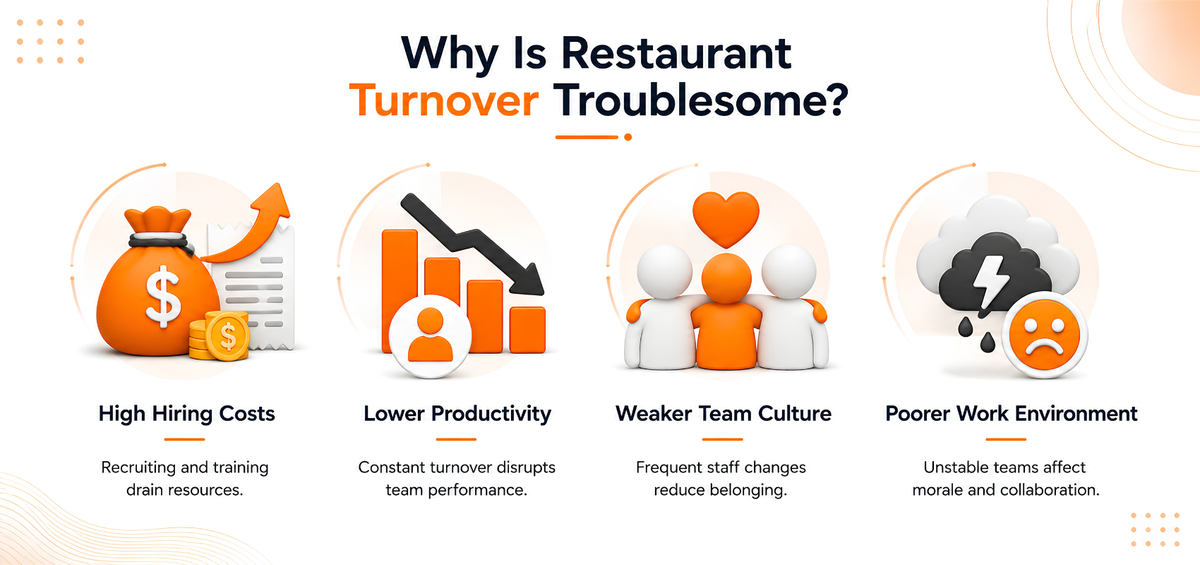
Every departure costs money, whether or not you notice it directly. Posting the role, screening applicants, interviewing, onboarding, and training all take time and budget, and none of it generates revenue while it's happening.
Industry estimates put the cost of replacing a single hourly restaurant employee anywhere from around $1,500 to $7,000, depending on the role, your location, and how long it takes a new hire to become fully productive. Costs run even higher for supervisors and general managers, since they take institutional knowledge and team relationships with them when they leave. If your restaurant loses even 20 or 30 people a year, that's a significant, recurring expense that could otherwise fund growth.
How Turnover Affects Team Culture and Guest Experience
High turnover doesn't just cost money. It affects your team and your guests too:
- New hires need time to reach full speed, so service can slow down or become inconsistent while they learn the menu and the floor.
- Remaining staff often absorb extra shifts and training duties, which can lead to burnout and push even more people toward the door.
- Frequent departures make it harder to build the kind of team culture that keeps both staff and regular customers coming back.
- Guests notice. A dining room staffed by unfamiliar faces every visit feels less consistent than one with an experienced, stable team.
Restaurant Turnover Benchmarks in 2026
Knowing the industry average helps you judge whether your own numbers are a real problem or simply typical for the sector.
- Restaurant and hospitality turnover has averaged above 75% annually over the past several years, according to Bureau of Labor Statistics data on accommodation and food services.
- Quick-service restaurants run the highest, with several industry reports putting QSR turnover above 100%, and in some cases above 130%, in a given year.
- Fine dining and full-service restaurants generally run lower, with turnover often in the 50 to 60% range, thanks to higher pay, tip income, and clearer career paths.
- By role, several recent studies put front-of-house turnover (servers, hosts, bartenders) at around 41%, back-of-house turnover (cooks, dishwashers) slightly higher at around 43%, and management turnover lower at around 28%.
- Average tenure for restaurant employees is short, with some retention studies putting it at around 110 days.
These figures are a benchmark, not a target. The goal isn't to match the industry average, it's to understand where your restaurant stands and reduce the number of avoidable departures, especially voluntary ones.
How to Calculate Your Restaurant Turnover Rate
The Restaurant Turnover Rate Formula
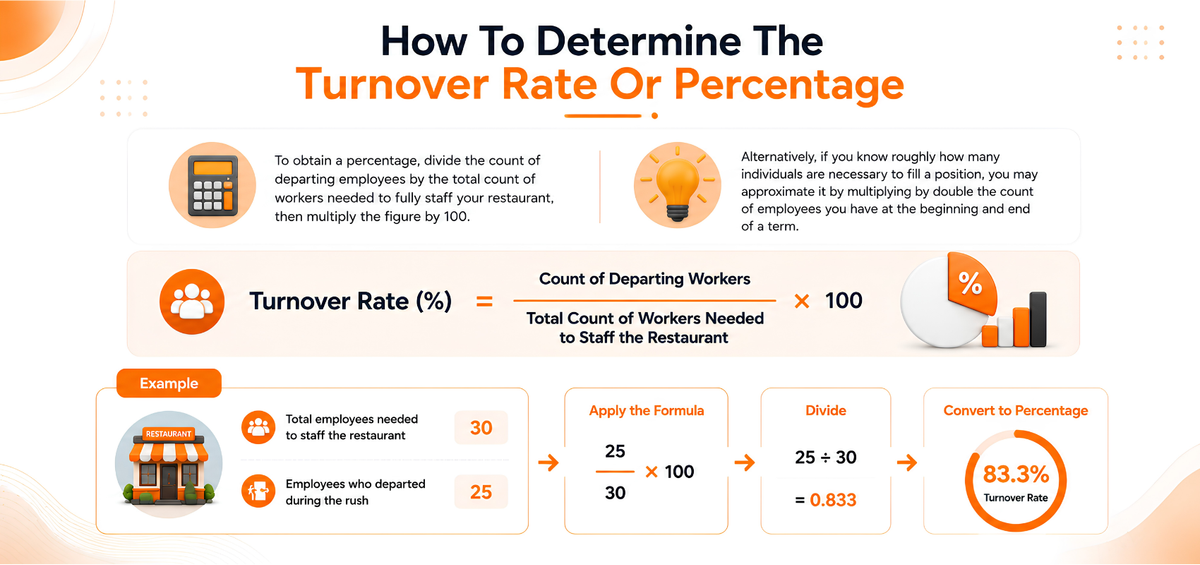
The standard formula used across HR and workforce management is:
Turnover Rate (%) = (Number of employees who left ÷ Average number of employees) × 100
To find your average number of employees for the period:
Average Number of Employees = (Employees at the start of the period + Employees at the end of the period) ÷ 2
Using the average, rather than just your headcount at the end of the period, gives you a more accurate rate, which matters in a restaurant where headcount can shift quickly during hiring seasons or holidays.
Restaurant Turnover Rate Example
Say your restaurant started the year with 40 employees and ended the year with 32. Your average headcount for the year is:
(40 + 32) ÷ 2 = 36
If 30 employees left over the course of that year, your turnover rate is:
(30 ÷ 36) × 100 = 83.3%
That's a high number, well above the industry average, and a clear signal to dig into why people are leaving and where the departures are concentrated, by role, shift, or manager.
How Often Should You Calculate Turnover?
- Monthly: useful for fast-moving, high-headcount operations like QSR, where you want to catch spikes early.
- Quarterly: a good middle ground for most full-service restaurants, giving enough data to spot trends without reacting to normal month-to-month noise.
- Annually: useful for comparing your restaurant against industry benchmarks and reporting to ownership or investors.
For an annual figure, you can also average your headcount across all 12 months instead of only using the start and end of the year. This smooths out seasonal hiring spikes and gives a more reliable number.
How to Reduce Restaurant Staff Turnover
Once you know your number, the next step is bringing it down. These are practical, widely used ways restaurants reduce staff turnover.
- Hire for fit, not just experience. Recruiting based on values and attitude, not only skills, helps you bring on people who are more likely to stay and grow with your restaurant. An employee referral program is also one of the fastest ways to find candidates who already fit your culture.
- Build a real onboarding process. New hires who understand expectations, get proper training, and feel supported in their first weeks are far less likely to leave early. A large share of restaurant turnover happens in the first few months on the job.
- Offer predictable, flexible scheduling. Publishing schedules further in advance and allowing staff to swap shifts gives employees more control over their lives outside work. Schedule unpredictability is consistently cited as one of the biggest drivers of voluntary turnover when it's missing.
- Keep pay and tips competitive and transparent. Regularly benchmark wages against nearby restaurants, and make sure tip pooling and distribution are clear and fair between front-of-house and back-of-house staff.
- Give people a path to grow. Employees who can see a route to shift lead, supervisor, or management roles are more invested in staying.
- Recognize good work. Simple, consistent recognition for reliability and performance goes a long way in frontline roles.
- Check in regularly. Monitoring performance and doing frequent, informal check-ins with staff helps you catch frustrations before they turn into resignations.
- Use the right technology. Your staff might not be as comfortable with technology as you are, so it pays to use easy-to-use restaurant POS software that removes friction from daily shifts instead of adding to it.
To automate this process, restaurant management software that's integrated with your POS at your restaurant can track attendance, manage shifts, and monitor staff performance in one place, so you catch turnover patterns by role, shift, or location instead of only reacting after someone has already quit. If labor costs are part of what's driving turnover at your restaurant, it's also worth reviewing strategies restaurants use to control high labor costs without cutting into service quality. Restaurant HR and payroll software can help bring all of this together in one place.
Frequently Asked Questions
What is a good turnover rate for a restaurant?
There's no single "good" number, since it depends on your segment and location, but a realistic target for a full-service restaurant is around 50 to 60% annually. Since the industry average sits close to 75%, treat anything above 80% as a red flag worth investigating. Quick-service restaurants will naturally run higher because of their staffing model.
What causes high turnover in restaurants?
The most common drivers are low or unpredictable pay, inflexible scheduling, limited growth opportunities, and inconsistent management. Physical demands and long, irregular hours also contribute to burnout, especially in high-volume back-of-house and front-of-house roles.
What's the difference between voluntary and involuntary turnover?
Voluntary turnover is when an employee chooses to leave, for example resigning for another job or better hours. Involuntary turnover is when the restaurant lets someone go, due to performance, conduct, or reduced staffing needs. Tracking them separately helps you tell a retention problem apart from a hiring problem.
How often should I calculate my restaurant's turnover rate?
Monthly tracking works well for high-turnover operations like QSR, since it catches spikes early. Most full-service restaurants get a clearer picture from quarterly tracking, with an annual calculation used to benchmark against industry averages.
How can restaurant software help reduce turnover?
Restaurant POS and staff management tools that handle scheduling, attendance, and performance tracking make day-to-day work easier for your team and give managers visibility into which shifts are understaffed and where training gaps exist, so you can act before someone quits rather than after.
Wrapping Up:
Calculating your restaurant turnover rate is straightforward once you have the right formula and accurate headcount numbers. The harder, more valuable work is what you do with that number: tracking it consistently, separating voluntary from involuntary departures, and addressing the scheduling, pay, and management issues that push people out the door.
Contact PosBytz if you're looking for a way to bring staffing, scheduling, and reporting together in one system. Operational efficiency is higher than ever thanks to our POS system for restaurants that helps you spot turnover risks early and build a team that sticks around.
Related Resources
- Best POS Software for Restaurants in UAE
- Best Quick Service Restaurant (QSR) POS Systems
- What are Pos Reports?
- Best Cloud Kitchen POS Software
- What Is a Retail POS
- 8 Best POS Inventory Systems
- HR & Payroll Software for Restaurants & Retail
- 5 Restaurant KPIs Every Restaurant Owner Should Monitor
- 8 Strategies Saudi Restaurants Use to Control High Labor Costs
About the author

The PosBytz Marketing Team
Editorial Team, PosBytz
The PosBytz Marketing Team shares practical insights on running smarter restaurants and retail stores from POS best practices to inventory management, online ordering, and customer loyalty strategies.