Should Your Small Business Accept Cryptocurrency?
Looking to accept crypto payments for your business? PosBytz offers a secure and efficient Bitcoin POS solution. Join the future of payments today.
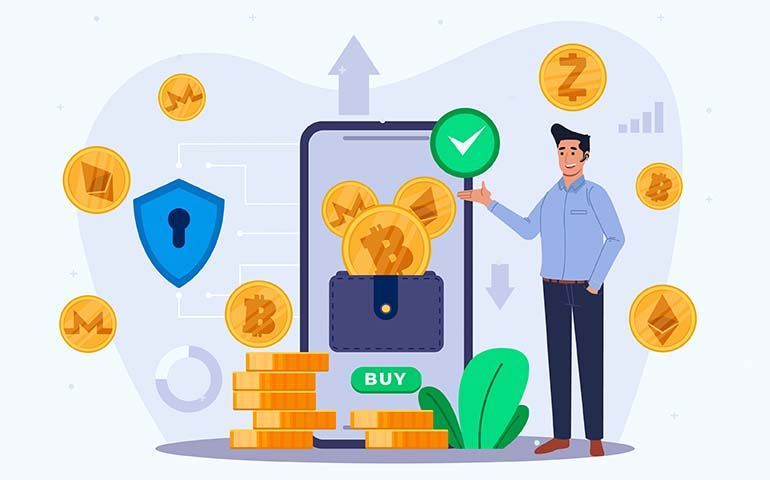


Bitcoin POS support is becoming a practical addition to point-of-sale infrastructure rather than a novelty. This guide explains what cryptocurrency is, how Bitcoin transactions work, and how to accept Bitcoin payments through PosBytz.
Crypto payments have moved from a niche experiment toward mainstream adoption. Bitcoin remains the most widely held cryptocurrency, and a growing number of businesses, particularly in retail and food service, now list it as a checkout option alongside cards and digital wallets. A Deloitte survey found that more than 2,300 US businesses accepted Bitcoin as payment, a signal that crypto acceptance is no longer limited to specialist retailers.
This raises a fair question for any business owner: should you add a Bitcoin POS option, and will it actually help your bottom line? Here is what you need to know before deciding.
What Is Cryptocurrency?
Cryptocurrency is a digital form of money you can use to buy goods and services, and like stocks, its value can rise or fall over time. Adoption accelerated during the pandemic, when contactless payments and secure digital storage of cash reserves became a bigger priority for both shoppers and merchants.
Bitcoin was the first cryptocurrency, launched in 2008, and it remains the largest and most widely used one today. Since then, alternatives such as Ethereum have emerged, each offering a different model from currency issued by a government.
How Bitcoin Transactions Work
Bitcoins are created through a process called mining. Individual miners or mining groups use powerful computer processors to solve complex mathematical problems, and the reward is newly issued Bitcoin. Those coins are held in a digital wallet, either cloud based or stored on the user's own device, which functions like a bank account for sending and receiving Bitcoin.
Every Bitcoin transaction worldwide is grouped into a "block," and miners confirm those transactions and record them on a shared, public ledger. The resulting chain of blocks is the blockchain, and it is what makes each transaction verifiable without a central authority.
Understanding this structure matters before you decide whether crypto payments make sense for your business, since it explains what actually happens between a customer's wallet and your POS software at the point of sale.
Key Features of Bitcoin as a Payment Method
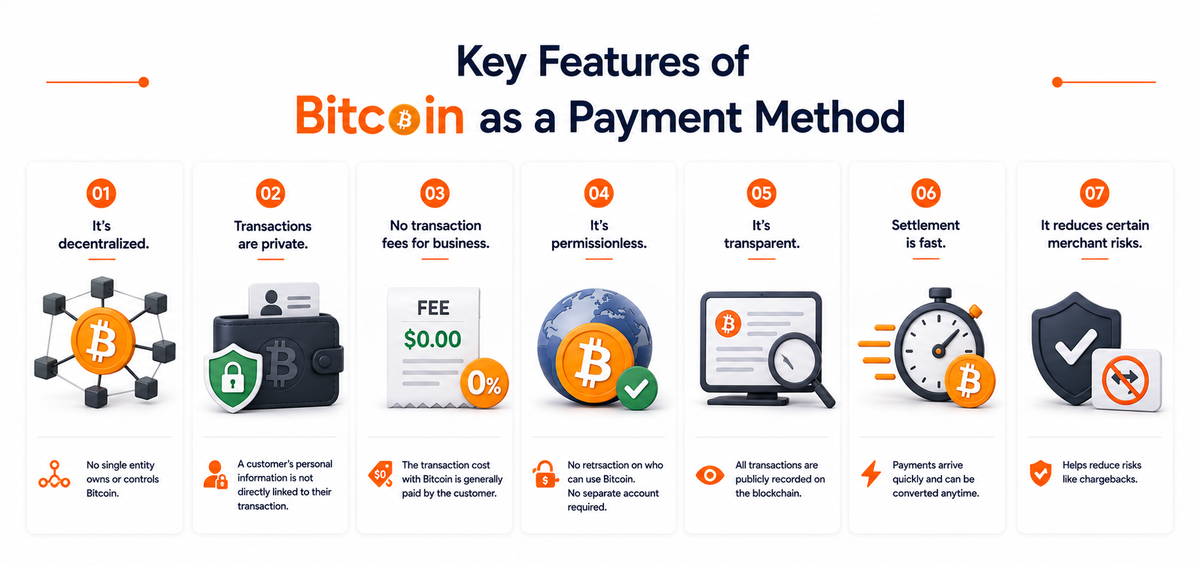
- It's decentralized. No single entity owns or controls Bitcoin, so no one party can manipulate or take over the network.
- Transactions are private. A customer's personal information is not directly linked to their Bitcoin transaction, which some customers find reassuring when paying.
- There are no transaction fees for the business. Unlike card or PayPal processing, where the merchant typically absorbs a fee, the transaction cost with Bitcoin is generally paid by the customer.
- It's permissionless. There is no restriction on who can use Bitcoin. Transactions simply need to follow the network's protocol to be confirmed, so no separate "Bitcoin account" is required.
- It's transparent. All Bitcoin transactions are publicly recorded on the blockchain, which reduces the risk of certain types of fraud.
- Settlement is fast. Payments arrive in your Bitcoin wallet quickly and can be converted to your local currency whenever you choose.
- It reduces certain merchant risks, such as chargebacks, which is part of why more retailers are open to adding a Bitcoin POS option.
Why Integrate Crypto Payments Into Your POS?
Bitcoin POS adoption is still a smaller share of overall payments, but it continues to grow as both customers and business owners get more comfortable holding and spending digital assets. Here is what adding crypto payments to your POS can do for your business:
- A POS that accepts cryptocurrency positions your business as an early mover in digital payments.
- Bitcoin POS works across industries — restaurants, cafes, bars, salons, and other local businesses can all accept it, letting merchants use a single terminal for crypto, credit cards, debit cards, and QR code payments.
- Customers get a straightforward way to spend their crypto holdings on everyday purchases.
- Encryption and PCI DSS standards remove intermediaries, so payments go directly into the owner's account or wallet.
- You can accept cryptocurrency from customers anywhere in the world without worrying about currency conversion.
- Merchant fees tend to be lower than traditional card payments — there are no compliance fees, monthly service charges, or card scheme fees.
- Accepting Bitcoin can help you reach new customer demographics who value the added privacy crypto payments offer.
How to Accept Bitcoin Payments With PosBytz
Bitcoin is steadily moving into the mainstream, which makes it worth ensuring your eCommerce platform and POS software can accept Bitcoin and other major cryptocurrencies, so you stay ahead of competitors who haven't made the move yet.
A simple POS integration with PosBytz gives your customers an easy way to spend their crypto — in your physical store and online.
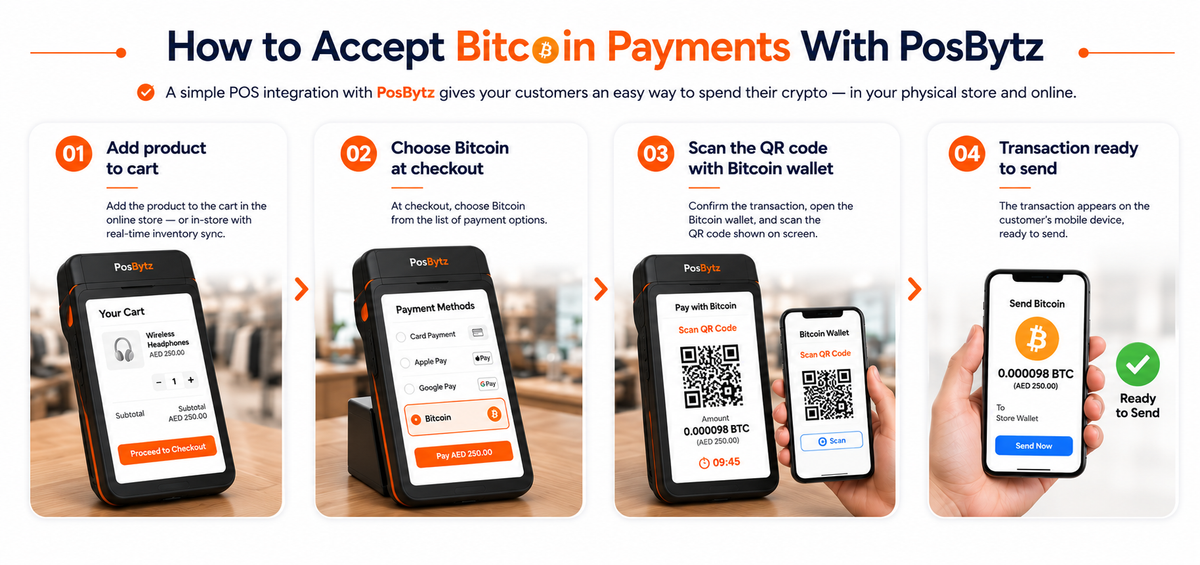
Accepting Bitcoin With PosBytz, Step by Step
Here's what the process looks like on a handheld device:
- Add the product to the cart in the online store — or in-store, thanks to PosBytz's real-time inventory view across channels.
- At checkout, choose Bitcoin from the list of payment options.
- Confirm the transaction, open the Bitcoin hot wallet, and scan the QR code shown on screen.
- The transaction appears on the customer's mobile device, ready to send.
That's the whole flow — fast for the customer and simple for staff to run at the counter.
PosBytz is built as a cloud-based platform with real-time inventory updates and employee management tools built in, so adding crypto as a payment option doesn't mean adding complexity elsewhere in the business. Its compatibility with your eCommerce setup makes it a practical way to open your store to a new, digitally native audience without disrupting how you already sell.
Frequently Asked Questions
What is a Bitcoin POS?
A Bitcoin POS is a point-of-sale system that lets a business accept Bitcoin as a payment method at checkout, alongside cards, wallets, and other standard payment types.
Is it safe for a small business to accept Bitcoin payments?
Bitcoin transactions rely on blockchain verification and are recorded publicly, and PosBytz processes payments using encryption and PCI DSS standards, which reduces certain fraud and chargeback risks compared with some traditional payment methods.
Does PosBytz charge extra fees for accepting Bitcoin?
Bitcoin transaction costs are generally paid by the customer rather than the merchant, and crypto payments typically avoid the compliance fees, monthly charges, and card scheme fees associated with traditional card processing.
Can I accept Bitcoin both online and in-store with PosBytz?
Yes. PosBytz supports Bitcoin as a checkout option across your physical POS and your online store, with real-time inventory synced across both.
Do I need a separate Bitcoin wallet to get started?
Yes, you will need a Bitcoin wallet, either cloud based or stored on a device, to receive payments. Customers pay by scanning a QR code from their own wallet at checkout.
Conclusion
Bitcoin POS adoption is still a smaller part of the payments landscape, but it is growing steadily as more customers hold and want to spend digital assets. Adding crypto as a checkout option does not require replacing your existing setup. With PosBytz, it works alongside cards, QR payments, and other methods you already offer, giving customers more ways to pay without adding operational complexity for your staff.
If you are weighing whether a Bitcoin POS fits your business, get started with PosBytz and add crypto payments to your existing checkout in minutes.
Related Resources
About the author

Saravana Damodaram
Co-Founder & CEO, PosBytz
Saravana Damodaram is the Co-Founder & CEO of PosBytz, a cloud-based POS-ERP platform built for F&B and retail businesses since 2018. He focuses on unified commerce, inventory, and multi-location operations, and has helped over 5,000 merchants across 25+ countries move off fragmented, disconnected tools and run their entire operation, billing, inventory, kitchen, and accounting on one platform.