Why Is My Restaurant Food Cost So High? 9 Hidden Leaks and How to Plug Them
Food cost above 35%? Find the 9 hidden leaks behind it, from portion creep to aggregator fees and Ramadan waste, with a free diagnostic table and fixes.
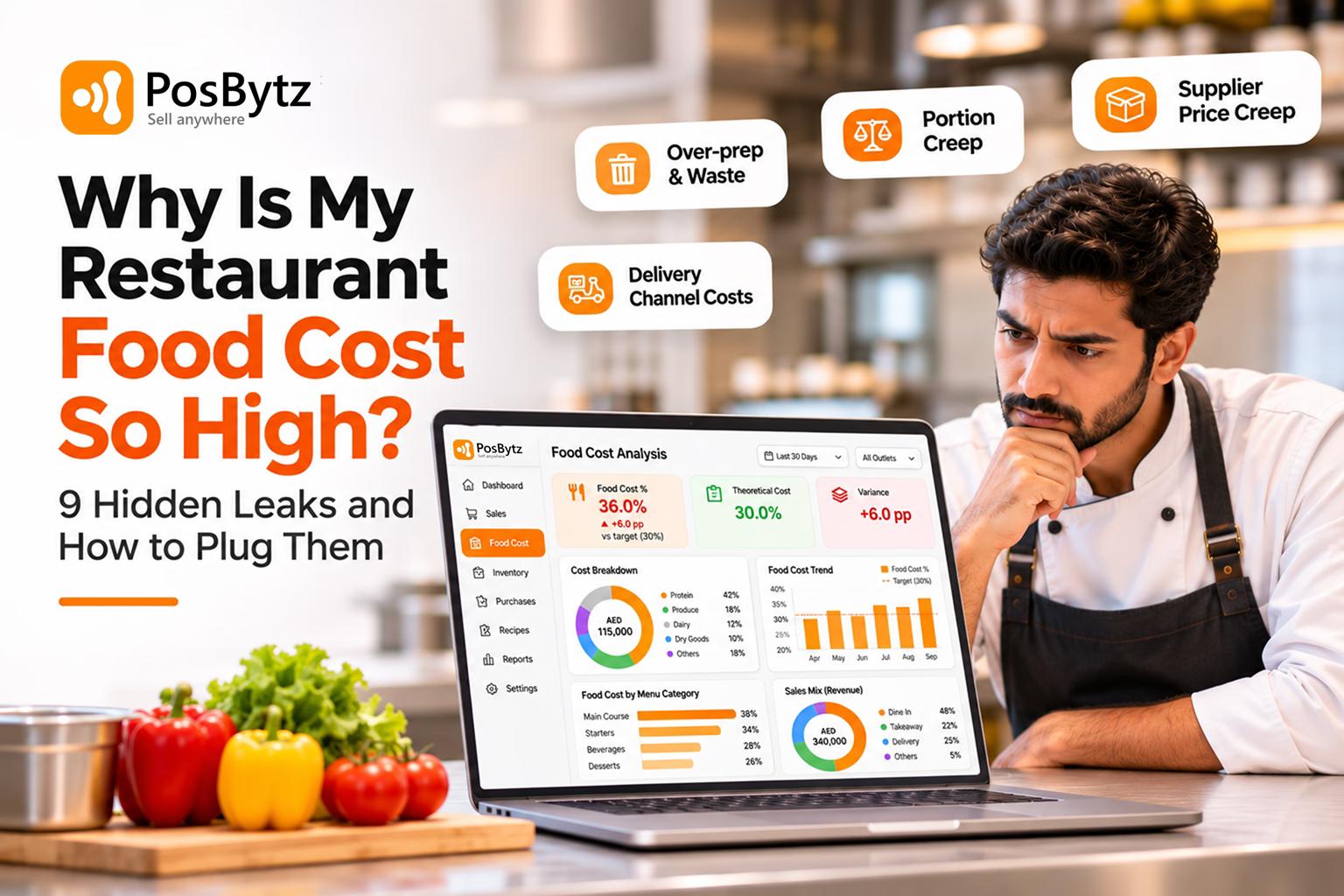


Quick answer: Restaurant food cost runs high when the food you pay for doesn't turn into sales. The 9 usual leaks are over-prep and waste, portion creep, stale recipe costs, supplier price and invoice creep, poor receiving, unlogged comps and voids, delivery-channel costs, sales-mix shifts, and inventory errors. Most kitchens should sit between 28% and 35%.
Your sales look healthy. Covers are steady. Yet the monthly report says food cost has crept from 30% to 36%, and nobody in the kitchen can tell you why.
That gap is rarely one big problem. It is a stack of small leaks spread across purchasing, the walk-in, the pass and the delivery tablet. Each one looks harmless on a single shift. Together they quietly eat the margin.
The stakes are higher for restaurants in the UAE, Saudi Arabia and the wider Gulf. The UAE imports around 85% of its food, so freight, currency and supplier price swings land on your invoices within weeks. Delivery apps take a commission on a large share of orders. And Ramadan can double your waste in a single month.
This guide shows you how to find which leak is draining your kitchen, put a number on it, and plug it in 30 days.
What one point of food cost is worth
Take a casual-dining restaurant in Dubai with AED 4,000,000 in yearly sales. Every 1 percentage point of food cost equals AED 40,000 a year. If food cost drifts from 30% to 34%, that's AED 160,000 gone, roughly the salary of two experienced chefs. In Riyadh, the same restaurant at SAR 4,000,000 loses SAR 160,000.
And you can't easily sell your way out. At an 8% net margin, recovering AED 160,000 means finding AED 2,000,000 in extra sales. Plugging the leak is far cheaper.
What is a good food cost percentage?
Most restaurants should aim for 28% to 35%, but the right number depends on your concept. A shawarma counter and a steakhouse will never share a target.
- QSR, shawarma, burger, pizza: 25% to 30%. Cheap staples, high volume and tight portions keep costs low.
- Cafés and coffee shops: 20% to 28%. Beverages carry low ingredient cost.
- Casual dining: 28% to 34%. A mixed menu and more proteins push the range up.
- Fine dining, steakhouses, seafood: 30% to 38%. Premium imported proteins and more trim raise the cost.
- Buffets (incl. iftar): 35% to 45%. Over-production is built into the model.
- Cloud kitchens (delivery-only): 28% to 33% food + packaging. Packaging and aggregator fees sit on top.
If you're 2 or more points above your concept's range for two months running, you have a leak, not bad luck.
How to calculate actual food cost
Food cost % = (Opening stock + Purchases − Closing stock) ÷ Food sales × 100
Example: opening stock AED 60,000 + purchases AED 110,000 − closing stock AED 55,000 = AED 115,000 used. On AED 340,000 food sales, food cost is 33.8%.
Two GCC-specific rules keep this number honest:
- Use VAT-exclusive figures on both lines. Input VAT you can reclaim (15% in Saudi Arabia, 10% in Bahrain, 5% in the UAE and Oman) is not food cost. Leaving it in makes a Saudi kitchen look up to 15% worse than it is.
- Count transfers. If your central kitchen sends marinated chicken to three branches, record it as a transfer out and a transfer in. Otherwise one outlet looks brilliant and another looks terrible.
Theoretical vs actual food cost: the number that finds your leak
Actual food cost tells you that you have a problem. Theoretical food cost tells you where.
Theoretical food cost is what you should have spent if every dish sold was made exactly to recipe, with zero waste. You get it by multiplying each item's recipe cost by the quantity sold in your POS.
Variance = Actual food cost % − Theoretical food cost %
A variance of 1 to 2 points is normal. Above 2 points, something is leaking between the invoice and the guest. The 9 leaks below are where to look.
The 9 hidden leaks behind high food cost
- Over-prep and spoilage
- Portion creep
- Plate costs that ignore import price swings
- Supplier invoice creep and weak receiving
- Ramadan and seasonal demand swings
- Comps, voids, staff meals and theft
- Delivery-channel leaks
- Sales-mix drift
- Inventory, transfer and VAT errors
Leak 1: Over-prep and spoilage
The biggest leak in most kitchens is food made or bought for guests who never came. In Dubai, around 38% of prepared food is wasted daily, and Saudi Arabia's grains authority puts the national cost of food loss and waste at about SAR 40 billion a year. Rice and bread lead the list, the same staples sitting in your hot-holding trays.
Gulf heat makes it worse. A delivery left on the loading bay at 42°C for 20 minutes, or a walk-in door propped open during a rush, shortens shelf life on dairy, leafy greens and seafood by days.
Signs: full bins at close, the same items discarded every week, stockouts and waste on the same day.
How to plug it:
- Prep to a forecast, not a feeling. Use last 4 same-weekday sales from your POS, adjusted for weather, events and paydays.
- For high-risk items (fresh fish, cut fruit, cooked rice), prep for 1.5 shifts at most.
- Log every discard with item, weight, reason and shift. One week of logging usually exposes 2 or 3 repeat offenders.
- Enforce FIFO with day-dot labels, and receive chilled goods straight into the cold room within 15 minutes.
- Turn trim into specials or staff meals before it turns into waste.
Leak 2: Portion creep
Nobody decides to over-portion. A cook adds a little extra chicken to a mandi for a regular, or a generous hand on the fries keeps a delivery review at 5 stars. Over a month, it becomes the new normal.
The math is brutal. An extra 20 g of chicken on a shawarma plate that sells 150 times a day, at AED 22/kg, costs about AED 66 a day, or AED 24,000 a year, on one dish.
Signs: actual food cost above theoretical, different plate weights between shifts, a protein running out faster than sales explain.
How to plug it:
- Put a digital scale at every protein station and use portion scoops, ladles and pre-portioned bags.
- Post a photo of the correct plate at the pass, labelled in English and Arabic (plus Hindi, Urdu or Tagalog if that is what your team reads).
- Run a blind plate-weight audit once a month on your top 5 sellers.
Leak 3: Plate costs that ignore import price swings
When most of your ingredients are imported, your recipe cost from six months ago is fiction. Freight rates, shipping-route disruptions, origin-country harvests and currency moves all flow into supplier price lists, often without a phone call.
If your burger was costed at AED 9.40 and the beef, cheese and bun now cost AED 11.20, every burger sold at the old menu price leaks AED 1.80 of margin.
Signs: food cost rising while sales, menu and team stay the same; popular dishes becoming less profitable.
How to plug it:
- Link every recipe to live ingredient prices, so plate cost updates when a new invoice comes in.
- Re-cost your top 20 items every month, and every week for proteins, dairy, cooking oil and imported produce.
- Set a trigger: if a dish's food cost moves more than 2 points, review its price, portion or spec.
- Keep a second approved supplier and a local-substitute spec (for example, regional poultry or GCC-grown tomatoes) for your most volatile items.
Leak 4: Supplier invoice creep and weak receiving
You negotiated a price in January. Is it still the price on today's invoice? Many operators check that the cases arrived but not that the unit price matches the quote.
Receiving is where money walks out before the food even enters the kitchen: short weights, substituted brands, chilled items that arrive warm, and credit notes that are promised but never issued.
Signs: invoice totals creeping up with no menu change, recurring disputes with one supplier, frozen goods with ice crystals or chilled goods above 5°C on arrival.
How to plug it:
- Receive against the purchase order, not the delivery note. Weigh proteins and check probe temperatures every time.
- Reject or record short and damaged items before the driver leaves, and chase the credit note the same week.
- Compare invoice prices against contract prices weekly. Software can flag any line that moved.
- Split ordering and receiving between two people where your team size allows.
Leak 5: Ramadan and seasonal demand swings
Gulf restaurants live through demand shocks that Western food-cost guides never mention. Dine-in lunch collapses during Ramadan, iftar and suhoor surge, and catering orders spike. Summer brings a resident exodus in July and August, while winter tourist season, national holidays and the two Eids push volumes up again.
Buffets suffer most. In Dubai, food waste rises from about 38% to close to 60% during Ramadan. Par levels set for a normal month are wrong for at least three months of the year.
How to plug it:
- Keep separate par levels and prep sheets for Ramadan, summer and peak season. Build them from last year's POS data for the same period.
- For iftar buffets, refill in smaller trays more often, use live stations, and track which dishes come back untouched. Then cook less of them.
- Offer set iftar menus or pre-booked counts to make demand predictable.
- Partner with a food bank such as the UAE Food Bank or Saudi Arabia's Etaam for safe surplus. It doesn't recover the cost, but logging it shows you what you over-made.
Leak 6: Comps, voids, staff meals and theft
Every comped dessert, voided kebab and "just one" staff meal is food cost with zero revenue. One manager comping AED 150 a shift across 26 shifts a month adds up to AED 46,800 a year.
Some of it is fine. Unrecorded, unreviewed and unlimited is not.
Signs: voids after the kitchen ticket printed, one employee with far more comps than peers, high-value items (saffron, premium meat, imported cheese) disappearing faster than sales show.
How to plug it:
- Require a reason code and manager PIN for every void and comp in the POS.
- Review comps and voids by employee every week, not every month.
- Ring up staff meals as a zero-price item so they show in your usage.
- Lock up high-value stock and count the top 10 cost items daily.
Leak 7: Delivery-channel leaks
In the Gulf, delivery is not a side channel. Aggregators commonly charge restaurants 25% to 30% commission per order, and many brands sell the same dish at the same portion on Talabat, Careem, Noon Food, HungerStation, Jahez or Keeta as in the dining room.
The food-cost leaks hide around that commission:
- Packaging (containers, sauce cups, bags, cutlery) often isn't in the recipe cost at all.
- Missing-item and quality refunds are remade or refunded, but the first portion still left the kitchen.
- Restaurant-funded promos such as "buy 1 get 1" double the food cost on the order.
- Delivery portions get bigger "to travel well" without a matching price.
How to plug it:
- Build a separate delivery recipe that includes packaging, and price delivery menus to cover commission and packaging.
- Route aggregator orders straight into your POS, so delivery sales, refunds and items show up in the same food-cost report.
- Track refunds by reason and by platform every week.
- Grow direct online ordering for repeat customers, where you keep the full margin.
Leak 8: Sales-mix drift
Your food cost can rise without a single mistake. If guests shift from a 22% food-cost pasta to a 40% food-cost steak, your blended percentage climbs, even though both dishes are made perfectly.
Signs: food cost up, waste and portions in line, but your top sellers have changed.
How to plug it:
- Run menu engineering monthly: plot each item by popularity and contribution margin.
- Keep and promote high-margin, high-popularity "stars". Reprice or re-spec popular but low-margin "plowhorses". Drop dishes that sell little and earn little.
- Train staff to recommend high-margin items, and place them in the top-right of the menu and first on delivery apps.
- Judge success by gross profit in AED or SAR, not only by percentage. A 38% steak can still earn more per plate than a 25% salad.
Leak 9: Inventory, transfer and VAT errors
Sometimes the leak is on paper. If the closing count is wrong, food cost is wrong, and you will chase a problem that doesn't exist or miss one that does.
Common errors in GCC operations: counting a full tin of ghee without subtracting the tin, valuing stock at last year's price, unrecorded transfers between outlets or from a central kitchen, and including reclaimable VAT in purchases.
How to plug it:
- Count on the same day and time every week or month, with the same counting sheet ordered by shelf location.
- Value stock at the latest purchase price.
- Record every branch-to-branch and central-kitchen transfer in the system.
- Book purchases net of input VAT, and reconcile theoretical vs actual usage per item, not just in total.
Find your leak in 10 minutes: the food cost diagnostic table
Match what you see in your reports to the most likely leak, then run the first check.
Actual 2+ points above theoretical, waste bins full: Leak 1, over-prep and spoilage. First check: a 7-day waste log by item and reason.
- Actual above theoretical, little visible waste: Leak 2 (portion creep) or Leak 6 (comps and theft). First check: weigh 5 plates of your top 5 sellers, and pull the comp and void report by employee.
- Actual and theoretical both rising together: Leak 3 (stale plate costs) or Leak 4 (invoice creep). First check: compare this month’s unit prices with last quarter’s.
- Sudden jump in one month only: Leak 9, count or transfer error. First check: recount the top 20 items and check transfers and VAT coding.
- Spike every Ramadan, summer or peak season: Leak 5, seasonal swings. First check: compare par levels with the same period last year.
- Food cost higher on delivery orders than dine-in: Leak 7, delivery-channel leaks. First check: add packaging to recipes and pull the refund report by platform.
- Waste, portions and prices normal, food cost still up: Leak 8, sales-mix drift. First check: run menu engineering on the last 60 days of POS sales.
Your 30-day plan to bring food cost back on target
- Days 1 to 3: Get a true baseline. Do a full stock count, book purchases net of VAT, and calculate actual food cost for last month.
- Days 4 to 7: Cost your top 20 dishes. Use current invoice prices and include packaging for delivery versions. This gives you theoretical food cost.
- Days 8 to 14: Measure. Start a daily waste log, run a blind plate-weight audit, and pull the comp, void and refund report by employee and platform.
- Days 15 to 21: Fix the two biggest leaks. Use the diagnostic table. Most kitchens recover 1 to 3 points from their top two.
- Days 22 to 28: Reprice and re-engineer. Adjust prices or specs on dishes more than 2 points over target. Set separate delivery prices if needed.
- Day 30: Recount and compare. Calculate actual vs theoretical again. Then make the weekly review a fixed habit.
How a connected POS and inventory system plugs these leaks
You can run every fix above on spreadsheets. Most busy kitchens stop after three weeks. A POS with built-in inventory and recipe management, such as PosBytz, does the tracking automatically, so the weekly review takes minutes.
Leak 1, over-prep and spoilage: Item-level sales history for prep forecasts, waste entry with reason codes, and low-stock and expiry alerts.
- Leak 2, portion creep: Recipe-based stock deduction, so actual vs theoretical usage shows per ingredient.
- Leak 3, stale plate costs: Recipe cost updates automatically from the latest purchase price.
- Leak 4, invoice creep and receiving: Purchase orders, goods received against the PO, and supplier price history.
- Leak 5, seasonal swings: Same-period sales comparisons to set Ramadan, summer and peak pars.
- Leak 6, comps, voids, theft: PIN-protected voids and discounts with reason codes, plus reports by staff.
- Leak 7, delivery leaks: Aggregator orders flow into one POS, with channel-wise sales and item reports.
- Leak 8, sales-mix drift: Item-wise sales and margin reports for menu engineering.
- Leak 9, inventory and transfers: Multi-outlet and central-kitchen stock transfers, plus VAT-compliant purchase and billing records.
Find your food cost leaks in one dashboard. Book a free PosBytz demo for your UAE, Saudi or GCC restaurant.
Frequently asked questions
Why is my restaurant food cost so high when sales are good?
Because food is leaking between purchase and sale. The usual causes are over-prep and waste, portion creep, outdated recipe costs, supplier price rises, comps and voids, delivery packaging and refunds, sales-mix changes, and inventory errors. Compare actual with theoretical food cost to see which one.
What is a good food cost percentage for a restaurant in the UAE or Saudi Arabia?
Most Gulf restaurants target 28% to 35%. QSR and shawarma outlets often run 25% to 30%, cafés 20% to 28%, and fine dining or seafood concepts 30% to 38%. Buffets, including iftar buffets, often run higher.
What is the difference between actual and theoretical food cost?
Theoretical food cost is what you should have spent if every dish followed its recipe with no waste. Actual food cost is what you really used, from stock counts and purchases. A gap above 2 points means something is leaking.
Should food cost include VAT?
No. Use VAT-exclusive purchase and sales figures. Reclaimable input VAT (15% in Saudi Arabia, 10% in Bahrain, 5% in the UAE and Oman) is not a food cost, and including it overstates your percentage.
Do delivery app commissions count as food cost?
Commission is usually booked as a selling expense, not food cost. Packaging, remade orders and restaurant-funded promotions do raise food and packaging cost, so track delivery as its own channel.
How do I reduce food waste during Ramadan?
Set separate Ramadan par levels from last year's sales, refill buffets in smaller batches, track which dishes return untouched, offer set iftar menus or pre-booked counts, and donate safe surplus to a food bank.
How often should I calculate food cost?
Weekly for high-volume restaurants, at least monthly for everyone else. Count high-value items such as meat, seafood and imported cheese daily or weekly.
Can a POS system reduce food cost?
Yes, when it is connected to inventory and recipes. It shows actual vs theoretical usage, flags supplier price changes, controls voids and comps, and brings aggregator orders into one report.
About the author

Saravana Damodaram
Co-Founder & CEO, PosBytz
Saravana Damodaram is the Co-Founder & CEO of PosBytz, a cloud-based POS-ERP platform built for F&B and retail businesses since 2018. He focuses on unified commerce, inventory, and multi-location operations, and has helped over 5,000 merchants across 25+ countries move off fragmented, disconnected tools and run their entire operation, billing, inventory, kitchen, and accounting on one platform.