Simplified Tax Invoice vs Full Tax Invoice Under Fawtara: What Your Checkout Needs to Issue
CloudMe covers a broad spread of business software, but scaling food and retail operators often need one productized platform with deeper multi-branch control.
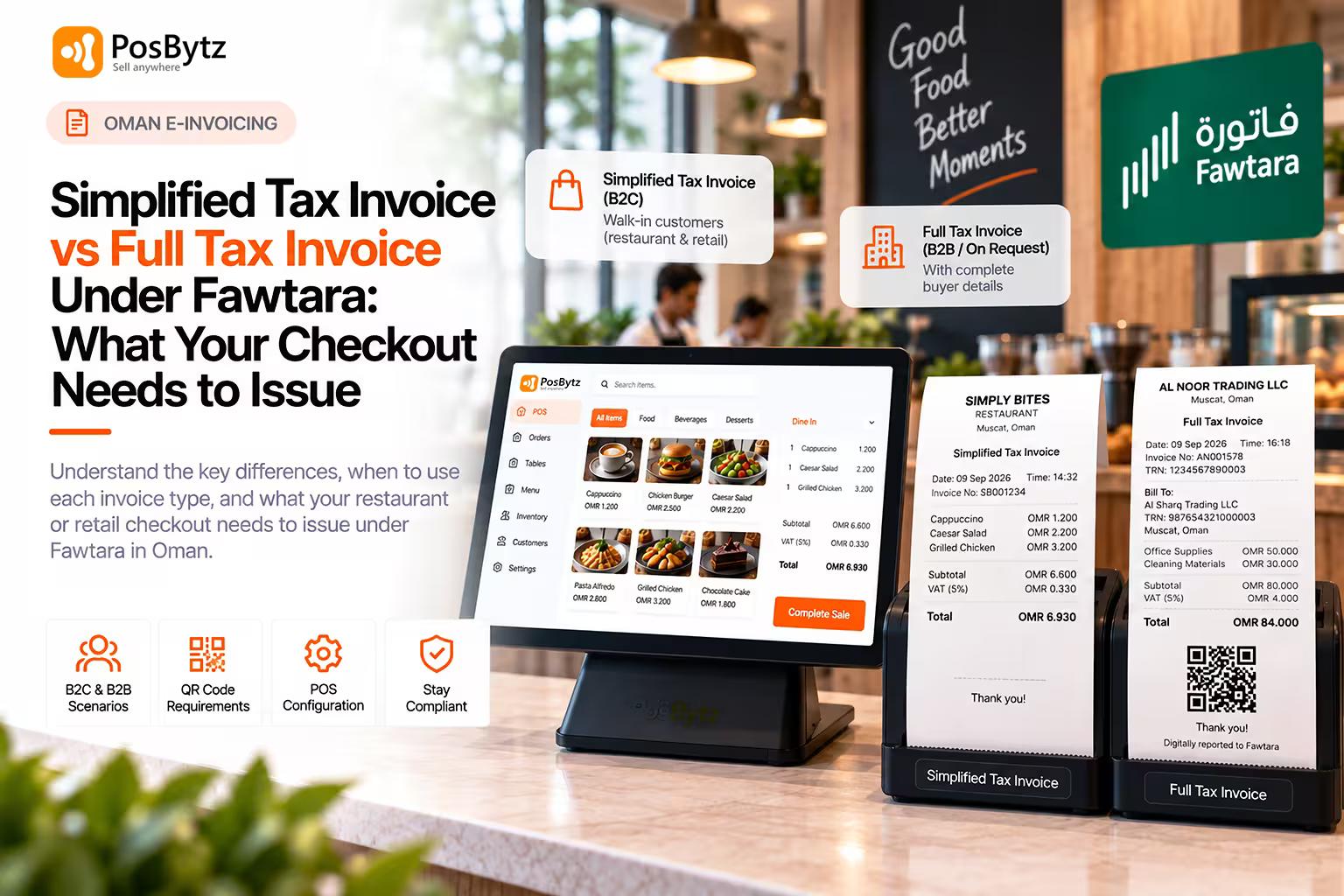


For most restaurant and retail sales in Oman, a simplified tax invoice with a QR code is what your checkout needs to issue, since these are walk-in, business-to-consumer (B2C) transactions. A full tax invoice, with complete buyer details, is used when a customer specifically requests one, or when the transaction is business-to-business. Both formats exist under Fawtara, and the rules for issuing and reporting them are different, which is exactly the kind of detail that gets lost in generic compliance guides written for finance teams rather than checkout staff.
This distinction sounds simple, but it has real operational consequences: which invoice type your POS defaults to, how quickly each one needs to be reported, and whether your staff know when to switch formats without holding up the queue. This guide breaks down both invoice types clearly, with a focus on what actually happens at a restaurant table or a retail counter.
Simplified vs Full Tax Invoice: At a Glance
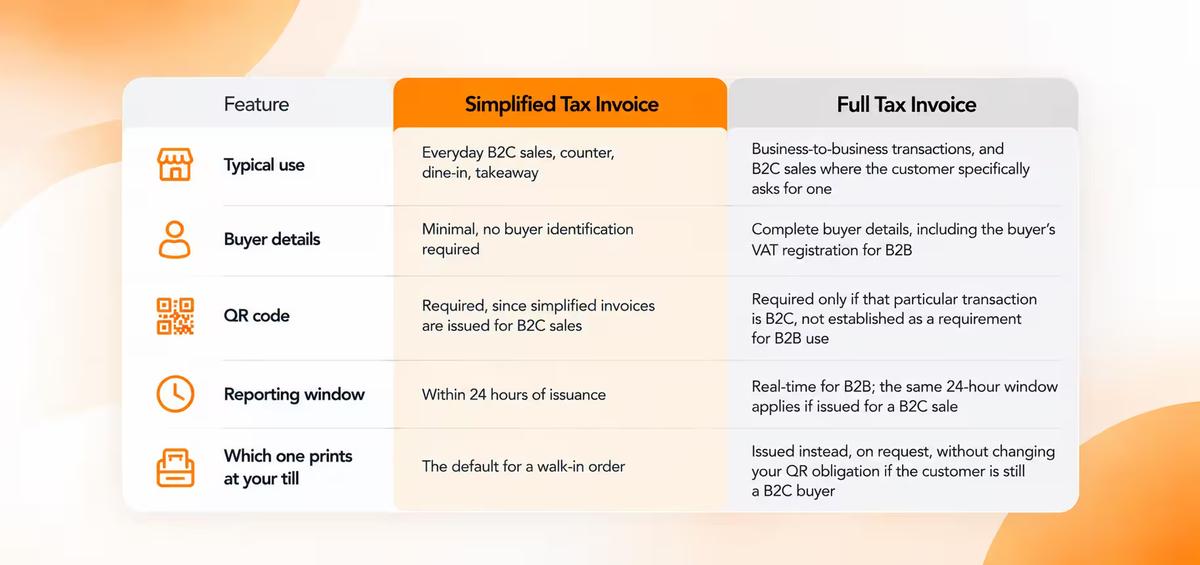
What Is a Simplified Tax Invoice
The everyday receipt format for walk-in customers
A simplified tax invoice is the everyday receipt format used for retail and restaurant sales to individual customers, where full buyer registration details are not required. Under Oman VAT rules, simplified invoices are typically permitted for B2C sales below a certain value, and they remain the standard format at most restaurant and retail checkouts.
What still has to appear on a simplified invoice under Fawtara
Under Fawtara, a simplified invoice issued for a B2C transaction still requires a QR code on the receipt, alongside the standard details already required under Oman VAT law, such as the seller's details, the VAT amount, and the transaction total. The format is simplified relative to a full tax invoice, not exempt from Fawtara's rules altogether. We cover the QR code requirement itself in more depth in our guide to QR codes on restaurant and retail receipts.
Where simplified invoices are used most
In a restaurant setting, this is the standard bill presented at the end of a meal or a takeaway order. In retail, it is the receipt handed over at the till after a purchase, whether at a supermarket, a boutique, or a grocery store. For the vast majority of daily transactions in this industry, the simplified invoice is the default, not the exception.
What Is a Full Tax Invoice
Complete details for both parties
A full tax invoice includes complete details of both the seller and the buyer, itemised VAT breakdowns, and the other fields required under Oman's VAT law. Full tax invoices are the default for business-to-business (B2B) transactions, where the buyer is also VAT registered and needs a complete invoice for their own input VAT claims.
When a B2C customer needs a full invoice too
A restaurant or retail store can also issue a full tax invoice to a walk-in customer if that customer specifically asks for one, such as a corporate customer expensing a meal, or an individual buying goods for a registered business. In these cases, the transaction is still technically B2C from a payment perspective, but the invoice format follows the full tax invoice requirements because the buyer needs complete documentation.
Why full invoices still need a QR code for B2C sales
It is worth repeating a detail that trips up a lot of businesses: even a full tax invoice issued for a B2C transaction still requires a QR code, because the QR code requirement is tied to whether the transaction is B2C, not to which invoice format is used. Only B2B transactions are exempt from the mandatory QR code rule.
Which One Should Restaurant and Retail Checkouts Issue
The general rule of thumb
As a general rule, walk-in B2C sales at a restaurant table or retail counter are handled with a simplified invoice, while B2B sales, or any B2C sale where the customer requests full invoice details, are issued as a full tax invoice. Your POS should support both formats at the same till, since staff need to be able to switch between them depending on what the customer asks for, without slowing down the queue.
Training staff to recognise when to switch formats
This is where team readiness, not just system readiness, matters. Staff need a simple rule to follow: default to a simplified invoice, and only switch to a full tax invoice when a customer explicitly asks for business-level details, such as their own company name and VAT number on the bill. Without this training, staff either issue full invoices unnecessarily, slowing service, or fail to issue one when a genuine B2B customer needs it.
Multi-outlet consistency matters here too
A chain running several cafes or retail branches needs every till to apply this rule the same way. Inconsistent invoice formatting across outlets creates confusion for repeat business customers and makes VAT reconciliation harder at head office.
The 24-Hour Reporting Rule for B2C Invoices
Real-time customer copy, delayed formal reporting
B2C invoices are not validated in real time the way B2B invoices are. Instead, the human-readable copy is given to the customer immediately at the till, and the underlying invoice data is then reported to your accredited service provider, and onward to OTA, within 24 hours of issuance.
How this differs from B2B invoice exchange
B2B invoices, by contrast, are exchanged and validated on a real-time basis between the seller's and buyer's service providers. This distinction matters for how your POS and back-office reporting are configured, since a restaurant issuing mostly B2C invoices needs a reliable batching or queuing mechanism to report data within the 24-hour window, rather than a strict real-time validation flow.
What this means for offline or connectivity-limited outlets
The 24-hour window gives some operational breathing room for outlets with intermittent connectivity, such as food trucks or pop-up retail locations, since the human-readable receipt can still be issued instantly while the formal e-invoice data syncs once connectivity is restored, provided it happens within the required window.
Do Human-Readable Invoices Stay Mandatory?
Yes, for now, and the reason is technical
Yes, for now. Oman Tax Authority has confirmed that human-readable invoices remain mandatory even after e-invoicing goes live, partly because Oman's VAT system uses three decimal places, while the underlying Peppol network currently supports only two decimal places on certain total-amount fields of the e-invoice.
The temporary decimal-place mismatch
Until that gap is resolved, the human-readable invoice given to the customer will still show amounts to three decimal places, while the reported e-invoice uses two, with a rounding-off field to reconcile the small difference. This is a genuinely unusual quirk of Oman's rollout, and it is worth building into your POS configuration and staff explanations now, rather than treating it as a bug later.
When this requirement is expected to change
Once Peppol's network is updated to support three decimal places, this mismatch should resolve itself, and OTA has indicated the human-readable invoice requirement will be reassessed at that point, once the full e-invoicing network covers B2B and B2C exchange end to end.
What Changes Once You Are Fully on the Fawtara Network
Real-time B2B, 24-hour B2C
Once your business is live on Fawtara, B2B transactions move to real-time exchange between service providers, while B2C transactions keep the 24-hour reporting window, with the QR-coded human-readable copy going to the customer instantly.
PDF invoices are no longer acceptable
Only electronic invoices are considered valid tax invoices once the mandate applies to you, so a PDF invoice, no matter how it is formatted, is no longer treated as valid documentation. This is a common mistake businesses make during the transition, which we cover in more detail in our guide on common Fawtara mistakes to avoid.
Getting your POS ready for both invoice types
A POS like PosBytz can generate the right invoice format automatically at checkout, simplified or full, apply the 24-hour B2C reporting logic in the background, and keep your receipts compliant without extra manual steps for your staff.
FAQs
Can a restaurant issue only a simplified invoice with no e-invoice data at all?
No, once the Fawtara mandate applies to your business. You still give the customer a human-readable simplified invoice at the till, but the underlying invoice data must be reported to your service provider within 24 hours.
Is a PDF invoice a valid tax invoice under Fawtara?
No. Oman Tax Authority has stated that after e-invoicing implementation, only electronic invoices are considered valid tax invoices, and PDF invoices are not valid regardless of the language used.
What if a walk-in customer asks for a full tax invoice instead of a simplified receipt?
Your checkout can issue a full tax invoice with the buyer's details instead. For B2C transactions, a QR code is still required even on a full tax invoice.
Do B2B transactions need a QR code on the invoice?
No. QR codes are mandatory only for B2C invoices under Fawtara. QR codes are optional, not required, on B2B invoices.
Why does my e-invoice show two decimal places when Oman uses three?
This is a temporary limitation caused by the underlying Peppol network, which currently supports only two decimal places on certain total-amount fields. OTA has said this will be updated once Peppol supports three decimal places, and a rounding-off field is used in the meantime to reconcile any small difference.
Should my staff be trained differently for simplified versus full invoices?
Yes. Staff should default to issuing a simplified invoice for walk-in customers and only switch to a full tax invoice when a customer specifically requests full business details, so a clear rule at the till avoids delays and mistakes.
About the author

Thaniyeal
Technical Content Writer & SEO Specialist, PosBytz
Thaniyeal is a Technical Content Writer and SEO Specialist on the PosBytz Marketing team, focused on turning complex POS and ERP topics into clear, practical guides for restaurant and retail businesses.