UAE Tax Penalties 2026: What Changed and How Restaurants and Retailers Can Pay Less
The FTA cut UAE tax penalties from 14 April 2026. See the new fines, the 14% late payment rate and voluntary disclosure costs for restaurants and retailers.



The short version
The UAE now charges lower fines for many common tax mistakes. Cabinet Decision No. 129 of 2025 came into force on 14 April 2026 and amends the Cabinet Decision on administrative penalties for tax law violations (Cabinet Decision No. 40 of 2017). It applies to violations under the Tax Procedures Law, the VAT Law and the Excise Tax Law.
Four changes matter most to a restaurant, café, cloud kitchen or retail store:
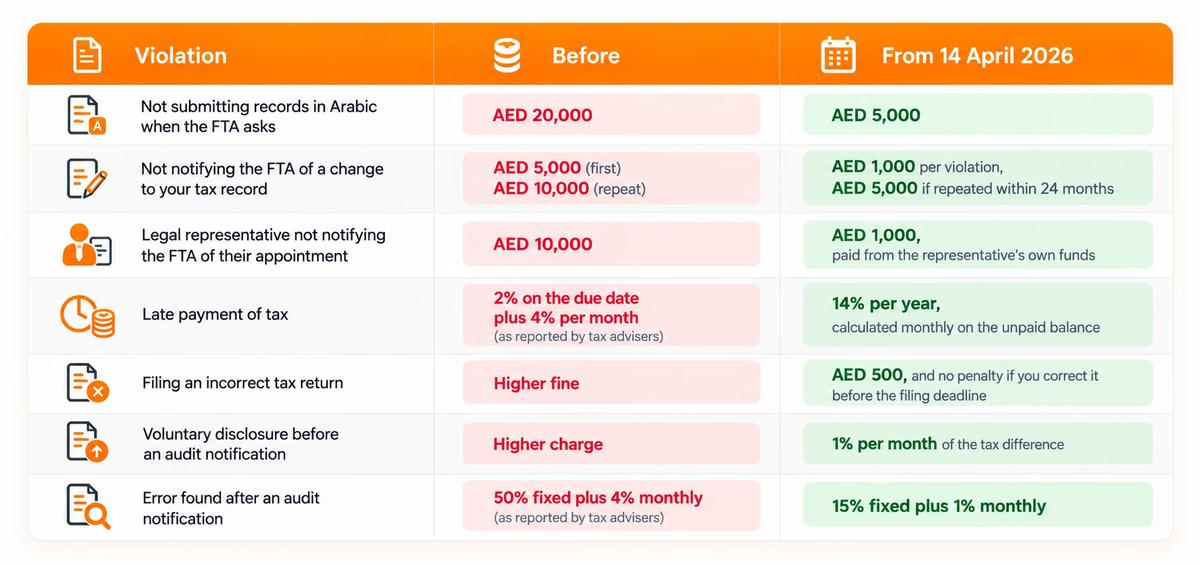
- The fine for not producing tax records in Arabic on request fell from AED 20,000 to AED 5,000.
- Late tax payments now carry a flat 14% a year, calculated monthly, instead of the old 2% plus 4% monthly structure.
- Fixing an error before the Federal Tax Authority (FTA) sends an audit notification now costs 1% of the tax difference per month.
- Fixing the same error after an audit notification adds a fixed 15% on top of that monthly charge.
The fines are lower, but they are not gone. Businesses with clean, searchable records pay the least, because they find errors early and can prove what happened.
UAE tax penalties at a glance
1. Arabic records: 75% lower fine
If the FTA asks for your tax records and you cannot supply them in Arabic, the penalty is now AED 5,000, down from AED 20,000. That is a 75% cut.
The rule matters most for multi-outlet groups whose invoices, supplier bills and payroll files sit in different systems and languages. The FTA can ask for documents at short notice. Decide now who prepares Arabic versions and how quickly they can do it.
2. Tax record updates: one fine, then a higher one
You must tell the FTA when something changes that affects the information on your tax record. Previously the fine was AED 5,000 for a first breach and AED 10,000 for a repeat. It is now AED 1,000 per violation, rising to AED 5,000 if you repeat the same violation within 24 months of the last one.
For a growing F&B or retail business, changes happen often: new branches, closed outlets, a change of trade name or licence, a new bank account, a new authorised signatory. Confirm with your tax agent which of these need an update on EmaraTax. Then set a reminder for each one.
The 24-month window is the part to watch. A second late update inside that window costs five times the first.
3. Legal representatives: AED 1,000 instead of AED 10,000
A legal representative who fails to tell the FTA about their appointment within the time limit now faces AED 1,000, down from AED 10,000. The penalty is payable from the representative's own funds, not the business's. If you appoint a representative for a company or outlet group, make the FTA notification part of the appointment checklist.
4. Late payment: a flat 14% a year
Late payment used to build up quickly. The new rule is simpler: 14% per year on the unpaid tax, calculated monthly, starting the day after the due date.
An illustration, using round numbers: if AED 20,000 of VAT stays unpaid for three months, the charge is roughly AED 700 (14% of AED 20,000 is AED 2,800 a year, or about AED 233 a month). Your tax agent can confirm the exact calculation for your case.
For businesses that run tight on cash between busy seasons, the cost of delay is now easier to forecast. It is still a cost, so pay on time where you can.
5. Voluntary disclosure: timing decides the cost
A voluntary disclosure is how you tell the FTA that a tax return, tax assessment or refund application contained an error. Under the new rules, the cost depends on when you file:
- Before the FTA sends an audit notification: 1% of the tax difference for each month, counted from the original due date until you submit.
- After an audit notification: a fixed 15% of the tax difference, plus the same 1% monthly charge.
An illustration: you find that a quarter's VAT return under-reported AED 50,000 of tax, and eight months have passed.
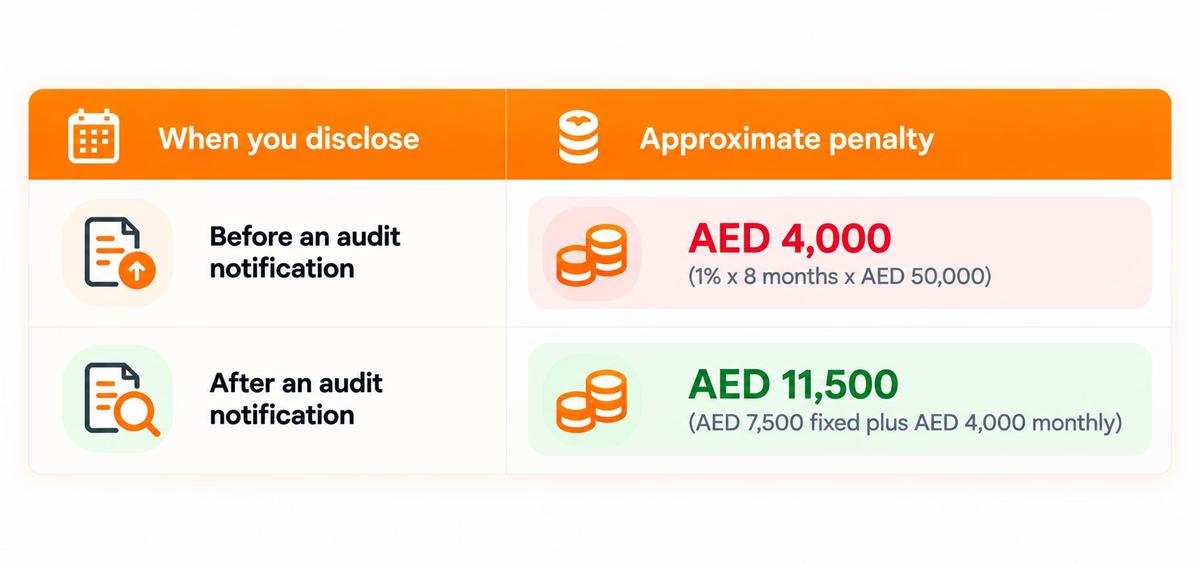
Waiting more than doubles the bill in this example. Advisers also report that the tax due from a disclosure should be paid within 20 business days of submitting it, or the 14% late payment charge starts on the unpaid amount. Confirm current handling with your tax agent.
Two smaller points help SMBs. An incorrect return that you fix before the filing deadline should carry no penalty. Advisers also report that errors with no change in tax due can now be corrected in the next return, without a formal disclosure. Check that with your agent before relying on it.
What did not change
Lower penalties do not create a penalty-free period. Late filing, late registration and failure to keep records still carry fines. Corporate Tax penalties follow their own decision, so confirm with your tax agent how your corporate tax position is treated.
For the separate 2026 changes to input VAT recovery, supplier checks and e-invoicing, read our guide to the new UAE VAT rules. This article covers penalties only.
Why records decide what you pay
Every penalty above depends on what you can show and how fast you can show it. Arabic records on request, a fast record update, a correct return, an early disclosure: each one is easier when sales, purchases and invoices live in one system.
PosBytz gives restaurants and retailers that single place. Sales produce FTA-compliant tax invoices, VAT reports are ready at filing time, and built-in accounting keeps purchases, supplier bills and payments beside your sales. When an error appears, you can trace it to the transaction, correct the return and disclose early, before an audit notice raises the cost.
Your UAE tax penalty checklist
- List every change to your business details since your last EmaraTax update and file the missing ones
- Note the date of each update so you can see any repeat inside 24 months
- Confirm who prepares Arabic copies of your records and how long it takes
- Confirm your legal representative's appointment has been notified to the FTA
- Set payment reminders ahead of each VAT due date
- Re-check the last four returns for errors and disclose any tax difference now, not after an audit notice
- Ask your tax agent to review your penalty exposure once a year
FAQs on UAE tax penalties
When did the new UAE tax penalties start?
Cabinet Decision No. 129 of 2025 came into force on 14 April 2026.
Which taxes do the new penalties cover?
The decision amends the penalties under the Tax Procedures Law, the VAT Law and the Excise Tax Law. Corporate Tax penalties have their own decision.
How much is the fine for not providing records in Arabic?
AED 5,000, down from AED 20,000.
What is the penalty for late VAT payment now?
14% per year on the unpaid tax, calculated monthly.
What does a voluntary disclosure cost?
Before an FTA audit notification, 1% of the tax difference per month from the original due date. After a notification, add a fixed 15%.
Is the fine for a legal representative paid by the business?
No. It is payable from the legal representative's own funds.
Do small restaurants and shops need to worry about this?
Yes, if you are registered with the FTA. The penalties apply to registrants of any size.
About the author

Saravana Damodaram
Co-Founder & CEO, PosBytz
Saravana Damodaram is the Co-Founder & CEO of PosBytz, a cloud-based POS-ERP platform built for F&B and retail businesses since 2018. He focuses on unified commerce, inventory, and multi-location operations, and has helped over 5,000 merchants across 25+ countries move off fragmented, disconnected tools and run their entire operation, billing, inventory, kitchen, and accounting on one platform.