How E Invoicing Works in KSA: A Complete ZATCA Guide
Enhance efficiency with e invoicing in KSA. Streamline transactions, ensure compliance, and boost business operations seamlessly.



E invoicing in KSA is the legal requirement to generate, issue, and store invoices electronically instead of on paper, in a format approved by the Zakat, Tax and Customs Authority (ZATCA). ZATCA rolled out einvoicing KSA in two phases starting December 4, 2021, and Phase 2 is now being enforced in waves based on business revenue, with the newest wave announced in July 2026.
This guide explains what e invoicing in KSA actually requires, how Phase 1 differs from Phase 2, which businesses are affected right now, and what happens if a business misses its compliance deadline.
Know more about e-invoicing software in Saudi Arabia.
What is an e invoicing in KSA?
Ksa e invoicing replaces handwritten, scanned, or text-editor-generated invoices with structured electronic invoices that meet ZATCA's technical rules. A scanned copy of a paper invoice does not count as an e-invoice under this regulation, even if it looks identical to a compliant one.
For VAT-registered businesses, einvoicing KSA invoices carry the same legal weight as standard VAT tax invoices, but they are created, transmitted, and archived through an electronic system rather than on paper.
Who Needs to Comply
The e invoicing in KSA mandate applies to VAT-registered resident taxpayers in Saudi Arabia, along with any party issuing tax invoices on behalf of a VAT-registered supplier. Non-resident taxpayers are excluded from the requirement.
Why It Matters for Your Business
Once your business crosses the revenue threshold for an active Phase 2 wave, ZATCA requires your invoicing system to connect directly to its Fatoora platform. Missing this step does not just create compliance risk, it can also disrupt VAT filing, since e-invoicing data feeds directly into ZATCA's tax records.
Why is the KSA e invoicing by government undergoing the transformation?
The Saudi Arabia government is implementing ksa e invoicing for a number of reasons. These broadly fall into two categories: efficiency and security.
Einvoicing KSA can increase efficiency in transactions by making trade more seamless, and efficient, which results in faster payments and reduced costs. This also enables fair competition, increases business competitiveness, and improves consumer protection in the market, in line with international best practices.
Read about ZATCA Approved Software to know more about e-invoicing for your business.
E-invoicing allows the government to detect and reduce the shadow economy and to monitor the movement of goods, services, and money in (near) real-time, depending on the model that will be implemented.
Taxpayers benefits of KSA e invoicing:
A better experience for sellers and buyers. When you issue e invoices quickly in real-time, input tax credits will be processed faster.
Electronic data will be more secure and less error-prone than paper entries.
A streamlined e invoicing process reduces slip-ups and additional hassles for business owners.
To comply with the rules, it’s essential that every resident taxpayer is prepared for einvoicing in KSA. Here’s what you need to know about how the KSA e invoicing regulations will impact you, and what you need to do in the future.
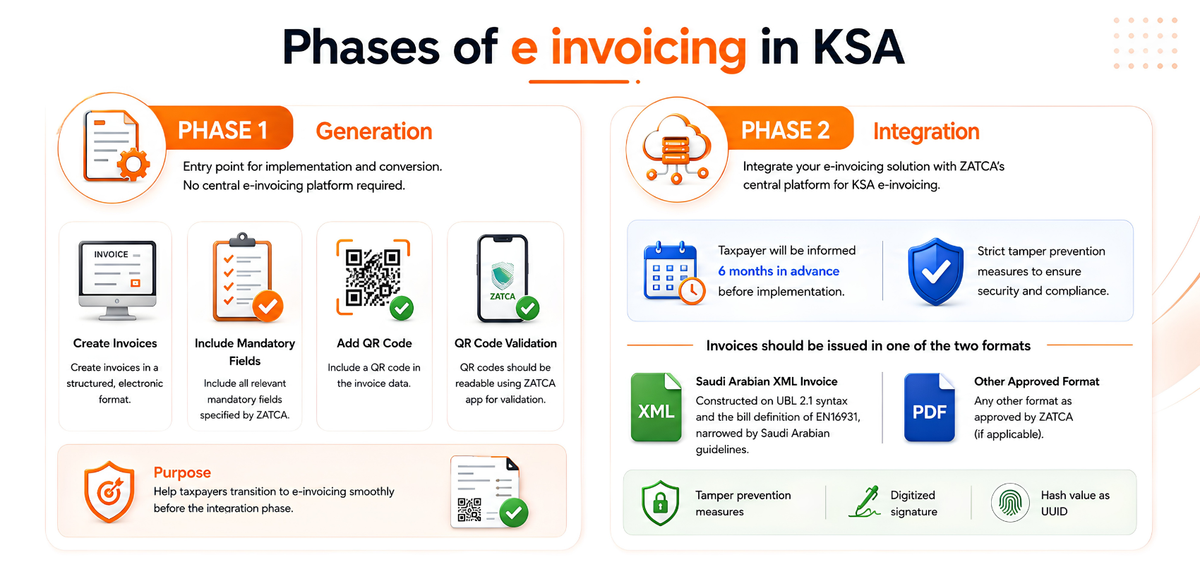
Phases of e invoicing in KSA
Phase 1: Generation
The first phase of the e-invoicing implementation in Saudi Arabia, which comes into effect on December 4, 2021, is intended to serve as an entry point for implementation and conversion. No central e-invoicing platform is yet required for this.
Taxpayers must create their invoices in a structured, electronic format. No format is prescribed, but it is recommended to use the format that will be mandatory from January 2023. The invoices must contain all relevant mandatory fields specified by ZATCA. In addition, a QR code must be included in the invoice data that can be scanned with a smartphone. QR codes generated in invoices should be readable using ZATCA app and will be used by ZATCA authorities for validating e invoicing in KSA.
Phase 2: Integration
During this phase, the e-invoicing solution of your choice must be integrated with ZATCA’s new central platform for KSA einvoicing. The taxpayer will be informed 6 months in advance regarding this implementation.
The invoices should be issued in one of the two formats-
The Saudi Arabian XML invoice is constructed on UBL 2.1 syntax and the bill definition of EN16931. This should be narrowed by Saudi Arabian guidelines.
The einvoicing in KSA solution must also have strict tamper prevention measures, such as a digitized signature and a hash value as a universally unique identifier(UUID).
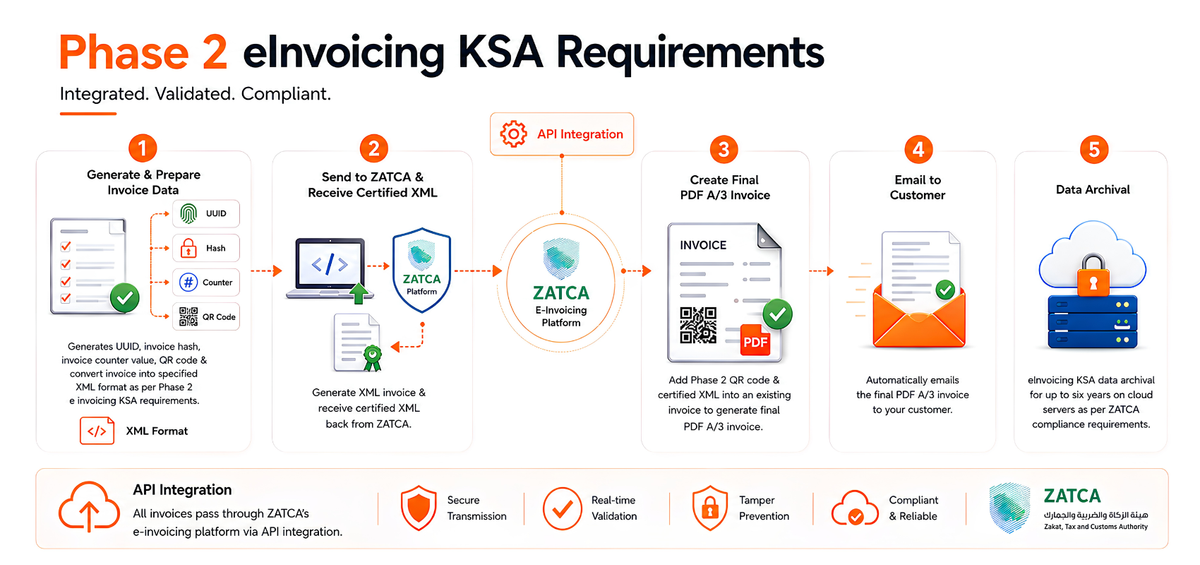
Points to be Completed as part of Phase -2 einvoicing KSA requirements.
- Generates UUID, invoice hash, invoice counter value, QR code & convert invoice into specified XML format as per e invoicing in Saudi Arabia phase 2 requirement.
- Generate XML invoice & receive certified XML back from ZATCA.
- Adding phase 2 QR code & certified XML into an existing invoice to generate final PDF A/3 invoice.
- Automatically emails the final PDF A/3 invoice to your customer.
- einvoicing KSA data archival for up to six years on cloud servers as per ZATCA compliance requirements.
Since all the invoices must pass through the ZATCA’s e-invoicing platform, it requires API integration to connect the e-invoicing solution to the central platform.
How to Prepare for Phase 2 Compliance
- Check your revenue against the current wave threshold to confirm whether your business is already in scope.
- Choose an e-invoicing solution that supports UBL 2.1 XML, cryptographic stamping, and API-based integration with Fatoora.
- Test in ZATCA's sandbox environment before your live integration date, if your provider supports this.
- Confirm QR code and UUID generation are working correctly on both standard and simplified invoices.
- Set up long-term archival so invoices, certified XML, and final PDFs are retrievable for at least six years.
- Complete integration before your notified deadline, since ZATCA now applies penalties from the first day after a wave's deadline passes.
Penalties for Not Complying with E Invoicing in KSA
ZATCA generally applies a warning-first principle for a first-time field violation, along with a correction window of 30 to 60 days depending on the issue. After that, penalties can apply, and they typically escalate with repeat violations within a 12-month period. Reported ranges include:
- Non-issuance or non-archiving of e-invoices, starting around SAR 5,000.
- Deleting or amending an e-invoice after issuance, starting around SAR 10,000.
- Missing QR codes or failing to notify ZATCA of a system malfunction, starting with a warning.
- Failure to integrate with Fatoora by the notified deadline, which can reach SAR 50,000 in serious cases.
ZATCA has also extended a fine-waiver initiative for certain historical VAT and filing issues into late 2026, but this does not remove the obligation to integrate on time. Because penalty amounts and waiver dates are updated periodically, confirm the current figures on ZATCA's official site before assuming a specific number applies to your case. You can also check the ZATCA Phase 2 FAQ for additional compliance questions.
Future ready e invoicing in KSA solution – Posbytz
PPosbytz is a cloud-based POS and ERP platform covering point of sale, inventory, online ordering, accounting, and CRM, used by businesses across the region. For einvoicing KSA specifically, Posbytz handles invoice generation, QR codes, and Fatoora-ready formatting from the same system used for daily billing, so finance teams are not maintaining a separate tool just for compliance.
Posbytz supports both outlet-based and e-commerce order flows under one setup, which matters for businesses issuing invoices across dine-in, delivery, and online channels. If you are evaluating options for ksa e invoicing, you can review our ZATCA and GST-ready e-invoicing software alongside our Retail POS system and Restaurant POS system.
Conclusion
E invoicing in KSA has moved well beyond the initial 2021 requirement to simply generate electronic invoices. With Phase 2 waves now reaching businesses with revenue as low as SAR 187,500, most VAT-registered businesses in Saudi Arabia will need to integrate with ZATCA's Fatoora platform within the next few reporting cycles, if they haven't already. Understanding your wave, your integration deadline, and the technical requirements for XML invoicing is the first step toward avoiding penalties and keeping VAT filing straightforward.
If you're getting your business ready for the next stage of einvoicing KSA compliance, Posbytz combines ZATCA-ready e-invoicing with POS, inventory, and accounting in one platform, so your billing system and your compliance requirements stay in sync. Explore Posbytz's e-invoicing software to see how it fits your setup.
Frequently Asked Questions
What is e invoicing in KSA and who does it apply to?
E invoicing in KSA is the ZATCA requirement to issue and store invoices electronically instead of on paper. It applies to VAT-registered resident businesses in Saudi Arabia and to anyone issuing tax invoices on behalf of a VAT-registered supplier.
What is the difference between Phase 1 and Phase 2 of e invoicing in KSA?
Phase 1 only required businesses to generate invoices electronically with a QR code, with no connection to a government platform. Phase 2 requires direct integration with ZATCA's Fatoora platform, XML invoicing, cryptographic stamps, and either clearance or 24-hour reporting depending on the invoice type.
How do I know which ZATCA e invoicing wave my business falls into?
ZATCA groups businesses into waves based on VAT-taxable revenue in prior years and lowers the threshold with each new wave. ZATCA notifies affected businesses directly at least six months before their deadline, so check your Fatoora account or official ZATCA correspondence to confirm your wave.
What happens if my business does not comply with e invoicing in KSA rules?
ZATCA generally issues a warning and a correction period for a first-time violation found during an inspection. After that, penalties can apply and escalate with repeat violations, ranging from around SAR 5,000 for non-issuance or non-archiving up to SAR 50,000 for failing to integrate with Fatoora on time.
Can I still issue invoices as a plain PDF under ZATCA e invoicing rules?
No. A standard PDF, scanned invoice, or text-editor invoice does not meet Phase 1 or Phase 2 requirements. Phase 2 specifically requires UBL 2.1 XML invoices, or PDF/A-3 files with the XML embedded.
Related Resources
About the author

Saravana Damodaram
Co-Founder & CEO, PosBytz
Saravana Damodaram is the Co-Founder & CEO of PosBytz, a cloud-based POS-ERP platform built for F&B and retail businesses since 2018. He focuses on unified commerce, inventory, and multi-location operations, and has helped over 5,000 merchants across 25+ countries move off fragmented, disconnected tools and run their entire operation, billing, inventory, kitchen, and accounting on one platform.