ZATCA Phase 2 FAQ's : All you need to know
ZATCA Phase 2 important details all you need to know to comply with e invoicing regulations in Saudi Arabia.
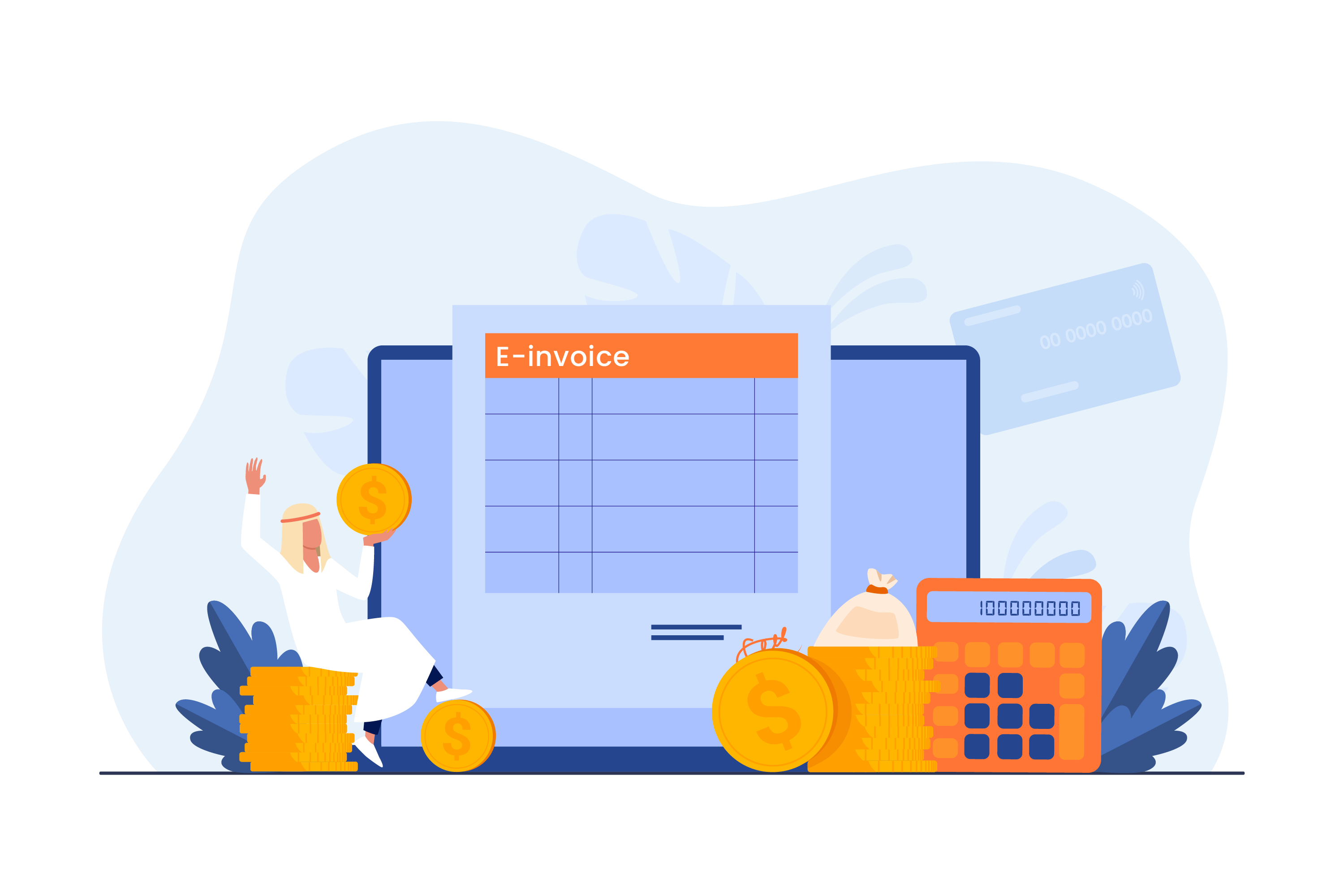


KSA e invoicing phase 2
The Zakat, Tax and Customs Authority (ZATCA), Saudi Arabia's taxation authority, rolled out the Integration Phase of e-invoicing, commonly known as ZATCA Phase 2, starting 1st January 2023. Unlike Phase 1, which only required businesses to generate invoices in a set format, Phase 2 requires businesses to integrate their POS, ERP, or accounting systems directly with ZATCA's Fatoora Portal so that invoices are validated, stamped, and reported electronically.
If you are preparing your business for ZATCA Phase 2 compliance, this guide answers the most common questions business owners and finance teams ask, from what the regulation actually requires to how to get your system onboarded.
Top FAQs when implementing ZATCA Phase 2
Below are the list of FAQ’s for KSA e invoicing Phase 2
FAQ
What Is ZATCA E-Invoicing Phase 2?
ZATCA Phase 2, also called the Integration Phase, requires any business issuing tax invoices in Saudi Arabia, whether through a POS system, accounting software, or ERP, to connect that system with ZATCA's Fatoora Portal. Once connected, every invoice generated by the business is automatically transmitted to the portal, where it is validated, digitally signed, and returned with a cryptographic stamp and QR code before it can be issued to the customer.
2) What is the difference between ZATCA phase 2 and phase 1?
Phase 1, known as the Generation Phase, only required businesses to issue a simplified tax invoice with a QR code, without any real-time connection to ZATCA. Phase 2 goes a step further: businesses must integrate their invoicing systems with the Fatoora Portal so that every invoice is reported for tax computation and used in return filings, rather than simply generated in the correct format.
Who Needs to Comply with ZATCA Phase 2
ZATCA Phase 2 applies to both B2B and B2C transactions, and all VAT-registered businesses in Saudi Arabia are required to integrate with the Fatoora Portal. Compliance is being rolled out in waves based on annual VAT turnover rather than all at once.
Wave-Wise Rollout Timeline
ZATCA notifies each wave of taxpayers directly, based on VAT-subject turnover, at least six months ahead of their integration deadline. The rollout began with the largest businesses and has progressively lowered the turnover threshold with each new wave:
With Wave 24, the threshold reached the mandatory VAT registration level itself, which means virtually every VAT-registered business in Saudi Arabia is now within Phase 2 scope. Wave 25 pushes even further, bringing in smaller businesses that hadn't previously needed to register at the higher thresholds. If your business has not yet received a ZATCA notification, check your Fatoora account or confirm your status with your tax advisor, since new businesses that register for VAT going forward are expected to fall into scope as they cross these thresholds too.
Is KSA e invoicing phase 2 is only applicable for B2B businesses or B2C businesses?
Phase 2 is not limited to business-to-business transactions. Both B2C and B2B businesses are required to integrate with the Fatoora Portal, so retail, restaurant, and service businesses that primarily sell to individual consumers are just as much in scope as wholesalers and distributors.
Is e invoicing phase 2 ZATCA mandatory for all business in Saudi Arabia?
Yes, ZATCA had begin the rollout of its E invoicing phase 2 mandate in from Jan 2023 and has been mandated in phases based on the turnover of the business. Check below to know the timeliness for various phases for implementation of KSA e invoicing Phase 2
E invoicing Phase 2 technical requirements in KSA
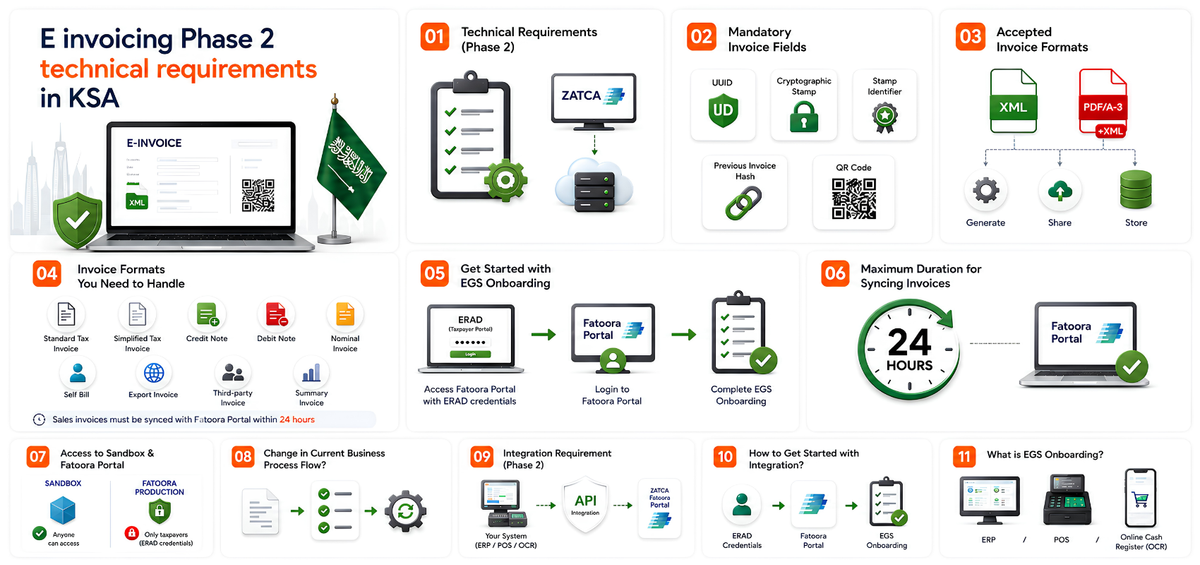
What are the technical requirements defined for KSA E invoicing Phase 2 ?
KSA e Invoicing Phase 2 imposed by ZATCA an additional set of requirements. The specified list of mandatory fields in the second phase of e invoicing includes UUID, Cryptographic Stamp, Cryptographic Stamp Identifier, Previous Invoice Hash, and QR Code. Further, such compliant e-invoicing solutions must be integrated with the system of ZATCA to generate e-invoices in a standard format.
Mandatory Invoice Fields
Every e-invoice must include a Universally Unique Identifier (UUID), a Cryptographic Stamp, a Cryptographic Stamp Identifier, the Previous Invoice Hash, and a QR code. A compliant e-invoicing solution needs to be integrated with ZATCA's system to generate invoices that include all of these fields in the standard format.
Accepted Invoice Formats
Your e-invoicing solution must be able to generate, share, and store invoices as XML or as PDF/A-3 with embedded XML. When invoice details are shared with the Fatoora Portal for clearance, they must be submitted in XML format specifically.
What invoice formats do i need to handle in new regime?
Most businesses operating in Saudi Arabia need to be able to issue several invoice formats, including:
- Standard tax invoice
- Simplified tax invoice
- Credit note
- Debit note
- Nominal invoice
- Self bill
- Export invoice
- Third-party invoice
- Summary invoice
Sales invoices must be synced with the Fatoora Portal within a maximum of 24 hours through your integrated e-invoicing solution.
How to Get Started with EGS Onboarding
To begin Phase 2 integration, you first need access to the Fatoora Portal using your Taxpayer Portal (ERAD) credentials, then follow the e-Invoice Generation Solution (EGS) onboarding process. An EGS can be your ERP, your POS system, or an online cash register.
What are the acceptable formats of e invoicing phase 2 ZATCA?
According to e-invoicing regulations in Saudi Arabia, your e-invoicing solution in the integration phase of e-invoicing must generate, share, and store e-invoices in specific formats of XML or PDF/A-3 with embedded XML. However, to share the invoice details to portal for clearance, it should be in XML format.
What is the maximum duration for syncing the e invoices to ZATCA Fatoora portal?
E invoicing phase 2 sales invoices should be synced within a maximum duration of 24 hours through an integrated e-invoicing solution with Fatoora Portal.
Can anyone access Sandbox and Fatoora Portal for integrating KSA e invoicing phase 2?
No, Sandbox can be accessed by anyone, but FATOORA production system can be accessed only by taxpayers using Taxpayer portal credentials (ERAD credentials).
Will I need to change anything in the current business process flow of creating an invoice to comply with the new ZATCA-compliant guidelines?
You must modify your invoicing process to capture the mandatory fields required as per phase 2 rules and regulations. You may need to make some system changes to do so.
Integration requirement for ZATCA e invoicing phase 2 in KSA ?
How can i get started with my E invoicing phase 2 integration with Fatoora portal?
Firstly as a tax payer you need to have access to Fatoora portal using Taxpayer Portal credentials (ERAD) and then follow the e-Invoice Generation Solution (EGS) onboarding process.
What is EGS onboarding under KSA e Invoicing phase 2?
The e-Invoicing Generation Solution (EGS) can either be an ERP, Point of Sale (PoS) machine, or Online cash register (OCR).
What are the Prerequisites for EGS Onboarding?
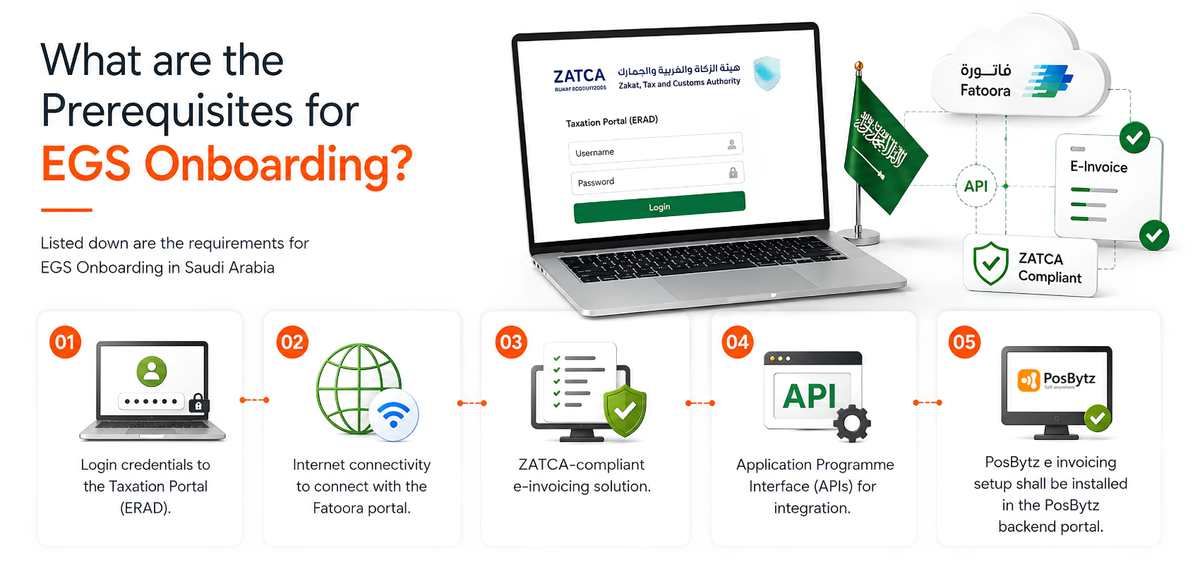
Listed down are the requirements for EGS Onboarding in Saudi Arabia,
- Login credentials to the Taxation Portal (ERAD).
- Internet connectivity to connect with the Fatoora portal.
- ZATCA-compliant e-invoicing solution.
- Application Programme Interface (APIs) for integration.
- PosBytz e invoicing setup shall be installed in the PosBytz backend portal.
How can I verify that my e-invoicing solution has been successfully integrated?
Once your EGS has been onboarded, ZATCA notifies you on whether the integration was successful. You can also check the Fatoora Portal directly, which shows a summary list of all your integrated e-invoicing solutions. There are several accepted methods for connecting your system to ZATCA, including direct API integration, so businesses can choose the approach that best fits their existing setup.
What are the different ways to implement Phase 2 Einvoicing ZATCA compliant ?
You can directly integrate with ZATCA using APIs; overall, six methods are available for integration.
Multi-Store Businesses
If you operate multiple stores with a POS machine at each location, integration should happen at the store level rather than only at the head office, even if sales data is later consolidated centrally. This ensures B2B and B2C invoices generated at each outlet are reported correctly.
In-House ERP Integration
If your business uses a custom, in-house ERP for invoicing, it can still be connected to ZATCA's Fatoora Portal through API integration. This typically requires working with your e-invoicing provider to map your existing invoice data to ZATCA's required fields and formats.
We have 15 stores across the kingdom, and each store has a POS machine in them. All the sales data is pushed to the HO centrally real time or later. Should we integrate with ZATCA from the store itself or from the HO?
You must integrate them with ZATCA at the store level to report B2B invoices generated at 58 stores.
How can PosBytz help you to be complied to ZATCA E invoicing phase 2?
PosBytz is a ZATCA approved e-invoicing software built for Phase 2 compliance. You can sign up for the full PosBytz ERP solution to manage POS, online ordering, inventory, accounting, CRM, and payroll in one platform, or opt for ZATCA Phase 2 e-invoicing alone through PosBytz's APIs to connect with your existing ERP or invoicing software. If you use a custom in-house ERP, PosBytz's e-invoicing solution can be integrated with it, and the team can be reached directly at info@posbytz.com for setup guidance.
We have an in-house customized ERP for invoicing. Can PosBytz help us and guide us on how to integrate with ZATCA for E invoicing Phase 2?
PosBytz E invoicing solution can be integrated with any in-house ERP or POS system. Please write to us at info@posbytz.com for any details.
Frequently Asked Questions
Do restaurants and retail businesses need to comply with ZATCA Phase 2?
Yes. All B2B and B2C businesses in Saudi Arabia, including restaurants and retail stores, are required to comply with ZATCA Phase 2. PosBytz supports both segments through its Restaurant Management software, which includes Restaurant POS, online ordering, inventory, and accounting, and its Retail Management software, which includes Retail POS, purchasing, inventory, and ecommerce.
Can I test my e-invoicing integration before going live?
Yes. ZATCA's sandbox environment is open to anyone who wants to test their integration. The production Fatoora system, however, can only be accessed using Taxpayer Portal (ERAD) credentials once you are ready to go live.
How quickly do invoices need to reach the Fatoora Portal?
Invoices generated under Phase 2 must be synced with the Fatoora Portal within a maximum of 24 hours through your integrated e-invoicing solution.
Will I need to change my current invoicing process for Phase 2?
Most businesses need to modify parts of their invoicing workflow to capture the additional mandatory fields required under Phase 2, such as the UUID, cryptographic stamp, and QR code. Depending on your current system, this may involve configuration changes or a system upgrade rather than a full process overhaul.
What is the latest ZATCA Phase 2 wave, and who does it cover?
As of August 2026, the most recent wave is Wave 25, announced 24 July 2026. It covers taxpayers whose VAT-subject revenue exceeded SAR 187,500 in any of 2022 through 2025, with an integration deadline of 1 February 2027. This is the lowest threshold set so far, meaning most VAT-registered businesses in Saudi Arabia, including small cafes, boutiques, and service providers, now fall within Phase 2 scope.
Conclusion
ZATCA Phase 2 moves e-invoicing in Saudi Arabia from simple invoice generation to full integration with the Fatoora Portal, with mandatory fields, approved formats, and a 24 hour sync requirement. Compliance applies to both B2B and B2C businesses and has been rolled out in successive waves based on turnover, with the threshold now down to SAR 187,500 under Wave 25. If your business hasn't yet integrated, it is worth confirming where you stand and preparing your systems well before your deadline arrives.
Explore more on how e-invoicing works in KSA, see ZATCA approved e-invoicing software options, or check out free e-invoicing software available in Saudi Arabia.
If you are ready to get your business ZATCA Phase 2 compliant, PosBytz offers a ZATCA approved e-invoicing solution that connects directly with your POS, accounting, and inventory, whether you're starting fresh or integrating with an existing ERP. Reach out at info@posbytz.com to discuss your setup.
Related Resources
About the author

Saravana Damodaram
Co-Founder & CEO, PosBytz
Saravana Damodaram is the Co-Founder & CEO of PosBytz, a cloud-based POS-ERP platform built for F&B and retail businesses since 2018. He focuses on unified commerce, inventory, and multi-location operations, and has helped over 5,000 merchants across 25+ countries move off fragmented, disconnected tools and run their entire operation, billing, inventory, kitchen, and accounting on one platform.