How to Start a Fast Food Restaurant: A Step-by-Step Guide
How to Start a Fast Food Restaurant? In this article, we gave you the step by step guide in explaining everything. Check this detaileed guide!



The fast food segment continues to be one of the fastest-growing parts of the food service industry, with the food service industry growing at roughly 19% per year. If you are ready to turn that opportunity into your own business, here is a step-by-step guide to starting a fast food restaurant, from choosing a legal structure to setting up your point of sale.
How to Start a Fast Food Restaurant – Step By Step Guide
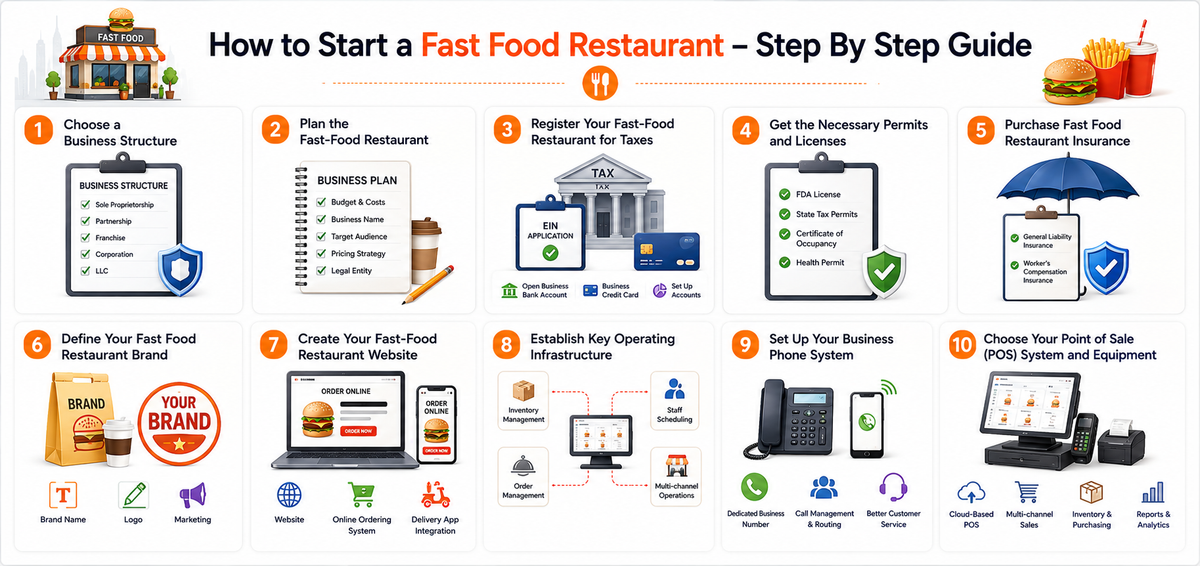
1. Choose a Business Structure
Before anything else, decide on the legal structure that gives your restaurant the right balance of protection and flexibility. Will you operate as a sole proprietorship, a partnership, a franchise, a corporation, or a limited liability company? This decision affects your tax obligations, personal liability, and the paperwork required to get started, so it is worth researching each option or consulting a business attorney before moving forward.
2. Plan the Fast-Food Restaurant
A clear fast food restaurant business plan keeps every later decision, from pricing to hiring, grounded in reality. Work through the following areas before you write a single line of your plan.
Cost of opening a fast-food restaurant
Opening a fast-food franchise in the US can cost you anywhere, starting from $10000 and even far more, as the estimation depends on lots of aspects. You may need to budget for expenses such as cooking equipment, monthly rent, laborers, marketing, insurance, and utilities.
Consideration of the best place to open a fast-food restaurant could affect the overall budget as monthly rent and the price of cooking ingredients differ from place to place.
Choose the best name for your business
Pick a name that is memorable and easy to search for. Before you commit, check that it:
- Follows the naming rules for your chosen business structure
- Is not already in use by another business
- Is free in federal and state trademark records
- Has an available web domain
- Can be used consistently across social media platforms
Define Your Target Audience
Your budget shapes your options, but your audience shapes your long-term success. Fast food restaurants typically draw kids, teenagers, and young adults, so your marketing should speak directly to that group's habits and preferences.
Set your pricing strategy
The target consumers will likely have less money for fast-food restaurant businesses in the US or elsewhere, but they are enough to attract parents. So, you can set the price for each item by considering the commodity price and price rise and comparing the competitor’s price. You can keep your pricing lower than others in your area to gain a competitive advantage.
For instance, suppose your restaurant is near a college or university. Following that, you will be targeting students who will most likely earn low wages from internships and private tuition or manage expenses with their pocket money. Thereby, only a low price with uncompromising quality could make your brand most desirable to them.
Form your fast-food restaurant into a legal entity
When you create a legal business entity for your company, you protect yourself from being held personally liable if your fast-food restaurant is accused of anything. You should choose a legal entity by considering the ease of starting and maintaining a business and how tax rules affect your finances, growth, and chance of partnering.
3. Register Your Fast-Food Restaurant for Taxes
How your business is taxed depends on the legal structure you chose in step one. Before you can register with the federal government, you will need to apply for an EIN (Employer Identification Number).
Open a business bank account and credit card
You’ll need to showcase a business bank account when you apply for business loans. It also protects your personal assets by separating them from your company’s assets and easing the accounting and tax filing processes. Having a business credit card will add another advantage by putting all business expenses in one place.
Set up accounts for your fast-food restaurant
Tracking income and expenses from multiple sources, cash sales, online orders, and delivery aggregators, is difficult to do manually. Restaurant accounting software connected to your POS can automate this by maintaining accurate records, tracking profit and loss, and preparing you for annual tax filing.
4. Get the Necessary Permits and Licenses for Your Fast-Food Restaurant
Serving food comes with a long list of permits and licenses from different authorities, and missing one can mean fines or a forced shutdown. At a minimum, plan to secure:
- A federal license from the Food and Drug Administration covering what can and cannot be sold
- State sales tax permits and licenses for local businesses
- A Certificate of Occupancy confirming your space meets zoning laws and building safety requirements
- Health permits from your local health department
Requirements vary by state and city, so check with your local authorities early. For a fuller breakdown, see this restaurant licenses checklist.
5. Purchase Fast Food Restaurant Insurance
Different types of businesses have different risks, and various business insurance policies are also available based on associated risk factors. Having general liability insurance and worker’s compensation insurance is enough to protect the financial well-being of a small start-up business.
6. Define Your Fast Food Restaurant Brand
A strong brand promotion through a wide variety of local channels, like advertisements on billboards, in local newspapers, on the radio, and TV, will help you promote your fast-food restaurant beyond your target audience. Before that, you must create a unique, remarkable brand name and logo that will be easy to remember and relate to your services.
7. Create Your Fast-Food Restaurant Website
The need for physical distance during the pandemic period increases the proclivity to order food online. So, you have to come up with your own online food ordering service with a website and be available on online food delivery apps like Zomato, Swiggy, etc. You can integrate a POS food ordering system and delivery system into your website to handle all online orders efficiently and with ease.
8. Establish Key Operating Infrastructure
A restaurant POS system ties your operations together, from inventory and table management to staff scheduling and order handling across dine-in, takeaway, and online channels. Whether you are running a single counter or planning multiple outlets, the right infrastructure keeps every part of the business connected instead of scattered across separate tools.
9. Set Up Your Business Phone System
Once you start taking online and phone orders, call volume rises quickly as customers follow up on orders or ask questions. A dedicated business phone system keeps customer calls separate from personal ones, reduces pressure on staff, and helps you deliver consistent customer service.
10. Choose Your Point of Sale (POS) System and Equipment
Your final setup decision is choosing POS software and hardware that match your budget and operational needs. Factor in staff count, expected customer volume, number of locations, and total budget before deciding. PosBytz is a cloud-based, all-in-one restaurant POS system that brings purchasing, multi-channel sales, and reporting into a single dashboard, which is especially useful if you plan to open more than one location or run a quick service restaurant with high order volume.
Frequently Asked Questions
How much does it cost to start a fast food restaurant?
Costs typically start around $10,000 and can run much higher depending on location, equipment, and restaurant size. Rent, cooking equipment, staff wages, marketing, insurance, and utilities are the main categories to budget for.
What licenses do I need to open a fast food restaurant?
At minimum, you will need a federal food license from the FDA, state sales tax permits, a Certificate of Occupancy, and health department approval. Exact requirements vary by state and city, so confirm the full list with your local authorities before opening.
Do I need a POS system to start a fast food restaurant?
A POS system is not legally required, but it makes daily operations far easier to manage. It handles billing, inventory, staff scheduling, and multi-channel orders (dine-in, takeaway, delivery) from one place, which becomes essential once order volume grows.
Should I register my fast food restaurant as an LLC?
An LLC is a common choice because it separates your personal assets from business liabilities and offers flexible tax treatment, but the right structure depends on your goals, funding plans, and state regulations. A business attorney or accountant can help you decide.
How do I attract customers to a new fast food restaurant?
Start with a clear brand identity, competitive pricing for your target audience, and a strong online ordering presence across your own website and delivery apps. Local advertising and consistent quality help build repeat customers once the doors open.
Conclusion
Opening a fast food restaurant is demanding, but it is also one of the more accessible ways to enter the food service industry. Every step, from choosing a business structure to setting up your POS system, builds the operational foundation your restaurant will run on for years to come. Getting these fundamentals right before opening day saves you from costly fixes later.
To run day-to-day operations smoothly from launch, consider a restaurant POS platform like PosBytz that brings billing, inventory, online ordering, and reporting into one dashboard, so you can focus on the food and the customers rather than juggling disconnected systems.
Related Resources
About the author

Saravana Damodaram
Co-Founder & CEO, PosBytz
Saravana Damodaram is the Co-Founder & CEO of PosBytz, a cloud-based POS-ERP platform built for F&B and retail businesses since 2018. He focuses on unified commerce, inventory, and multi-location operations, and has helped over 5,000 merchants across 25+ countries move off fragmented, disconnected tools and run their entire operation, billing, inventory, kitchen, and accounting on one platform.