Fawtara E-Invoicing Timeline in Oman From 2026 to 2028
A clear, date-by-date Fawtara e-invoicing timeline for Oman restaurants and retailers, from the 2026 voluntary phase to full rollout in 2028.
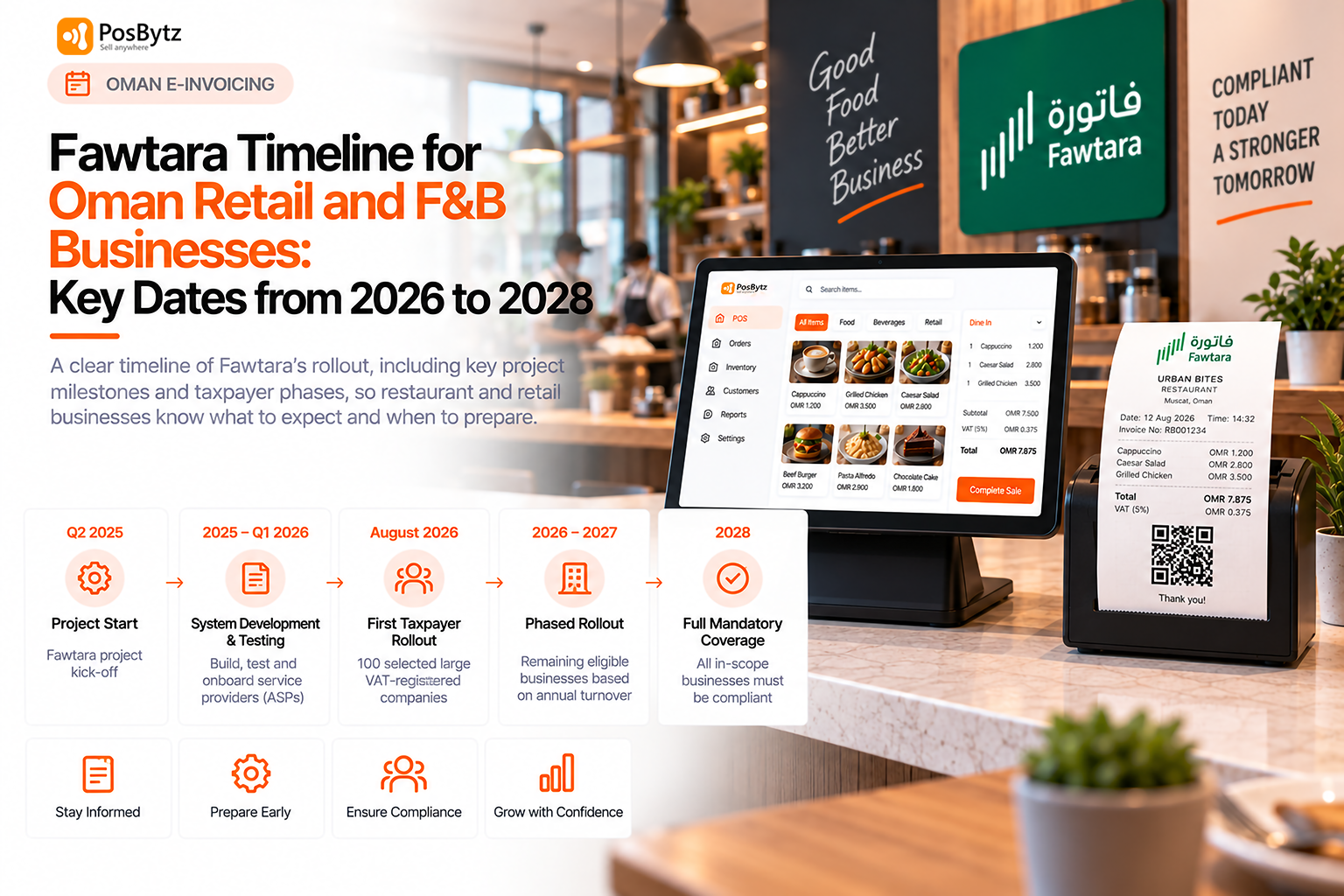


Fawtara's rollout runs from a project start in Q2 2025 through to full mandatory coverage by 2028. For restaurant and retail owners, the dates that matter most are the taxpayer rollout phases, which are based on annual turnover, In August 2026, OTA began the first rollout with 100 selected large VAT-registered companies. Other eligible businesses may also adopt e-invoicing voluntarily ahead of their mandatory date. This guide lays out every stage of that timeline clearly, so you can see exactly where your business sits and what should be happening at each point along the way.
One of the more confusing aspects of following Fawtara news is that OTA communicates about two different timelines side by side: the technical build-out of the system itself, and the actual dates businesses need to comply. Mixing these up leads to real confusion, such as businesses assuming a "service provider testing" announcement means their own compliance deadline has moved. This guide separates the two clearly.
Releases Versus Rollouts: Two Timelines Running in Parallel
What a "release" actually refers to
Oman Tax Authority organises Fawtara around two tracks. Releases describe OTA's own build-out of the system: publishing the data dictionary, opening service provider registration, running service provider testing, and finally enabling live e-invoice exchange. These are largely infrastructure milestones, relevant mainly to service providers and the technical side of the programme.
What a "rollout" actually refers to
Rollouts describe when taxpayers, meaning your business, are required to comply. This is the timeline that determines your actual legal obligations as a restaurant or retail owner. Rollout dates are tied to your annual turnover, not to how the underlying technical releases are progressing.
Why the distinction matters for your own planning
Understanding both helps explain why some announcements are about service providers getting ready, while others are about your own go-live date. A news update about "Release 2 testing beginning" does not mean your business needs to act immediately, but it is a signal that accredited service providers are becoming available, which is directly useful once you start the process covered in our POS readiness checklist.
The Fawtara Release Timeline (Project Side)
Release 0: the data dictionary
OTA shares the e-invoicing data dictionary with taxpayers and service providers. This is the first technical artefact businesses and their POS or ERP vendors can use to start assessing what changes their systems will need.
Release 1: service provider registration opens
The service provider registration portal opens, and companies apply for accreditation. This is when businesses interested in becoming their own accredited service provider, rather than working through a third party, can begin that process.
Release 2: service provider testing and the accredited list
Approved service providers complete testing and compliance checks, and OTA announces the accredited service provider list. This is the point at which restaurant and retail businesses have a concrete list of vetted providers to start evaluating, rather than working from incomplete information.
Release 3: live e-invoice exchange begins
Live e-invoice exchange begins between taxpayers and their service providers, with data flowing automatically to OTA. This is the technical "switch on" moment for the whole ecosystem, though individual businesses only need to be live by their own assigned rollout date, not the moment Release 3 begins nationally.
The Fawtara Taxpayer Rollout Timeline (The Dates That Matter to You)
Where the legal basis comes from
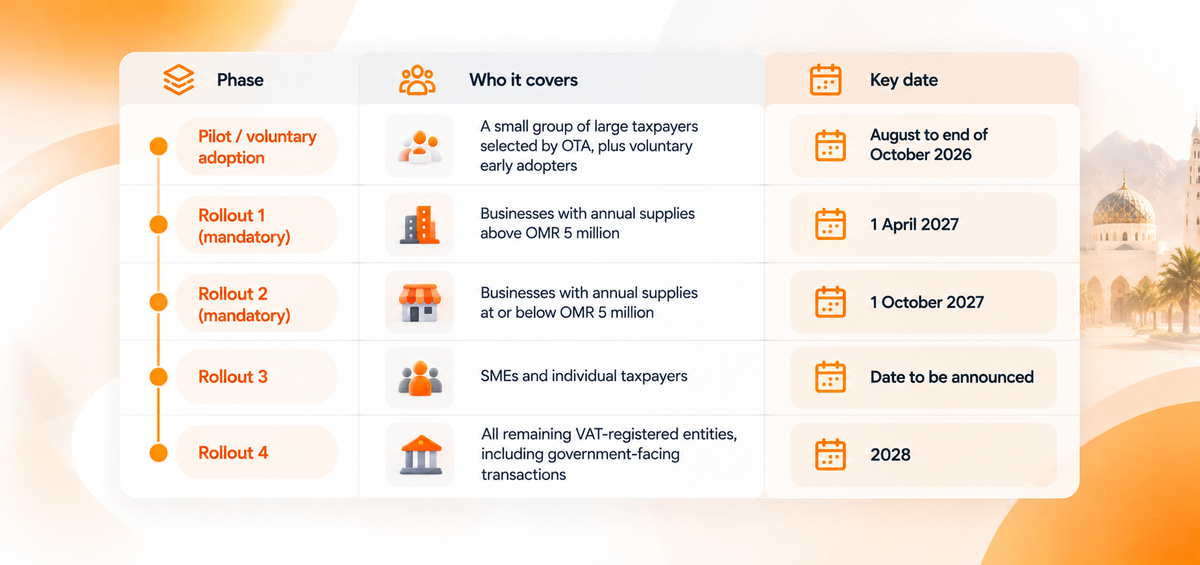
These mandatory dates are set out in Decision No. 189/2026. This is the legal instrument that formally establishes Oman's phased e-invoicing mandate, and it is the reference point OTA officials cite whenever the timeline is questioned in public sessions.
Which phase applies to most restaurants and shops
Most independent restaurants, cafes, and retail stores in Oman, with turnover below OMR 5 million, should plan around the 1 October 2027 Rollout 2 date, while larger groups and chains above that threshold need to be ready by 1 April 2027. If you are unsure which category your business falls into, our guide on whether Fawtara applies to your business walks through how to check your exact rollout batch using the OTA VAT lookup tool.
Why the pilot phase started ahead of the legal deadlines
It is worth noting that a small group of large taxpayers has already been operating under Fawtara since around August 2026, well ahead of the April 2027 legal deadline. This pilot exists to test the system with real transaction volume before the wider mandate takes effect, and it is a separate track from the general voluntary adoption window, though both started around the same time.
What Should Be Happening at Each Stage of Your Countdown
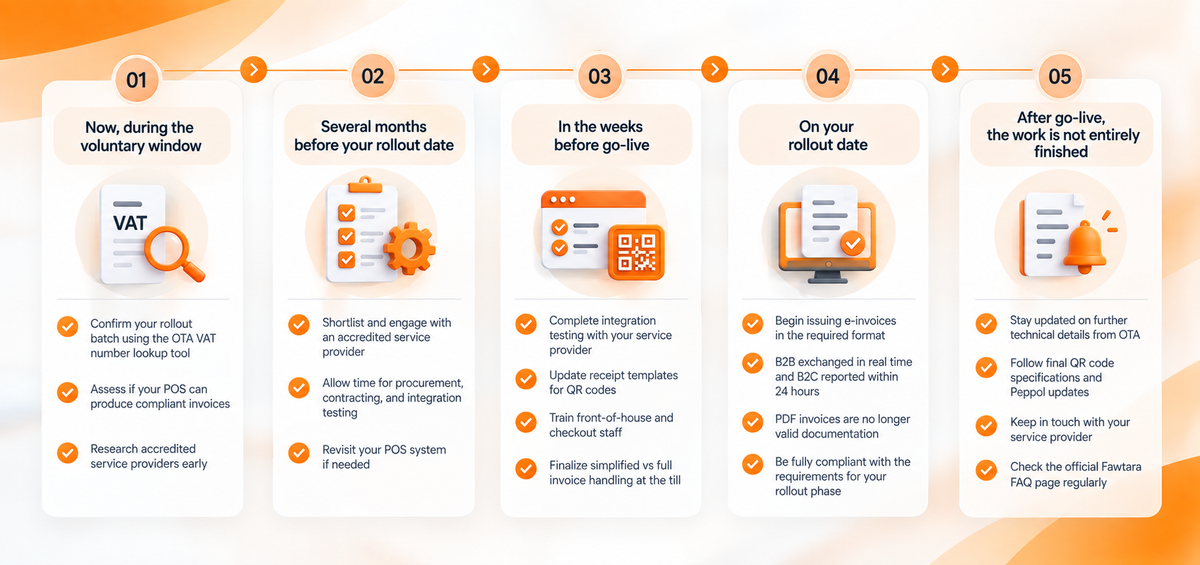
Now, during the voluntary window
Confirm your rollout batch using the OTA VAT number lookup tool, and start assessing whether your POS can produce compliant invoices. This is also the stage to research accredited service providers as OTA's list becomes available, rather than waiting until Rollout 2 testing periods created by other businesses' deadlines create demand pressure on providers.
Several months before your rollout date
Shortlist and begin engaging with an accredited service provider, since procurement, contracting, and integration testing all take time. This is also a reasonable point to revisit your overall POS system choice if your current setup is unlikely to meet the checklist covered in our Fawtara readiness guide.
In the weeks before go-live
Complete integration testing with your service provider, update receipt templates for QR codes, and train front-of-house and checkout staff. This is the stage where the operational details, such as simplified versus full invoice handling at the till, need to be locked in and rehearsed, not left to figure out on day one.
On your rollout date
Begin issuing e-invoices in the required format, with B2B exchanged in real time and B2C reported within 24 hours. From this point forward, PDF invoices are no longer valid documentation, and your business is expected to be fully compliant with the requirements that apply to your rollout phase.
After go-live, the work is not entirely finished
Even once you are live, OTA has indicated further technical detail is still to come, including the final QR code specification and updates once Peppol supports three decimal places. Staying subscribed to updates from your service provider, and periodically checking the official Fawtara FAQ page, remains worthwhile well past your initial go-live date.
Whatever your exact rollout date, the practical work, choosing a service provider, testing your POS, and training your team, takes longer than most businesses expect, which is why OTA has consistently encouraged early preparation rather than waiting for the deadline to approach.
How Oman's Timeline Compares to Other GCC E-Invoicing Rollouts
A familiar pattern across the region
Oman is not the first GCC country to phase in mandatory e-invoicing by business size. Saudi Arabia's ZATCA system followed a similar logic, starting with larger taxpayers before expanding to smaller businesses over subsequent waves. If your restaurant or retail group also operates in Saudi Arabia, our guide on ZATCA e-invoicing phase 2 is a useful reference for how a comparable phased rollout played out there.
What multi-country operators should watch for
Businesses running outlets in both Oman and Saudi Arabia, or elsewhere in the GCC, should treat each country's e-invoicing mandate as a separate compliance project with its own data dictionary, QR code rules, and service provider ecosystem, even though the overall shape of the rollout, turnover-based phasing, a pilot group, then broader mandatory waves, tends to repeat. Our overview of e-invoicing in Saudi Arabia covers the parallel system in more depth for operators managing compliance across more than one market.
Know your rollout date, but not sure your systems will be ready in time? Talk to PosBytz about a region-ready POS that keeps pace with Oman's Fawtara timeline, so your go-live date is a formality, not a scramble.
FAQs
Has the Fawtara timeline changed since it was first announced?
Oman Tax Authority representatives have repeatedly confirmed in public sessions through mid-2026 that there have been no changes to the mandatory rollout dates, though it is always worth checking the official Fawtara portal for the latest confirmation.
What law sets the Fawtara mandatory dates?
Decision No. 189/2026 establishes the mandatory e-invoicing requirement and its phased implementation dates based on annual turnover.
Is there a grace period after a business's go-live date?
OTA has not formally announced a general grace period in public sessions. Businesses facing genuine system delays have been advised to raise their specific case directly with OTA rather than assume an automatic extension.
When did the Fawtara project actually start?
The project began in the second quarter of 2025 with Release 0, when OTA first shared the e-invoicing data dictionary with taxpayers and prospective service providers.
Which rollout applies to most small restaurants and shops?
Most independent restaurants and retail stores, with annual supplies at or below OMR 5 million, fall under Rollout 2, with a mandatory date of 1 October 2027.
Should I wait until closer to my rollout date to start preparing?
No. Given how long service provider selection, integration testing, and staff training can take, OTA and most implementation experience across the region suggest starting well before your assigned date, ideally as soon as your rollout batch is confirmed
About the author

Saravana Damodaram
Co-Founder & CEO, PosBytz
Saravana Damodaram is the Co-Founder & CEO of PosBytz, a cloud-based POS-ERP platform built for F&B and retail businesses since 2018. He focuses on unified commerce, inventory, and multi-location operations, and has helped over 5,000 merchants across 25+ countries move off fragmented, disconnected tools and run their entire operation, billing, inventory, kitchen, and accounting on one platform.