E Invoicing Saudi Arabia: A Complete Guide to ZATCA Compliance
See how e invoicing Saudi Arabia works under ZATCA's Fatoora mandate, from Phase 1 and 2 waves to penalties, and how PosBytz keeps you e invoice KSA ready.
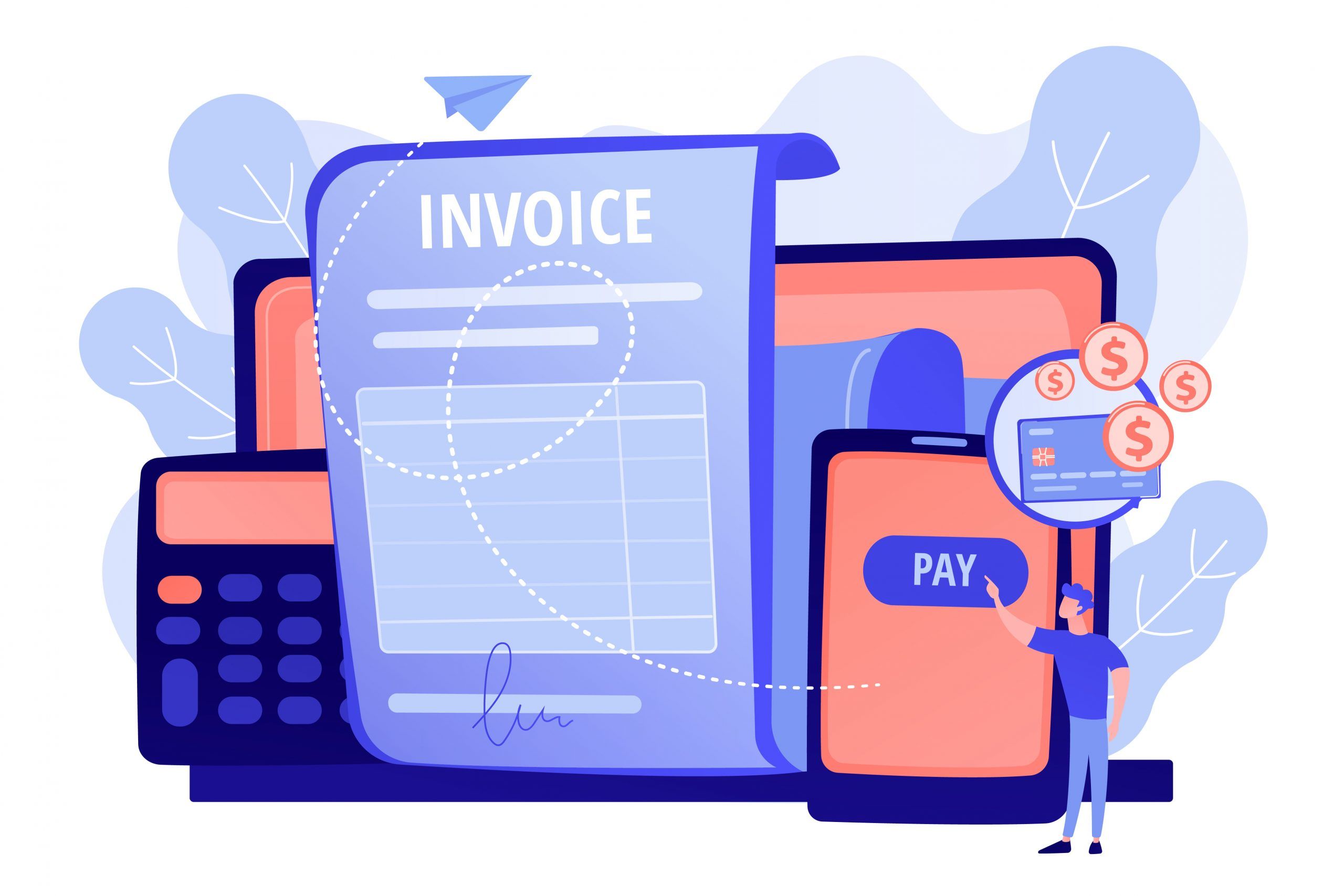


E invoicing Saudi Arabia is no longer an upcoming change, it is the current legal requirement for VAT registered businesses under the Zakat, Tax and Customs Authority (ZATCA), and the rules keep expanding to smaller businesses every few months. If you run a restaurant, a retail store, or any VAT registered business in the Kingdom, you need to know which phase applies to you, what an e invoice KSA must contain, and what happens if your business misses a deadline.
This guide covers how e invoicing in Saudi Arabia works, the difference between Phase 1 and Phase 2, the current wave thresholds, the penalties for non-compliance, and the practical steps to get your business ready. We also look at how a POS and accounting platform like PosBytz helps you meet these requirements without disrupting daily billing.
What Is E-Invoicing in Saudi Arabia?
E-invoicing, also referred to as e invoice KSA or Fatoora, is the electronic generation, storage, and transmission of tax invoices, replacing handwritten notes, unstructured PDFs, and text editor invoices. ZATCA, formed in 2021 when Saudi Arabia's General Authority of Zakat and Tax merged with the Customs Authority, introduced the e-invoicing regulation to bring VAT registered transactions onto a structured, verifiable digital record. The benefits of moving to e-invoicing software include a simpler accounting process, invoices that are validated with minimal risk of error, and lower administrative costs compared to paper based billing.
E invoicing in Saudi Arabia applies to B2B, B2C, and B2G transactions. Every resident, VAT registered business (non-resident taxpayers are exempt from issuing e-invoices) must issue invoices electronically and, depending on turnover, connect its systems directly to ZATCA's central platform, Fatoora.
Phases of E-Invoicing in Saudi Arabia
ZATCA rolled out e invoicing Saudi Arabia in two phases. Phase 1 required businesses to generate and store invoices electronically. Phase 2 goes further and connects your invoicing system directly to ZATCA in real time.
Phase 1: Generation (Since December 2021)
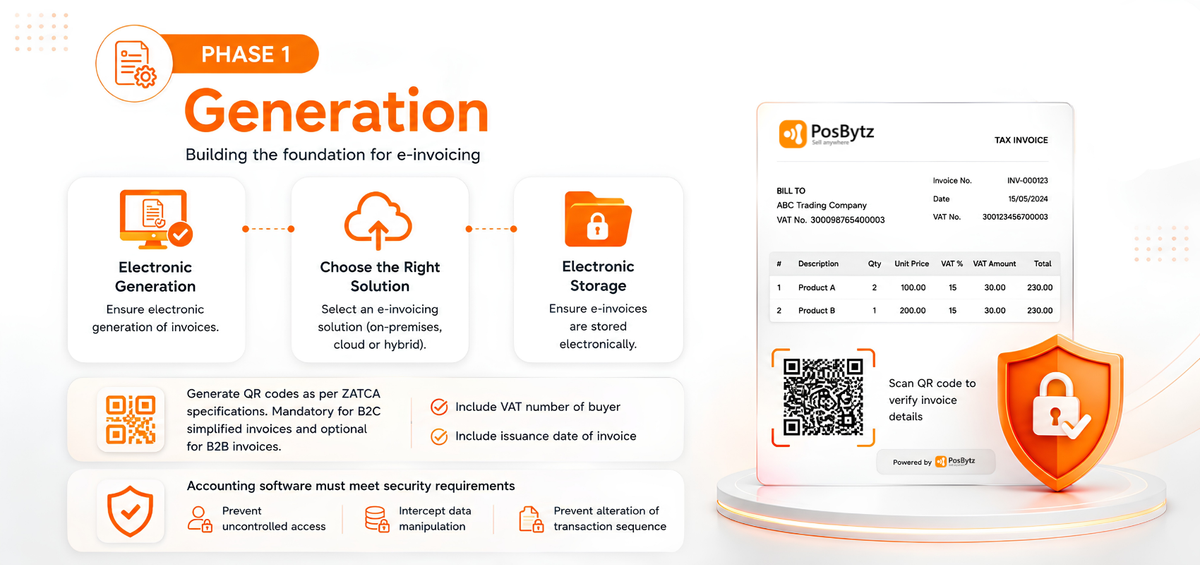
Phase 1 began on 4 December 2021 and applies to all VAT registered taxpayers in Saudi Arabia. It moved businesses away from paper and handwritten invoices toward electronic generation and storage. Under Phase 1, businesses must:
- Generate invoices electronically instead of on paper or in a text editor
- Store e-invoices electronically rather than in physical files
- Use software that can generate a QR code on every invoice based on ZATCA's specifications. The QR code is optional on B2B invoices but mandatory on B2C simplified invoices
- Include mandatory VAT fields, such as the buyer's VAT number where applicable and the invoice issuance date
- Prevent uncontrolled system access, block data manipulation, and stop any tampering with the sequential invoice counter
Phase 2: Integration (Since January 2023) and the Current ZATCA Waves
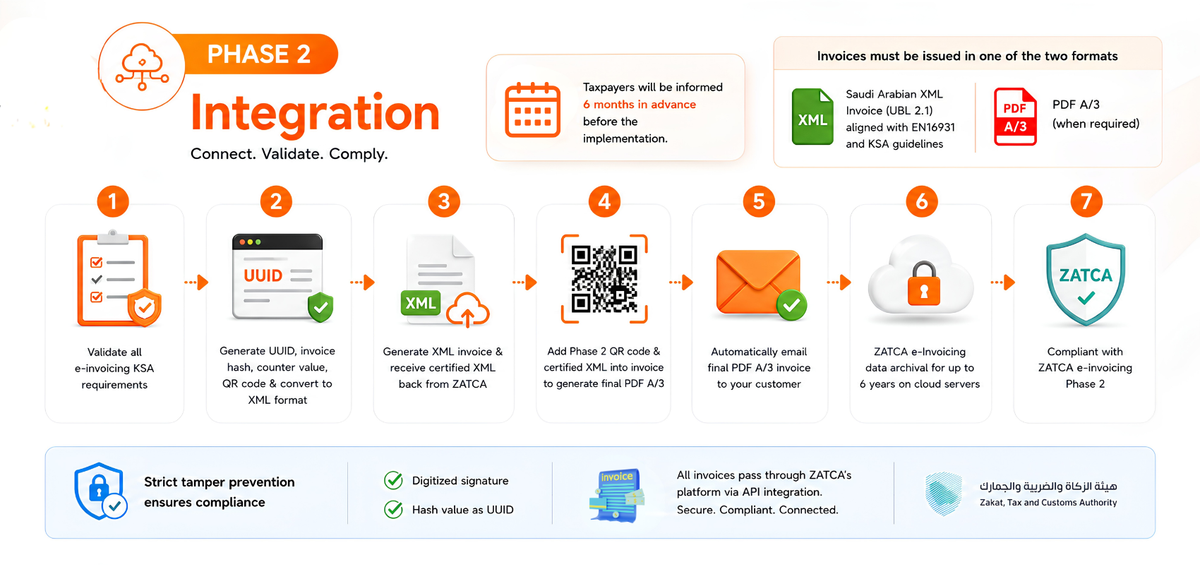
Phase 2, the Integration Phase, began on 1 January 2023. It requires businesses to connect their e-invoicing solution directly to ZATCA's Fatoora platform through an API, so invoices are cleared in real time or reported within a set window.
ZATCA is not applying Phase 2 to every business at once. It is rolling it out in waves based on each company's VAT liable turnover in a base year, and it keeps lowering the threshold to bring in smaller businesses. Notified taxpayers receive at least six months' notice before their integration date. Some of the confirmed waves include:
- Wave 1: turnover above SAR 3 billion, integration from 1 January 2023
- Wave 2: turnover above SAR 500 million, integration from 1 July 2023
- Wave 3: turnover above SAR 250 million, integration from 1 October 2023
- Waves 4 to 6: thresholds stepping down to SAR 70 million, integration completed by January 2024
- Wave 23: turnover above SAR 750,000 in 2022, 2023, or 2024, integration by 31 March 2026
- Wave 24: turnover above SAR 375,000 in 2022, 2023, or 2024, integration by 30 June 2026
- Wave 25: turnover above SAR 187,500, announced in July 2026 with an integration deadline of 1 February 2027
Because ZATCA keeps announcing new waves and adjusting thresholds, always confirm your exact wave and deadline through your Fatoora account or ZATCA's official notifications rather than relying on a fixed list. For a deeper breakdown of the technical requirements, see our ZATCA e invoicing phase 2 guide.
Under Phase 2, an e invoice KSA must also carry additional fields and safeguards beyond Phase 1:
- Structured XML built on UBL 2.1 and aligned with EN 16931, or a PDF/A-3 file with the XML embedded
- A Universally Unique Identifier (UUID) for every invoice
- A cryptographic stamp and digital signature to prevent tampering
- An invoice counter value and a hash of the previous invoice, linking each invoice to the one before it
- A ZATCA compliant QR code
- Direct API integration with the Fatoora platform
Standard vs Simplified E-Invoices in Saudi Arabia
Not every e invoice KSA follows the same workflow. ZATCA splits invoices into two categories, and which one applies to a sale determines how quickly it must reach the Fatoora platform.
Standard Tax Invoices: B2B and B2G Clearance
Standard tax invoices cover B2B and B2G transactions, along with cross border and export sales. Under Phase 2, these invoices follow the clearance model: your system sends the invoice to ZATCA before it reaches the buyer, ZATCA validates it and returns a cleared invoice with a cryptographic stamp, and only then can you share it with the buyer. If a supplier fails to clear an invoice correctly, the buyer risks losing the input VAT deduction on that purchase, so accurate integration protects both sides of the transaction.
Simplified Tax Invoices: B2C Reporting
Simplified tax invoices are used for retail, restaurant, and other B2C sales, typically where the buyer does not need to claim input VAT. Under Phase 2, these invoices follow the reporting model: you issue the invoice to the customer immediately, then report it to ZATCA within 24 hours. The QR code, optional for B2B invoices, is mandatory on every simplified invoice.
Why Is the KSA Government Moving to E-Invoicing?
There are two main reasons why e invoicing in Saudi Arabia is being implemented.
The first includes an increase in productivity and transactions. Businesses will notice that they will have quicker and seamless payments and incur lesser costs. The government also has greater visibility on the condition of the market. This means there will be unbiased competition and helps strengthen consumers’ protection in the market.
The second refers to the aspect of security e invoice KSA provides. E-invoices help the government view the movement of goods and services in real-time and prevent black market trade. There will also be an increase in tax compliance, and better decisions can be made thanks to the availability of data the software providers like Posbytz permit.
What Happens If You Do Not Comply?
Non-compliance with e invoicing Saudi Arabia requirements is not just a compliance risk, it carries real financial penalties. ZATCA enforces the mandate with escalating fines, starting from a smaller penalty for a first violation and rising as high as SAR 50,000 for repeated failures to integrate, issue, or store invoices correctly.
ZATCA has also run penalty waiver initiatives that reduce or cancel fines tied to VAT registration, filing, and payment issues when a business corrects its position and pays the outstanding tax. These initiatives do not remove the requirement to integrate with Fatoora on time, so relying on a waiver instead of preparing your e-invoicing system is not a safe strategy.
Businesses must also retain e-invoices and their supporting records for the retention period required under Saudi VAT law, so your e-invoicing or accounting software needs to archive data securely, not just generate a QR code and move on.
How to Prepare Your Business for E Invoicing Saudi Arabia
- Confirm your wave and deadline. Check your VAT liable turnover for 2022, 2023, and 2024 against ZATCA's published wave thresholds, or check your Fatoora account and any official notification from ZATCA.
- Map your affected systems. Identify every system that touches billing, from your POS and ERP to procurement, and confirm whether each one can generate a compliant e invoice KSA.
- Choose a ZATCA compliant provider. Look for software that supports the required XML format, UUID, cryptographic stamp, QR code, and Arabic language invoices, with direct API integration into Fatoora rather than a manual workaround.
- Test before you go live. Run your invoices through ZATCA's sandbox environment, or your provider's testing environment, to catch formatting or field errors before your integration deadline.
- Plan for ongoing changes. ZATCA periodically updates its technical specifications and adds new waves, so your provider should be able to push updates without you rebuilding your billing system each time.
How Can PosBytz Help With e invoice KSA Compliance?
PosBytz helps you manage incoming and outgoing invoices while meeting the technical specifications for e invoicing in Saudi Arabia for POS.
PosBytz generates ZATCA approved e invoice KSA directly from billing, covering Phase 1 and Phase 2 requirements, automatic QR codes, and structured reporting without switching software. Paired with PosBytz's built-in accounting module, every cleared or reported invoice flows into your VAT records, so you are not reconciling Fatoora data and your books separately. PosBytz also offers free e invoicing Saudi Arabia software to start with for evaluation.
PosBytz offers e invoicing Saudi Arabia software for:
- e invoicing Saudi Arabia for Restaurants
- e invoicing in Saudi Arabia for Retail Stores
- e invoicing Saudi Arabia for Trading businesses
- ZATCA approved e-invoicing software for Grocery stores
- ZATCA approved e-invoicing software for Meat stores
- e invoicing Saudi Arabia for Boutique stores
- e invoicing in Saudi Arabia for Cafe shops
- ZATCA approved e invoice KSA for Food Trucks
- ZATCA approved e-invoicing in Saudi Arabia for Cloud kitchens
Conclusion
E invoicing Saudi Arabia has moved from a future requirement to an active, expanding mandate. Phase 1 already applies to every VAT registered business, and Phase 2 keeps reaching further down the turnover scale with each new wave. Rather than waiting for a notification, it is worth checking your turnover against the current thresholds now, confirming which systems in your business need to change, and choosing an e-invoicing solution that can keep up as ZATCA adds new waves and technical requirements.
Ready to get your billing ZATCA compliant? Try PosBytz's e invoicing Saudi Arabia software and generate a compliant e invoice KSA directly from your POS, with accounting, inventory, and reporting built in.
Frequently Asked Questions
What is e-invoicing in Saudi Arabia?
E-invoicing, or e invoice KSA, is ZATCA's mandate requiring VAT registered businesses to generate, store, and, from Phase 2 onward, transmit tax invoices electronically through the Fatoora platform instead of using paper or unstructured PDF invoices.
Who has to comply with e invoicing Saudi Arabia rules?
All resident VAT registered taxpayers in Saudi Arabia must comply with Phase 1. Phase 2 integration applies in waves based on turnover, and ZATCA has been steadily lowering the threshold, so most VAT registered businesses will eventually need to integrate with Fatoora. Non-resident taxpayers are exempt from issuing e-invoices.
What is the difference between Phase 1 and Phase 2 of ZATCA e-invoicing?
Phase 1, Generation, only requires businesses to create and store invoices electronically. Phase 2, Integration, requires those systems to connect directly to ZATCA's Fatoora platform, so B2B invoices are cleared in real time and B2C invoices are reported within 24 hours.
What happens if my business misses its ZATCA e-invoicing deadline?
Missing your wave's deadline can lead to escalating fines, along with the risk that your buyers cannot claim input VAT on invoices you failed to clear correctly. Correcting your setup and integrating as soon as possible limits further exposure.
How do I find out which ZATCA wave applies to my business?
ZATCA notifies targeted taxpayers directly, at least six months before their integration date, based on VAT liable turnover in a specified base year. You can also check your status through your Fatoora account or by comparing your turnover against ZATCA's published wave criteria.
Related Resources
About the author

The PosBytz Marketing Team
Editorial Team, PosBytz
The PosBytz Marketing Team shares practical insights on running smarter restaurants and retail stores from POS best practices to inventory management, online ordering, and customer loyalty strategies.