Abu Dhabi's New Healthy Food Law: A Compliance Guide for Hotels and Restaurants
Abu Dhabi's new SEHHI menu law takes effect October 1, 2026. Here is what hotels and restaurants need to know to stay compliant and menu-ready.
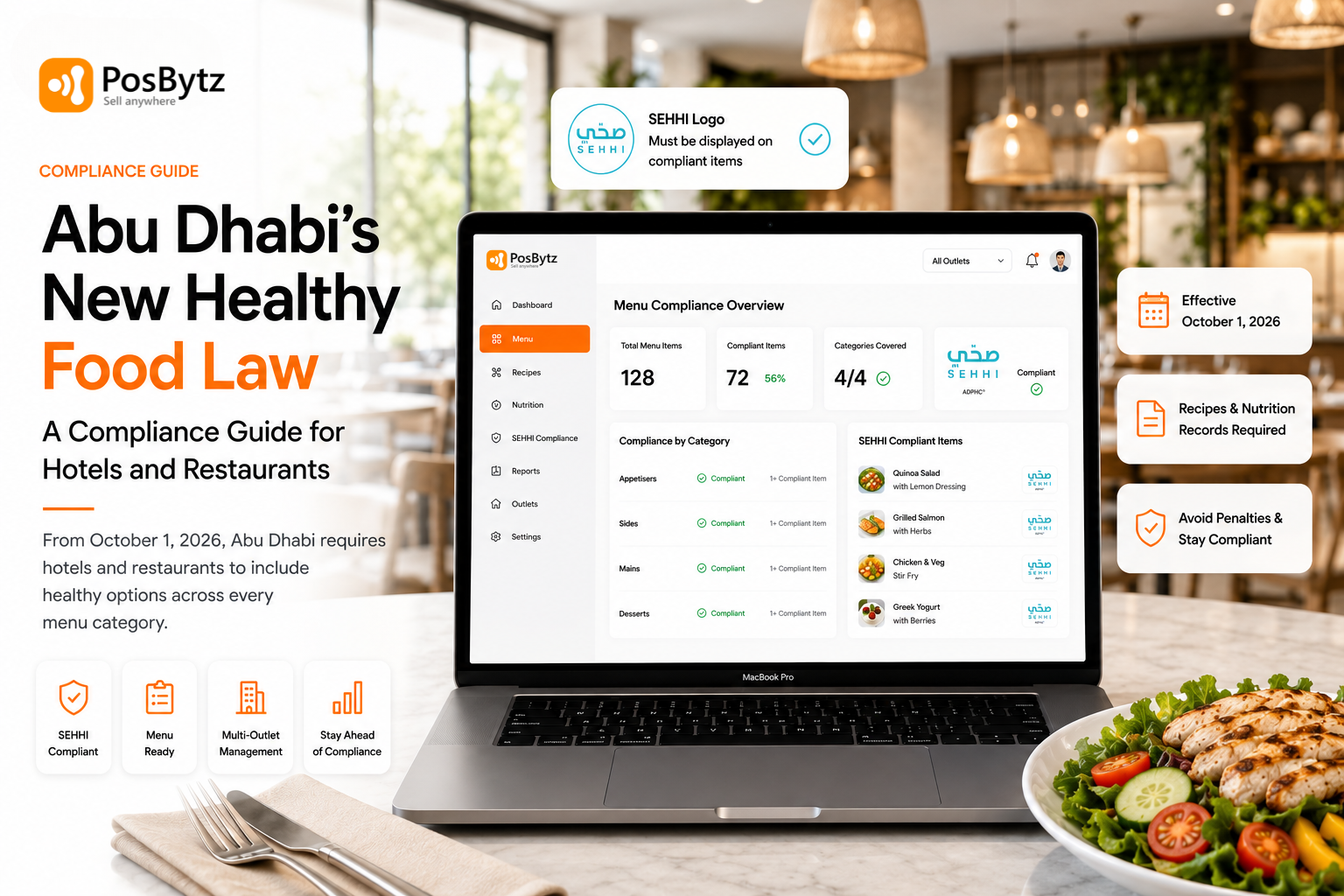


A new menu rule is coming into force in Abu Dhabi, and it changes how hotels and restaurants build their menus, not just what they serve. From October 1, 2026, the Department of Culture and Tourism, Abu Dhabi will require licensed food and beverage outlets to include healthy options across every menu category.
For most operators this raises a practical question: what exactly counts as compliant, who has to follow it, and what happens if a menu falls short. Below is a plain breakdown of the law, the paperwork behind it, what it costs to fall behind, and what it takes to stay ahead of it.
What Abu Dhabi's Healthy Food Law Actually Requires
The rule itself is simple to state. Every adult menu needs at least one healthy option in each category, meaning appetizers, sides, mains, and desserts all need a compliant dish somewhere on the list.
"Healthy" is defined against the SEHHI standard, a nutritional classification that looks at fat, sugar, salt, and overall nutritional value. An item either meets the SEHHI threshold or it doesn't, so there's little room for a menu to claim a dish is "lighter" without it actually qualifying.
Children's menus carry a higher bar. At least half the items on a kids' menu must be SEHHI compliant. Operators don't need to invent new dishes from scratch either. An existing adult dish that already meets SEHHI can simply be served in a smaller, child-sized portion.
Any dish that qualifies has to display the SEHHI logo on the menu itself, so guests can spot it without asking.
This applies to hotel-run outlets as well as independent restaurants and cafes holding a tourism licence, which covers most of the F&B businesses operating in the emirate.
SEHHI Compliance Documentation Restaurants Need to Keep
The part that catches most operators off guard isn't the menu change itself. It's what happens after the menu is updated.
Authorities can request menus at any time to check compliance. Outlets may also need to hand over recipes and nutritional breakdowns for review by the Abu Dhabi Public Health Centre. If your kitchen team currently keeps recipe specs on paper or in personal notes, this is worth digitizing before it's requested rather than after, and a restaurant inventory management system that already tracks recipes and food costing per dish is a natural place to hold that data rather than starting a separate record from scratch.
Businesses already working through SEHHI verification with the Public Health Centre are treated as compliant during that process, as long as they can show steady progress. So this isn't a one-time submission and forget situation. It's ongoing.
The detail that matters most for day-to-day operations is this: every time a menu item is added, dropped, or reformulated, the outlet has to check it still meets the minimum number of SEHHI-compliant dishes. And if a previously approved healthy item gets changed in any way, it needs to go back through validation again.
That means a seasonal menu refresh or a recipe tweak isn't just a kitchen decision anymore. It's also a compliance check.
Which Restaurants Are Exempt From the Healthy Menu Rule
Not every food outlet in Abu Dhabi falls under this law. Three types of businesses are carved out.
Buffets and similar formats without a fixed menu aren't covered, though they're still expected to offer some reasonable healthy choices. Tasting menus are exempt too, since guests are working through a set, pre-curated selection rather than choosing freely from a list.
Small, limited-format outlets are also excluded, but only if they meet a specific set of conditions. The outlet can offer no more than three food categories (something like hot dogs, ice cream, and candy), it can't provide seating, it can't have a written menu beyond signage, or it sells drinks only.
If your business doesn't clearly match one of these three cases, the safest assumption is that the law applies to you.
What Happens If a Restaurant Doesn't Comply
The circular introducing this rule doesn't publish a specific fine table for menu violations, and it's worth understanding why that matters rather than reading it as low risk. Rather than a fixed penalty attached to a single rule, non-compliance is likely to run through DCT Abu Dhabi's broader authority over every tourism-licensed establishment in the emirate, the same authority responsible for licensing, classification, and annual renewal.
A closely related policy gives a useful preview of how this tends to play out in practice. Abu Dhabi's ban on outdoor advertising for food and drinks that fall short of SEHHI's healthier grades comes with an explicit enforcement path: financial penalties, removal of the advertisement, and further permit-related action, enforced under Abu Dhabi's General Appearance Law. That's not a separate legal system built for one rule. It's an existing law being applied to a new SEHHI-based requirement, monitored through the responsible authority's normal channels. There's little reason to expect the menu rule would work any differently.
Abu Dhabi's food and hospitality regulators also have a documented track record of escalating enforcement once a pattern is established: warnings and notices first, financial fines next, and administrative closure for outlets that don't correct course after repeated violations. In a single year, Abu Dhabi's food inspectors issued 967 fines following more than 150,000 inspection visits, alongside tens of thousands of warnings. That's the same inspection infrastructure that will be checking menus against SEHHI going forward.
The cost that's easiest to overlook isn't the fine itself. Abu Dhabi is tying SEHHI compliance to its tourism identity and to public recognition for participating establishments, and a licence renewal is reviewed periodically, not granted once and forgotten. An outlet with an open compliance gap walks into that renewal conversation from a weaker position, independent of whether a fine was ever issued. For operators still confirming their broader regulatory standing is solid, a restaurant licences checklist is a useful way to check nothing else is outstanding before layering this requirement on top.
Abu Dhabi's Wider Push for Healthier Food Regulation
This menu law didn't appear out of nowhere. It's the latest piece of a pattern that's been building across Abu Dhabi for a while.
Supermarkets, including online grocery platforms, will need to move high-fat, high-sugar, and high-salt products away from entrances, checkout counters, and end-of-aisle displays starting January 1, 2027. Early education institutions are already working under a structured nutrition policy that covers school meals, packed lunches from home, and food served at celebrations. Public advertising has also tightened, with junk food and sugary drink promotions restricted on billboards and outdoor digital screens since late 2025.
Read together, these rules point in one direction. Food and beverage regulation in Abu Dhabi is only going to get more detailed, not less. Operators who build habits around tracking and documenting menu compliance now will have an easier time adapting to whatever comes next.
How Restaurants Can Prepare for the October 2026 Deadline
A few steps make this transition manageable rather than stressful.
Start by checking your current menu against SEHHI criteria, category by category, so you know exactly where the gaps are before the deadline arrives. Next, get nutritional information for each dish recorded somewhere central rather than scattered across recipe cards or a chef's memory, since that's the data you'll need to produce on request.
From there, treat every menu change as a compliance step, not just a culinary one. Before a new dish goes live or an old one gets reworked, someone should be checking whether the menu still hits its required count of healthy options.
For groups running more than one outlet, keeping menu and nutritional data consistent across branches and ordering channels matters just as much. It's easy for one location to update its menu correctly while another location, or the delivery app listing, falls out of sync. A restaurant inventory system built for multiple outlets helps keep recipes and ingredient data standardized across branches instead of letting each location manage its own version.
This is where a connected restaurant management system earns its keep. With PosBytz, menu items and categories are managed from one place and pushed out consistently across every outlet and ordering channel. When a dish changes to meet a compliance requirement, it updates everywhere at once instead of needing to be fixed branch by branch. It won't file your SEHHI paperwork for you, but it does remove a lot of the manual coordination that makes multi-outlet compliance harder than it needs to be.
Frequently Asked Questions
When does Abu Dhabi's healthy food law take effect?
The rule takes effect on October 1, 2026, and applies to hotel-operated and independent food and beverage outlets holding a tourism licence.
What is the SEHHI standard?
SEHHI is Abu Dhabi's nutritional classification for food items. It sets limits on fat, sugar, and salt, and identifies dishes with higher nutritional value as "healthy" for the purposes of this law.
How many healthy items does a menu need?
Adult menus need at least one SEHHI-compliant item in each category, meaning appetisers, sides, mains, and desserts. Children's menus need at least half their items to be SEHHI compliant.
Do buffets need to follow this rule?
No. Buffets and similar formats without a fixed menu are exempt, though they're still expected to offer reasonable healthy choices.
What happens when a restaurant changes its menu?
Any addition, removal, or reformulation of a dish triggers a fresh check against the minimum SEHHI requirement. If a previously approved healthy item is modified, it has to be resubmitted for validation.
Are small food kiosks exempt?
Only if they meet all the conditions: no more than three food categories, no seating, no written menu beyond signage, or beverages only.
Is there a fixed fine for menu non-compliance?
Not a published one specific to this rule. Enforcement is expected to run through DCT Abu Dhabi's existing authority over tourism-licensed establishments, which can include warnings, fines, classification review, and, for repeated or serious cases, licence or closure action.
The Bottom Line
Abu Dhabi's new menu law comes with a firm start date and an ongoing set of obligations that don't end once the menu is updated. Restaurants and hotels that start auditing their menus and organising their nutritional data now will walk into October 2026 with far less scrambling, and far less exposure, than those who wait until the deadline is close.
About the author

Saravana Damodaram
Co-Founder & CEO, PosBytz
Saravana Damodaram is the Co-Founder & CEO of PosBytz, a cloud-based POS-ERP platform built for F&B and retail businesses since 2018. He focuses on unified commerce, inventory, and multi-location operations, and has helped over 5,000 merchants across 25+ countries move off fragmented, disconnected tools and run their entire operation, billing, inventory, kitchen, and accounting on one platform.