Common Abu Dhabi Restaurant Menu Compliance Mistakes
The specific mistakes that get SEHHI menu items rejected in Abu Dhabi, from portion size caps to disqualified cooking methods, and how to avoid them.
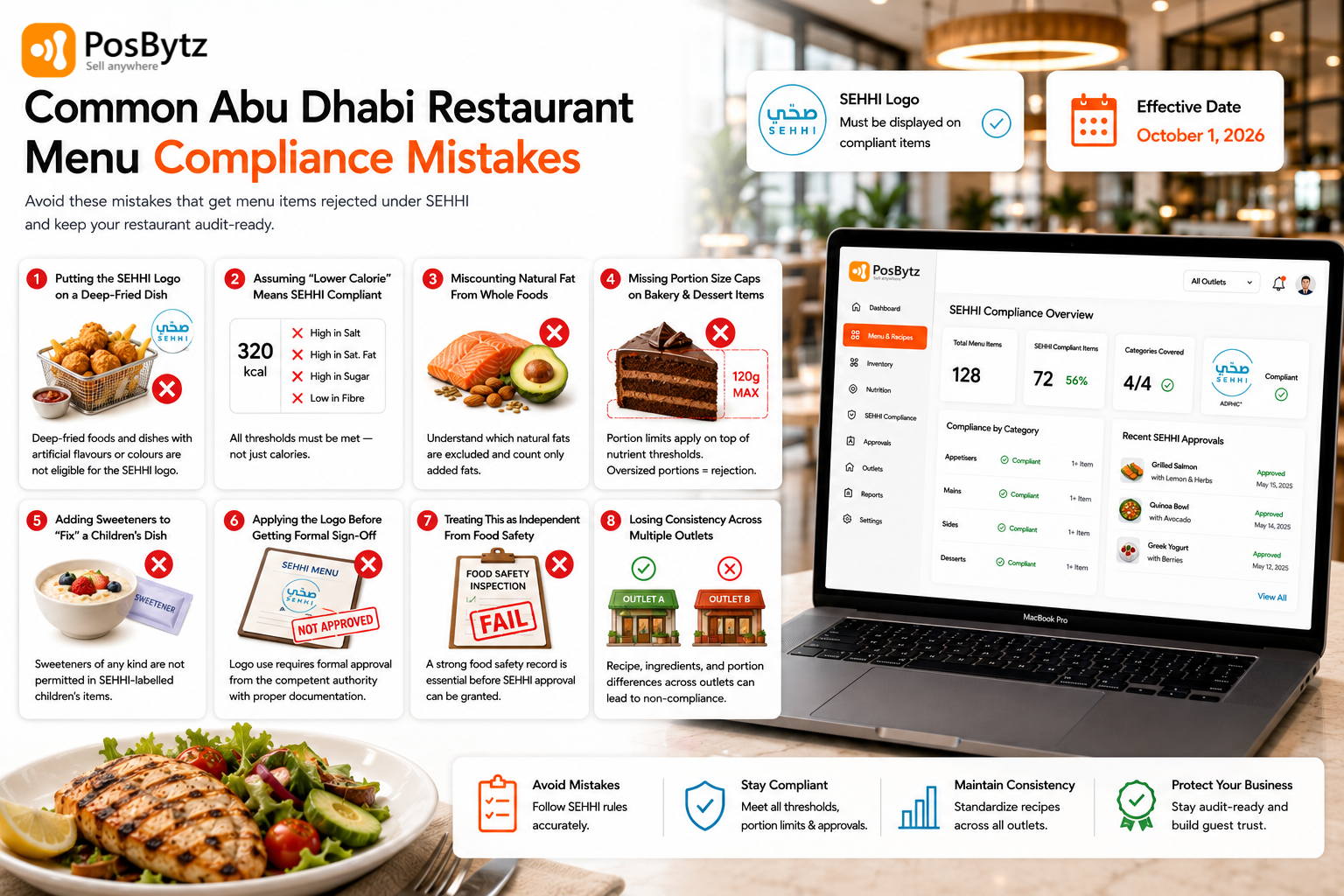


A dish can look healthy and still fail. Kitchens often assume that cutting sugar or trimming visible fat is enough to qualify a dish under Abu Dhabi's SEHHI standard, then find out at review stage that the dish doesn't pass, for reasons that have nothing to do with how the recipe was calculated. Below are the mistakes that actually get menu items rejected, flagged, or pulled at audit, based on the technical detail behind the SEHHI classification rather than the headline version of the rule, along with what fixes each one.
Mistake 1: Putting the SEHHI Logo on a Deep-Fried Dish
This is the single most common rejection reason, and it has nothing to do with fat content, calories, or salt. Under the SEHHI standard, the logo cannot be applied to any food that is deep-fried, full stop, regardless of what the nutritional numbers say afterward. A kitchen can produce a version of a fried dish that comes in under every fat and calorie threshold on paper and it still won't qualify, because the cooking method itself disqualifies it.
The same applies to any dish containing artificial flavours or artificial colours. A sauce or marinade with an artificial flavouring agent knocks the whole dish out of contention, even if every other ingredient is compliant.
How to fix it:
Before running nutritional numbers on a dish at all, confirm the cooking method and ingredient list don't already rule it out. This saves the time of calculating a dish that was never going to qualify. If a fried dish needs a SEHHI equivalent on the menu, the practical fix is usually a grilled, baked, or steamed version of the same base recipe, treated as a separate dish rather than a reformulated version of the fried one. Run the same check on flavourings: swap any artificial flavouring or colouring agent for a natural one before the recipe goes anywhere near a nutritional calculation.
Mistake 2: Assuming "Lower Calorie" Means SEHHI Compliant
SEHHI isn't a single calorie ceiling. It's a set of thresholds that all have to be met at once, and restaurants that focus on calories alone often miss the others. For adult mains and sides specifically, a compliant dish needs to sit within limits on total fat, saturated fat, trans fat, added sugar, and salt, in addition to a calorie cap.
A dish can be low-calorie and still fail on salt. A dish can be low in sugar and still fail because it's cooked in an oil that pushes the saturated fat over the limit. Treating "healthy" as a single number rather than a set of independent thresholds is one of the most common reasons a dish that looks fine on the surface doesn't actually pass.
There's also a requirement that goes the other direction: a qualifying dish needs to contribute a meaningful amount of at least one beneficial nutrient, such as fibre, protein, calcium, or vitamin A or D. Stripping fat, sugar, and salt out of a dish without adding anything nutritionally useful back in can still leave it short.
The fix here is procedural more than culinary: check a candidate dish against every threshold, not just the one that seems easiest to hit. Build a simple pass/fail line for each of the six criteria, calories, total fat, saturated fat, sugar, salt, and beneficial nutrient content, and only mark a dish compliant once every line clears. A dish that clears five out of six still isn't ready to carry the logo.
Mistake 3: Miscounting Natural Fat From Whole Foods
Fat limits under SEHHI exclude the natural fat that comes from certain whole ingredients, fish, lean chicken, lean red meat, eggs, cheese within certain fat bands, avocado, nuts, legumes, and seeds. Kitchens that don't know this exclusion sometimes disqualify a dish unnecessarily, assuming the fat from a salmon fillet or a handful of almonds counts against the cap the same way oil or butter would.
The reverse mistake also happens: assuming any fat from a "healthy" ingredient is automatically excluded, when the exclusion applies to specific ingredients within specific limits, not fat in general. Getting this distinction wrong in either direction either disqualifies a dish that would have passed, or approves one that shouldn't.
Fixing this means separating the fat in a recipe into two buckets before calculating anything: fat that comes from an excluded whole-food ingredient, and fat that comes from added oil, butter, cream, or dressing. Only the second bucket should be counted against the cap. Whoever is running the nutritional analysis needs the current exclusion list on hand, not a general impression of which ingredients "count as healthy."
Mistake 4: Missing Portion Size Caps on Bakery and Dessert Items
Beyond nutrient thresholds, several bakery and dessert categories carry hard portion size limits, regardless of what the nutritional breakdown shows. A croissant capped around 67 grams, a slice of cake or scone capped around 120 grams, small pastries capped around 65 grams: these ceilings apply on top of, not instead of, the fat and sugar requirements.
A pastry chef can reformulate a recipe to hit every fat, sugar, and salt threshold and still have the dish rejected because the portion served is simply too large. This is one of the easier mistakes to fix, since it's a plating and portioning issue rather than a recipe reformulation, but it's also one of the easiest to overlook because it isn't a nutrient calculation at all. Keeping portion weights standardized at the recipe level, the same discipline used for food costing in restaurant inventory management, is what catches this before a dish goes out the door oversized.
Mistake 5: Adding Sweeteners to "Fix" a Children's Dish
A common workaround for a kids' dish that's slightly over the sugar threshold is to swap real sugar for a non-sugar sweetener, natural or artificial. For children's SEHHI items specifically, this doesn't work: sweeteners of any kind aren't permitted in a SEHHI-labelled children's dish. A kitchen that solves a sugar problem this way ends up with a dish that's still disqualified, just for a different reason.
Children's dishes also carry their own structural requirement that's separate from the adult menu rules: a qualifying main needs at least two components from set categories (whole grains, lean protein, low-fat dairy, a fruit serving, or a vegetable serving), and a side needs at least one. A dish can meet every calorie and fat number for a child's portion and still not qualify if it doesn't hit this component count.
If a kids' dish is running over on sugar, the fix is to reduce added sugar directly rather than substitute it, using smaller portions of naturally sweet ingredients like fruit, or reworking the recipe to rely less on a sweetened sauce or glaze in the first place. Then check the component count separately: a compliant kids' main needs two of the five listed categories present, so it's worth confirming that structural requirement before spending time adjusting the sugar content at all.
Mistake 6: Applying the Logo Before Getting Formal Sign-Off
A recipe passing your own internal nutritional calculation is not the same as being approved to carry the SEHHI logo. The logo requires the competent authority's approval before it can be displayed, and outlets need to keep a record of that approval, evidence of the analysis behind it, and the specific list of approved items. Printing the logo on a menu because a spreadsheet says the dish qualifies, without that formal step completed, is a compliance gap even if the underlying numbers are correct.
This distinction matters most at audit time. Being able to produce a record of what was submitted and approved, and when, is what separates a compliant outlet from one that's technically serving a healthy dish without the paperwork to back the label up.
The fix is sequencing: treat internal calculation as step one of two, not the finish line. Submit the recipe, nutritional breakdown, and supporting analysis for formal review, and hold off on printing the logo anywhere, menu, signage, delivery listing, until written approval comes back. Keep that approval on file alongside the recipe it applies to, so the two never drift apart when either one changes.
Mistake 7: Treating This as Independent From Your Food Safety Standing
SEHHI sits on top of, not instead of, an outlet's general food safety compliance. In comparable SEHHI frameworks, eligibility to carry the logo has been tied to holding a strong food safety inspection grade in the first place. An outlet that's behind on routine food safety or hygiene requirements is starting a SEHHI submission from a weaker position than one that's already current on its licensing and inspection standing.
The fix is sequencing this correctly: resolve any open food safety or hygiene findings before submitting menu items for SEHHI review, rather than running both processes at the same time and hoping neither slows the other down. For operators still working through the basics of licensing, it's worth getting that foundation solid before layering a menu compliance project on top of it. A restaurant licences checklist is a useful starting point for confirming nothing on the operational side is outstanding before a SEHHI submission goes in.
Mistake 8: Losing Consistency Across Multiple Outlets
A dish approved and correctly labelled at one branch doesn't automatically stay compliant at every branch of the same brand. Different outlets often source from different suppliers, portion slightly differently, or have a chef adjust a recipe locally without realizing it was carrying a SEHHI approval. The result is a menu item with the same name and the same logo showing up correctly at one location and incorrectly at another.
This is less a nutritional mistake than an operational one, and it tends to show up first in multi-outlet or multi-brand groups where recipes aren't centrally controlled. Keeping ingredient sourcing, portion sizes, and recipe versions consistent across branches, and flagging any local substitution for review before it reaches the plate, is what prevents one compliant location from becoming three inconsistent ones. A restaurant inventory system built for multiple outlets that standardizes ingredient and recipe data across branches makes this kind of drift far easier to catch before it reaches a customer's plate.
Quick Reference: What Disqualifies a Dish Regardless of Its Nutrient Numbers
//photo
How to Fix These Compliance Mistakes with PosBytz
Most of the mistakes above aren't one-time errors. They're the kind of thing that creeps back in every time a recipe changes, a new outlet opens, or a chef adjusts a dish on the fly. Fixing them once in a spreadsheet doesn't stop them from happening again three months later at a different branch.
A cloud-based restaurant POS and management system closes that gap by keeping recipes, portions, and menu data in one connected place instead of scattered across kitchen notebooks and individual outlet decisions:
Recipe control at the source.
- Every dish is built from a standardized recipe with fixed ingredient weights and portion sizes, so a pastry item can't quietly drift past its portion cap, and a compliant dish can't get resized without someone noticing.
Cooking method and ingredient flags stay attached to the item.
- Once a dish is marked as deep-fried, or built with a flavouring that disqualifies it, that flag travels with the recipe, so it doesn't get mistakenly submitted for SEHHI review a second time.
Menu changes trigger a review instead of going live silently.
- When an ingredient, portion, or recipe is edited, the system surfaces the item for a compliance recheck rather than letting the change reach the menu and the guest at the same time.
Consistency across every outlet.
- For groups running more than one branch, recipes and approved menu items are pushed out centrally, so what's compliant at one location matches what's actually being served at every other location, closing the exact gap described in Mistake 8.
Approval and audit records stay in one place.
- Nutrition data, recipe versions, and approval history sit with the item itself, so producing evidence of what was submitted and when isn't a scramble through old emails and spreadsheets.
None of this replaces the SEHHI submission and approval process itself, that still runs through DCT and ADPHC. What it does is remove the operational gaps, drifted recipes, unflagged ingredient swaps, inconsistent branches, that turn a correctly approved dish into a non-compliant one without anyone deciding that on purpose.
FAQs
Can a fried dish ever qualify for the SEHHI logo?
No. The SEHHI logo cannot be applied to deep-fried food, regardless of its final nutritional profile.
Why did a low-calorie dish still fail SEHHI review?
Calories are only one of several thresholds. Fat, saturated fat, trans fat, sugar, and salt all have separate limits, and a dish needs to meet all of them, not just the calorie count.
Does fish or nut fat count against the SEHHI fat limit?
Natural fat from specific whole foods, including fish, lean meat, eggs, avocado, nuts, legumes, and certain cheeses, is excluded from the general fat cap. Added fats like oil or butter are not.
Can we use a sugar substitute in a children's SEHHI dish?
No. Non-sugar sweeteners, whether natural or artificial, aren't permitted in children's items carrying the SEHHI logo.
Are there size limits on desserts and pastries even if the nutrition numbers pass?
Yes. Several bakery and dessert categories carry maximum portion sizes that apply regardless of the nutrient calculation.
Does a dish become non-compliant automatically once approved?
It stays compliant only if the recipe, portion size, and ingredients stay the same. Any change to a previously approved item needs to be re-submitted.
If one branch's dish is compliant, are all branches automatically compliant?
No. Each outlet needs its own version of the recipe to match what was approved. Supplier or portion differences between branches can put one location out of compliance while another remains fine.
Does a restaurant need a strong food safety record before applying for SEHHI approval?
Outstanding food safety or licensing issues can weaken a SEHHI submission, since menu compliance sits on top of an outlet's general food safety standing rather than replacing it.
About the author

The PosBytz Marketing Team
Editorial Team, PosBytz
The PosBytz Marketing Team shares practical insights on running smarter restaurants and retail stores from POS best practices to inventory management, online ordering, and customer loyalty strategies.