Diwali Discount Ideas That Don't Kill Your Margin: 15 Offers for Retail and Restaurants
15 Diwali discount ideas for shops and restaurants: margin maths, how to send coupons with your CRM, GST notes, and offers to avoid. Protect your profit.


Quick Answer: How Do You Give Diwali Discounts Without Losing Margin?
The best Diwali discounts increase the bill value or bring customers back, instead of cutting the price of items that would have sold anyway. Margin-safe offers include:
- Combos and gift hampers that pair popular items with higher-margin ones
- Tiered "spend more, save more" offers that reward bigger baskets
- Free gifts above a bill value, using slow-moving stock
- Bounce-back coupons that customers redeem after Diwali
- Loyalty bonus points instead of instant price cuts
- Festive set menus and pre-order sweet boxes for restaurants
- Offers sent directly to customers through your CRM, so the right people get the right coupon and every redemption is tracked
Before running any offer, check how much extra you must sell to earn the same profit. A 10% discount on an item with a 30% margin needs 50% more sales just to break even. The table below shows the numbers for common margins.
First, Do the Margin Maths
Every discount comes straight out of your profit, not your revenue. That's why a discount that looks small can be expensive.
The Break-Even Formula
Extra sales needed to break even = Discount % ÷ (Margin % − Discount %)
Here, margin means your gross margin on the selling price, which is (selling price − cost) ÷ selling price.
Example: You sell a dry fruit box for ₹1,000. It costs you ₹700, so your margin is 30% and you earn ₹300 per box.
- Give 10% off, and you sell it for ₹900, earning ₹200 per box.
- To earn the same ₹300 in total profit, you need to sell 1.5 boxes for every 1 box you sold before.
- That's 50% more sales, just to stand still.
How Much More You Must Sell to Break Even
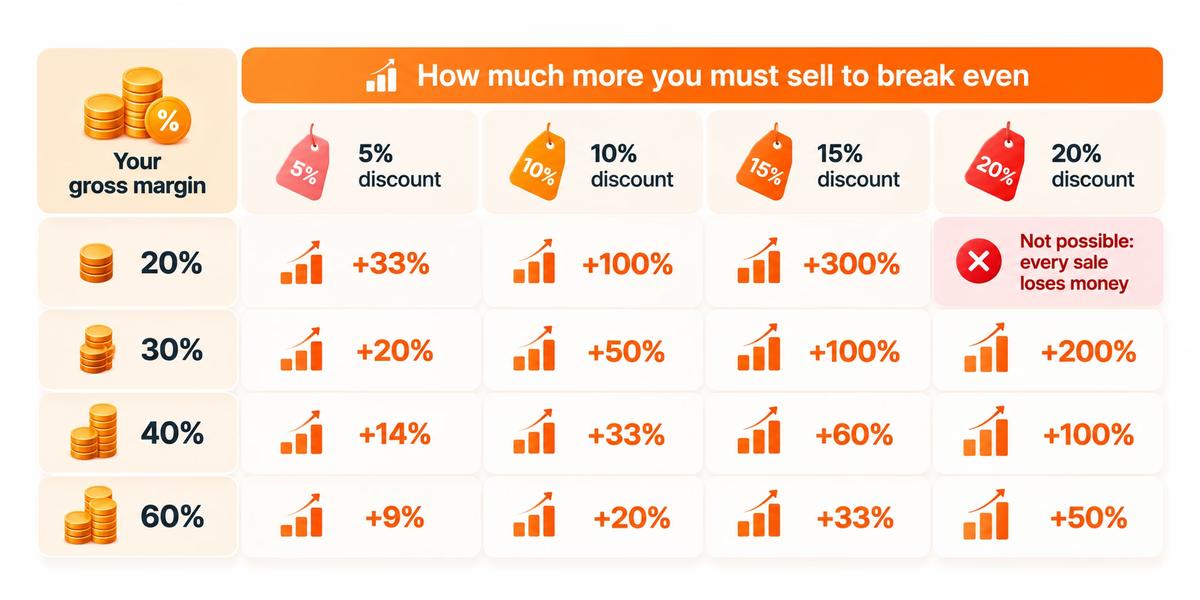
If your gross margin is 20%:
- 5% discount: sell 33% more
- 10% discount: sell 100% more
- 15% discount: sell 300% more
- 20% discount: not possible, because you earn zero profit on every sale
If your gross margin is 30%:
- 5% discount: sell 20% more
- 10% discount: sell 50% more
- 15% discount: sell 100% more
- 20% discount: sell 200% more
If your gross margin is 40%:
- 5% discount: sell 14% more
- 10% discount: sell 33% more
- 15% discount: sell 60% more
- 20% discount: sell 100% more
If your gross margin is 60%:
- 5% discount: sell 9% more
- 10% discount: sell 20% more
- 15% discount: sell 33% more
- 20% discount: sell 50% more
What this tells you:
- On low-margin items, even a 10% discount needs you to double your sales.
- Flat discounts on everything rarely pay for themselves.
- Offers that raise the bill value or use slow stock protect profit far better than a straight price cut.
With that in mind, here are 15 offers that work harder than a flat discount.
Diwali Discount Ideas for Retail Stores
1. Festive Combos and Gift Hampers
How it works: Bundle a popular item with complementary or higher-margin items at a combined price, for example dry fruits with a decorative box and a diya set.
Why it protects margin: The customer sees value in the bundle, so you don't need a deep discount on any single item. Higher-margin add-ons lift the overall margin of the bundle.
Watch out for: Set the combo up in your POS so each item's stock reduces when the hamper sells.
2. Spend More, Save More (Tiered Offers)
How it works: Offer a bigger saving as the bill grows. For example, 5% off above ₹2,000, 8% off above ₹4,000, and 10% off above ₹6,000.
Why it protects margin: You only discount larger baskets, and customers add items to reach the next tier. Set the first tier slightly above your current average bill value.
Watch out for: Exclude very low-margin categories from the bill total if needed, and state the rules clearly.
3. Free Gift Above a Bill Value
How it works: Give a free gift, such as a set of diyas, a small sweet box, or a festive tote bag, on bills above a set amount.
Why it protects margin: The gift costs you its purchase price, not its selling price. Using slow-moving stock clears inventory at the same time.
Watch out for: Under GST, input tax credit is generally not available on goods given away as free gifts, so include that in your cost calculation and confirm the treatment with your accountant.
4. Bounce-Back Coupons for After Diwali
How it works: Give every Diwali customer a coupon redeemable after the festival, for example ₹200 off on a bill above ₹1,500, valid from 15 to 30 November.
Why it protects margin: You don't reduce the festive sale at all. The discount only applies on a future visit, during the slower post-Diwali weeks, and only if the customer returns and spends a minimum amount.
Watch out for: Record the customer's phone number so you can remind them before the coupon expires.
5. Double or Bonus Loyalty Points
How it works: Offer double loyalty points on festive purchases instead of an instant discount.
Why it protects margin: Points are redeemed later, and some are never redeemed. Points also bring customers back to your store instead of a competitor's.
Watch out for: Decide the points value and expiry clearly, and track points liability in your system.
6. Early-Bird Offers Before Dhanteras
How it works: Give a small saving on purchases made in the week before Dhanteras.
Why it protects margin: It spreads demand across more days, which reduces queues, stock-outs, and staff overtime during peak days. You don't need to discount the peak days at all.
Watch out for: Keep the early-bird saving modest, and end it on a clear date.
7. Corporate and Bulk Gifting Slabs
How it works: Offer quantity-based pricing for businesses buying gifts in bulk. For example, 3% off for 25+ hampers and 5% off for 50+.
Why it protects margin: Bulk orders bring large, predictable revenue, often with advance payment, and lower selling cost per unit.
Watch out for: Issue GST invoices with the buyer's GSTIN, and take an advance to confirm the order.
8. Clearance on Old Stock Only
How it works: Run deeper discounts only on last season's or slow-moving stock, never on festive bestsellers.
Why it protects margin: Old stock is already tying up cash and shelf space. Turning it into cash during high footfall is better than carrying it for another year.
Watch out for: Keep clearance items in a separate section so they don't pull attention from full-price festive stock.
9. Free Delivery Above a Threshold
How it works: Offer free home or local delivery on orders above a set value.
Why it protects margin: Customers add items to qualify. Set the threshold slightly above your average order value, for example ₹1,500 if your average order is ₹1,200.
Watch out for: Calculate your real delivery cost per order first, so the threshold covers it.
10. Prepaid Order Incentives for Online Sales
How it works: Offer a small saving or a free add-on for prepaid online orders instead of cash on delivery.
Why it protects margin: Prepaid orders usually have fewer cancellations and returns than COD, which saves you return shipping and wasted packing time.
Watch out for: Keep the incentive small and apply it consistently. For more on festive online selling, see our Diwali checklist for your online store.
Diwali Offer Ideas for Restaurants, Cafés, and Sweet Shops
11. Festive Set Menus and Thalis
How it works: Create a Diwali thali or set menu at a fixed price, combining popular dishes with lower-cost items and a festive sweet.
Why it protects margin: You control the food cost of the whole set, kitchen preparation becomes more predictable, and the bill value is usually higher than a typical single order.
Watch out for: Map each dish to its recipe so stock and food cost are tracked accurately.
12. Pre-Order Sweet Boxes With an Advance Saving
How it works: Offer a small saving on sweet boxes and festive hampers ordered and paid in advance.
Why it protects margin: Advance orders let you plan production and buy ingredients accurately, which cuts waste. You also receive cash before the festival.
Watch out for: Record pickup dates and times so the kitchen can plan, and keep a pickup counter separate from walk-in billing.
13. Off-Peak Hour Offers
How it works: Offer a discount or a free dessert only during quieter hours, such as weekday afternoons in festive week.
Why it protects margin: You fill tables and kitchen capacity that would otherwise be idle, without discounting your busiest hours.
Watch out for: Use hourly sales reports to choose the right time slots.
14. Family and Group Bundles
How it works: Offer a bundle for four or six people, for example starters, mains, and desserts at a combined price.
Why it protects margin: Groups order more in total, and bundles nudge them towards dishes you have planned for.
Watch out for: Build bundles around dishes with good margins and ingredients you already stock in volume.
15. Gift Cards With Bonus Value
How it works: Sell gift cards with a small bonus, for example pay ₹1,000 and get a ₹1,100 gift card, redeemable after Diwali.
Why it protects margin: You receive cash now, the card brings a new or returning customer to your restaurant or store later, and many customers spend more than the card value when they visit.
Watch out for: Record gift card sales and redemptions properly in your accounts. Your accountant can advise on the right accounting and GST treatment.
How to Send Diwali Discounts and Coupons to Customers with an Integrated CRM
A good offer only works if the right customers hear about it. Many stores put the offer on a poster and hope people walk in. With an integrated CRM, you send the offer directly to customers who have already bought from you, and you can see exactly who used it.
Because the CRM is part of your billing system, every sale is linked to a customer profile automatically. You don’t need a separate spreadsheet or a second app.
Step 1: Capture customer details at billing
Ask for the customer’s name and phone number at the counter, and a birthday or anniversary if they’re happy to share. Each bill then builds the customer list you will use for Diwali campaigns.
Step 2: Group customers into segments
Different customers need different offers. Useful Diwali segments include:
- Customers who bought during last Diwali
- High-spending customers
- Customers who haven’t visited in 60–90 days
- New customers from the last month
- Customers of a specific outlet or category
Step 3: Create the coupon or offer
Set the rules once, in the system: discount value, minimum bill, valid dates, eligible items or categories, and one use per customer. The rules are then applied automatically at billing, with no manual discount at the counter.
Step 4: Send it to the right segment at the right time
Schedule your campaigns instead of sending everything at once:
Which offer to send, to whom, and when
Early-bird saving
- Send to: past festive buyers and loyal customers
- When: 7-10 days before Dhanteras
Tiered “spend more, save more” offer
- Send to: high-spending customers
- When: Dhanteras week
Bounce-back coupon (e.g. ₹200 off above ₹1,500)
- Send to: everyone who buys during the festival
- When: right after purchase, valid 15-30 Nov
Win-back offer
- Send to: customers who haven’t visited in 60-90 days
- When: start of festive week
Loyalty points reminder
- Send to: members with unused points
- When: before points expire
Thank-you and “Shubh Deepavali” message
- Send to: all customers
- When: Diwali day
Step 5: Redeem at the billing counter
The cashier applies the coupon at billing. It is checked against the rules, so it can’t be used twice, used after expiry, or used on a bill below the minimum.
Step 6: Check the results
After Diwali, see how many coupons were sent, how many were redeemed, how much those customers spent, and how many came back. Use this to plan next year’s offers.
Tips for better campaigns
- Keep each message to one offer, with a clear expiry date.
- Use the customer’s name. Personal messages get more attention than generic ones.
- Don’t over-message. Two or three messages in the festive season is enough.
- Send messages only to customers who have agreed to receive them, and follow the messaging rules for each channel.
- Test your coupon at the billing counter before you send it to customers.
Diwali Offers to Avoid
Some festive offers look good on a poster but damage your profit or your reputation:
- Flat storewide discounts. They reduce the price of items customers would have bought anyway. Check the margin table before running one.
- Discounts on your festive bestsellers. If an item sells out every Diwali at full price, discounting it only gives away profit.
- Unplanned stacking. A coupon on top of a combo on top of a loyalty discount can push some sales below cost. Decide which offers can combine before launch.
- Inflated "original" prices. Raising the price to show a bigger discount misleads customers and can breach consumer protection rules. Always calculate savings from the genuine regular price, and never sell above MRP.
- Unlimited manual discounts at the counter. During the rush, ad-hoc discounts are hard to track and easy to misuse. Configure offers in your POS and require manager approval for anything extra.
- Offers with no end date. Festive offers that keep running after Labh Pancham train customers to wait for discounts.
GST Notes on Diwali Discounts
These are general points. Confirm your specific situation with your accountant.
- Discounts shown on the invoice at the time of sale reduce the taxable value, so GST is charged on the discounted price.
- Free gifts: input tax credit is generally not available on goods given away as free gifts.
- Combos and hampers: if items with different GST rates are sold together, the way you bill the hamper affects the tax charged. Ask your accountant how to set up mixed hampers.
- Check current rates: GST rates were rationalised from 22 September 2025, so confirm the rate on every festive product before your offers go live.
How to Measure Whether Your Diwali Offers Worked
Run every offer through your POS, not as manual price changes, so you can measure it afterwards. After Diwali, check:
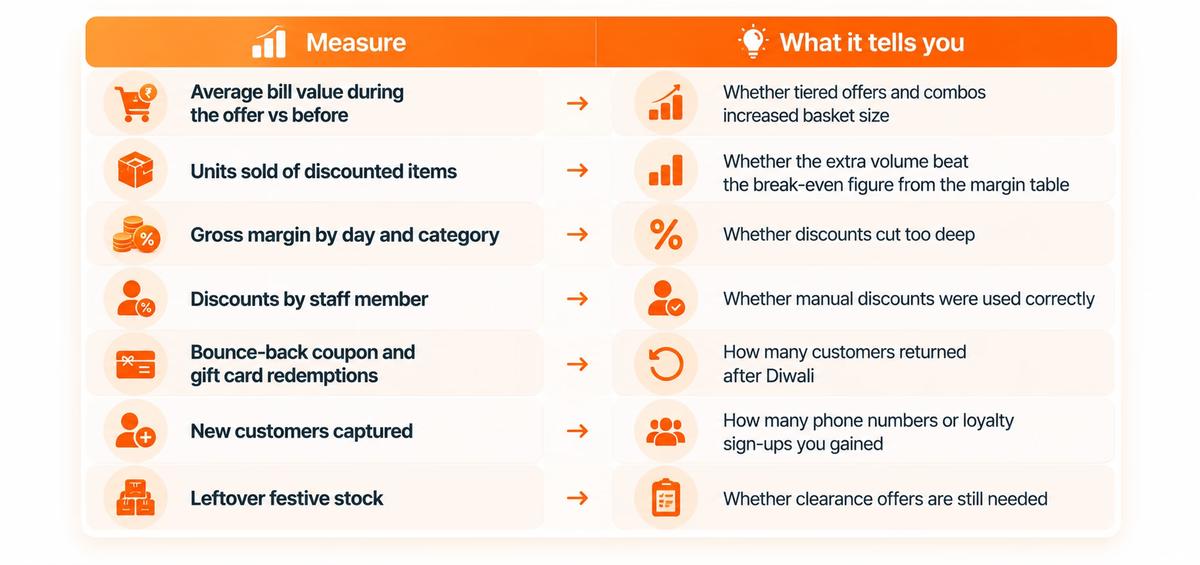
- Average bill value during the offer vs before
- Tells you: whether tiered offers and combos increased basket size
- Units sold of discounted items
- Tells you: whether the extra volume beat the break-even figure from the margin table
- Gross margin by day and category
- Tells you: whether discounts cut too deep
- Discounts by staff member
- Tells you: whether manual discounts were used correctly
- Bounce-back coupon and gift card redemptions
- Tells you: how many customers returned after Diwali
- New customers captured
- Tells you: how many phone numbers or loyalty sign-ups you gained
- Leftover festive stock
- Tells you: whether clearance offers are still needed
How PosBytz Helps You Run Profitable Diwali Offers
PosBytz is a cloud-based POS and ERP for retail stores and restaurants. It helps you run festive offers with control:
- Combos and hampers billed as single items, with inventory that updates as you sell
- Staff logins and approvals, so extra discounts and voids are recorded against a named person
- CRM, loyalty, and automated campaigns: segment customers, send Diwali discounts and coupons, schedule bounce-back offers, and track every redemption at billing
- Sales reports by item, category, staff, outlet, and time, to measure each offer
- GST-compliant billing with e-invoicing support for India
- Accounting with Zoho Books and QuickBooks integrations
- Online and in-store offers in one system, with a free online store and restaurant online ordering
Getting your billing counter ready too? Read our Diwali 2026 POS checklist.
Start your 14-day free trial, check pricing, or talk to the PosBytz team.
Frequently Asked Questions About Diwali Discounts
What are the best Diwali discount ideas for shops?
Combos and gift hampers, tiered "spend more, save more" offers, free gifts above a bill value, bounce-back coupons for after Diwali, bonus loyalty points, and bulk pricing for corporate gifting. These raise bill value or bring customers back instead of cutting prices on items that sell anyway.
How much discount should I give during Diwali?
It depends on your margin. Use the formula: extra sales needed = discount ÷ (margin − discount). With a 30% margin, a 10% discount needs 50% more sales to break even. Keep discounts small on low-margin items, and use value-based offers instead.
Are flat discounts a good idea for Diwali?
Usually not. Flat storewide discounts cut the price of items customers would have bought at full price. Targeted offers such as combos, tiered discounts, and clearance on old stock protect your profit better.
What Diwali offers work best for restaurants?
Festive set menus or thalis, advance-order sweet boxes, off-peak hour offers, family and group bundles, and gift cards with bonus value. These raise bill value, improve kitchen planning, or fill quiet hours.
How is GST calculated on discounted items?
When the discount is shown on the invoice at the time of sale, GST is charged on the discounted price. Treatment of free gifts and mixed-rate hampers is different, so confirm with your accountant.
Can I show a higher original price to make the discount look bigger?
No. Inflating the original price to show a larger discount misleads customers and can breach consumer protection rules. Calculate savings from the genuine regular price and never sell above MRP.
What is a bounce-back coupon?
A coupon given during the festive sale that can only be redeemed on a later visit, usually after Diwali. It brings customers back during slower weeks without reducing your festive sale.
How can I send Diwali discounts and coupons to my customers?
Use a CRM that is connected to your billing system. Capture customer details at the counter, group customers into segments (for example, last year’s Diwali buyers or customers who haven’t visited recently), create a coupon with a value, minimum bill and expiry date, and send it to the right segment. The coupon is then applied at billing and the redemption is recorded.
Why use an integrated CRM instead of sending offers manually?
With a manual list, you can’t easily tell who received an offer, who used it, or whether a coupon was used twice. An integrated CRM links every offer to a customer profile and every redemption to a bill, so you can control offers and measure results.
How do I stop staff from giving too many discounts during the rush?
Configure offers in your POS in advance, give each staff member an individual login, and require manager approval for discounts above a set limit. Review discounts by staff member every day.
How do I know if my Diwali offers worked?
Compare average bill value, units sold, and gross margin during the offer with a normal period. Check whether extra volume beat the break-even figure, and track bounce-back coupon and gift card redemptions after Diwali.
Final Thoughts
The goal of a Diwali offer isn't to be the cheapest store on the street. It's to give customers a real reason to buy more, buy from you, and come back after the festival, while keeping enough margin to make the busiest season your most profitable one.
Do the margin maths first, choose offers that grow the basket or bring customers back, set clear rules in your POS, and measure what worked.
Shubh Deepavali from the PosBytz team.
عن الكاتب

فريق التسويق في PosBytz
فريق التحرير، PosBytz
يشارك فريق التسويق في PosBytz رؤى عملية حول إدارة المطاعم ومتاجر التجزئة بشكل أذكى، بدءاً من أفضل ممارسات نقاط البيع ووصولاً إلى إدارة المخزون والطلبات عبر الإنترنت واستراتيجيات ولاء العملاء.