Food Truck Business in Dubai: The Real Costs, Pain Points and a Business Plan Example (2026)
Real 2026 costs, licence fees, a food truck business plan example with Dubai numbers, and fixes for the pain points that sink most new trucks.
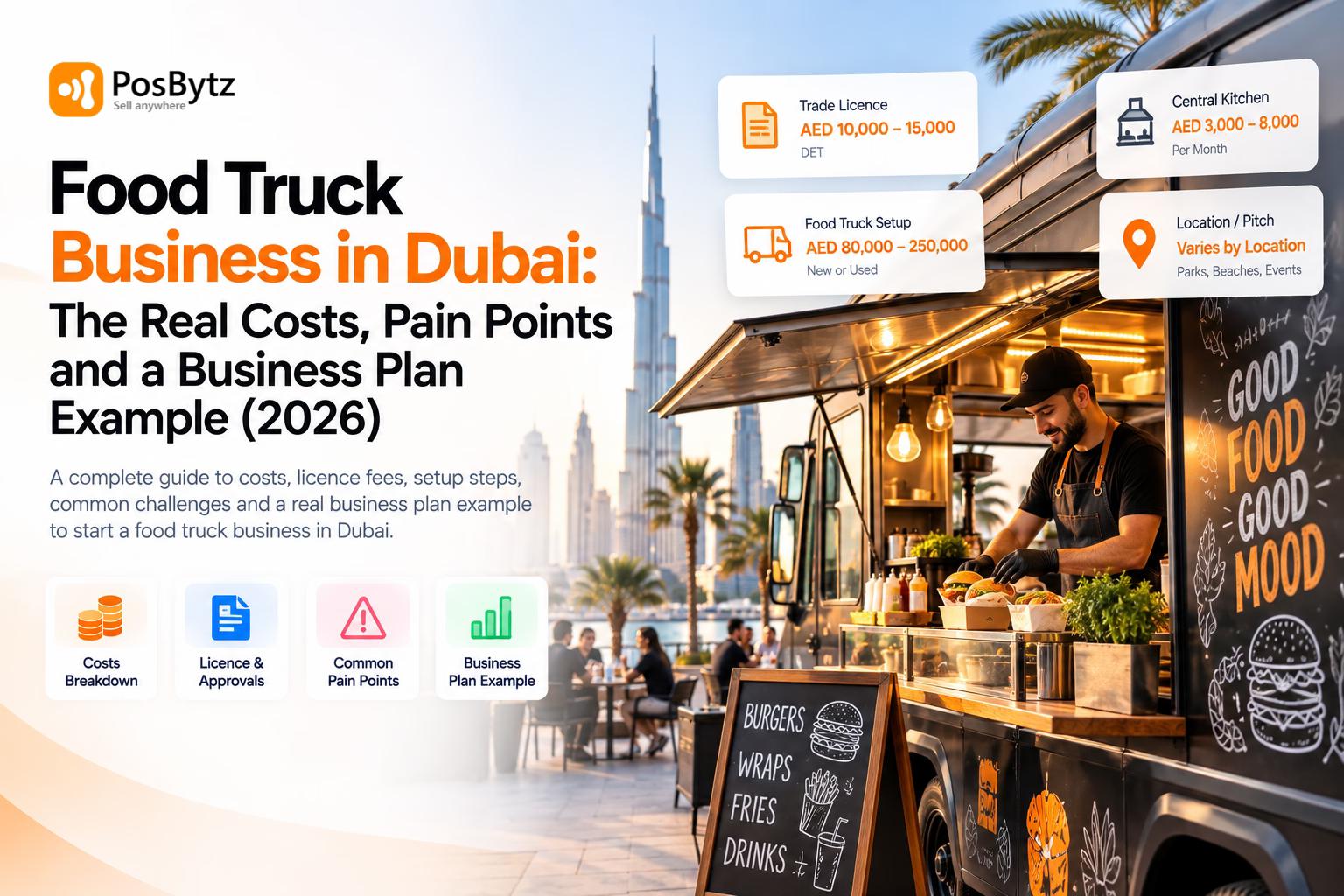


A food truck business in Dubai can be profitable, but only if it survives the summer, pays for a location and a central kitchen, and keeps delivery commissions under control. Most guides skip those three costs, which is why their numbers look so attractive.
If you search how to start a food truck business in Dubai, you will find the same list every time: get a trade licence, buy a truck, find a spot, start selling. Then you read what actual operators say in community forums, and the picture changes. Owners talk about trucks that make good money from October to April and then bleed cash for four months. They talk about paying for a pitch the way a restaurant pays rent. Some estimate that most new trucks never break even.
This guide is built around those problems. You will get:
- The 7 pain points that sink new food trucks in the UAE, each with a practical fix
- A food truck business license cost table that reconciles the conflicting figures online and shows a realistic first-year budget
- A food truck business plan example with real Dubai-style numbers, including a summer loss and how to fix it
- A free food truck business plan template you can copy
- Food truck business ideas matched to Dubai locations and seasons
- The setup steps in the order that avoids expensive rework
All figures are 2026 estimates compiled from licensing consultants, operator reports and market listings. Fees change, so confirm current amounts with the Department of Economy and Tourism (DET), Dubai Municipality and the RTA before you commit money.
7 pain points of a food truck business in the UAE (and how to fix each one)
The biggest risks in a UAE food truck business are operational, not legal. Licensing is mostly a cost and a timeline. These seven problems are what decide whether you are still trading in year two.
1. The summer revenue cliff
From roughly June to September, daytime temperatures make outdoor eating unpleasant, and beach and park footfall drops sharply. Many trucks earn most of their annual profit in the cooler months and lose money in summer.
Fix: Plan the year as two businesses. In season, trade at parks, beaches and markets. In summer, switch to private catering, corporate lunches, indoor or air-conditioned venues and delivery from your central kitchen. Build your budget so the cooler months fund at least four summer months of fixed costs.
2. You cannot just park and sell
Unlike some Western cities, a Dubai food truck cannot stop on any street and open the hatch. Every spot needs a permit or a landlord agreement. Dedicated food truck parks, beachfront pitches and seasonal markets charge fees, and operators report that premium spots cost as much as restaurant rent.
Fix: Treat location as rent in your plan, not an afterthought. Start with lower-cost options such as weekend markets, corporate parks with a developer NOC and community events. Move to premium pitches only after you have proven your daily sales numbers.
3. The central kitchen requirement
Most food trucks must be linked to a licensed central kitchen for bulk preparation, storage and cleaning. Saying you will cook everything inside the truck is usually not accepted, and a home kitchen does not qualify. Shared commercial kitchens typically cost AED 3,000 to 8,000 a month.
Fix: Secure your kitchen before you finalise the truck layout, because Dubai Municipality reviews them together under your HACCP plan. Choose a kitchen whose licence covers your food category. Better still, use it as a second revenue line by running delivery-only orders from it, the same model as a cloud kitchen in the UAE.
4. Buying the truck before the approvals
The most expensive mistake is buying or fitting out a truck, then discovering the layout fails HACCP review, Civil Defence fire requirements or RTA vehicle rules. Rebuilding a kitchen inside a truck can cost tens of thousands of dirhams and months of delay.
Fix: Get initial trade name approval and your kitchen layout reviewed first. Only then buy or fabricate. If you buy second-hand, ask for proof the vehicle is already registered as a commercial food unit and passed previous inspections.
5. Delivery commissions eat your margin
Delivery apps help in summer, but commissions commonly run around 25% to 30% or more of the order value. On a menu with 30% food cost, that can leave almost nothing after packaging and staff.
Fix: Price delivery items separately from truck prices where platform rules allow, and push repeat customers to direct ordering through your own link or Instagram. Track profit per channel, not just total sales. A POS that pulls aggregator orders into one screen, like a Talabat-integrated POS, makes this comparison simple.
6. Too many burger and shawarma trucks
Generic concepts compete on price with cafeterias and established chains. Without a reason to visit, a truck at a busy park still gets passed by.
Fix: Pick a narrow, story-led concept with one or two signature items people will queue for and photograph. See the ideas section below for concepts matched to Dubai locations.
7. No visibility into cash, stock and compliance
A truck that moves between three locations, takes cash, cards and app orders, and runs on two small fridges is hard to manage from a notebook. Owners often discover spoilage, cash gaps or that they crossed the AED 375,000 VAT registration threshold months too late.
Fix: Use a mobile POS from day one that works offline, tracks sales by location and day, deducts stock by recipe and produces VAT-ready invoices. Review daily: covers, average ticket, food cost percentage and net margin. Our guide to restaurant KPIs covers the numbers that matter.
Food truck business license cost in Dubai (2026): the real numbers
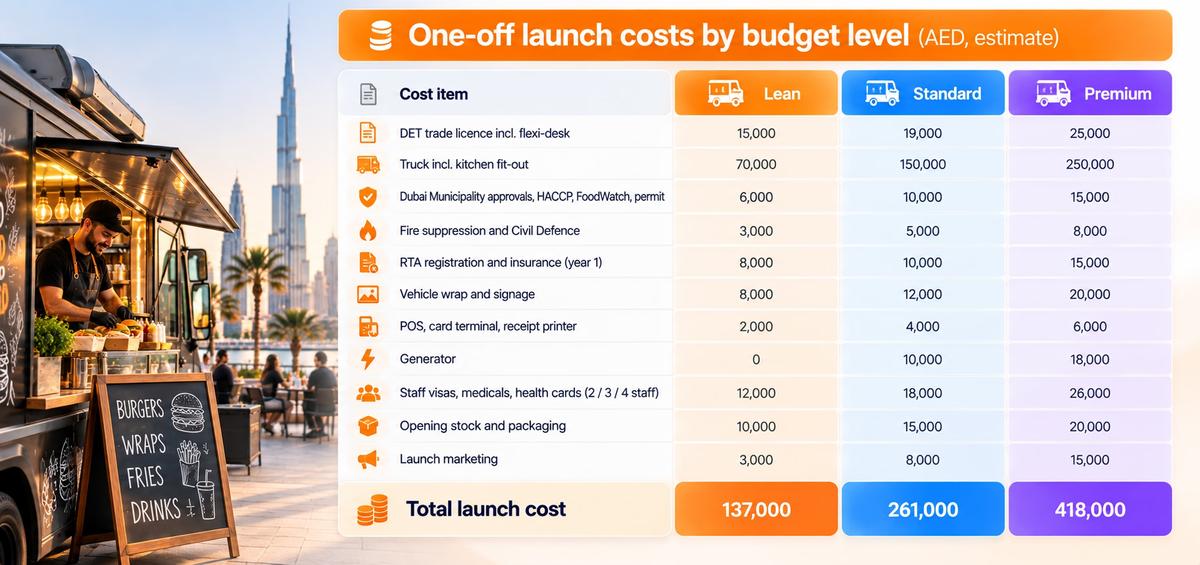
The food truck business license cost in Dubai is usually AED 13,000 to 25,000 for the DET trade licence, plus roughly AED 6,000 to 15,000 for Dubai Municipality approvals, HACCP and permits. But the licence is a small part of the bill. A realistic launch costs roughly AED 137,000 to 418,000 before you hold any cash reserve.
Why the figures online disagree
You will see licence costs from AED 5,000 to 25,000 and truck prices from AED 35,000 to 350,000. Both can be true. The spread comes from four choices:
- Professional vs commercial licence. A professional licence for a sole owner-operator is cheaper (around AED 13,000 quoted by consultants). A commercial licence for a company that sponsors staff visas is higher (around AED 19,000 and up).
- Whether the office is included. Mainland licences need a physical office or flexi-desk with a valid Ejari. Some quotes include it, some do not.
- New, second-hand or leased truck. A used truck with equipment can sit around AED 60,000 to 150,000. A new purpose-built unit is AED 150,000 to 350,000. A low "AED 35,000" figure usually refers to leasing, not buying.
- What counts as a startup cost. Many guides leave out the central kitchen, staff visas, location fees and a summer cash reserve. Those are where new owners get caught.
One-off launch costs by budget level
Monthly fixed costs most guides leave out
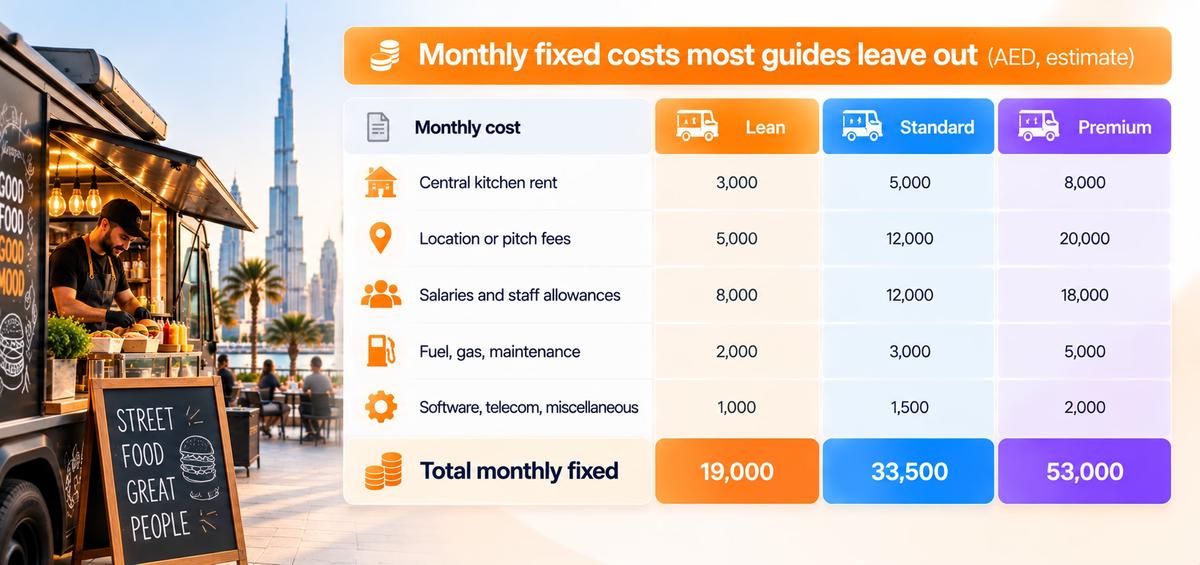
The summer reserve rule: keep at least four months of fixed costs in the bank at launch. That means roughly AED 76,000 (lean), AED 134,000 (standard) or AED 212,000 (premium) on top of the launch cost. Add a 10% to 15% contingency for approval delays or fit-out changes.
Need funding for this? Our guide to restaurant financing and loans covers the options.
Food truck business plan example (with Dubai numbers)
A food truck business plan for Dubai must prove two things: that you can cover fixed costs in the cooler months with room to spare, and that you have a plan for summer. Below is a worked food truck business plan example for a fictional concept, followed by a template you can copy.
DET and Dubai Municipality ask for a business plan during approvals, and banks or investors will ask too. Most templates online are US-based and ignore seasonality, pitch fees and the central kitchen. This one does not.
Sample concept: "Dosa Lane"
- Concept: South Indian dosas and filter coffee, made to order in under 4 minutes
- Why Dubai: a very large South Asian community, strong vegetarian demand and low ingredient cost per plate
- Locations: business parks at lunch, weekend markets and community events in season; corporate catering and delivery from the central kitchen in summer
- Team: owner plus 3 staff
- Launch budget: AED 261,000 (the standard column in the cost table above) plus a AED 134,000 summer reserve
Key assumptions
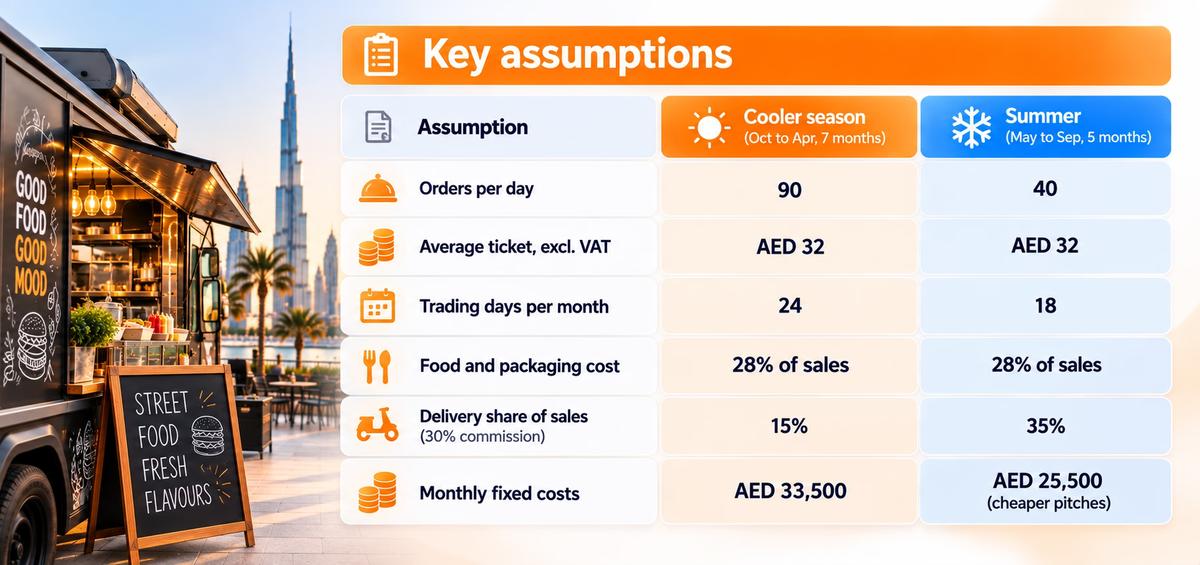
Fixed case: two changes that make the plan work
- Summer catering. Four corporate or private events a month at about AED 5,000 each, at a 50% contribution after food and labour, adds roughly AED 10,000 a month. The summer loss shrinks to about AED 1,300 a month.
- A stronger season. A signature item and a better lunch pitch lift orders from 90 to 110 a day. That adds about AED 10,400 of monthly profit in season.
With both changes, annual revenue is about AED 807,000 and net profit about AED 158,000, a margin near 20%. Payback on the launch cost drops to under two years. The plan's job is to show these levers before you spend money, not after.
Your break-even number
Every food truck business plan should state one number: how many orders a day you need to cover fixed costs.
\text{Break-even orders per day} = \frac{\text{Monthly fixed costs}}{\text{Average ticket} \times \text{Contribution margin} \times \text{Trading days}}
For Dosa Lane in season: 33,500 / (32 × 0.675 × 24) = about 65 orders a day. The contribution margin of 67.5% is what remains after 28% food cost and 4.5% delivery commission. If your planned location cannot realistically deliver your break-even number, change the location or the concept before you sign anything.
Food truck business plan template (copy and fill)
Use this food truck business plan template as your starting point. It follows the order DET reviewers and lenders expect, with Dubai-specific sections added.
# [Truck name] Food Truck Business Plan
## 1. Executive summary
- Concept in one sentence:
- Signature items (1 to 2):
- Target customers:
- Launch date and total investment:
- Expected break-even orders per day:
## 2. Concept and menu
- Cuisine and story:
- Menu (8 to 12 items, prep time per item):
- Halal sourcing and approved suppliers:
- Average ticket target (excl. VAT):
## 3. Market and competition
- Target locations and why:
- 3 to 5 competitors nearby, their prices and gaps:
- Your difference:
## 4. Location plan (season vs summer)
- Oct to Apr: parks, markets, beaches, business parks:
- May to Sep: catering, indoor venues, delivery:
- Permits or NOCs needed for each:
## 5. Operations
- Central kitchen (name, licence category, monthly cost):
- Truck spec and kitchen layout (HACCP reviewed?):
- Staff, roles, health cards, Person in Charge:
- Daily routine: prep, travel, service, cleaning:
- POS, inventory and ordering system:
## 6. Regulatory checklist
- DET trade licence (professional or commercial):
- Dubai Municipality approval, HACCP, FoodWatch:
- RTA registration and vehicle approval:
- Civil Defence fire certificate:
- VAT and Corporate Tax registration plan:
## 7. Marketing
- Instagram and TikTok plan, daily location posts:
- Launch partners or creators:
- Direct ordering vs delivery apps:
## 8. Financials
- Launch cost table:
- Monthly fixed costs:
- Season and summer revenue assumptions:
- Monthly P&L for 24 months:
- Summer cash reserve (min. 4 months fixed costs):
- Break-even and payback period:
## 9. Risks and fallback
- What if the pitch underperforms?
- What if approvals take 4 extra weeks?
- What if summer sales fall below plan?
Food truck business ideas that suit Dubai in 2026
The best food truck business ideas for Dubai are narrow, fast to serve and able to earn in summer through catering or delivery. Judge every idea on three tests: food cost per plate, service speed, and whether it has a summer income route.
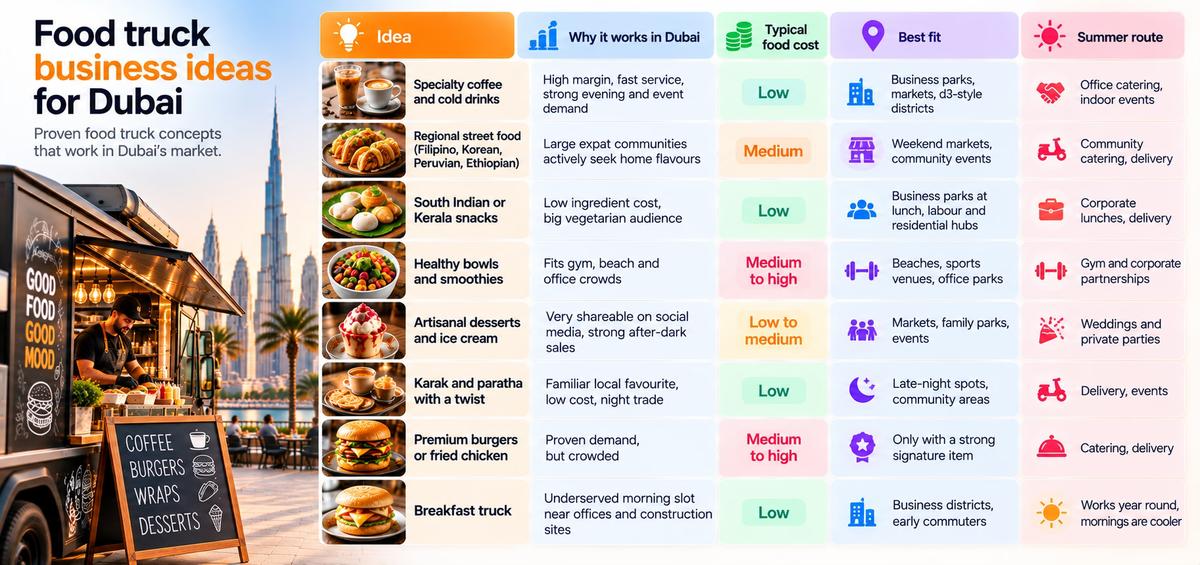
What to avoid: concepts that need long cooking times, more than 12 menu items, or ingredients that spoil fast in a small fridge. Generic burger and shawarma trucks can work, but only with a clear reason to choose you over the cafeteria next door. For brand positioning tips, read our restaurant branding strategy guide.
All menus sold in Dubai must meet UAE halal requirements, and your concept is reviewed by Dubai Municipality during approval, so confirm your menu is approvable before you invest in branding.
How to start a food truck business in Dubai: steps in the order that saves money
To start a food truck business in Dubai, validate the numbers, secure approvals and a central kitchen, and only then buy the truck. The full process usually takes 8 to 12 weeks when documents are in order. The sequence matters more than the checklist.
- Validate before you register (weeks 1 to 2). Visit your target locations at the times you plan to trade. Count queues at similar trucks, note prices and calculate your break-even orders per day. If you can, test the concept at a weekend market using a rented truck or a stall.
- Choose your licence and structure (week 2). Decide between a professional licence (sole owner-operator) and a commercial licence (company that will sponsor staff). Mainland DET licences allow 100% foreign ownership for most F&B activities. Reserve your trade name and get initial approval.
- Lock in your central kitchen (weeks 2 to 3). Sign with a shared or private kitchen whose Dubai Municipality licence covers your food category. You need its details for your HACCP plan.
- Get the kitchen layout and HACCP plan reviewed (weeks 3 to 5). Prepare the truck kitchen drawings (stainless steel surfaces, raw and cooked separation, ventilation, hand wash) and the central kitchen procedures. Get them approved before fabrication.
- Buy, fabricate or lease the truck (weeks 4 to 8). Now commission the build or buy second-hand with proof of prior registration as a food unit. Include fire suppression and extinguishers that meet Dubai Civil Defence requirements.
- Register and inspect the vehicle (weeks 7 to 9). Complete RTA registration and approval for the vehicle and any wrap or external modifications, get commercial insurance that covers food preparation, and pass the Civil Defence and Municipality inspections.
- Staff, visas and health cards (weeks 6 to 10). Process employment visas, medical screening and Occupational Health Cards for every food handler. Train a certified Person in Charge.
- Register on FoodWatch and set up systems (weeks 8 to 10). Complete your FoodWatch profile, open a corporate bank account, and set up your POS, card terminal, menu, recipes and stock levels.
- Secure locations and permits (weeks 6 to 12). Apply to food truck parks and seasonal markets early, since popular programmes have waiting lists and applications often close months before the season. Get developer NOCs for private sites and event permits for each event.
- Soft launch, then scale (week 12 onward). Start at one location, measure orders per hour and food cost for two weeks, fix the menu, then add locations and catering.
The main approvals involve the DET (trade licence), Dubai Municipality (food safety, HACCP, FoodWatch, permits), the RTA (vehicle and location NOCs), Dubai Civil Defence (fire safety) and health screening for food handlers. For a broader F&B licence list, see our restaurant licenses checklist, and if you later move to a fixed outlet, our guide on how to start a restaurant in the UAE.
Documents usually required: passport and visa copies of all owners, passport photos, trade name reservation, initial approval, business plan, kitchen layout drawings, central kitchen agreement, vehicle documents, RTA NOC, food safety training records and Ejari for the office or flexi-desk.
Running a food truck in the UAE: compliance and the daily numbers that keep you open
Once you open, profit depends on three habits: knowing your numbers every day, staying ahead of tax and inspection rules, and having a summer plan already in motion by April.
Tax and compliance owners miss
- VAT: registration is mandatory once taxable turnover passes AED 375,000 in 12 months, and voluntary above AED 187,500. A busy truck can cross the mandatory line in its first season, as the business plan example above shows. Decide early whether your menu prices include 5% VAT.
- Corporate Tax: every UAE business must register with the Federal Tax Authority, even if profit is low. The 9% rate applies only to taxable profit above AED 375,000, and businesses with revenue up to AED 3 million may elect Small Business Relief. Read our guide to Corporate Tax for UAE restaurants.
- E-invoicing: the UAE is rolling out mandatory e-invoicing in phases, starting with larger businesses. Choose billing software that can produce compliant invoices so you are not forced to switch systems later.
- Inspections: Dubai Municipality can inspect without notice. Expired permits, staff without health cards or poor temperature records can lead to fines and suspension. Keep digital logs for temperatures, cleaning and supplier invoices.
- Waste oil and food waste: use an approved collection provider. Never dispose of cooking oil in drains or public bins.
The daily dashboard
Check these numbers at the end of every service, not at month end:
- Orders and revenue by location and by hour
- Average ticket
- Food cost percentage against your target (aim for 25% to 32%)
- Sales by channel: truck, direct online, each delivery app
- Stock remaining for your top 10 ingredients
- Progress toward your daily break-even orders
Our guide to restaurant inventory management explains how to set par levels when storage is tight.
Your summer plan checklist (start in March)
- Pitch catering packages to 20 companies and event planners
- Book indoor or shaded venues for May to September
- Set up a delivery-only menu from your central kitchen
- Cut pitch fees for summer months where contracts allow
- Schedule truck maintenance and deep cleaning in the quietest weeks
- Confirm your cash reserve covers four months of fixed costs
How PosBytz helps food truck owners
A food truck needs a POS built for movement, small teams and multiple sales channels. PosBytz food truck POS is designed for exactly that:
- Works on tablets and mobile devices, so billing stays fast in a cramped hatch, with offline billing that syncs when the connection returns
- Location-wise reports, so you can compare a Tuesday at the business park with a Saturday at the market and drop pitches that do not hit break-even
- Recipe-based inventory, which deducts ingredients with every sale and warns you before your best seller runs out
- Online ordering and aggregator integration, so truck, direct and delivery orders land on one screen and you can see real profit per channel
- VAT-ready invoices and accounting, so registration and filing are simpler when you cross the threshold
- CRM and loyalty, to turn a one-time market visitor into a regular who follows your daily location
Book a free PosBytz demo to see how it would run your truck, from the first sale on launch day to your summer catering orders. See pricing.
FAQs: food truck business in Dubai and the UAE
Is a food truck business profitable in Dubai?
It can be, but margins vary widely. Well-run trucks report net margins of around 15% to 25%, while many new trucks lose money because of summer slowdowns, pitch fees and delivery commissions. Profitability depends on a strong location, a differentiated concept and a summer revenue plan such as catering.
How much is a food truck license in Dubai?
The DET trade licence typically costs about AED 13,000 for a professional licence and AED 19,000 to 25,000 for a commercial licence, depending on the office arrangement. Add roughly AED 6,000 to 15,000 for Dubai Municipality approvals, HACCP, FoodWatch and permits.
How much does it cost to start a food truck business in Dubai?
Expect roughly AED 137,000 to 418,000 in launch costs depending on whether you use a second-hand or new truck. On top of that, keep a cash reserve of about four months of fixed costs, which is AED 76,000 to 212,000 for most operators.
Can I run a food truck from my home kitchen in Dubai?
Generally no. Dubai Municipality usually requires food trucks to be linked to a licensed central kitchen for preparation, storage and cleaning. Shared commercial kitchens cost around AED 3,000 to 8,000 a month.
Can a foreigner start a food truck business in the UAE?
Yes. Mainland reforms allow 100% foreign ownership for most food and beverage activities, and free zones have always allowed full ownership. You still need the correct trade licence, food safety approvals and a valid UAE residence visa.
Where can food trucks operate in Dubai?
Only in approved spots: dedicated food truck parks, licensed markets and festivals, permitted beach locations and private sites with a developer NOC and RTA approval. Selling from a public road without approval is not allowed and can lead to fines or closure.
How long does it take to start a food truck in Dubai?
Usually 8 to 12 weeks from trade name approval to first sale. Delays usually come from truck fabrication, layout changes after HACCP review or waiting lists at popular locations.
Can I rent or lease a food truck instead of buying?
Yes. Renting is a smart way to test a concept at markets before committing. Check that the rented truck is already registered as a food unit and that its layout fits your menu and HACCP plan.
Do food trucks work in Dubai during summer?
Street trade drops sharply from around June to September. Trucks that stay profitable shift to private catering, corporate events, indoor venues and delivery from their central kitchen during these months.
Food truck or cloud kitchen: which is better in Dubai?
A cloud kitchen has lower setup costs and works year round, but depends on delivery apps and their commissions. A food truck builds a visible brand and earns more per order at events, but faces seasonality and pitch fees. Many operators combine both, using the required central kitchen for delivery orders.
What is the best food truck business plan template to use?
Use a template that includes seasonality, location fees, central kitchen costs and a break-even calculation, not just a generic US format. The free template in this guide covers all of these.
Do I need a POS system for a food truck?
Yes, in practice. You need fast billing, card payments, VAT-compliant invoices and sales data by location. A cloud POS like PosBytz also tracks stock and combines delivery app orders in one place.
About the author

Saravana Damodaram
Co-Founder & CEO, PosBytz
Saravana Damodaram is the Co-Founder & CEO of PosBytz, a cloud-based POS-ERP platform built for F&B and retail businesses since 2018. He focuses on unified commerce, inventory, and multi-location operations, and has helped over 5,000 merchants across 25+ countries move off fragmented, disconnected tools and run their entire operation, billing, inventory, kitchen, and accounting on one platform.