How to Start a Restaurant Business in Dubai (With All Licenses)
How to start restaurant business in Dubai with all permits from required documents, fees, and other important aspects you should know.



Dubai's rising tourist arrivals, growing urban population, and high disposable income have made it one of the most attractive food service markets in the region. If you are wondering how to start a restaurant business in Dubai and want a clear picture of the permits, documents, and costs involved, this guide walks you through the entire process, from choosing your business structure to getting your food license approved.
Step 1: Choose Your Business Location and Structure
Before anything else, you need to decide where and how your restaurant will be registered. This decision affects ownership rules, sponsorship requirements, and which authority approves your setup.
Mainland vs Free Zone
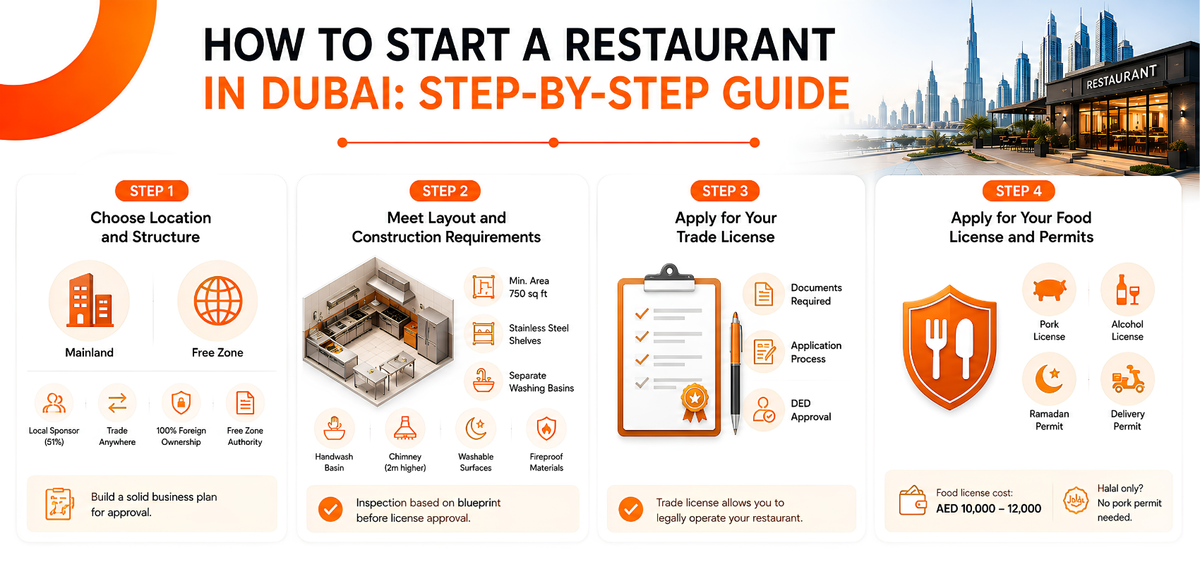
If you set up on Dubai's mainland, you are required to allocate 51% of your company to a local Emirati sponsor. In return, you get to trade freely anywhere in the UAE and take on walk-in customers from any location. A mainland restaurant needs approval from the Department of Economic Development (DED).
If you choose a free zone instead, you can retain 100% ownership of your company without a local sponsor. Free zone restaurants are approved by the relevant free zone authority rather than the DED, though there may be restrictions on operating outside the free zone itself.
Either route requires formal approval before you can move forward with licensing.
Building Your Restaurant Business Plan
Once you have chosen a location, you need a detailed business plan for the DED (or your free zone authority) to review. This plan should include:
- Your restaurant's vision, concept, and long-term goals
- Estimated capital needed for initial setup and ongoing operations
- Why you are opening this restaurant and what activities it will offer
- A contingency plan for unforeseen challenges
If you're specifically planning a quick-service concept rather than a full-service restaurant, our guide on how to start a fast food restaurant covers the format-specific considerations worth factoring into your plan.
Step 2: Meet Dubai's Restaurant Layout and Construction Requirements
Your trade license will only be issued after the authorities review your restaurant's construction plan. The Food Control Department sets minimum standards that every restaurant must meet, including:
- A restaurant area of at least 750 sq ft, with a kitchen area between 300 and 380 sq ft depending on whether you use a tandoor oven
- Stainless steel shelves in all food storage areas
- Separate washing basins for fish, meat, fruits, and vegetables
- A dedicated basin for handwashing
- A chimney in the cooking area, extending at least 2 meters higher than the nearest building
- Walls, floors, and roofing that are washable, non-absorbent, and fireproof
Meeting these requirements upfront saves you from delays later, since inspectors check your blueprint against these standards before approving your license.
Step 3: Apply for Your Trade License
A trade license confirms your legal right to operate a restaurant business in Dubai.
Documents Required for a Dubai Trade License
- Initial approval letter from the DED
- A finalized and detailed business plan
- Blueprints and floor plan of the restaurant
- Premises tenancy contract
- For mainland setups, a Memorandum of Association with your local sponsor
How to Obtain a Trade License
- Establish your business nature, whether commercial, industrial, or professional.
- State the expected corporate activities of your company.
- Declare your business's legal status in the UAE.
- Register a trading name for your restaurant.
- Fill in the application form with the DED.
- State your corporate office details and complete the registration forms.
- Submit all required documents to the DED for final approval.
Step 4: Apply for Your Food License and Permits
You need a business license from the DED to legally run your restaurant, and a food license from the Food Safety Department to serve food. You can only apply for a food license once your trade license has been approved.
Special Permits You May Need
Depending on what you plan to serve, you may also need:
- A pork license
- An alcohol license
- A permit for operating during Ramadan
- A permit for food delivery
A food license typically costs approximately AED 10,000 to AED 12,000 in Dubai. If your restaurant serves only Halal food, you do not need a pork permit.
How to Obtain a Food License
- Present the blueprint of your restaurant layout to the authorities.
- Get approval for your food code from Dubai's Food Control Department.
- Provide clear details of your restaurant area, food storage areas, washing areas, chimney, and handwashing basin in your blueprint.
- Visit the DED with all supporting documents to get your food license registered.
Documents Checklist to Open a Restaurant in Dubai
Here is a consolidated list of the documents you will need to start a restaurant business in Dubai:
- Trading license
- Food license
- Non-Objection Certificate (NOC) issued by Dubai Municipality
- Photocopy of the issued trade license
- Typed BR/1 form
- Confirmation report of P.O. box
- Ejari Registration Certificate
- Passport size photo
- DED letter approving your restaurant name
- Memorandum of Association (MOA)
- Tenancy agreement form
- Proof of payment
- UAE ID number
Planning Your Restaurant Budget
Beyond licensing fees, your budget should account for fit-out costs, kitchen equipment, staff, rent, and the technology you'll run day-to-day operations on. If you're comparing options for billing and order management as part of your setup costs, our breakdown of how much a restaurant POS system costs can help you plan that line item more accurately. For a full breakdown of every license you may need depending on your concept, see our restaurant licenses checklist.
Restaurant owners in the UAE should also factor corporate tax into their financial planning; our guide to corporate tax's effect on restaurants in the UAE explains what changed and how it applies to F&B businesses.
Get Your Business Ready for UAE E-Invoicing
Starting a restaurant in the UAE? Plan for e-invoicing from day oneAlong with your trade licence and VAT registration, you'll need an e-invoicing setup. Most new restaurants fall in the below-AED 50M group:
Appoint an ASP by 31 Mar 2027
E-invoicing becomes mandatory from 1 Jul 2027
(Larger groups with AED 50M+ revenue: ASP by 30 Oct 2026, live from 1 Jan 2027.) Choose a POS that's ready for it now so you don't have to switch later.
[Get ready for UAE e-invoicing with PosBytz →]
Frequently Asked Questions
Do I need a local sponsor to open a restaurant in Dubai?
Only if you set up on the mainland, where 51% ownership must go to a local Emirati sponsor. If you choose a free zone, you can retain 100% ownership without a local sponsor.
How much does a food license cost in Dubai?
A food license generally costs between AED 10,000 and AED 12,000, in addition to your trade license fees and any special permits your restaurant requires.
Do I need a pork or alcohol license for my restaurant?
Only if you plan to serve pork or alcohol. If your restaurant serves Halal food exclusively, you do not need a pork permit. Alcohol requires a separate license regardless of your other permits.
Can I apply for a food license before my trade license is approved?
No. Your trade license must be approved first. Only after that approval can you apply for your food license with the Food Safety Department.
What is the minimum restaurant size required by Dubai's Food Control Department?
The Food Control Department requires a restaurant area of at least 750 sq ft, with a kitchen area of 300 to 380 sq ft depending on whether a tandoor oven is used.
Final Words
Dubai's position as a leading tourist and business destination makes it a strong market for a new restaurant. Getting there without delays comes down to following each step carefully: choosing the right business structure, meeting layout requirements, securing your trade license, and completing your food license and permits in order. Gathering all required documents ahead of time will help you avoid unnecessary back-and-forth with the authorities.
Once your restaurant is licensed and ready to open, running it smoothly is the next challenge. PosBytz is an all-in-one restaurant management software built to handle billing, inventory, online ordering, and reporting from a single dashboard, so you can focus on your customers instead of juggling systems. Learn more about our restaurant POS software and how it fits into your new restaurant's setup. Start your Free Trial.
Related Resources
- Guide for Corporate tax UAE effect to Restaurants industry
About the author

Saravana Damodaram
Co-Founder & CEO, PosBytz
Saravana Damodaram is the Co-Founder & CEO of PosBytz, a cloud-based POS-ERP platform built for F&B and retail businesses since 2018. He focuses on unified commerce, inventory, and multi-location operations, and has helped over 5,000 merchants across 25+ countries move off fragmented, disconnected tools and run their entire operation, billing, inventory, kitchen, and accounting on one platform.