White Friday 2026 for Restaurants: A Profit-First Playbook for GCC Owners
Plan White Friday 2026 offers that protect margin. Discount math in SAR/AED, aggregator costs, ZATCA invoicing, staffing and a 5-week plan.
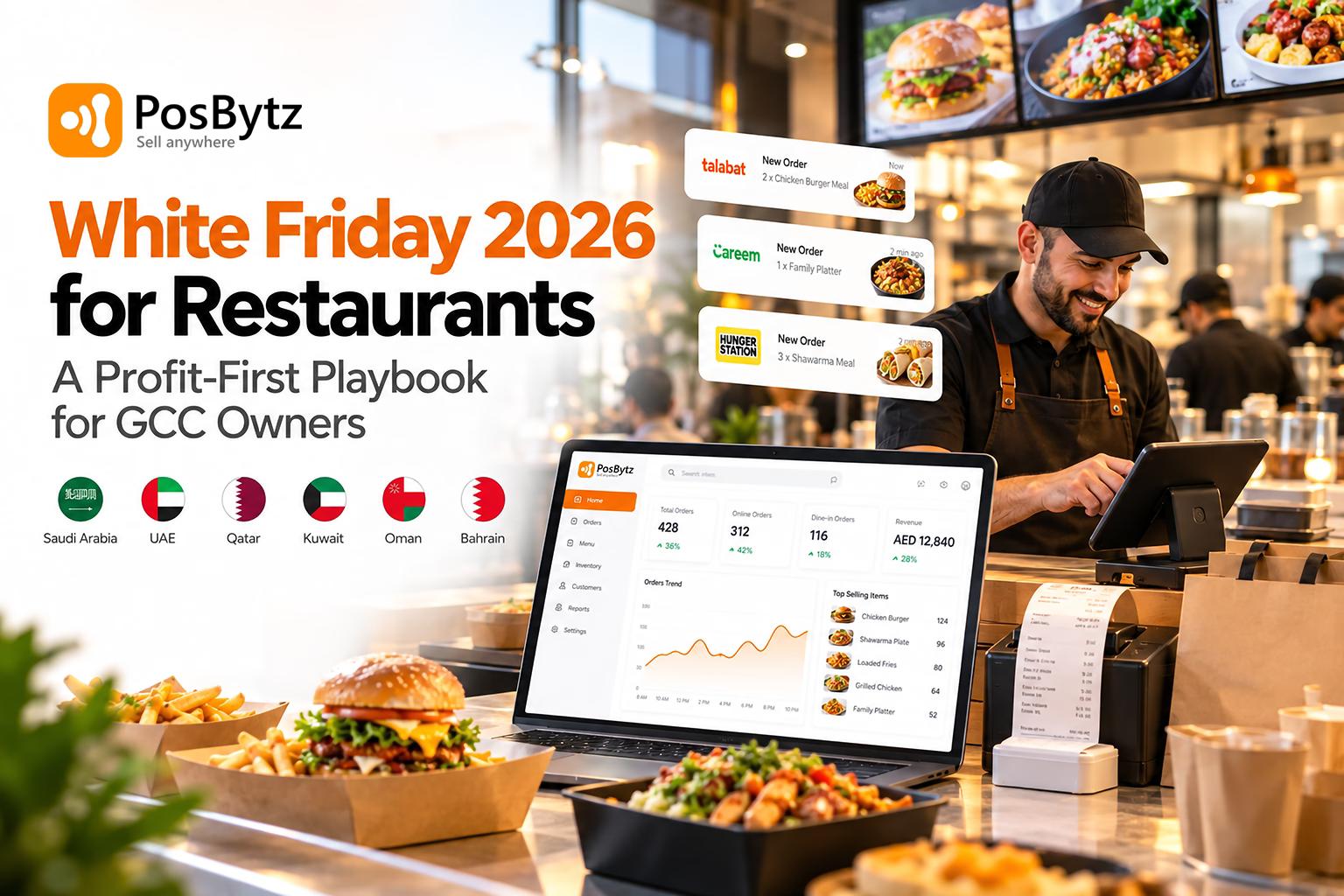


White Friday lands on Friday, 27 November 2026. If you run a restaurant in Riyadh, Dubai, Doha or Kuwait City, you already know the pattern. Retail runs the big banners, the delivery apps push their own campaigns, and somewhere in the noise your customers start expecting a deal from you too.
The question isn't whether to take part. It's how to take part without spending November working harder for less money.
This year carries more weight than usual. Restaurant data from Syrve MENA for the first half of 2026 showed UAE delivery orders up about 15% year on year, while dine-in orders fell by roughly 10% and gross restaurant revenue slipped 5.5%. Delivery now makes up close to a third of orders in that sample. That shift changes where your White Friday money should go, and it's a big part of why copying last year's "20% off everything" will hurt.
This playbook is written for owners and managers. It covers the numbers, the platforms, the tax side, the floor and a dated plan you can start this week.
Key dates for White Friday 2026 in the GCC
White Friday doesn't behave the same way across the region, mostly because weekends and pay cycles differ.
Saudi Arabia. Friday is part of the weekend, so your peaks are Thursday night and Friday after Jumu'ah prayers. Government salaries are paid on the 27th of each Gregorian month, and when the 27th falls on a Friday, payment usually moves up to Wednesday or Thursday. In 2026 that means many Saudi customers get paid on the 25th or 26th, right before White Friday. That's a rare overlap. Plan stock and staffing for a stronger Thursday and Friday than you saw last year.
UAE. The working week runs Monday to Friday with the weekend on Saturday and Sunday, so White Friday is a working day. Lunch may be quieter, while Friday dinner and Saturday carry the load. Eid Al Etihad (UAE National Day) holidays are expected on Wednesday 2 and Thursday 3 December, just five days later. Treat 27 November to 3 December as one campaign window, not two separate events.
Qatar, Kuwait, Bahrain and Oman. Friday and Saturday are the weekend, so the pattern looks closer to Saudi Arabia: Thursday night and Friday family meals are where volume shows up.
Before the day. 11.11 (Wednesday, 11 November) pulls some early promotional attention, mainly in retail and on delivery apps. Use it to test one offer at small scale before you commit to it on the 27th.
The discount math most owners skip
Here's the uncomfortable part. A discount doesn't come off your price. It comes straight off your profit, and your profit per order is much smaller than your price.
Take a chicken shawarma meal priced at SAR 30 (VAT exclusive). Food and packaging cost you SAR 10.50, so each order leaves SAR 19.50 to cover rent, salaries, utilities and, eventually, profit. We'll call that the contribution per order.
Now look at what happens as the discount grows:
- No discount: Price stays at SAR 30.00, leaving SAR 19.50 contribution per order. This is your baseline.
- 10% off: Price drops to SAR 27.00, contribution falls to SAR 16.50, and you need 18% more orders to earn the same.
- 20% off: Price drops to SAR 24.00, contribution falls to SAR 13.50, and you need 44% more orders to earn the same.
- 30% off: Price drops to SAR 21.00, contribution falls to SAR 10.50, and you need 86% more orders to earn the same.
- 50% off: Price drops to SAR 15.00, contribution falls to SAR 4.50, and you need 333% more orders to earn the same.
The formula is simple enough to keep on a sticky note:
Orders needed = current contribution ÷ contribution after discount
So at 20% off, 19.50 ÷ 13.50 = 1.44. You need 44% more orders just to stand still. At 50% off, you need more than four times your normal volume, and very few kitchens can physically produce that without service falling apart.
Two things make this worse in practice. First, a lot of White Friday traffic is customers who would have ordered anyway, now paying less. Second, these numbers don't yet include delivery commissions, which we'll get to next.
What to do with this: run the formula for your top ten items using your own food cost. Pull it from your item-wise sales and recipe costing in your POS reports. Any item where a 20% discount needs more than 30% to 40% extra volume is a poor candidate for a straight price cut.
Aggregator or direct: where your White Friday orders should land
In much of the GCC, delivery apps own the White Friday conversation. In Saudi Arabia that's HungerStation, Jahez, Keeta and Mrsool. In the UAE it's Talabat, Deliveroo, Careem and Noon Food. Qatar and Kuwait have Talabat, Snoonu and Deliveroo. They'll invite you into campaigns, and some will offer to co-fund the discount.
Before you agree, work out what one order is actually worth to you on each channel. Here's the same SAR 30 shawarma meal. The commission and delivery costs below are examples, so replace them with the figures in your own contracts.
Aggregator, full price, 25% commission: Price SAR 30.00, commission SAR 7.50, food and packaging SAR 10.50. You keep SAR 12.00.
- Aggregator, 20% off you fund, 25% commission: Price SAR 24.00, commission SAR 6.00, food and packaging SAR 10.50. You keep SAR 7.50.
- Direct order, full price, free delivery (rider cost SAR 7, card fee 2.5%): Price SAR 30.00, delivery and card cost SAR 7.75, food and packaging SAR 10.50. You keep SAR 11.75.
- Direct order, free delivery + free dessert (dessert cost SAR 2): Price SAR 30.00, delivery and card cost SAR 7.75, food and packaging SAR 12.50. You keep SAR 9.75.
Look at rows two and four. A free dessert plus free delivery on your own channel leaves you 30% more per order than a 20% discount on an aggregator. The customer arguably gets a better deal too. And you keep their phone number, which matters more after November than during it.
That doesn't mean leaving the apps. They bring customers who don't know you yet. A sensible split for White Friday:
- On aggregators: join co-funded campaigns only where the platform carries a real share of the discount. Limit your offer to two or three high-margin items. Don't discount your whole menu.
- On your direct channel: run your best offer here, such as free delivery, a bundle or a free add-on. Put a QR code or card in every aggregator bag pointing customers to your own commission-free online ordering for next time.
- On operations: make sure every channel feeds one screen. If tablets for three apps sit on the counter during a rush, orders get missed. Connecting your apps to the POS, for example when you integrate your POS with Talabat, removes the re-keying.
If you don't have your own riders, a free delivery app connected to your POS lets you dispatch direct orders through your own staff or a third-party fleet.
Want to run White Friday orders from every channel on one screen? Book a PosBytz demo.
Offers that bring in money, not just orders
The best White Friday offers in F&B share one trait. They raise the size of the order or bring revenue forward, rather than cutting the price of what people would have bought anyway.
Bundles priced just under the sum of the parts. A burger, fries and drink at SAR 39 when they'd cost SAR 44 separately feels like a deal. But if fries and drinks carry a 75% to 80% margin, you protect most of your contribution. Build bundles around one popular main and two high-margin sides.
Free add-ons above a spend threshold. "Free kunafa on orders above SAR 80" costs you the kunafa's food cost, maybe SAR 3 to 4. It also pushes many orders past SAR 80 that would have landed at SAR 60. Set the threshold roughly 20% to 25% above your current average order value.
Prepaid credit instead of discounts. "Pay SAR 200, get SAR 250 to spend from 1 December to 31 January." You receive cash in November and fill some of the slower weeks after the holidays. Some credit will never be used. Check with your accountant how VAT applies to the voucher type you choose before launching.
A White Friday-only item. A limited dish or drink sold only that week gives you something to promote without discounting anything. It also tests a new menu item at volume.
Corporate and group orders. Late November is busy for office gatherings, and in the UAE it runs straight into National Day celebrations. A pre-order platter menu for 10, 20 or 50 people with 48 hours' notice is easy to prep and has a high ticket value.
Playbook by restaurant type
QSR (shawarma, burgers, broasted)
- What tends to work: Bundles, free delivery on direct orders, and family boxes for Thursday night.
- What to avoid: A flat percentage off the whole menu on aggregators.
Cafés and coffee chains
- What tends to work: Prepaid coffee cards (pay for 10, get 12), morning bundles, and double loyalty points.
- What to avoid: Discounting the core drink you sell most.
Casual and family dining
- What tends to work: Pre-booked family set menus for Thursday and Friday, and free dessert above a set spend.
- What to avoid: Walk-in-only offers that create queues you can’t seat.
Fine dining
- What tends to work: A limited tasting menu with a booking deposit, and prepaid credit.
- What to avoid: Any visible price cut, as it weakens the brand.
Cloud kitchens
- What tends to work: Cross-brand bundles from one kitchen, co-funded app campaigns on two or three items, and bag inserts that push direct ordering.
- What to avoid: Joining every app campaign at once and overloading one line.
Bakeries and dessert shops
- What tends to work: Pre-orders for gatherings, National Day boxes, and collection-time slots.
- What to avoid: Taking same-day orders you can’t fulfil.
If you run a café or a cloud kitchen, our guides on café POS and cloud kitchen software cover how to set these offers up by brand and outlet.
Getting the invoice right: ZATCA and UAE VAT on promotions
This is the section most White Friday guides skip, and it's where Saudi restaurants run into trouble under ZATCA Phase 2. Every discount you run has to show up correctly on a compliant e-invoice. That's hard to fix after thousands of invoices have already been reported.
The points to get right before 27 November:
A discount at the time of sale reduces the taxable amount. If the meal is SAR 30 and you give 20% off, VAT is calculated on SAR 24. Your POS should apply the discount before VAT, either on the item line or on the whole invoice, and show it clearly.
Line-level and invoice-level discounts are treated differently in the e-invoice. A discount on one item sits on that line. A discount on the total, like SAR 10 off above SAR 80, sits at document level. Both are valid. The important part is that your POS sends them to ZATCA in the right structure every time, including when staff apply discounts manually.
"Free" items need care. With buy-one-get-one or a free dessert, the treatment depends on whether the free item is part of one discounted sale or counts as a separate free supply. Saudi VAT rules set a limit for free supplies, commonly cited as SAR 200 per recipient per year, beyond which VAT may apply. ZATCA's Business Promotions guideline sets out how to treat these cases. Read it, or ask your tax advisor, before you design a BOGO offer.
UAE restaurants face a similar question. Under UAE VAT, free goods given as commercial gifts or samples are excluded from deemed supply only up to AED 500 per recipient over 12 months. A free item tied to a purchase is usually treated as part of that sale. Again, confirm how your specific offer works with your advisor.
Vouchers and prepaid credit have their own rules in both countries. Settle the VAT treatment before you sell a single card.
Practical step: on a quiet day in early November, create every planned offer in the POS, ring up a few test orders and review the e-invoices. Check that VAT is calculated on the discounted amount and that discounts appear where they should. If you're using ZATCA-compliant e-invoicing built into your POS, promotions and invoices follow the same rules automatically.
This section is general information, not tax advice. Rules change, so check the current ZATCA and FTA guidance or speak with a registered tax agent.
Running the floor and the kitchen on the day
A good offer with poor execution is worse than no offer. A customer who waits 70 minutes for a discounted order rarely returns at full price.
Stock and prep
Pull last November's sales by item and by hour. Look for three things: which items spiked, which hours were the busiest, and where you ran out. Plan pars for White Friday week at your expected uplift on the items in your offers, plus a buffer. Order packaging early, since suppliers get tight in late November.
Over-ordering has its own cost. Fresh proteins and dairy prepped for a spike that doesn't arrive end up in the bin. Use your restaurant inventory management reports to set pars by item rather than guessing across the board. If you run several branches, compare outlets. One branch's spike is not every branch's spike. The guide on inventory for multiple outlets walks through this.
Staffing without blowing the labour budget
Rostering everyone for the whole day is the most common mistake. Use hourly sales from last year to add staff only during your real peaks, typically Thursday 7 pm to 11 pm and Friday 1 pm to 4 pm in Saudi Arabia, and Friday and Saturday evenings in the UAE. Split shifts and part-timers cover those windows without paying for idle hours. Our piece on how Saudi restaurants control labour costs has practical rostering ideas.
Brief the team on every offer before the day. Cashiers should know the exact rules, such as which items qualify, the minimum spend and whether offers stack. Confused staff improvise, and improvising costs money.
The kitchen line
Bundles help here as much as they help margins. Five fixed combos are far easier to produce at speed than 40 variations. If you're still using handwritten tickets, peak days are when orders go missing. An automatic KOT system or kitchen display that routes dine-in, takeaway, direct and aggregator orders to the right station removes that risk. More on this in our guide to managing multiple online orders.
Leak control
Busy days are when discounts get misused, sometimes by mistake and sometimes not. Set these rules in your POS before the day:
- Manager PIN required for any discount above your planned offer level, and for all voids and comps
- One promo code per order, with automatic expiry at the end of the campaign
- Offers tied to specific items and channels, so a delivery-only offer can't be applied at the counter
- End-of-shift review of discounts by cashier, voids and cash variance
A single cashier applying the 30% "staff meal" discount to customer orders during a rush can wipe out a day's promotional margin. You'll only see it if the report exists and someone reads it.
Your 5-week White Friday plan
Today is roughly five and a half weeks out. Here's a schedule that works backwards from 27 November 2026.
Week 1 (26 Oct to 1 Nov)
- Pull November 2025 sales by item, hour, channel and branch.
- Calculate break-even for your top items.
- Choose two or three offers.
Week 2 (2 to 8 Nov)
- Confirm aggregator campaign terms in writing, including who funds what.
- Set offers up in the POS.
- Run test invoices and check VAT.
- Order packaging.
Week 3 (9 to 15 Nov)
- Soft-test one offer around 11.11.
- Prepare bag inserts and direct-ordering QR codes.
- Draft WhatsApp and SMS messages for your existing customer list.
Week 4 (16 to 22 Nov)
- Finalise rosters and prep lists.
- Brief every shift on offer rules.
- Lock stock orders with suppliers.
- Start promoting to your own customers.
Week 5 (23 to 29 Nov)
- Begin final prep from Wednesday.
- In Saudi Arabia, expect Thursday to pick up after payday.
- Monitor wait times hourly on the day and pause offers if the kitchen falls behind.
After White Friday (30 Nov to 3 Dec for the UAE, and through December)
- Review results within a week.
- UAE outlets roll straight into Eid Al Etihad.
- Start the retention plan.
After the rush: measuring it and keeping the new customers
Most restaurants judge White Friday by one number: sales were up. That tells you very little. Within a week, compare White Friday week against a normal week and against last year's White Friday on these restaurant KPIs:
Discounts as a % of gross sales: Shows what the campaign really cost you.
- Contribution per order: Revenue minus food, packaging, commission and delivery. Did it hold up?
- Average order value: Did bundles and spend thresholds work?
- Orders by channel: Did you shift volume toward direct ordering?
- New vs returning customers: Did you reach anyone new, or just discount regulars?
- Average ticket time at peak: Did service hold up under load?
- Voids, comps and manual discounts: Was there any leakage?
- Waste on promo items: Did you over-prep?
Write down what you'd change. Next November, that note will be worth more than any guide.
A 30-day plan to keep White Friday customers
The customers who found you through a deal are the ones most likely to drift to the next deal. You have about a month to give them a reason to stay.
- Day 1 to 3: Thank first-time direct customers with a short WhatsApp or SMS message. No offer yet, just a thank you and a link to order again.
- Day 7 to 10: Send a modest, personal offer to customers who haven't come back, such as a free side on their next order. This is far cheaper than another round of discounts.
- Day 14 to 21: Invite them into your loyalty programme, ideally with points already credited from the White Friday order.
- Day 30: Check how many returned at full price. That's the real result of your campaign.
A restaurant CRM linked to your POS lets you build this list automatically from order data. WhatsApp ordering gives customers the shortest path back to you.
How PosBytz helps GCC restaurants run a profitable White Friday
Everything above is easier when the numbers live in one place. Most restaurants we speak with in Riyadh and Dubai don't struggle with ideas for White Friday. They struggle because their POS, delivery tablets, inventory sheet, loyalty app and invoicing tool don't talk to each other, so nobody can see what the campaign is really earning until weeks later.
PosBytz is a cloud POS and restaurant management system that puts those pieces on one platform. Here's how it lines up with the plan in this guide.
Work out which items can carry an offer: Recipe cost control deducts ingredients automatically with every sale, so your food cost per item comes from real data, not a spreadsheet from last year.
- Move orders from aggregators to your own channel: Zero commission on direct orders through your own branded website and iOS and Android apps. The free PosBytz delivery app handles your riders with live tracking, ETA updates and cash-on-delivery collection.
- Keep aggregator orders under control: Talabat, Careem and Deliveroo orders flow into the POS, so your team works from one screen instead of three tablets.
- Stay ZATCA compliant while running offers: ZATCA e-invoicing is built into billing, so invoices are generated in the required format at the point of sale.
- Keep the kitchen moving at peak: The Kitchen Display System routes orders to the right station, tracks prep times and alerts staff when tickets run late.
- Plan stock across branches: Multi-location inventory shows ingredient levels by outlet in real time, with an audit log for every stock movement.
- Staff the rush without overspending: Employee management covers shifts, attendance and role-based access, so only the right people can make sensitive changes at the till.
- Turn deal-seekers into regulars: The CRM builds customer segments by spend, visit frequency and last order, then sends WhatsApp, SMS or email campaigns. Loyalty points and tiers apply automatically at checkout.
- Measure the result: Business reports cover sales, inventory and staff performance across every outlet and channel.
Payments run through GCC gateways such as PayTabs and Tap, and sales can sync to Zoho Books, QuickBooks or Xero, so your accountant isn't rebuilding November by hand in December.
The real value shows up after the weekend. On Saturday morning, you can open one dashboard and see what White Friday actually made, by item, channel and branch. Then you can message every new customer from that list the same week.
If you're planning White Friday on a patchwork of tools this year, there's still time to change that before 27 November. Setup for a single outlet is quick, and our team can help you configure your menu, outlets and delivery channels ahead of the rush.
Book a free PosBytz demo or see pricing to find the plan that fits your restaurant.
Frequently asked questions
When is White Friday 2026?
Friday, 27 November 2026. Many brands in the GCC run offers through the whole week or the whole month of November.
How much discount should a restaurant give on White Friday?
Work it out from your contribution per order, not from what competitors advertise. For most restaurants, a straight cut above 20% needs an unrealistic jump in orders to break even. Bundles, free add-ons above a spend threshold and free delivery on direct orders usually protect margin better.
Should I join aggregator White Friday campaigns?
Join where the platform co-funds a meaningful share of the discount, and limit it to a few high-margin items. Keep your strongest offer for your own ordering channel so you keep the customer relationship.
How do I show a buy-one-get-one-free offer on a ZATCA e-invoice?
It depends on whether the free item counts as a discount within one sale or as a separate free supply. ZATCA's Business Promotions guideline covers this, and the treatment can affect how much VAT you report. Confirm with your tax advisor and test the invoice output in your POS before launch.
Is White Friday worth it for fine dining restaurants?
Usually not through visible discounts. A limited tasting menu with a booking deposit, or prepaid dining credit for December and January, brings in revenue without lowering the perceived value of the brand.
Final word
White Friday rewards the restaurants that plan with real numbers: margins per item, costs per channel, staffing by the hour, and invoices that pass ZATCA checks the first time. Done well, it's a strong week that also leaves you with a list of new customers for December. Start with the break-even table this week, pick your two or three offers, and give your team time to get comfortable with them before the 27th.
About the author

Saravana Damodaram
Co-Founder & CEO, PosBytz
Saravana Damodaram is the Co-Founder & CEO of PosBytz, a cloud-based POS-ERP platform built for F&B and retail businesses since 2018. He focuses on unified commerce, inventory, and multi-location operations, and has helped over 5,000 merchants across 25+ countries move off fragmented, disconnected tools and run their entire operation, billing, inventory, kitchen, and accounting on one platform.