How to Open a Cloud Kitchen in the UAE (2026): License, Cost and Rent in Dubai and Abu Dhabi
License steps for Dubai and Abu Dhabi, real AED costs, where to rent a kitchen and how to get on Talabat.


To open a cloud kitchen in the UAE you need three things: a trade license with a food activity, a food safety approval for the kitchen, and a kitchen that passes inspection. In Dubai that means DET (Department of Economy and Tourism) and Dubai Municipality. In Abu Dhabi it means ADDED (through TAMM) and ADAFSA.
If you rent a pod in a shared cloud kitchen, you can be taking orders in 2 to 4 weeks. Budget roughly AED 45,000 to 100,000 to launch. An independent kitchen takes 6 to 12 weeks and usually AED 75,000 to 150,000 or more.
This guide covers each license step with its cost and timing, where to rent a kitchen in Dubai and Abu Dhabi, what Talabat and the other apps charge, and whether you can start from home.
Quick answer
Dubai: DET trade license plus Dubai Municipality food approval. License from about AED 15,000 to 25,000. Takes 2 to 12 weeks.
Abu Dhabi: ADDED license on TAMM plus ADAFSA approval. License from about AED 8,000 to 20,000. Takes 2 to 10 weeks.
Shared kitchen rent: about AED 5,000 to 15,000 a month.
Delivery app commission: about 15% to 35% of each order.
What is a cloud kitchen?
A cloud kitchen (also called a ghost kitchen or dark kitchen) is a delivery-only food business with no dining area. Orders come from apps like Talabat, Deliveroo, Noon Food and Keeta, or from your own ordering website. With no dining room or front-of-house staff, it costs less to open than a restaurant.
UAE law has no separate "ghost kitchen license". A cloud kitchen gets the same food licenses as any other food business, under a delivery-focused activity.
There are four main ways to run one:
- Model: Shared or plug-and-play kitchen
- How it works: You rent an equipped pod in a facility that already holds the food permits
- Best for: First-time operators who want to launch fast
- Model: Managed or turnkey kitchen
- How it works: The operator supplies the kitchen and often the staff; you supply the brand and recipes
- Best for: Existing brands expanding into a new emirate
- Model: Delivery-app kitchen
- How it works: A kitchen site run by or with a delivery platform
- Best for: Brands with proven order volume on that app
- Model: Independent kitchen
- How it works: You lease and fit out your own unit
- Best for: Multi-brand operators who want full control
How does a cloud kitchen work?
The cloud kitchen business model works similarly to popular apps like Deliveroo, Ubereats, Careem, Noon and Talabat that deliver food online. Cloud kitchens offer customers an online ordering portal where they can place orders and have the food delivered to their doorstep.
This business model is ideal for somebody who wants to enter the restaurant industry but doesn’t want or can’t afford to make a significant upfront investment. The low-risk, the low-cost setup makes it a lucrative option compared with opening up a traditional establishment from scratch.
Why the UAE Is a Strong Market for Cloud Kitchens in 2026
The UAE’s online food delivery market has grown from roughly USD 1.7 billion in 2024 toward an estimated USD 2.8 billion by 2026, driven by a tech-savvy, majority-expatriate population and near-universal smartphone adoption. That kind of growth is exactly why a delivery-first model — one that isn’t dependent on walk-in footfall — is one of the more resilient ways to enter the UAE’s food industry right now. Multi-brand cloud kitchens, where a single facility runs two or three virtual restaurant concepts at once, have become a particularly popular way to maximize revenue per square foot of kitchen space.
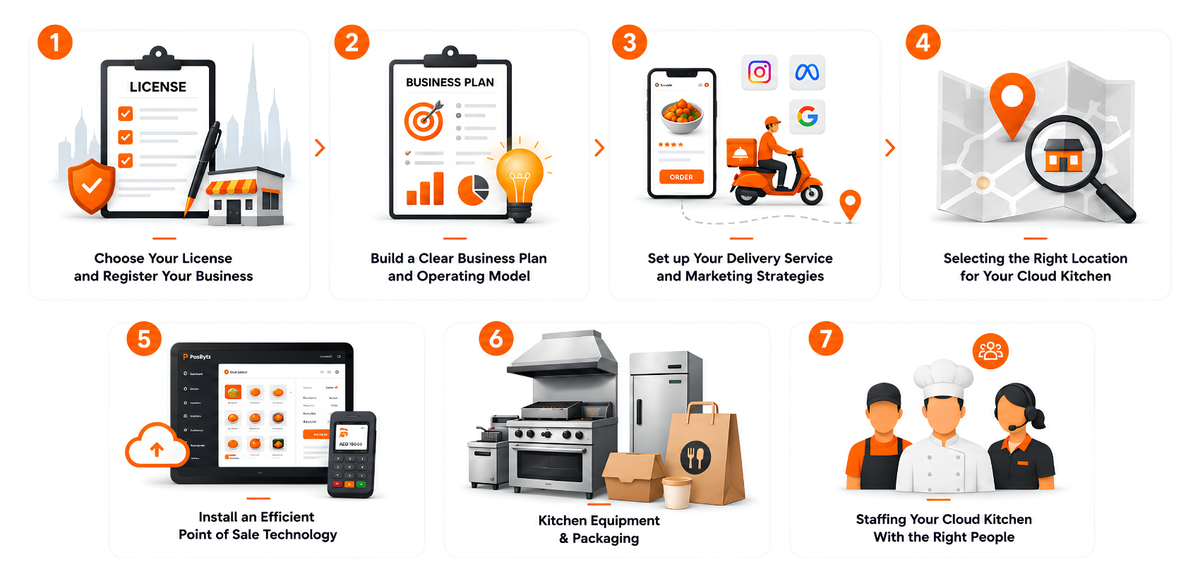
How to Open a Cloud Kitchen in the UAE: 7 Steps
Cloud kitchen allows you to get your feet wet while testing the waters of the industry without having to make a potentially costly investment in equipment and infrastructure.
You can open your cloud kitchen by following these simple steps,
Step 1: Get your license
Your license depends on the emirate the kitchen is in, not where your customers are. Get initial approval before you sign a lease, so you never pay rent on a kitchen you can't use.
Step 1A: Cloud kitchen license in Dubai
In a shared kitchen this takes 2 to 4 weeks. An independent kitchen takes 6 to 12 weeks. The license costs about AED 15,000 to 25,000, and approvals add AED 2,000 to 15,000.
- Step-1: Choose your legal form and a delivery food activity (for example food preparation and delivery). Use a mainland license unless a free zone confirms it allows a kitchen at your site.
- Authority: DET or free zone
- Typical cost (AED): N/A
- Typical time: 1 day
- Step-2: Reserve your trade name and get initial approval
- Authority: DET (Invest in Dubai portal)
- Typical cost (AED): About 620 for the name
- Typical time: 3 to 5 working days
- Step-3: Sign the kitchen lease and register it on Ejari. In a shared kitchen, the operator gives you the lease.
- Authority: Landlord, Ejari
- Typical cost (AED): Rent, plus a market fee of about 5% of annual rent on mainland leases
- Typical time: 1 to 7 days
- Step-4: Get your kitchen layout approved, then fit out (independent kitchens only). Plans must cover ventilation, drainage and grease traps.
- Authority: Dubai Municipality, Food Safety Department
- Typical Cost: 5,000 to 10,000
- Typical Time: 2 to 6 weeks including fit-out
- Step-5: Civil Defence fire safety approval (independent kitchens only)
- Authority: Dubai Civil Defence
- Typical Cost: 2,000 to 5,000
- Typical Time: 1 to 2 weeks
- Step-6: Pay the license fees and collect your trade license
- Authority: DET
- Typical cost (AED): 15,000 to 25,000 (food activity, including activity fees)
- Typical time: 1 to 3 days
- Step-7: Pass the pre-opening inspection, register on FoodWatch, and certify a Person in Charge (PIC)
- Authority: Dubai Municipality
- Typical cost: FoodWatch free; PIC 300 to 500 per person
- Typical time: About 1 week
After you have your license, apply for visas for your staff (about AED 4,000 to 7,000 each). Register for VAT if your sales will pass AED 375,000 a year.
For a full breakdown of license fees by emirate, see our trade license cost in UAE guide.
Step 1B: Cloud kitchen license in Abu Dhabi
In a shared kitchen this takes 2 to 4 weeks. An independent kitchen takes 6 to 10 weeks. Government fees usually come to AED 12,000 to 30,000. The biggest difference from Dubai: ADAFSA must approve your kitchen layout before any fit-out starts.
- Step-1: Choose a delivery-only food activity on the ADDED activity list. A general trading license does not cover food preparation.
- Authority: ADDED (TAMM)
- Typical cost (AED): n/a
- Typical time: 1 day
- Step-2: Reserve your trade name and get initial approval
- Authority: ADDED (TAMM portal or service centre)
- Typical cost (AED): 500 to 1,000
- Typical time: 1 to 5 working days
- Step-3: Sign the kitchen lease and register it on Tawtheeq
- Authority: Landlord, Abu Dhabi Municipality
- Typical cost (AED): Rent
- Typical time: 1 to 7 days
- Step-4: Get preliminary approval of your kitchen layout, before fit-out (independent kitchens only)
- Authority: ADAFSA
- Typical cost (AED): About 200
- Typical time: 1 to 3 weeks
- Step-5: Fit out the kitchen and pass the fire safety inspection
- Authority: Abu Dhabi Civil Defence
- Typical cost (AED): 500 to 2,000
- Typical time: 2 to 4 weeks including fit-out
- Step-6: Pay for and receive the trade license, then the establishment card
- Authority: ADDED
- Typical cost (AED): License 8,000 to 20,000; establishment card 1,000 to 2,000
- Typical time: 1 to 3 days
- Step-7: Pass the final inspection and get your food permit. Train staff in basic food hygiene.
- Authority: ADAFSA
- Typical cost (AED): 1,500 to 5,000, depending on risk category
- Typical time: About 1 to 2 weeks
In a shared kitchen, the facility's ADAFSA permit covers the premises. You still need your own ADDED trade license with a food activity, plus the brand-level approvals the operator asks for.
Step 2: Pick the kitchen model and location
Choose shared, managed, delivery-app or independent (see the table above). Then pick an area by delivery radius, not footfall. Most UAE cloud kitchens sit in industrial or mixed-use areas with lower rent and easy rider access. In Dubai that is Al Quoz and Dubai Investment Park. In Abu Dhabi it is Mussafah and ICAD. Check that the area your kitchen covers includes the neighbourhoods where your target customers order. See rent prices below.
Step 3: Set up the kitchen and packaging
In a shared kitchen, the main equipment and extraction are usually included. You add smallwares, storage and packaging. In an independent unit, plan equipment and fit-out to match the layout the authorities approved, because changes trigger re-inspection. Dubai Municipality now expects clear allergen labelling and temperature control in delivery: chilled food at 5°C or below, hot food at 60°C or above. Choose packaging that keeps those temperatures for your delivery radius.
Step 4: Build your menu and brands
Start with one brand and a short menu that travels well. Many UAE operators later add a second or third virtual brand from the same kitchen, sharing ingredients across menus to keep waste down.
Step 5: List on the delivery apps and your own channel
Get on Talabat first (it has the most orders in most areas), then add Deliveroo, Noon Food or Keeta. Your own ordering website lets repeat customers order without paying commission.
Step 6: Set up your POS before the first order
A cloud kitchen POS should do four things:
- Bring all delivery-app orders into one screen
- Run several brands and menus from the same kitchen
- Track stock and recipe costs at the ingredient level
- Produce VAT-ready invoices
VAT-ready invoices matter more from 2027, when B2B invoices move to the UAE e-invoicing mandate (businesses under AED 50M revenue go live on 1 July 2027). PosBytz cloud kitchen software does all of this from one dashboard.
Cloud kitchen in Abu Dhabi
Abu Dhabi is cheaper to license than Dubai. ADDED fees start around AED 8,000. The approval order is stricter, though: ADAFSA first, then fit-out. Most new operators start in a shared or managed kitchen and keep their own ADDED license.
Where cloud kitchens are
- Area: Mussafah
- Why operators choose it: Lowest rent, close to central Abu Dhabi, easy for riders
- Area: ICAD (Industrial City of Abu Dhabi)
- Why operators choose it: Bigger units, suits multi-brand kitchens
- Area: Khalifa City
- Why operators choose it: Near large residential areas and universities
- Area: Al Reem Island and the city centre
- Why operators choose it: Shared kitchens close to high-density delivery zones
Who rents kitchens in Abu Dhabi
Shared and managed options include KitchenPark (equipped CloudKitchens in Abu Dhabi and Dubai) and Truss (turnkey kitchens with staff and a shared dine-in area at WTC Mall). Prices are by quote, so ask each one for a written price that shows rent, utilities and service charges separately.
Abu Dhabi checklist
- ADDED trade license with a food activity (TAMM)
- Tawtheeq-registered lease
- ADAFSA layout approval before fit-out (independent kitchens)
- Civil Defence inspection
- ADAFSA food permit and staff food hygiene training
- Talabat and other delivery app accounts set to deliver from your Abu Dhabi address
Cloud kitchen for rent in Dubai and Abu Dhabi
A shared cloud kitchen pod costs about AED 5,000 to 15,000 a month in both Dubai and Abu Dhabi. A private unit you fit out yourself in Al Quoz runs about AED 13,000 to 26,000 a month, depending on size.
- Option: Shared kitchen pod or workstation
- Size: About 150 to 300 sq ft
- Example area: Al Quoz, Downtown Dubai, Mussafah, Al Reem
- Rent (AED per month): 5,000 to 15,000
- Fit-out needed: No: equipment and permits included
- Option: Dedicated central kitchen
- Size: About 3,000 sq ft
- Example area: Al Quoz
- Rent (AED per month): About 13,000
- Fit-out needed: Partial
- Option: Mid-size standalone unit
- Size: About 5,000 sq ft
- Example area: Al Quoz Industrial Area 1
- Rent (AED per month): About 26,000
- Fit-out needed: Yes
- Option: Managed or turnkey kitchen
- Size: By agreement
- Example area: Dubai and Abu Dhabi
- Rent (AED per month): Fee or revenue share, by quote
- Fit-out needed: No
The shared-pod range comes from setup consultants. The unit prices are from live Al Quoz listings in 2026.
Providers to compare
- Dubai: KitchenPark, The Co-Kitchens (Downtown), Kitchen Works (Al Quoz), Express Kitchens, Kitch
- Abu Dhabi: KitchenPark, Truss
Before you sign, ask what the rent includes
Rent usually covers the kitchen space, basic equipment, utilities and shared areas like cold storage and loading bays. These are the items most often charged on top:
- DEWA (water and electricity) in Dubai, or utilities in Abu Dhabi
- Equipment maintenance
- Pest control
- Waste and grease-trap disposal
- Service charges and the security deposit
Ask for a 3 to 6 month minimum term while you test demand, and confirm the facility's food permit covers your menu type.
Talabat, Deliveroo, Noon and Keeta: commissions and listing
Most UAE cloud kitchens pay 15% to 35% of each order to the delivery app. Commission is usually your biggest cost after food and rent, so negotiate it before you sign.
- App: Talabat
- Typical commission: 15% to 30%, negotiated per restaurant
- Notes: Largest UAE platform. Big chains report around 18% to 22%.
- App: Deliveroo
- Typical commission: 25% to 35%
- Notes: An onboarding fee may apply on top
- App: Noon Food
- Typical commission: About 21% base, about 23% with payment processing
- Notes: Lower rates for Emirati SMEs under a Dubai SME partnership
- App: Keeta
- Typical commission: Not published
- Notes: Founding Vendor Program with no setup or registration fee
Rates are reported figures, not official rate cards. Ask each platform for its written commission schedule. Since 2025, Dubai consumer protection guidance (DCCPFT) requires delivery platforms to disclose commissions clearly and give 30 days' notice before changing contract terms.
Talabat and other app-run cloud kitchens
Talabat and Deliveroo have both run their own kitchen sites in the UAE, where a brand cooks inside a facility linked to the platform. These programmes open, close and change terms often, so ask your account manager what is available in your area. If one is open to you, compare its commission and rent together against a shared kitchen plus a standard listing.
What you need to list on a delivery app
- Trade license with a food activity
- Food permit (Dubai Municipality or ADAFSA), or the shared kitchen's permit plus your lease
- Menu with prices that include VAT, plus photos
- Owner's Emirates ID or passport, and company bank details
- VAT certificate (if registered)
Make each order more profitable
Raise your app prices slightly to cover commission. Push repeat customers to your own ordering website, where there's no commission. Track profit separately for each app and each brand.
How Much Does It Cost to Open a Cloud Kitchen in the UAE?
A single-brand cloud kitchen in a shared facility costs about AED 42,000 to 124,000 to launch, including the first three months' rent. An independent kitchen costs about AED 70,000 to 180,000 before rent, because you pay for fit-out, equipment and your own approvals.
- Cost item: Trade license with a food activity (DET or ADDED)
- Shared kitchen (AED): 8,000 to 25,000
- Independent kitchen (AED): 8,000 to 25,000
- Cost item: Trade name, initial approval, establishment card
- Shared kitchen (AED): 1,500 to 3,000
- Independent kitchen (AED): 1,500 to 3,000
- Cost item: Food safety and Civil Defence approvals
- Shared kitchen (AED): 300 to 1,000 (staff certification only)
- Independent kitchen (AED): 4,000 to 15,000
- Cost item: Rent: deposit plus first 3 months
- Shared kitchen (AED): 15,000 to 45,000
- Independent kitchen (AED): 40,000 to 90,000 (about 3,000 sq ft)
- Cost item: Fit-out (estimate, get 3 quotes)
- Shared kitchen (AED): 0 to 5,000
- Independent kitchen (AED): 25,000 to 60,000
- Cost item: Equipment and smallwares
- Shared kitchen (AED): 5,000 to 15,000
- Independent kitchen (AED): 20,000 to 50,000
- Cost item: First packaging stock
- Shared kitchen (AED): 2,000 to 5,000
- Independent kitchen (AED): 2,000 to 5,000
- Cost item: Launch marketing and app promotions
- Shared kitchen (AED): 10,000 to 25,000
- Independent kitchen (AED): 10,000 to 25,000
The independent total includes rent. Before rent it comes to about AED 70,000 to 180,000.
Monthly running costs to plan for
- Delivery app commission: 15% to 35% of app orders
- Rent: AED 5,000 to 15,000 (shared) or 13,000 to 26,000 (independent unit)
- Staff: salaries, plus about AED 4,000 to 7,000 per visa when you hire
- Food cost: most delivery menus aim for about 28% to 35% of the menu price
- POS and online ordering: a monthly subscription. See PosBytz pricing.
The fastest way to cut setup cost is a shared kitchen: the facility's equipment and food permits replace most of your fit-out and approval spend.
Can you run a cloud kitchen from home in the UAE?
Partly. Dubai and Abu Dhabi both license small home food businesses, but only for low-risk food at low volume. A multi-brand delivery kitchen still needs a commercial or shared kitchen.
Dubai
- License route: Home food business permit from Dubai Municipality, plus a home-based business license
- Typical fees (AED): About 1,000 to 3,000, plus 300 to 500 for food safety training
- Who can apply: Reported as open to nationals and residents. Expats may need landlord and community approval.
- Food allowed: Low-risk items such as baked goods, desserts, packaged snacks and some cooked meals
- Usually not allowed: Raw seafood, unpasteurised dairy, some meat products
- Inspection: Dubai Municipality inspects your home kitchen before approval
Abu Dhabi
- License route: Tajer Abu Dhabi license from ADDED, plus ADAFSA approval
- Typical fees (AED): Government fees from under 1,000, plus the ADAFSA permit
- Who can apply: Check your eligibility on TAMM
- Food allowed: Approved after an ADAFSA kitchen inspection
- Usually not allowed: High-risk items, per ADAFSA's risk category
- Inspection: ADAFSA inspects your home kitchen before approval
Eligibility rules for home food licenses have changed several times, and sources disagree on who can apply. Confirm with DET or Dubai Municipality (Dubai) or TAMM (Abu Dhabi) before you spend money. Selling food from home without a license can bring heavy fines.
If your home business grows past a few dozen orders a day, or you want to be on Talabat at scale, move to a shared kitchen. It's the usual next step and keeps your costs low.
Choosing the Right Cloud Kitchen POS and Delivery Tech
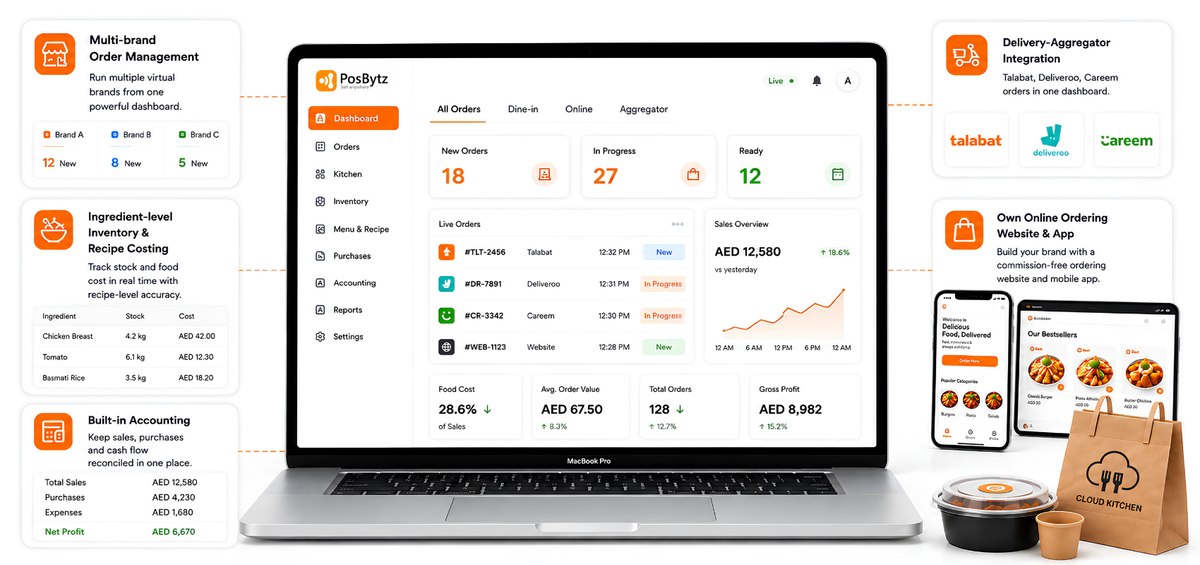
Once you’re operational, the biggest ongoing risk isn’t licensing — it’s losing track of food cost, inventory, and order accuracy across multiple channels. The right cloud kitchen POS should give you:
- Multi-brand order management from one screen, so you can run several virtual concepts out of one kitchen
- Ingredient-level inventory and recipe costing, so food cost stays visible in real time rather than showing up as a surprise at month-end
- Delivery-aggregator integration with Talabat, Deliveroo, and Careem, so every order lands in one dashboard instead of three separate tablets
- Your own commission-free online ordering website and app, so you’re not entirely dependent on aggregator commissions
- Built-in accounting, so sales, purchases, and cash flow stay reconciled without a separate bookkeeping system
Get Your Business Ready for UAE E-Invoicing
Cloud kitchens and UAE e-invoicingIf you supply brands, corporate clients, or other kitchens, those B2B invoices come under the UAE e-invoicing mandate.
Under AED 50M revenue: appoint an ASP by 31 Mar 2027 · live 1 Jul 2027
AED 50M+: appoint an ASP by 30 Oct 2026 · live 1 Jan 2027
[Get ready for UAE e-invoicing with PosBytz →]
2026 Trends Shaping UAE Cloud Kitchens
Two shifts are worth planning around this year. First, both regulators and consumers are pushing harder on eco-friendly, recyclable packaging — worth factoring into your packaging budget now rather than retrofitting later. Second, quick-commerce-style delivery (fast, small-batch orders) continues to grow faster than traditional food delivery in the UAE, which rewards kitchens that can turn around small orders quickly and run multiple brands from a single footprint rather than opening new locations.
Ready to start your cloud kitchen in UAE?
You may wonder if starting a cloud kitchen in Abu Dhabi is right for you. Suppose you have an inventive business idea and resources to start, then yes! It’s essential to ensure your business plan is on point. You also have to monitor your inventory, track sales, and make sure you’re meeting customer demand.
On top of that, you have to think about having your delivery app, multiple payment solutions, customer service tools, and much more. And that’s why it’s essential to have the best cloud kitchen POS software.
With the help of the best cloud kitchen software like PosBytz, you can manage your business more efficiently. You can manage your inventory, customer orders, payments, order management, and food costs with it. The best cloud kitchen POS software will help eliminate clunky hardware devices and save money on expensive upgrades.
Start your cloud kitchen Dubai with PosBytz with a free demo. Get your cloud kitchen up and running now!
Start your own online ordering website & app with a free delivery app for your riders.
FAQs
Is a cloud kitchen legal in the UAE?
Yes. You need a trade license with a food activity and a food safety approval for the kitchen. In Dubai that is DET and Dubai Municipality. In Abu Dhabi it is ADDED and ADAFSA. There is no separate "ghost kitchen license".
What license do I need for a cloud kitchen in Dubai?
A DET mainland trade license with a delivery food activity. The kitchen also needs Dubai Municipality food approval and FoodWatch registration, and you need a certified Person in Charge (PIC). Independent kitchens also need Civil Defence approval.
How much is a cloud kitchen license in Dubai?
The DET license with a food activity is usually AED 15,000 to 25,000. Approvals add AED 2,000 to 15,000, depending on whether you use a shared or independent kitchen.
How long does it take to set up a cloud kitchen in Dubai?
About 2 to 4 weeks in a shared kitchen, and 6 to 12 weeks for an independent kitchen that needs fit-out and inspections.
How do I open a cloud kitchen in Abu Dhabi?
Get an ADDED trade license on TAMM with a food activity. If you build your own kitchen, get ADAFSA layout approval before fit-out, then pass the Civil Defence and ADAFSA inspections. In a shared kitchen, the facility's ADAFSA permit covers the premises.
How much does it cost to rent a cloud kitchen in Dubai or Abu Dhabi?
A shared pod is about AED 5,000 to 15,000 a month. Private units in Al Quoz run about AED 13,000 to 26,000 a month, depending on size.
How much does it cost to open a cloud kitchen in the UAE?
About AED 42,000 to 124,000 in a shared kitchen, including three months' rent. An independent kitchen costs about AED 70,000 to 180,000 before rent.
Can I join a Talabat cloud kitchen?
Talabat has run kitchen programmes in the UAE, but availability and terms change. Ask your Talabat account manager. Most new brands start in a shared kitchen and list on Talabat as a normal restaurant, paying about 15% to 30% commission.
Can I run a cloud kitchen from home in the UAE?
Only for small, low-risk food businesses with a home food license (Dubai Municipality) or a Tajer license with ADAFSA approval (Abu Dhabi). High-volume delivery needs a commercial or shared kitchen.
Can one cloud kitchen run several brands?
Yes. Each brand needs its own app listings and menu. Your POS must route orders from every brand and app into one kitchen screen.
Do I need special software to run a cloud kitchen?
You need a POS that brings in delivery-app orders, runs several brands from one screen, tracks recipe costs and produces VAT-ready invoices. See PosBytz cloud kitchen software.
Related Resources
About the author

Saravana Damodaram
Co-Founder & CEO, PosBytz
Saravana Damodaram is the Co-Founder & CEO of PosBytz, a cloud-based POS-ERP platform built for F&B and retail businesses since 2018. He focuses on unified commerce, inventory, and multi-location operations, and has helped over 5,000 merchants across 25+ countries move off fragmented, disconnected tools and run their entire operation, billing, inventory, kitchen, and accounting on one platform.