How to Become a High-Tech Restaurant: A Complete Guide for 2026
Learn how to turn your restaurant into a high-tech restaurant with the right POS, kitchen display, online ordering, and CRM tools for 2026.



When people hear the phrase "high-tech restaurant," they often picture robots carrying plates to tables. That is one version of restaurant technology, but it is a small part of a much bigger picture.
A high-tech restaurant is really about making every part of the operation, from the kitchen to the checkout counter, faster, more accurate, and easier for both staff and customers. Diners today judge a restaurant not only on food quality but also on how smooth the ordering, payment, and delivery experience feels.
This guide walks through the practical steps to build a high-tech restaurant, covering the POS, kitchen, ordering, delivery, inventory, and customer-facing systems that make the biggest difference in 2026.
What Is a High-Tech Restaurant?
A high-tech restaurant is a food business that uses connected software and hardware, such as a POS system, kitchen display system, online ordering platform, and CRM, to run day-to-day operations instead of relying on manual processes like paper tickets, handwritten orders, or disconnected spreadsheets.
The goal is not technology for its own sake. Each tool should solve a specific operational problem: faster billing, fewer missed orders, better stock control, or stronger customer relationships. Restaurants that adopt restaurant technology thoughtfully tend to run more consistent service, even during peak hours or staff shortages.
Why Restaurant Technology Matters
The restaurant industry runs on thin margins, and a single missed order, stockout, or billing mistake can affect an entire shift. Connected restaurant technology helps close these gaps by keeping the POS, kitchen, inventory, and ordering channels in sync, so information does not get lost between the front of house and the back of house.
Restaurant technology trends over the past few years, from contactless payments to unified online ordering, have moved from being optional to becoming close to standard practice. Restaurants that fall behind often struggle to compete with brands that offer a smoother ordering and delivery experience.
How to Become a High-Tech Restaurant: 8 Practical Steps
Becoming a high-tech restaurant does not require replacing every system at once. Start with the tool that solves your biggest operational bottleneck, then build outward. Here are eight practical steps to guide the process.
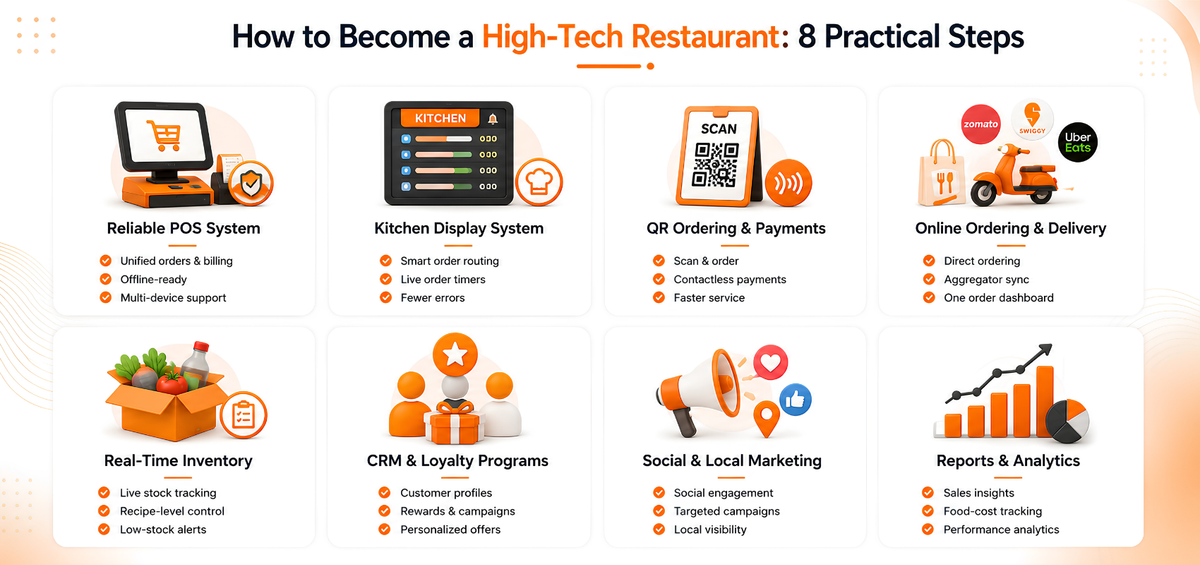
1. Invest in a Reliable Restaurant POS System
A restaurant POS system is the foundation of restaurant technology. It is where billing, orders, and payments come together, so it needs to work reliably across every channel: dine-in, takeaway, delivery, and online orders.
Look for a restaurant POS software that:
- Works offline and syncs automatically once the connection returns
- Runs on the devices you already have, including Windows, Android, and iPad
- Handles dine-in, takeaway, delivery, and online orders from one screen
- Supports split billing, modifiers, and table-side ordering
- Connects to your payment terminals and printers without extra setup
Beyond billing, a strong restaurant POS platform should also include simple [online order integration], central kitchen management, CRM integration, third-party delivery integrations, and built-in reporting, so you are not stitching together five different tools to run one restaurant.
PosBytz is one option built for this kind of restaurant technology stack. It works across food and beverage formats, from quick-service counters to full-service dine-in, and includes:
- A branded online ordering store you can launch without extra development work
- Dine-in table management alongside takeaway and delivery
- Kitchen order ticket (KOT) printing and routing to improve kitchen coordination
- Ingredient-level inventory tracking with profit and loss visibility
- Support for discounts, combos, and split billing
- Multiple outlet management from a single dashboard
- Integrations with Zoho, WhatsApp, Shopify, and WooCommerce
Choosing restaurant technology that connects these functions in one platform reduces the number of logins, exports, and manual reconciliations your team has to manage.
2. Add a Kitchen Display System to Cut Order Errors
A kitchen display system, or KDS, replaces paper tickets with digital order screens in the kitchen. Orders route automatically to the right station based on category or prep time, so cooks are not chasing down slips of paper during a rush.
A well-set-up KDS typically includes:
- Automatic order routing by station and prep time
- Live order timers so nothing sits too long
- Bump, recall, and refire options for correcting mistakes without slowing service
- Priority alerts for rush orders
- Prep time and kitchen performance analytics
Pairing a KDS with your POS keeps the front of house and back of house working from the same order data in real time, which cuts down on missed or duplicated orders during peak hours.
3. Offer QR Code Ordering and Contactless Payments
Letting guests order and pay from their phones has gone from a novelty to an expectation. QR code ordering lets diners scan a code at the table, browse the full menu with modifiers and combos, and place an order without waiting for a server to take it down.
This matters for a few practical reasons:
- Guests can order and pay at their own pace, which reduces perceived wait time
- Staff can focus on food and service instead of order-taking
- Multiple orders from the same table are easier to manage
- Contactless payment reduces the handling of cash and cards at the table
QR ordering works best alongside table-side POS ordering rather than replacing waitstaff entirely. The goal is to give guests a choice, not to remove the human part of dining out.
4. Streamline Online Ordering and Delivery Aggregators
Not every guest wants to dine in, and a high-tech restaurant needs to handle online and delivery orders just as smoothly as in-house ones.
Start with your own restaurant online ordering system so you can take direct orders without paying a commission on every sale. A branded ordering page also lets you keep the customer relationship and their contact details, instead of only knowing them through a delivery app.
From there, connect your POS integrations to delivery aggregators such as Swiggy, Zomato, Uber Eats, Talabat, and Deliveroo. This gives you:
- Automatic menu, pricing, and availability sync across every platform
- A single dashboard for orders coming from your website, app, and aggregators
- Fewer manual entry errors and missed orders during busy periods
- Lower labor costs, since staff are not manually re-entering orders from multiple tablets
Handling online ordering this way protects your margins while still meeting guests wherever they prefer to order from.
5. Track Inventory and Stock in Real Time
Back-of-house technology matters just as much as anything guests see. Restaurant inventory management software gives you real-time visibility into stock levels across every location and sales channel, including in-store, online, and delivery aggregators.
With ingredient-level and recipe-based tracking, stock is deducted automatically as items sell, so you are not manually counting inventory at the end of every shift. Low-stock alerts and automatic stop-selling when an item runs out help prevent the awkward moment of confirming an order you cannot actually fulfill.
For multi-outlet or multi-brand operations, centralized inventory means you can compare consumption and waste across locations from a single dashboard instead of collecting spreadsheets from each site.
6. Build Customer Relationships with CRM and Loyalty Programs
Restaurant technology should not stop at the transaction. Restaurant CRM software tracks customer profiles, order history, and spending patterns, so you can turn one-time visitors into repeat guests.
Two things make the biggest difference here:
Loyalty programs. Points, stamps, or tier-based rewards give customers a reason to come back and let you see who your most valuable guests are. Discount coupons and birthday or anniversary campaigns work well when they are based on real purchase history rather than a blanket offer sent to everyone.
Direct communication. Once you have a customer's phone number or email, automated SMS, email, and WhatsApp campaigns keep them informed about offers and menu updates without relying on them to check social media or a delivery app. Keeping this data connected to your POS means you can segment customers by what they actually order, not guesswork.
7. Stay Active on Social Media and Local Marketing
Social media remains one of the simplest ways to stay visible between visits. Regularly posting your menu, behind-the-scenes kitchen content, and customer photos gives potential guests a reason to check your restaurant out. A weak or inactive profile can quietly cost you bookings, since many diners check social media before deciding where to eat.
Pair social content with a broader restaurant marketing strategy that includes email and SMS campaigns pulled from your CRM data, seasonal promotions, and local search visibility. Technology helps here too: scheduling tools and CRM-driven campaigns take the manual work out of staying consistent.
8. Use Reports and Analytics to Guide Decisions
The last piece of a high-tech restaurant is turning all this operational data into decisions. Live dashboards and reports covering sales, item-wise performance, food costing, and staff performance let you spot problems before they become expensive.
Useful reports to check regularly include:
- Item-wise and category-wise sales, to see what is actually selling
- Food costing and recipe cost analysis, to protect margins as ingredient prices shift
- Multi-outlet comparisons, if you run more than one location
- Shift and staff performance reports, to plan scheduling around real demand
Restaurants that review this data weekly, rather than only at month-end, tend to catch pricing or menu issues while they are still small.
Common Mistakes to Avoid When Adding Restaurant Technology
A few patterns show up often when restaurants adopt technology too quickly or without a plan:
- Buying disconnected tools. A POS from one vendor, a delivery app from another, and a separate CRM often means re-entering the same data three times. Look for tools that integrate with each other, or a single platform that covers most of these functions.
- Skipping staff training. Even a well-built system will slow down service if staff are not comfortable using it. Budget time for training before a full rollout, not just a quick walkthrough on launch day.
- Removing the human element entirely. Technology should support the guest experience, not replace every interaction. QR ordering and self-service tools work best alongside staff, not instead of them.
- Ignoring the data the system already collects. Many restaurants have reporting tools they rarely open. Reviewing sales, cost, and inventory reports regularly is often more valuable than adding another tool.
Frequently Asked Questions
1. What is a high-tech restaurant?
A high-tech restaurant uses connected software and hardware, such as a POS system, kitchen display system, online ordering platform, and CRM, to manage billing, kitchen operations, delivery, and customer relationships instead of relying on manual, paper-based processes.
2. What is the first technology a restaurant should invest in?
A restaurant POS system is usually the right starting point, since it touches billing, orders, and payments across every channel. Most other tools, including inventory, CRM, and reporting, work best when they are connected to the POS rather than running separately.
3. How much does it cost to make a restaurant high-tech?
Costs vary depending on how many systems you add and whether you choose cloud-based, subscription software or on-premise hardware. Cloud-based platforms generally have lower upfront costs since they do not require dedicated servers, and you can add features like QR ordering or a KDS as your budget allows rather than all at once.
4. Can a small restaurant afford to go high-tech on a limited budget?
Yes. Many restaurant technology providers offer cloud-based plans that scale with the size of your business, so a single-location restaurant is not paying for enterprise features it does not need. Starting with a POS and adding QR ordering or a loyalty program later is a practical way to spread out the investment.
5. Does restaurant technology replace waitstaff?
No. Technology like QR ordering, kiosks, and online ordering handles repetitive tasks such as order-taking and payment processing, which frees staff to focus on service, hospitality, and handling exceptions. Guests still expect a human touch, especially in full-service dining.
Conclusion
If you stand out in the restaurant industry and scale up, then incorporating restaurant technology and making a high-tech restaurant is a must. But choosing the best software is vital. And as already mentioned, one of the best ways to make your restaurant tech at an affordable price is via Posbytz.
This robust POS software has a lot to offer and can streamline your restaurant business. By becoming a high-tech restaurant, you can deliver a better customer experience and, at the end of the experience, what they look forward to. You can check out more about what Posbytz restaurant POS software can do to your restaurant business here.
Related Resources
About the author

Saravana Damodaram
Co-Founder & CEO, PosBytz
Saravana Damodaram is the Co-Founder & CEO of PosBytz, a cloud-based POS-ERP platform built for F&B and retail businesses since 2018. He focuses on unified commerce, inventory, and multi-location operations, and has helped over 5,000 merchants across 25+ countries move off fragmented, disconnected tools and run their entire operation, billing, inventory, kitchen, and accounting on one platform.