Setting the right Foundation for eCommerce – A Complete Guide
Build the right eCommerce website foundation with this complete guide covering branding, checkout, security, mobile experience and unified commerce.



The beauty of an eCommerce portal is the complete visibility it provides the buyer and seller for placing orders and transactions. Customers enjoy the power of transparency and businesses are rewarded accordingly based on the personalized updates sent to the customer.
“According to Econsultancy, around a quarter of the customers who shop online have high cart abandonment rates if there is no delivery date provided”.
Businesses enjoy the benefits of using limited capital to begin their online venture. An eCommerce portal provides a professional feel to your business for your customer. This means that the target audience has everything they need to make an informed decision with a smooth customer journey and a clear call to action. It also allows you to operate your business from anywhere in the world.
However, enticing the customer to make the final decision to purchase the product is not an easy feat to accomplish. According to Baymard, around 70% of the customers add an item to the cart without checking out.
The process of planning and developing a customized eCommerce store may seem frustrating. However, the final perception of your brand will be a rewarding experience for your business.
Why Your eCommerce Foundation Matters
Even well-designed stores lose customers at checkout. Research from the Baymard Institute puts the average online shopping cart abandonment rate at around 70 percent. Econsultancy has also found that unclear delivery timelines are enough to push a meaningful share of shoppers to abandon their cart altogether. Most of these losses trace back to foundational issues: confusing navigation, generic branding, a checkout process with too many steps, or a lack of visible trust signals.
A solid foundation does more than make your eCommerce store look professional. It removes the friction that causes shoppers to leave mid-purchase, and it gives your team the structure to add features like loyalty programs, omnichannel selling, and analytics later without rebuilding the site from scratch.
Essential Elements for an online eCommerce store
Strong attention to detail as a business can help your venture grow in the long run. Each eCommerce store looks at the challenges they face in selling their product and strategizes their digital marketing campaigns accordingly. Let us look at a few essential elements that you need to consider while creating an eCommerce store.
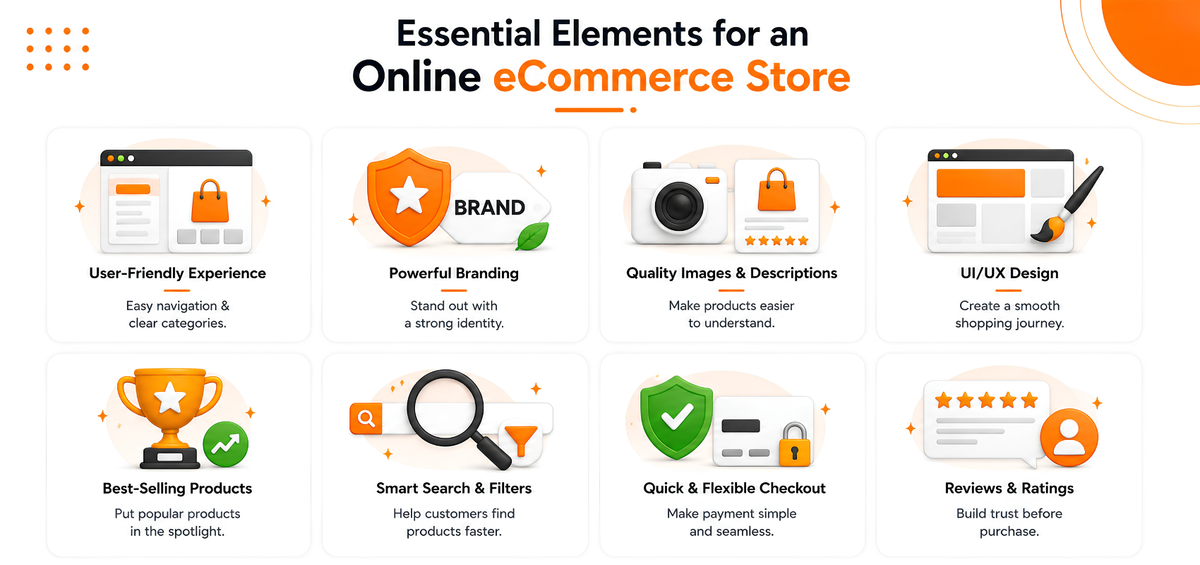
1) User-friendly
The ability of your user to easily navigate is important as this plays an essential role in the final sales of the product. Your homepage should look attractive, have different categories and provide clear promotional messages so that customers can make their purchases based on their search intent.
2) Powerful Branding
Your brand needs to create an impact when your customer hits the landing page. According to Truelist, around 57% of Millennial female customers decide to purchase a product based on the brand’s representation of their values. Your identity as an organization should reflect on your website colours, logo and even the tagline. This helps your customers differentiate your product from the rest of your competitors.
3) Quality Images and Detailed Descriptions
A customer with an intent to purchase a particular product analyses the benefits and features before making a purchase. They develop a perception of quality based on the visual elements you place on your eCommerce store. Besides having well- photographed pictures of your products, you should add a zoom feature to help users feel comfortable with their purchase decision. You can also consult with a content specialist to write attractive descriptions for your product, and this would also position your business as a specialist in the market.
4) Website UI/UX Design
This includes your website layout, the navigation, placement of your banners etc. The better your user experience is, the higher the probability that the customer will make a sale. You can now easily create a beautiful website with Posbytz’s eCommerce platform.
5) Preview of the Best Selling Products
When a customer first enters a physical store, the first question they refer to is the best selling section of the store. The same principle applies to your online store. Online customers tend to have a shorter waiting time and quickly browse through the website to understand the eCommerce store’s products. So, it is important to feature your best selling products on your homepage.
6) Precise Search Feature and Price Filters
As a customer, it can be frustrating to browse through billions of products. Prospects lose interest in the webpage as it does not answer their question with respect to their pain point or requirement. Adding an authentic search feature and a price filter will help finetune the search results based on customer preferences
7) Quick and Flexible Checkout Process
One of the top reasons for high shopping cart abandonment rates is the complicated checkout process. Providing flexible payment options like UPI, credit or debit card payments and net banking will simplify their buying experience and ensure customer satisfaction.
Making the check out process fast and straightforward can significantly reduce your shopping cart abandonment rates.
8) Reviews and Rating
According to Truelist, around 40% of the Millenials make it a point to check the reviews online before purchasing the product.
Reviews make a direct impact on the purchase decision as they strengthen your business’s credibility.You can also provide customer support to build a loyal customer base. After-sales customer support creates a bond with the customer.
Building Trust, Speed, and Security Into Your Store
Beyond page-level design, buyers now expect an online store to perform well and protect their data by default. These factors have become part of the baseline foundation, not optional extras.
Design for Mobile First
Most shoppers now browse and buy from a phone, and search engines primarily evaluate the mobile version of a site when ranking it. Your eCommerce website foundation should work smoothly across desktops, laptops, tablets, and mobile devices, not just on the layout you designed and tested on a desktop screen.
Keep Pages Fast and Reliable
Slow-loading pages push shoppers toward a competitor before they even see your products. Compressing images, minimizing unnecessary scripts, and choosing hosting or a platform built for eCommerce traffic all help keep load times low during peak periods.
Make Security Visible
Buyers look for clear signs that a store is safe before entering payment details, such as an SSL certificate, a secure checkout flow, and transparent policies. Making these signals visible, not just technically present, helps convert hesitant first-time visitors.
Offer Multiple, Trusted Payment Options
Supporting cards, UPI, wallets, net banking, and cash on delivery where relevant removes a common last-minute reason for abandoning a purchase. The more naturally a payment method fits your customer base, the less friction there is at checkout.
Creating a Unified Commerce Experience
Unified commerce means running every sales channel, in-store, online, delivery, and third-party aggregators, from a single system with one shared view of inventory, orders, and customers. It replaces the disconnected spreadsheets and separate logins that many growing businesses end up managing across channels.
Centralize Inventory Across Every Channel
Instead of tracking stock separately for your website, in-store counter, and delivery aggregators, a unified system keeps one live inventory count across all of them, including WhatsApp and call-in orders. This prevents overselling and gives you accurate stock visibility no matter where an order comes from. Platforms built for omnichannel selling are designed specifically to manage this kind of multi-channel complexity from one dashboard.
Use Customer Data to Personalize and Retain
Owning your customer database, rather than relying only on marketplace traffic, lets you send personalized messages, run birthday or anniversary campaigns, and build loyalty programs based on points, stamps, or tiers. Coupons and discount schemes based on real purchase history tend to perform better than generic, one-size-fits-all promotions, and they help you build a repeat customer base instead of one-time buyers.
Choosing the Right Platform to Build and Scale Your Store
Once the fundamentals are in place, the platform you build on determines how easily you can maintain them as you grow. Some businesses choose to build custom, while many start with a ready-made ecommerce software that already includes hosting, templates, and payment integrations out of the box.
If you are comparing options, it helps to look at what you would need to piece together yourself versus what comes built in, whether that is a free online store with no setup cost, or a fuller platform once you are ready to invest in your own branded storefront. Reviewing Shopify alternatives side by side on pricing, fees, and features is a useful step before committing to one platform long term.
Frequently Asked Questions
What is the most important element of an eCommerce website foundation?
There is no single most important element. Navigation, branding, product presentation, checkout, and security all work together, and weakness in any one of them can undo the strength of the others. Checkout friction and unclear trust signals tend to have the most direct, measurable impact on lost sales.
How can I reduce cart abandonment on my online store?
Simplify the checkout flow to as few steps as possible, be upfront about delivery timelines before the final step, offer more than one payment method, and make security signals like SSL and clear policies visible. Each of these addresses a common, well-documented reason shoppers abandon a cart.
Is a mobile-friendly design necessary for an eCommerce website?
Yes. Most online shopping traffic now comes from mobile devices, and search engines evaluate the mobile version of a site for ranking purposes. A store that only works well on desktop will lose both search visibility and mobile conversions.
What is unified commerce and how is it different from regular eCommerce?
Regular eCommerce typically covers a single sales channel, usually your website. Unified commerce connects your website, in-store POS, delivery, and aggregator orders into one system with a single view of inventory, orders, and customer data, so you are not managing each channel separately.
Should I build my own eCommerce website or use an existing platform?
That depends on your technical resources, timeline, and budget. Building custom gives you full control but takes longer and needs ongoing development support. A ready-made unified commerce platform lets you launch faster while still controlling your branding, inventory, and payment setup.
Conclusion
A strong eCommerce website foundation is not a one-time checklist you complete before launch and forget. It is the combination of user-friendly design, consistent branding, visible trust and security signals, and a unified view of inventory and customers that keeps working as your business grows. Businesses that revisit this foundation periodically, rather than only at launch, are better positioned to adapt as customer expectations and channels keep changing.
If you are setting up your store for the first time or rebuilding an existing one, start with the fundamentals in this guide, then layer in unified commerce and personalization once your core foundation is solid.
Ready to put this foundation into practice? You can create your free online store with Posbytz and manage your branding, inventory, and payments from one dashboard as you grow.
Related Resources
About the author

Kamalakannan
CTO, PosBytz
Kamalakannan is the CTO of PosBytz, where he leads product and engineering for the company's all-in-one POS and ERP platform. He writes about the technology decisions behind building reliable, scalable software for restaurants and retail businesses.