Restaurant CRM Software: A Complete Guide to Customer Engagement in 2026
Discover how restaurant CRM software can transform customer relationships, build customer loyalty, retain cusomers and drive business growth.


Struggling to turn first-time diners into regulars? In a crowded market, the restaurants that win are the ones that remember their guests, not just their orders. Restaurant CRM software gives you a single, centralized view of every customer so you can personalize service, automate marketing, and keep people coming back. This guide covers what restaurant CRM software does, the features that matter most, and how to put it to work in your business, whether you are comparing options for the first time or looking to get more value out of the crm system for restaurants you already have.
What Is Restaurant CRM Software?
Restaurant CRM software is a system that captures and organizes guest data, contact details, birthdays and anniversaries, order history, and preferences, in one place so your team can serve every customer like a regular. Instead of treating each visit as a one-off transaction, a restaurant crm connects the dots between visits, giving you a full picture of who your customers are and what keeps them coming back.
That guest data is only useful if you act on it. A good restaurant CRM turns raw order history into decisions: which dishes to promote, which customers are close to becoming regulars, and which ones have not visited in a while and need a nudge. It also automates the busywork, sending birthday offers, managing loyalty points, and collecting feedback, so your team can focus on service instead of spreadsheets. Comprehensive restaurant CRM software, like PosBytz, is built into your POS so guest data updates in real time with every sale, whether the order comes from dine-in, takeaway, delivery, or your online ordering page. For a complete operational setup, many restaurants pair this with restaurant POS software to run billing, kitchen, and customer engagement from one platform.
Key Features of Restaurant CRM Software
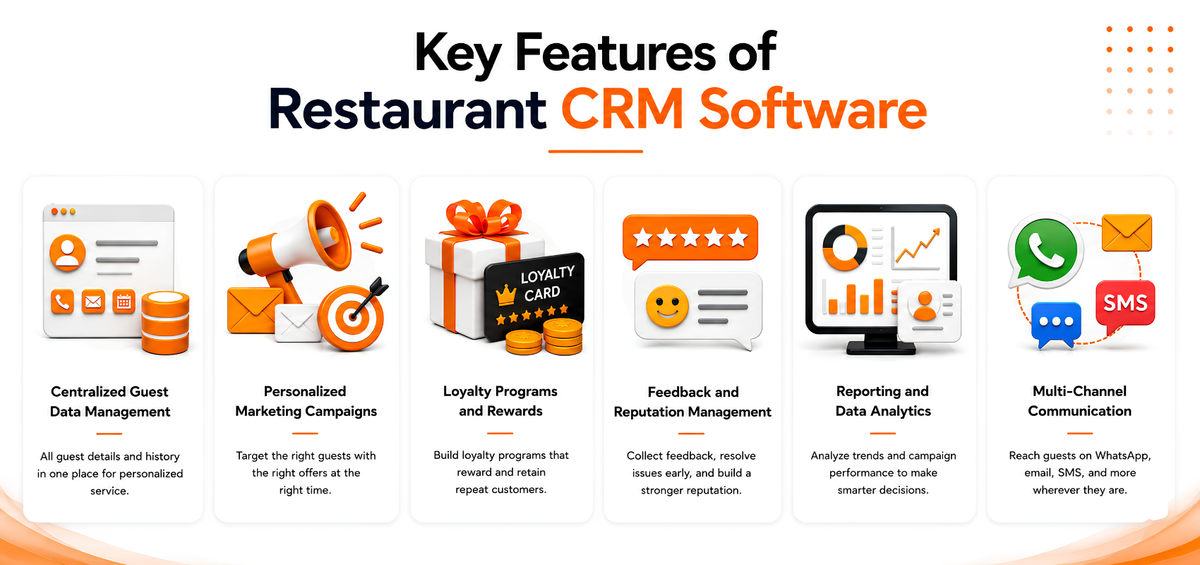
When evaluating a restaurant CRM solution, look for the following core capabilities.
Centralized Guest Data Management
A restaurant CRM software centralizes contact details, preferences, important dates, and order history in one guest profile. This gives staff the context to offer personalized service and lets marketing teams build targeted campaigns instead of guessing what customers want. If you are still narrowing down options, our guide to choosing the best restaurant CRM walks through what to prioritize.
Personalized Marketing Campaigns
By using guest data, restaurants can build campaigns aimed at specific customer segments rather than sending the same offer to everyone. A restaurant crm can automate birthday and anniversary campaigns, and it can trigger win-back discounts for customers who have not ordered in a while, helping you market to the right guest at the right time.
Loyalty Programs and Rewards
Effective restaurant CRM software lets you design and run loyalty programs, points, stamps, or tier-based rewards, that give repeat customers a reason to keep choosing you. Coupon incentives and automated loyalty updates keep the program running without manual tracking.
Feedback and Reputation Management
Collecting and analyzing feedback through a crm system for restaurants helps you catch problems early and improve based on real guest input. Automated feedback collection means you are not relying on customers to volunteer complaints, and the same insights can help you build a stronger online reputation over time.
Reporting and Data Analytics
Analytics turn guest data into decisions. A restaurant CRM should show you customer spending trends, campaign performance, and repeat-visit patterns so managers can see what is actually driving retention rather than guessing. Pairing this with the right restaurant KPIs makes it easier to tell which campaigns are moving the needle and which ones are not.
Multi-Channel Communication
A specialized restaurant crm software reaches customers through WhatsApp, email, SMS, and other channels, so promotions and updates land wherever your guests already are, rather than relying on a single channel that not everyone checks.
Why Every Restaurant Needs CRM Software
Enhanced Customer Experience
- Personalizes each visit by using stored preferences and past order behavior.
- Enables tailored service, such as suggesting a guest's usual order or remembering a special occasion.
- Makes customers feel recognized, which builds satisfaction and loyalty over time.
- Pairs well with table-side technology like QR code ordering, which feeds even more preference data back into the guest profile.
Improved Customer Retention
- Flags customers who have gone quiet by analyzing visit frequency and feedback patterns.
- Sends personalized offers or reminders through your restaurant crm to bring lapsed customers back.
- Replaces generic blasts with targeted communication, which consistently performs better for re-engagement.
Streamlined Operations
- Automates repetitive customer management tasks, including campaigns and feedback follow-up.
- Frees staff to focus on service instead of manual data entry and outreach.
- Feeds customer data into broader operational and marketing decisions.
Increased Sales and Revenue
- Uses purchase patterns to inform targeted promotions and upselling opportunities.
- Turns occasional visitors into frequent customers through consistent, relevant outreach.
Competitive Advantage
- Differentiates your restaurant by making the guest experience feel personal rather than generic.
- Builds the kind of loyalty that is harder for competitors to win away with a discount alone.
- Reinforces a broader restaurant branding strategy built around recognition and repeat visits, not just price.
In short, a crm system for restaurants is no longer a nice-to-have. It is the operational layer that turns first-time guests into a loyal customer base.
Restaurant CRM Trends to Watch in 2026
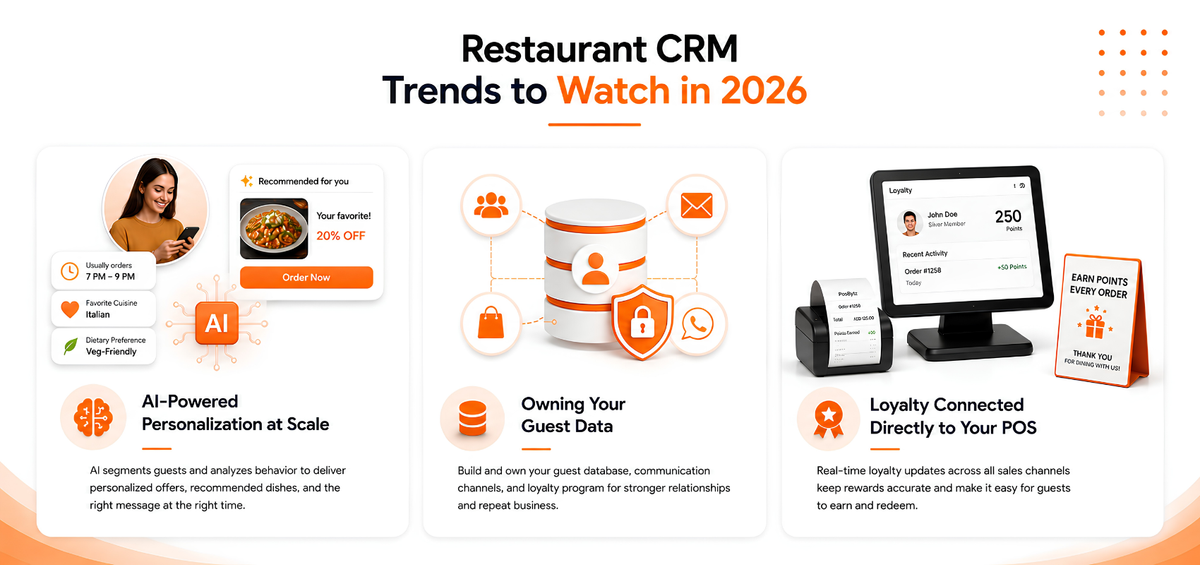
Guest expectations have shifted, and restaurant CRM software has evolved with them. Here is what is shaping the category this year.
AI-Powered Personalization at Scale
Restaurants are moving beyond blanket discounts toward offers built around individual ordering habits, a regular's usual dish, a guest's typical visit time, or a dietary preference. AI-assisted segmentation makes this practical even for restaurants without a dedicated marketing team, since the CRM can group guests and trigger relevant campaigns automatically instead of requiring manual list-building.
Owning Your Guest Data
As more orders flow through delivery aggregators, restaurants increasingly rely on data they do not fully control. Industry commentary on 2026 restaurant technology consistently points to owned guest communication channels, your own database, your own loyalty program, as a durable advantage over depending solely on third-party platforms for repeat business.
Loyalty Connected Directly to Your POS
Standalone punch cards and disconnected loyalty apps are giving way to loyalty programs tied directly into POS and order data. When loyalty tracking updates in real time with every sale, whether dine-in, delivery, or online, rewards stay accurate and guests do not have to remember to scan a separate app.
Staying current with these shifts matters beyond CRM alone. For a broader view of what is changing in the industry, see our restaurant trends 2026 guide.
How to Implement CRM Software in Your Restaurant
Assess Your Needs
Start by evaluating your restaurant size, customer interaction volume, and marketing goals. A small cafe may only need basic restaurant crm functions for guest data and simple campaigns, while a multi-outlet brand will likely need loyalty tiers, segmentation, and detailed analytics.
Choose the Right Software
Pick a crm system for restaurants that fits how you actually operate. Prioritize an intuitive interface and integration with the systems you already use, especially your POS, since a CRM that sits apart from your billing and order data will always be a step behind. Our roundup of essential restaurant POS integrations covers what to check before you commit.
Train Your Staff
Give your team hands-on training on entering and using guest data, running marketing tools, and reviewing feedback. A CRM only delivers value if staff actually use it at the counter and in the kitchen, not just in a back-office dashboard.
Monitor and Optimize
Track how the restaurant crm performs after rollout. Gather feedback from staff and customers, then refine your segments, campaigns, and loyalty rules based on what the data actually shows, not just what you assumed would work at launch.
Conclusion
Investing in restaurant CRM software is ultimately about the guest experience, not just data management. As dining habits keep shifting and guests expect to be recognized wherever they order from, the importance of a solid crm system for restaurants will keep growing. By centralizing guest data and acting on it consistently, restaurants can improve retention, drive repeat sales, and build the kind of loyalty that outlasts any single promotion, as part of a wider restaurant management strategy rather than a standalone tool.
Frequently Asked Questions
What is restaurant CRM software?
Restaurant CRM software is a tool that helps restaurants manage customer data and interactions in one place, contact details, order history, preferences, and loyalty activity. By centralizing this information, a restaurant crm helps businesses understand and serve their guests better while streamlining marketing and feedback management.
How does a restaurant CRM improve customer retention?
A crm system for restaurants helps you spot guests who have stopped visiting by tracking order frequency and engagement patterns, then re-engage them with personalized offers instead of generic discounts. Because the outreach is based on actual guest behavior, it tends to convert better than one-size-fits-all promotions, which strengthens long-term retention.
What features should I look for in a restaurant CRM?
Look for centralized guest profiles with order and feedback history, personalized marketing tools for targeted campaigns, loyalty program management for points or tiers, and analytics that show customer behavior and campaign performance. Integration with your POS matters too, since disconnected systems create data gaps and manual work.
Does restaurant CRM integrate with POS and online ordering?
It should. A restaurant CRM that is built into your POS system captures order data automatically across dine-in, takeaway, delivery, and online channels, so guest profiles stay accurate without staff having to enter information by hand. This is increasingly the standard, since fragmented tools make it hard to build a complete picture of any one customer.
What kind of ROI can I expect from restaurant CRM software?
Results vary by restaurant, but CRM systems are widely reported across industries to generate a strong return by improving retention and campaign targeting rather than relying on broad, untargeted marketing spend. For restaurants specifically, the return typically shows up as more repeat visits and higher customer lifetime value rather than a single large sale.
Scale Your Restaurant Business
Connect with your customers on a deeper level. Use PosBytz's restaurant CRM software to automate engagement and boost retention.
Start Your Free Trial with PosBytz
Related Resources
About the author

The PosBytz Marketing Team
Editorial Team, PosBytz
The PosBytz Marketing Team shares practical insights on running smarter restaurants and retail stores from POS best practices to inventory management, online ordering, and customer loyalty strategies.