Restaurant ERP system to revolutionize your F&B business
Restaurant ERP system to maximize restaurant efficiency and success, explore benefits and solutions for F&B Businesses!


Introduction
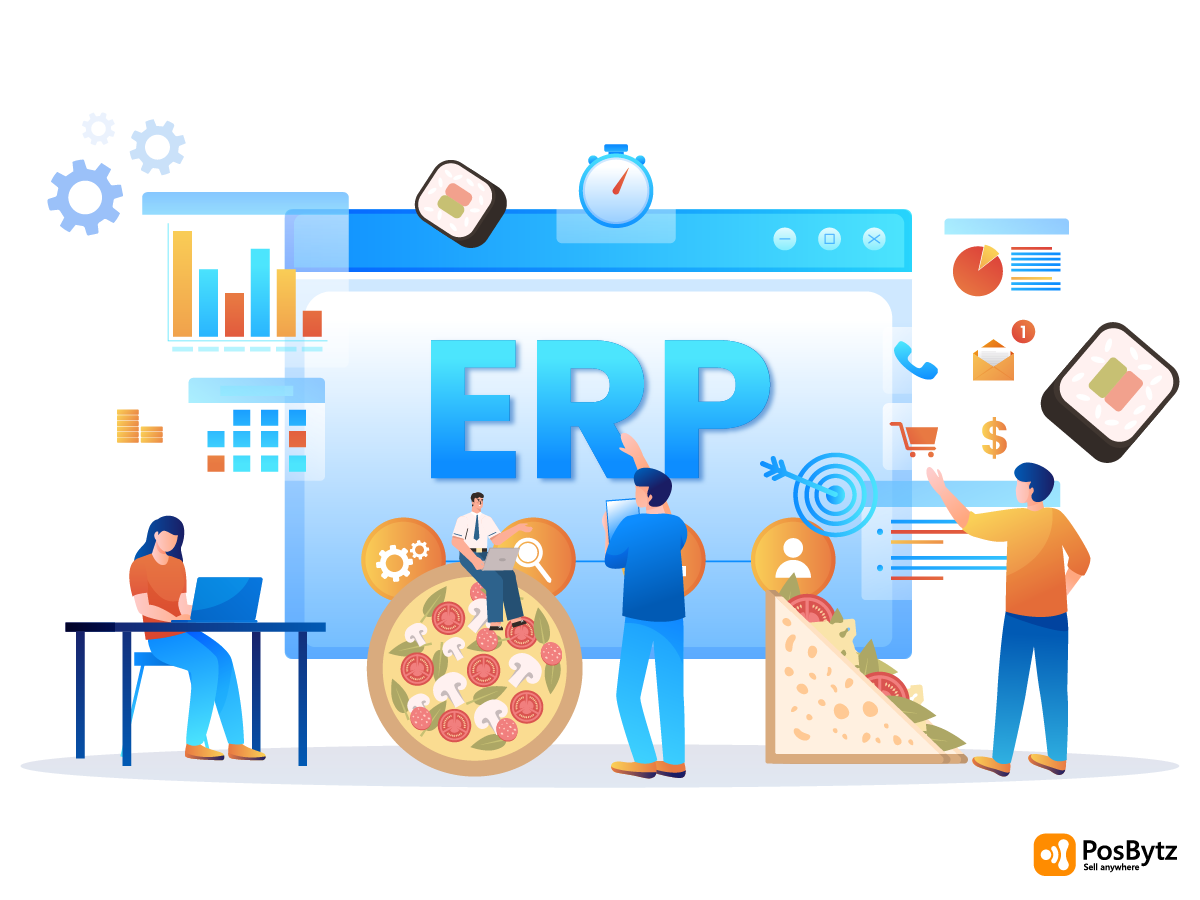
Running a successful restaurant ERP system for a chain restaurant requires juggling numerous responsibilities, from managing inventory and staff to ensuring exceptional customer service. However, as your business grows, these tasks can become increasingly complex and time-consuming, leading to inefficiencies and lost profits. If you’re struggling to keep up with the demands of your restaurant operations, consider implementing a robust erp for restaurant chain management strategy.
A comprehensive software solution that integrates various aspects of your business, streamlining operations and providing valuable insights to help you make informed decisions. A restaurant ERP system can help you reduce costs, improve efficiency, and enhance the overall customer experience by automating routine tasks and providing real-time data.
What is a Restaurant ERP System?
A software platform that combines multiple business functions into a single integrated system. It allows restaurant owners and managers to manage various aspects of their business efficiently; this includes:
- Inventory management: Track and monitor your restaurant’s inventory levels, ensuring that you always have the right recipes and ingredients on hand and reducing waste.
- Financial management: Handle all financial transactions, including e-invoicing, sales, expenses, payroll expenses, and VAT calculations, while providing valuable insights into your restaurant’s financial performance.
- Customer relationship management (CRM): Manage customer data, track preferences, and personalize marketing efforts to build loyalty and drive repeat business.
- Online ordering: Streamline your online orders by managing orders from multiple channels, tracking orders, and optimizing delivery schedules.
- Human resource management: Manage employee records, track attendance, and handle payroll and benefits, ensuring a smooth and efficient workforce.
By integrating these functions into a single system, modern erp systems for chain restaurant environments provide a centralized platform, reducing the need for multiple software solutions and improving overall efficiency.
How a Restaurant ERP Differs from a POS System
These two terms get used interchangeably, but they solve different problems. A POS handles the front-of-house transaction: taking the order, processing payment, printing the receipt. A restaurant ERP is the back office running underneath it: it pulls sales data from every register, deducts ingredients from inventory based on the recipe sold, updates purchasing, and rolls all of it into consolidated financial reports. Most restaurant chains need both, working together rather than as separate systems that require manual reconciliation.
Why Chain Restaurants Need a Purpose-Built ERP
Generic, industry-agnostic ERP platforms are usually built for retail or manufacturing first, which means recipe costing, kitchen order routing, and multi-brand menu management often have to be bolted on or customized at extra cost. A restaurant-specific ERP comes with those built in from the start. If you want a deeper look at how this plays out for growing chains, our guide to modern ERP for restaurants walks through it in more detail.
Benefits of Implementing a ERP System for Chain Restaurants
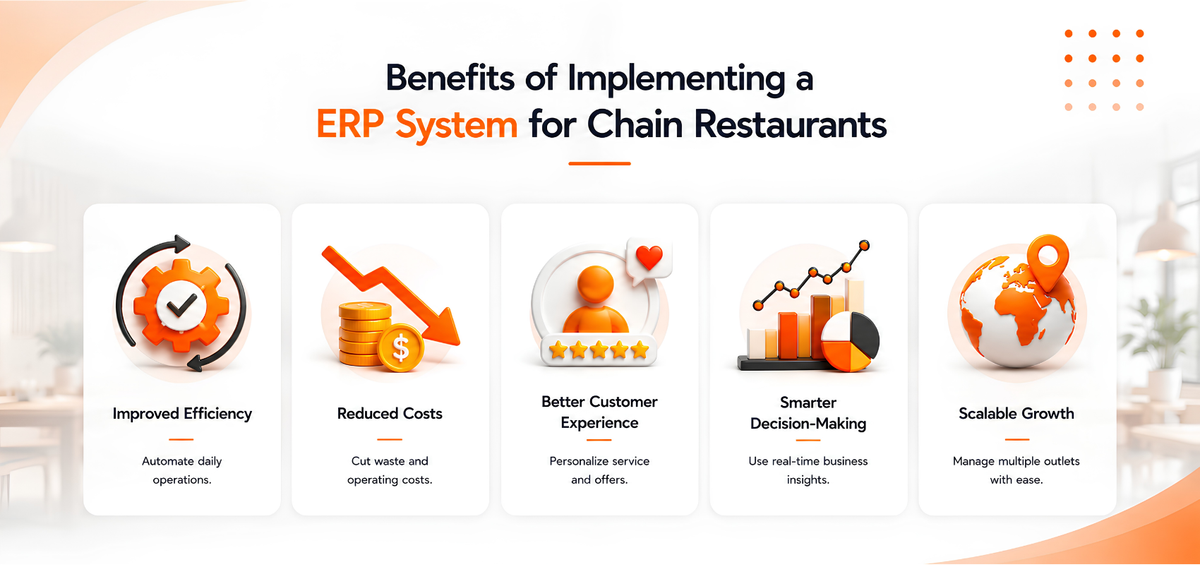
- Improved Efficiency: Automates many of the manual processes involved in running a restaurant, such as inventory management and order processing, allowing staff to focus on service.
- Reduced Costs: By streamlining operations and reducing waste, a restaurant ERP system helps save money on inventory, labor, and other expenses.
- Enhanced Customer Experience: Better understand customer preferences and tailor offerings to meet their needs, leading to increased loyalty and higher revenue.
- Improved Decision-Making: Provides real-time data and analytics, giving you a clear picture of performance across your entire network.
- Scalability: As your restaurant chain grows, a specialized erp for restaurant chain can scale with your business, managing multiple locations with ease.
Key Features of a Restaurant ERP System
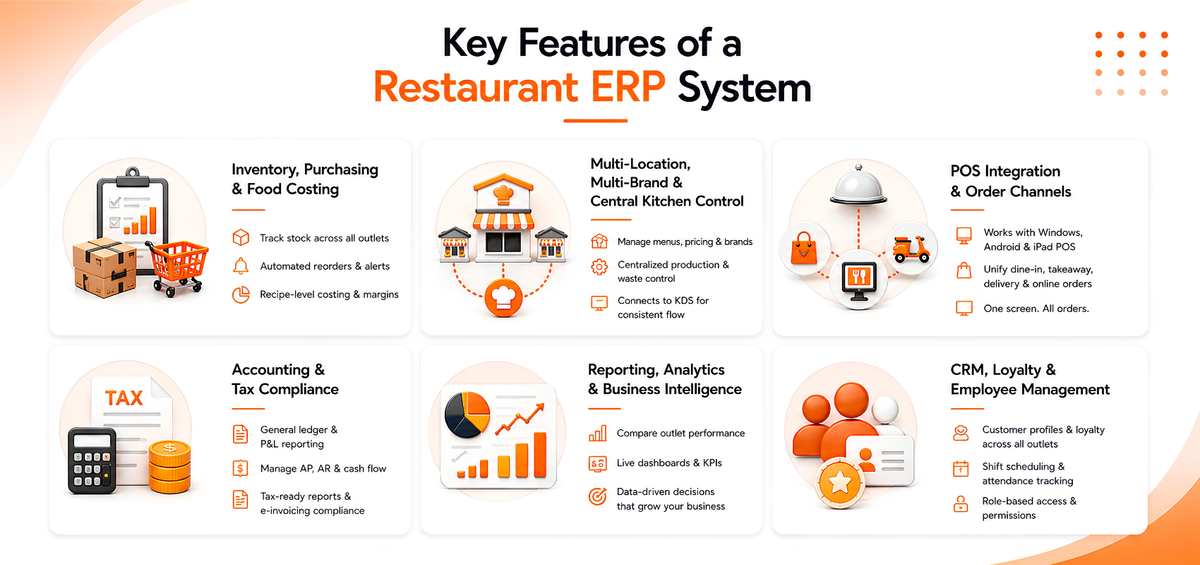
When you're evaluating a system, these are the areas that matter most for a multi-outlet operation.
Inventory, Purchasing & Food Costing
Look for multi-outlet inventory management that tracks stock, suppliers, purchases, and goods received notes (GRNs) across every location from one dashboard. Automatic reorder points and low-stock alerts prevent stockouts before they happen. Recipe-level costing is just as important: it ties each dish to its actual ingredient cost, so you know your real food cost and margin per item, not just an estimate.
Multi-Location, Multi-Brand & Central Kitchen Control
This is where a generic system usually falls short. A restaurant-specific ERP should let you manage separate menus, pricing, and branding for each outlet or sub-brand from a single dashboard, while still giving you centralized control over production planning and waste tracking if you run a central or commissary kitchen supplying multiple locations. It should also connect to your kitchen display systems, so order routing and prep timing stay consistent no matter which outlet the order came from.
POS Integration & Order Channels
Your ERP needs to work with whatever hardware your outlets are already running, whether that's Windows POS, Android POS, or iPad POS. It should also unify dine-in, takeaway, delivery, and online orders onto one screen, so staff aren't switching between multiple systems during a rush.
Accounting & Tax Compliance
Built-in accounting that covers general ledger, accounts payable and receivable, and profit and loss reporting saves you from exporting data into a separate finance tool every month. For chains operating in regions with e-invoicing or VAT requirements, tax-ready reports and compliance support (such as ZATCA e-invoicing in Saudi Arabia) matter a lot more once you're filing for multiple outlets instead of one.
Reporting, Analytics & Business Intelligence
You need to compare performance across outlets, not just look at each one in isolation. Multi-outlet comparisons, benchmarking, and live dashboards let you spot which location is underperforming and why. Tracking the right restaurant KPIs consistently across every branch is what turns raw sales data into decisions you can act on.
CRM, Loyalty & Employee Management
On the customer side, look for customer profiles, purchase history, and loyalty programs you can run consistently across every outlet. On the staffing side, shift scheduling, attendance tracking, and role-based access keep operations consistent as headcount grows. A dedicated CRM tied into your ERP means loyalty points and customer data work the same way whether someone orders from your flagship location or your newest one
How to Choose the Right ERP for Your Restaurant Chain
A few questions are worth answering before you commit to a platform:
- Is it cloud-based, and does it work offline? Outages happen. A system that syncs automatically once connectivity returns protects you from lost sales data.
- Does it scale with location count without a full re-implementation? Ask specifically how adding a new outlet works, not just how the demo looks with one.
- Does it integrate with your existing POS hardware and payment terminals? Ripping out working hardware to switch ERPs adds cost and disruption you probably don't need.
- How is pricing structured as you grow? Some platforms charge per location in ways that get expensive fast. Compare pricing plans against your expansion timeline, not just your current outlet count.
- What does onboarding and support actually look like? Multi-location rollouts need real implementation support, not just a help center article.
Implementing a ERP System for Chain Restaurants
Implementing a system can be a complex process, but these steps ensure a successful transition:
- Assess Current Systems: Identify areas for improvement in your current workflow.
- Evaluate Vendors: Research features, pricing, and scalability of ERP vendors.
- Plan Implementation: Develop timelines, milestones, and resource requirements.
- Train Your Staff: Provide comprehensive training to ensure a smooth transition.
- Monitor and Optimize: Continuously adjust based on data-driven insights.
Frequently Asked Questions
What is an ERP system for a chain restaurant?
It's a software platform that integrates the core functions of running multiple restaurant locations, including accounting, inventory, POS, loyalty, CRM, and human resources, into one connected system instead of separate tools per outlet.
What's the difference between a restaurant ERP and a POS system?
A POS handles the transaction at the counter or table: taking orders and processing payment. The ERP is the back-office layer that uses that sales data to update inventory, track food cost, and generate financial reports across every location. Most chains need both, connected to each other.
What features should I look for in a restaurant ERP?
Prioritize POS integration, recipe-level costing, multi-location inventory, consolidated reporting, and built-in accounting. These are the features that actually get harder to manage as you add outlets, so they matter more than nice-to-have extras.
Does PosBytz offer a restaurant management system?
Yes. PosBytz covers the full stack, from POS to online ordering and accounting, built for restaurants running one location or many.
Does PosBytz work for QSR and multi-brand cloud kitchen businesses?
Yes. It's built to support cafes, food trucks, and cloud kitchens running multiple brands out of a single kitchen, with separate menus and pricing managed from one dashboard.
Conclusion
A restaurant ERP system is what makes it possible to run a growing chain without losing visibility into any single outlet. By connecting inventory, recipes, accounting, and reporting into one platform, an erp for restaurant chain operation gets the centralized control that manual, disconnected tools can't provide. If you want to go deeper on any of the areas covered here, our comprehensive guide to restaurant ERP is a good next read.
Scale Your Restaurant Chain
Experience the ultimate restaurant ERP system. Connect your branches, automate inventory, and master your finances today.
Start Your Free Trial Book a Demo
Related Resources
CRM for Diner Engagement
Why every restaurant needs CRM for enhanced customer engagement.
Automating Operations
Revolutionizing restaurants with ERP systems to boost success.
Small Restaurant ERP Guide
Streamlining operations with ERP: A guide for small restaurants.
Restaurant Tech Trends
The top technology trends revolutionizing the industry in 2026.
Must-Have Integrations
How modern kitchens are streamlining orders and operations.
About the author

Saravana Damodaram
Co-Founder & CEO, PosBytz
Saravana Damodaram is the Co-Founder & CEO of PosBytz, a cloud-based POS-ERP platform built for F&B and retail businesses since 2018. He focuses on unified commerce, inventory, and multi-location operations, and has helped over 5,000 merchants across 25+ countries move off fragmented, disconnected tools and run their entire operation, billing, inventory, kitchen, and accounting on one platform.