Modern ERP for Restaurants: How to Streamline Kitchen Operations
Learn how modern restaurant ERP software improves kitchen workflows, automates orders, and increases revenues for smarter operations in 2026.


Introduction
Upgrading Kitchens and Simplifying Orders: The Evolution of Modern ERP for Restaurants
Here’s a mind-blowing stat: The global foodservice market size is expected to grow up to a whopping $5,194.60 billion by 2029. This indicates that the restaurant industry is becoming highly competitive and populated, and you can’t take chances with your customers. Because they have so many options, if they choose to dine in or order from your restaurant, you must ensure they get a rich experience.
And, one of the major issues with restaurants is that they struggle with streamlining their processes, especially in their kitchen operations. Food delivery errors, a lack of inventory tracking, and food order mess-ups can affect your business and your customers. To solve this, restaurateurs are now turning to technology like Modern ERP for Restaurants to modernize and streamline operations.
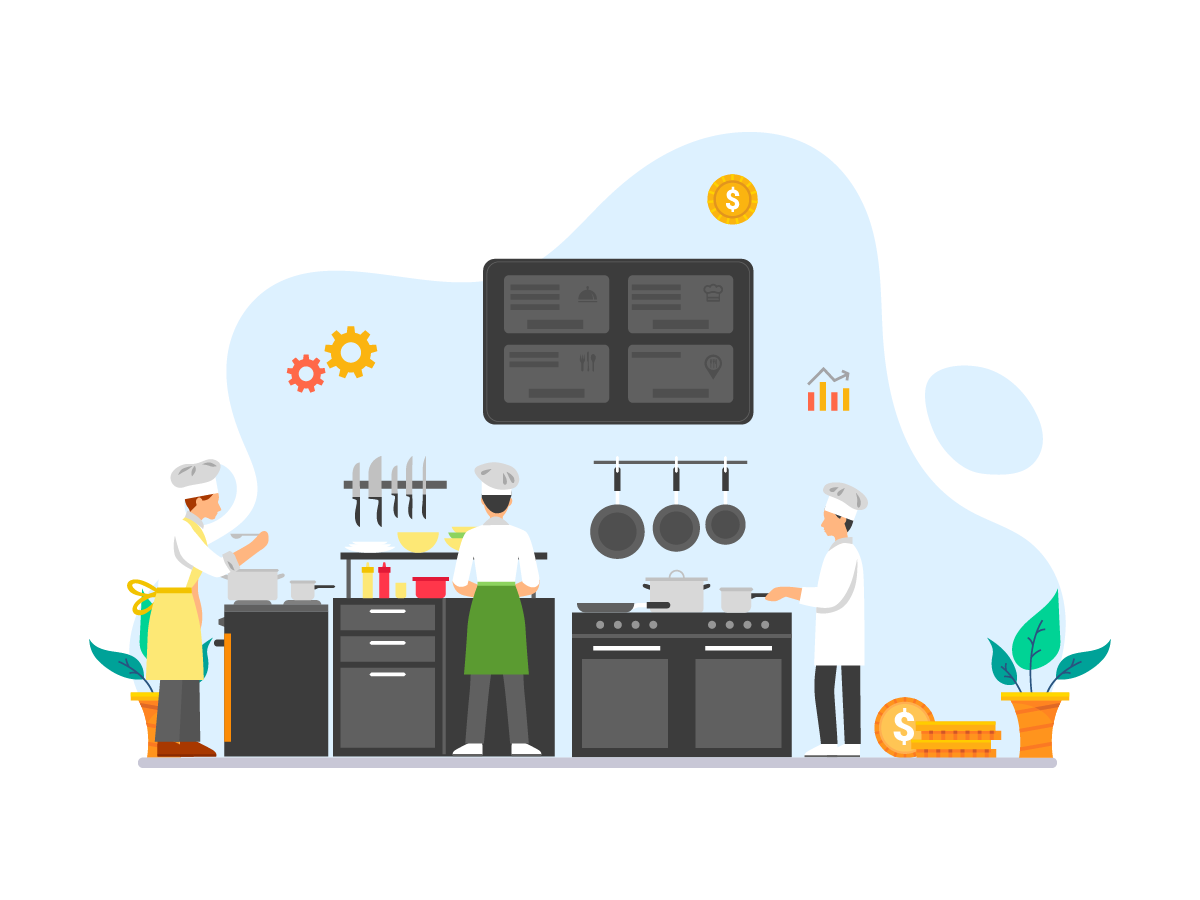
Implementing modern restaurant kitchen systems helps a restaurant by increasing efficiency, reducing downtime, and allowing for a wider range of menu offerings. It can also improve the overall dining experience for customers by increasing the speed and quality of food preparation and service. You will learn how to modernize kitchens and streamline orders in this article with some restaurant kitchen efficiency tips.
What Is a Modern ERP for Restaurants?
A Modern ERP for Restaurants is a connected software system that combines point of sale, kitchen operations, inventory, accounting, and reporting into a single platform instead of running each function in a separate tool. Rather than staff switching between a billing app, a spreadsheet for stock, and a separate accounting tool, everything flows through one system in real time.
This matters because restaurant operations are interdependent. A sale affects inventory. Inventory affects purchasing. Purchasing affects cost of goods and, ultimately, profit margins. When these functions are disconnected, small errors compound. When they're connected through an ERP, each transaction updates every relevant part of the business automatically.
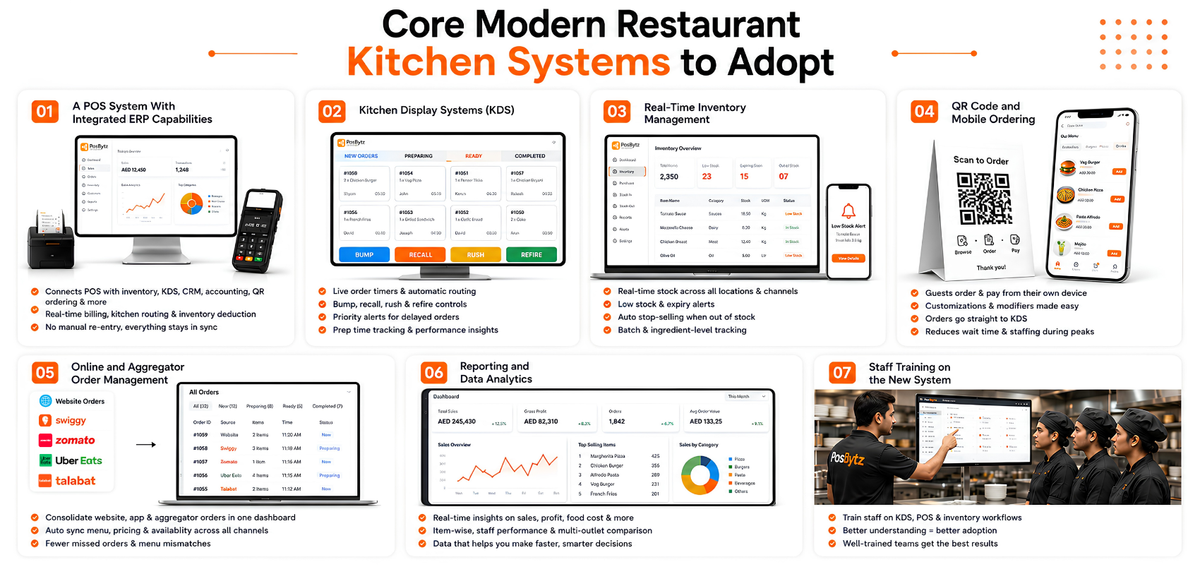
Core Modern Restaurant Kitchen Systems to Adopt
Modernizing a kitchen isn't about buying one piece of software. It's about connecting a set of modern restaurant kitchen systems so information moves automatically between the front of house, the kitchen, and the back office.
A POS System With Integrated ERP Capabilities
Your point of sale is the starting point. Look for a Cloud POS system that connects natively to table management, inventory, kitchen display, online ordering, CRM, accounting, QR code ordering, and staff scheduling, rather than one that requires third-party plugins for each function.
When billing, kitchen routing, and inventory deduction all run through the same POS, an order placed at the counter or a table updates stock levels and kitchen tickets at the same moment, with no manual re-entry required.
Kitchen Display Systems (KDS)
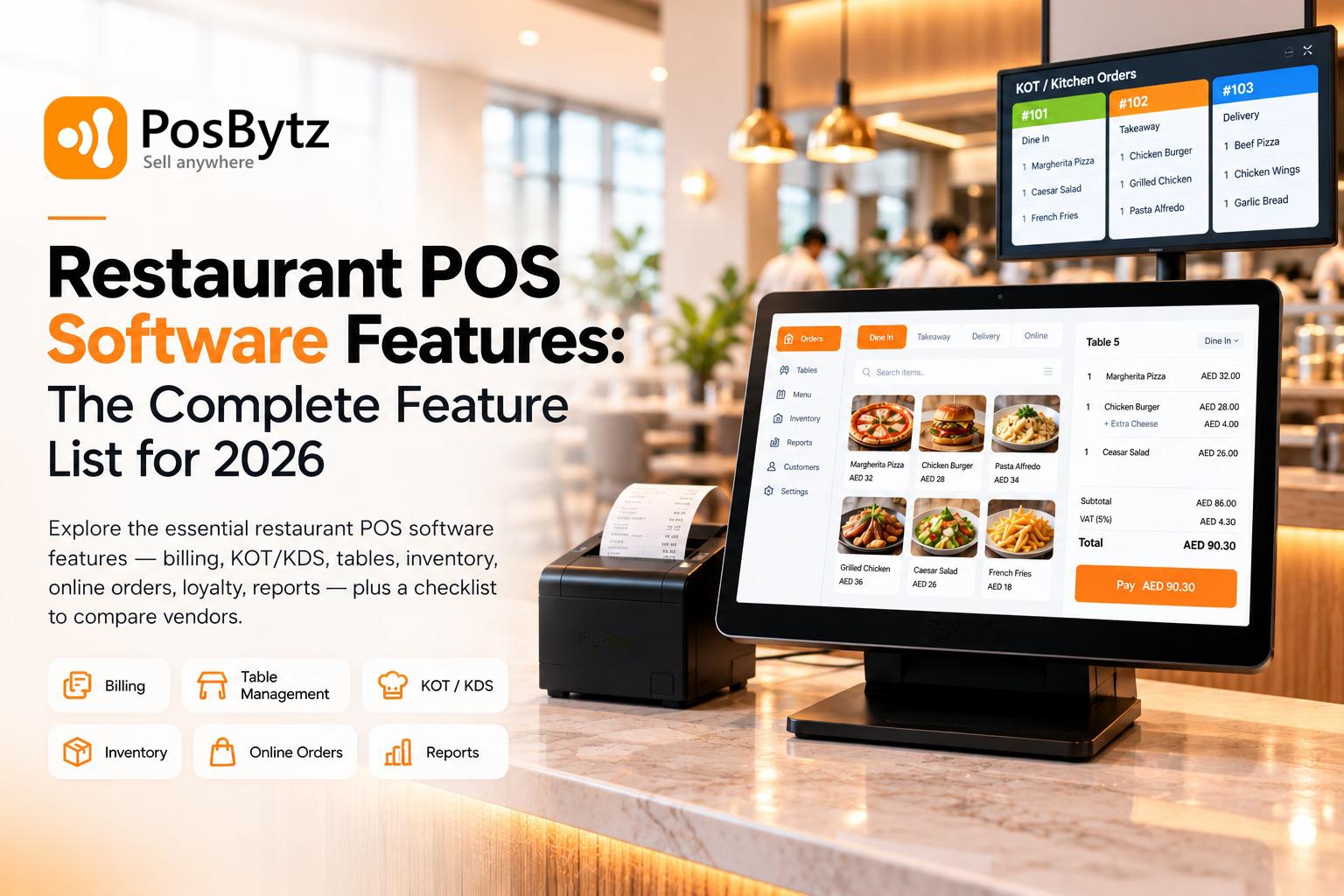
Paper tickets and shouted orders are one of the biggest sources of confusion in a busy kitchen. A kitchen display system replaces them with a digital screen that shows every order by station, with automatic routing based on category or prep time.
A well-configured KDS gives kitchen staff:
- Live order timers so nothing sits too long
- Bump, recall, rush, and refire controls for handling real-time changes
- Priority alerts for orders that are falling behind
- Prep time tracking and performance data by dish or station
This alone removes much of the guesswork about what needs to go out next, which is one of the fastest wins on any list of restaurant kitchen efficiency tips.
Real-Time Inventory Management
Running out of an ingredient mid-shift, or discovering a stock discrepancy only at month-end, both point to the same problem: inventory that isn't tracked in real time. A modern ERP deducts stock automatically as items are sold, down to the ingredient level, and tracks it across every channel, including in-store, online, delivery aggregators, and call-in orders.
This gives you:
- Real-time stock visibility across single or multiple locations
- Low stock and expiry alerts before a shortage becomes a service issue
- Automatic stop-selling when an item runs out, so the kitchen and POS stay in sync
- Batch and ingredient-level tracking for accurate recipe costing
QR Code and Mobile Ordering
QR-based ordering lets guests browse the full menu, customize items with modifiers, and pay from their own device, without downloading an app. Orders route straight to the kitchen display, which cuts down on order-taking time and reduces the staffing needed to manage table service during peak hours.
Online and Aggregator Order Management
Restaurants today take orders from their own website, a branded app, and multiple delivery aggregators such as Swiggy, Zomato, Uber Eats, or Talabat. Managing each of these separately multiplies the chance of a missed order or a menu that's out of sync. A connected system consolidates all of these into one dashboard, with automatic menu, pricing, and availability sync across channels.
Reporting and Data Analytics
A Modern ERP for Restaurants should give you more than a daily sales total. Look for real-time dashboards covering item-wise sales, food costing, staff performance, and multi-outlet comparisons. These reports make it possible to spot which dishes are underperforming, where food cost is creeping up, and which locations need attention, instead of finding out weeks later.
Staff Training on the New System
Technology only improves kitchen efficiency if the team actually knows how to use it. Once a Modern ERP for Restaurants is in place, invest time in training staff on the KDS, POS, and inventory workflows specific to your setup. A system that's configured correctly but poorly understood by staff will underperform one that's simpler but well understood.
Benefits of Connecting Your Kitchen Systems
When POS, KDS, inventory, and reporting run on one platform instead of several disconnected tools, restaurants typically see:
- Fewer order errors, since tickets move digitally instead of being re-keyed
- Lower food costs, from tighter inventory and recipe-level tracking
- Faster table turnover, thanks to quicker billing and kitchen routing
- Better visibility into which items and channels actually drive profit
- Less time spent reconciling sales, inventory, and accounting manually
Frequently Asked Questions
What does ERP mean in a restaurant context?
In a restaurant, ERP (Enterprise Resource Planning) refers to software that connects core operations, such as POS billing, kitchen management, inventory, purchasing, and accounting, into one system instead of running them as separate tools.
How is a restaurant ERP different from a regular POS system?
A standalone POS mainly handles billing and order-taking. A restaurant ERP includes POS functionality but also connects it to inventory, recipe costing, accounting, and reporting, so data flows between departments automatically.
Do small restaurants need a modern ERP, or is it only for large chains?
Modern ERP systems are built to scale, so a single-location restaurant can use the core POS, KDS, and inventory features, while multi-outlet or multi-brand operations add reporting, multi-location inventory, and brand-level management as they grow.
Can a modern restaurant ERP work offline?
Many cloud-based restaurant ERP systems, including PosBytz, are designed to keep working during internet outages and automatically sync data once connectivity is restored, so billing and kitchen operations aren't interrupted.
What's the first system to modernize in a restaurant kitchen?
Most restaurants see the fastest impact from starting with a POS and kitchen display system (KDS) integration, since this directly reduces order errors and ticket delays, before layering in inventory and reporting tools.
Conclusion
Modernizing a restaurant kitchen isn't about adopting technology for its own sake. It's about removing the manual handoffs, such as re-keyed orders, disconnected inventory counts, and separate reporting tools, that slow down service and eat into margins. A Modern ERP for Restaurants connects POS, kitchen display, inventory, and reporting into one system, so staff spend less time on admin and more time on service.
PosBytz is an all-in-one restaurant management software that brings these modern restaurant kitchen systems together on a single platform.
Modernize Your Kitchen Today
Increase your speed of service and reduce food waste with a connected Modern ERP for Restaurants.
Related Resources
- READ MORE: CRM for Restaurant Engagement
- EXPLORE NOW: Revolutionizing Restaurants with ERP
- LEARN MORE: Modern Kitchen Efficiency Guide
About the author

Saravana Damodaram
Co-Founder & CEO, PosBytz
Saravana Damodaram is the Co-Founder & CEO of PosBytz, a cloud-based POS-ERP platform built for F&B and retail businesses since 2018. He focuses on unified commerce, inventory, and multi-location operations, and has helped over 5,000 merchants across 25+ countries move off fragmented, disconnected tools and run their entire operation, billing, inventory, kitchen, and accounting on one platform.