Abu Dhabi Supermarket Junk Food Display Rules: What Retailers Need to Know
From January 1, 2027, Abu Dhabi supermarkets and their online platforms must stop featuring high-fat, salt, and sugar products at entrances, checkouts, and end-of-aisle spots. Here's what the policy covers, who it applies to, and how to prepare.
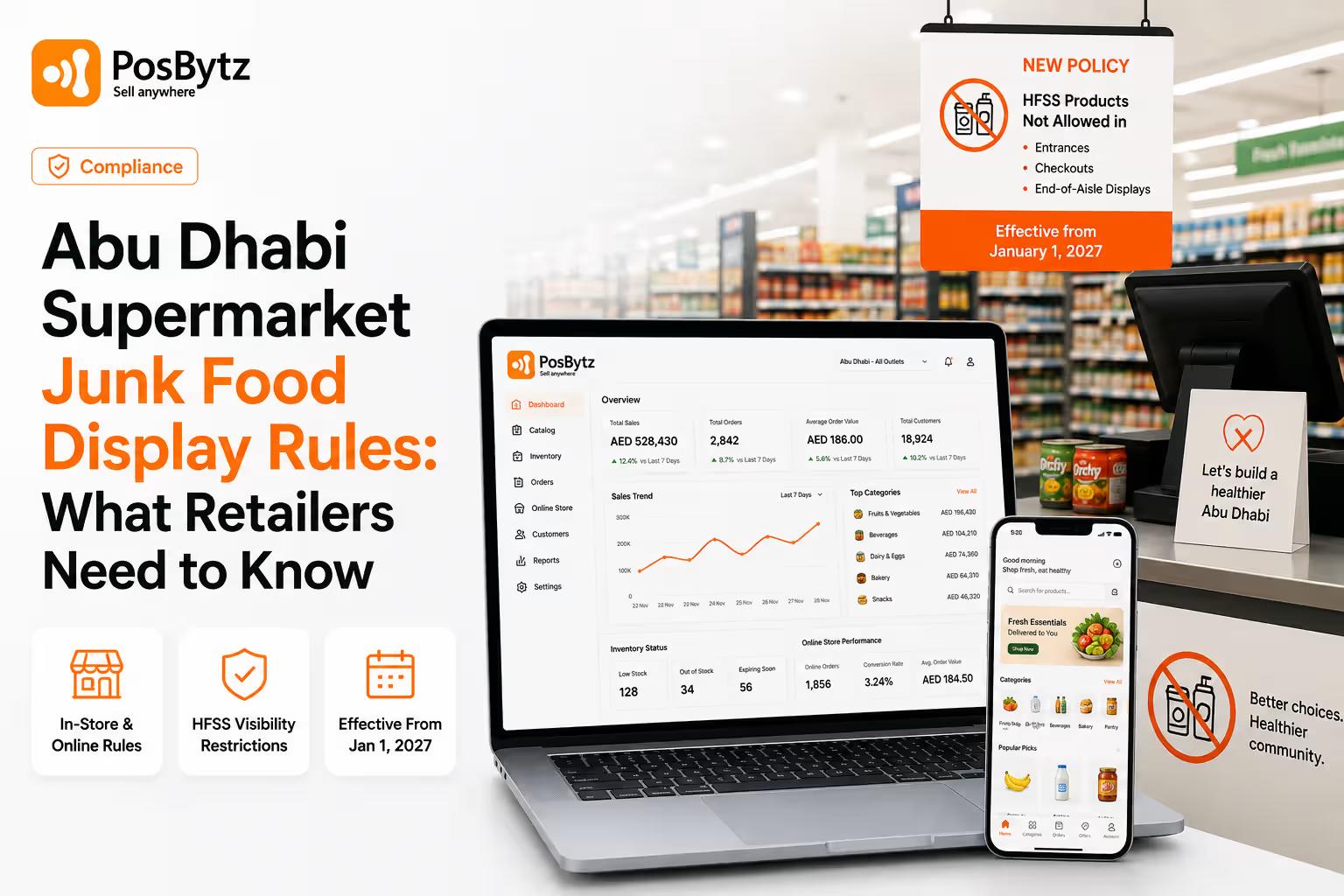


Starting January 1, 2027, supermarkets across Abu Dhabi will no longer be able to place high-fat, salt, and sugar (HFSS) food and drink products in high-visibility spots like store entrances, checkout counters, and end-of-aisle displays. The mandatory policy, introduced by Healthy Living in partnership with the Abu Dhabi Registration Authority (ADRA), also extends to online supermarket platforms, meaning homepages, search results, checkout pages, and promotional pop-ups will need to change too.
If you run or manage a supermarket in Abu Dhabi, this isn't a ban on selling any product. It's a shift in where and how prominently certain items are shown to shoppers, both on the shop floor and on your website or app. Here's what the policy actually covers, who it applies to, and what it means operationally.
What the Policy Requires
The rules target food and beverage products classified as unhealthy under the Abu Dhabi Public Health Centre's (ADPHC) SEHHI classification system. For physical stores, HFSS products will no longer be allowed in:
- Store entrances
- End-of-aisle displays
- Checkout areas
The same principle applies online. Supermarket websites and apps will need to stop featuring these products prominently on:
- Homepages
- Search results
- Promotional pop-ups
- Checkout pages
Products aren't being pulled from sale; they'll still be available on regular shelves and in your online catalog. What changes is visibility in the highest-traffic, highest-impulse spots, both in-store and online.
Who Has to Comply
The policy applies to physical supermarkets larger than 4,000 square feet, along with their online ordering platforms. It was developed by Healthy Living and ADRA in collaboration with the Department of Health (DoH), ADPHC, the Abu Dhabi Quality and Conformity Council (ADQCC), and the Abu Dhabi Agriculture and Food Safety Authority (ADAFSA), and is built on evidence from similar placement policies used in other markets.
Carrefour, operated by Majid Al Futtaim, has already completed implementation across its Abu Dhabi stores ahead of the deadline, a signal that larger retailers are treating this as a near-term operational priority rather than a policy to revisit closer to January.
Why This Matters Beyond the Shelf Reset
The in-store part of this, physically moving products off the checkout counter and end caps, is a merchandising and layout exercise. The online part is where most of the actual work will land, and it's easy to underestimate.
Every homepage banner, search ranking, checkout upsell, and pop-up promotion on a supermarket's online ordering platform runs on the same catalog data that powers in-store pricing and availability. If your online store and your in-store systems aren't pulling from a single, centrally managed catalog, updating what's featured across every channel (website, app, and physical layout) consistently and on deadline becomes a manual, error-prone job repeated across every property and outlet.
This is where the operational side of retail technology matters. A few things worth checking as you plan for January:
Can you control what's featured, by channel, from one place?
If your supermarket software supports centralized menu and catalog management with the ability to set different placement or pricing by channel, updating what shows on your homepage or checkout page doesn't require touching every product listing by hand.
Do your online and in-store systems share one self-wise inventory view?
Supermarket software that keeps inventory synced in real time across online ordering and in-store selling means a product's status and visibility can be updated once and reflected everywhere, rather than reconciled separately across a website, an app, and the shop floor.
Is your online ordering setup flexible enough to restructure quickly?
A branded online ordering platform that supermarkets can update themselves, adjusting what's shown on the homepage, in search results, and at checkout, gives retailers more control over compliance timelines than platforms that require developer changes for every layout adjustment.
None of this replaces the physical work of resetting checkout displays and end-of-aisle spots. But for supermarkets with online ordering, which is now explicitly in scope under this policy, getting the underlying catalog and inventory setup right is what makes the compliance deadline manageable rather than a scramble in late December.
Getting Ahead of the January Deadline
With the deadline set and Carrefour already compliant, other supermarkets across Abu Dhabi will likely move from planning to implementation over the coming months. Retailers running both physical stores and online ordering platforms have the added task of updating two environments in parallel, which is a good reason to review how centrally your catalog, pricing, and channel-level placement are currently managed before the compliance window closes.
For supermarkets evaluating their systems ahead of this shift, PosBytz's supermarket billing software and grocery store software support centralized inventory and catalog management across in-store and online channels, and the online ordering platform gives retailers control over how products are presented on their own branded storefront. You can read more on why supermarkets need dedicated billing software to understand how catalog and channel management fit into day-to-day operations.
FAQs
When does the Abu Dhabi junk food display policy take effect?
The policy becomes mandatory from January 1, 2027. Retailers are expected to be compliant by that date, though some, like Carrefour, have already completed implementation ahead of schedule.
Does this policy ban the sale of junk food in Abu Dhabi supermarkets?
No. The policy does not restrict the sale of any product. It only limits where high-fat, salt, and sugar (HFSS) items can be displayed. Shoppers can still buy the same products from regular shelves.
Which supermarkets does the policy apply to?
It applies to physical supermarkets larger than 4,000 square feet in Abu Dhabi, along with their online ordering platforms (websites and apps).
How does the policy affect online supermarket platforms?
Online platforms can no longer feature HFSS products prominently on homepages, in search results, in promotional pop-ups, or on checkout pages. Products can still be sold and listed in the regular catalog.
How can supermarkets prepare for the January 2027 deadline?
Beyond resetting physical store layouts, supermarkets should review how their catalog and inventory are managed across in-store and online channels. Centralized menu and inventory management makes it easier to update what's featured across every channel consistently and on time.
Related Resources
- Supermarket Billing Software: Cloud-Based Supermarket Billing Software & POS System
- Grocery Store Operations: Grocery Store Software — Streamline Your Retail Operations
- Why Billing Software Matters for Supermarkets: Supermarket Billing Software: The Key to Supermarket Operations
- Choosing the Right Grocery POS: Best POS System for Grocery Stores in 2026
- Benefits of Supermarket Billing Software: 5 Benefits of Using Supermarket Billing Software
About the author

The PosBytz Marketing Team
Editorial Team, PosBytz
The PosBytz Marketing Team shares practical insights on running smarter restaurants and retail stores from POS best practices to inventory management, online ordering, and customer loyalty strategies.