Best POS Systems for Shopify eCommerce in 2026
Shopify POS Software - In this article, we picked and reviewed the 5 best POS systems for Shopify POS integration.



Do you have an online ecommerce store and a retail outlet? Are you finding it challenging to handle the payments of both? We guess you did
To ease the payment process and track it efficiently, you must connect your ecommerce platform to your point-of-sale system using a POS integration. But the problem is that POS integrations can create chaos if both online and offline data isn’t shared between both systems in real-time
This is where Shopify comes to the rescue. Integrating your Shopify site and POS system can solve the problem because it can sync data quickly and hassle-free.
This article has picked and reviewed the 5 best POS systems for Shopify POS integration.
Why POS Integration?
The global Point of Sale(PoS) market size was valued at $22.08 billion in 2021, and the number is expected to increase to 70.75 billion by 2029.
This highlights the rapid growth of POS systems. So integrating POS systems can help the selling processes easily across multiple channels.
We will take a flier and assume you’re curious to learn more about Shopify inventory integration; since Shopify stands out with more users across the globe, like other online retailers.
The next thing that comes to mind is maybe whether Shopify integrates with other POS or not. Yes, there are some dedicated plugins meant for Shopify, and some others are versatile tools; that work with Shopify, WooCommerce, and many more open-source platforms. We’ll be discussing them below.
Before all, know the general benefits of most Shopify POS integrations –
- Simplifies business process
- Automate features save a lot of time
- Improves customer service
- Helps modify sales strategy
What to Look for in a Shopify POS Integration
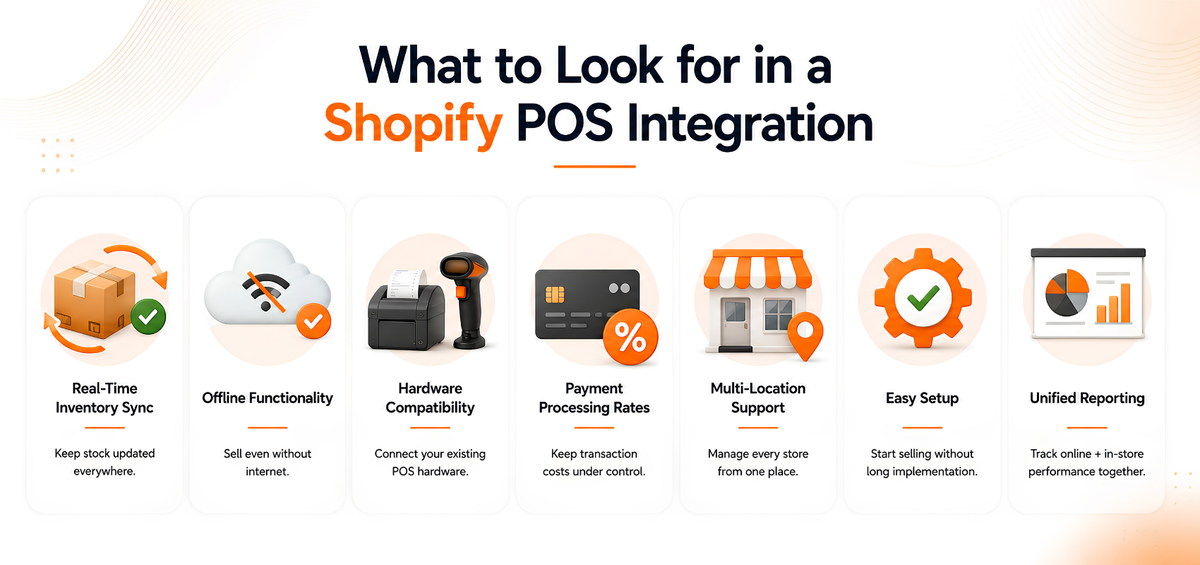
Before comparing specific products, it helps to know which features actually matter for a Shopify store:
- Real-time inventory sync: Stock changes on one channel should reflect everywhere within seconds, not hours.
- Offline functionality: The POS should keep taking sales during an internet outage and sync automatically once the connection returns.
- Hardware compatibility: Check support for your existing card readers, receipt printers, and barcode scanners, or budget for new hardware.
- Payment processing rates: In-person and online transaction fees vary by provider and add up fast at volume.
- Multi-location support: If you run more than one store or warehouse, confirm the POS can manage inventory across all of them from one account.
- Ease of setup: A long implementation timeline delays the whole point of integrating in the first place.
- Reporting: Look for sales and inventory reports that combine online and in-store data, not two separate dashboards.
Top POS Systems That Integrate With Shopify
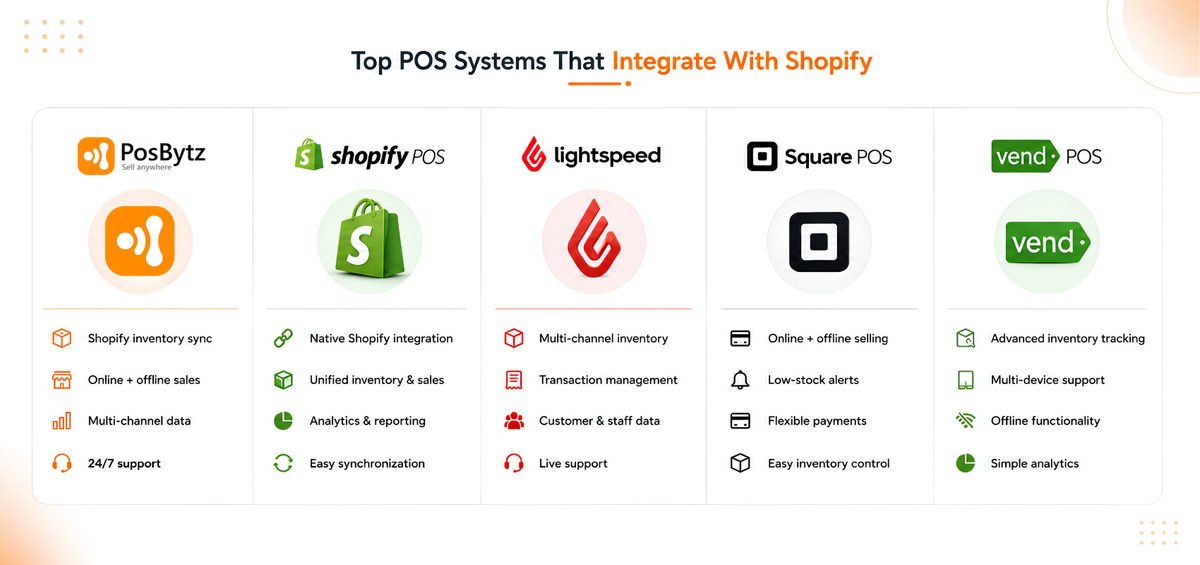
1.Posbytz
you’ve already made up your mind to use Shopify, next, all you need is a feature-rich eCommerce solution, like Posbytz, to create and customize an online store quickly and easily.
With Posbytz, creating an online store, customizing it according to your brand’s requirement, and launching the site is just a matter of a few minutes.
Linking your in-store and Posbytz’s Shopify inventory integration, you can ensure accurate and updated stock on all the platforms; you sell. When you synchronize the inventory integration across multiple platforms, your customer will get the best shopping experience.
Feature-packed Posbytz manages everything under one roof, from inventory management to analyzing customer databases for modifying strategy.
Price & Support:
- Let you Launch your online store for free with the basic pack, a premium version with more add-ons ranging between $90 to $750.
- 24*7 customer support in multiple languages
Pros:
- Help embed a unique and protected checkout experience
- Process transactions across online and offline channels
- Support most payment gateways
- Collect real-time business data from multiple systems
Cons:
- Relatively fewer CRM options
2.Shopify POS
No doubt, Shopify is one of the best eCommerce platforms in terms of scalability, SEO friendliness, mobile or other device responsiveness, and security
If you’re all set to go with Shopify and looking for the best Shopify POS integration, why don’t you consider your own POS integration of Shopify?
From inventory management to keeping up business analyzing real-time sales data, the joint venture of Shopify eCommerce and POS integration brings everything to your fingertips.
But the best part of Shopify POS is you don’t need to be concerned about integration compatibility or the hassle of data synchronization.
So, if you have a physical store and planning to launch an online store at Shopify, Shopify POS will be the simplest option for you. It will help you combine your offline and online store into a single platform for better business administration in just a few steps.
Price & Support:
POS Lite is available in all Shopify pricing plans, and the POS Pro version charges $89 per month.
Pros:
- Let you access several analytics tools
- Can integrate with several third-party apps
- Pin protected system helps track all cash register activity
Cons:
- Lacks some features for brick-and-mortar retailers
- Doesn’t support offline sale mode
3.Lightspeed POS Integration
By connecting Lightspeed retail accounts to your online retail store on Shopify, you can manage inventory, transactions, and data of service, staff, and customers smoothly from a single interface.
Besides the easy-to-use interface and FAQ section, it provides live support through phone, email, and chat to help beginners.
Price & Support:
- It costs $149 with a 30-day money-back guarantee
Pros:
- Safe online payment
- Manage inventory and transactions across multiple channels
- Automatically update the stock qualities in the WooCommerce and Shopify interface
Cons:
Not sure about offline support
4.Square POS
Like the previous two, Square POS is another cloud-based POS solution that can be used with Android, iOS, and other Square’s point-of-sale hardware.
With the easy-to-use interface of Square POS and low-stock alert feature updating and managing inventory is a breeze.
Price & Support:
Basic Free plan, Plus plan costs $60/ month/ location, and Premium version costs custom pricing and processing rate (processing rate is 2.9% + 30¢ for online payments and 2.6% + 10¢ for in-person & invoice payments)
Pros:
Custom payment method supports a variety of payment gateways
Process and save transactions in online and offline mode
Push notifications for low or out-of-stock items
Cons:
Doesn’t provide live 24/7 customer support
5.Vend POS
Inventory-rich retail business owners could opt for this cloud-based POS solution. With user-friendly functions, the inventory management system of Vend has extensive dedicated features for tracking product and supply information, stock levels, and sales records, expanded across multiple selling platforms.
The application can be used on multiple devices, including iPads, iOS, and android mobiles. Most admin functions can be accessed from the app, but some features are only available in a browser.
Price & Support:
14-day-free trial and three premium versions, Lite, Pro, and Enterprise, cost $99 to $129 annually.
Monthly plans are also available.
Pros:
Enhanced features for inventory management, including low stock alert
Short and simple to use the report and analytic feature
Works on offline mode
Cons:
Monthly paid plans are far more expensive than annual plans.
Frequently Asked Questions
What is a Shopify POS integration?
A Shopify POS integration connects a point-of-sale system to your Shopify store so inventory, orders, and customer data stay in sync between your online store and physical checkout.
Does Shopify have its own built-in POS?
Yes. Shopify POS is Shopify's native point-of-sale app. It runs on the same platform as your online store, so inventory updates without a separate integration step.
Can I use a different POS system with my Shopify store?
Yes. Several POS providers, including PosBytz, Lightspeed Retail, Square, and Clover, offer integrations that sync with Shopify, so you're not limited to Shopify's own POS.
How does inventory sync work between Shopify and a POS?
Once connected, a sale on either channel, online or in-store, updates the shared stock count so both systems reflect the same available quantity. The speed of that update depends on the integration: native integrations sync instantly, while some third-party connectors sync on a short delay.
Which POS is best for a small Shopify store?
For a single-location store just starting out, Shopify POS or Square are the simplest options since both offer free or low-cost entry plans. As you add locations or need built-in accounting and recipe costing, a platform like PosBytz becomes more worthwhile.
Conclusion
If you adore the Shopify eCommerce platform, the Shopify POS integration is there to serve you from all aspects, though it lacks an offline mode. So, we also picked the top alternative of Shopify POS.
We hope the detailed reviews, including the pros and cons, have helped you finalize the decision. If you still have any queries, feel free to leave a comment below!
Related Resources
About the author

Saravana Damodaram
Co-Founder & CEO, PosBytz
Saravana Damodaram is the Co-Founder & CEO of PosBytz, a cloud-based POS-ERP platform built for F&B and retail businesses since 2018. He focuses on unified commerce, inventory, and multi-location operations, and has helped over 5,000 merchants across 25+ countries move off fragmented, disconnected tools and run their entire operation, billing, inventory, kitchen, and accounting on one platform.