How to Build an Online Shopping App: A Step-by-Step Guide
How to Get Started with your Online Shopping App Idea? Setting up an online store is now a strategic art and read this article to know more.



Today, you use mobile applications to read, listen to music, edit photos or videos, and even quickly book your travel tickets. According to Statista, it is estimated that mobile apps are expected to generate over $935 billion in revenue by 2023.
Mobile applications offer better conversion rates due to the increasing number of smartphone users. A great example of a mobile application focused on creating customer engagement on its application is McDonald’s.
The new application allows users to order food and get promotional discounts at , takeaway,dine-in and drive-thru. The drive-thru plan has been an ingenious idea as, during the pandemic, many customers prefer eating in the comfort of their cars rather than sitting at a restaurant. The App also allows users to share feedback, peruse the menu and get the best deals on their burgers.
The main idea was to create an interactive in-store experience for the customer through developing an online eCommerce store. The ability to offer better discounts and quick payments and the analytics of consumer behaviour online is why businesses adopt online shopping apps to grow their business.
What are the benefits of developing an online shopping application?
1. Builds customer loyalty and creates brand engagement
You can build engagement by providing discounts, running flash sales, or exclusive offers for premium customers. This helps build loyalty, and customers feel rewarded during their consumer journey.
You can go heavy on your content creation to have customers actively engage with your brand. For example, Snapdeal has teamed up with an OTT service provider to provide video content on its eCommerce application. This engages customers with information and encourages them to browse through your website for a longer duration.
2. Personalized marketing
You can easily pitch to your customers based on their locations, interests, and data from past shopping behaviour. Thus, you can create customized strategies according to each target persona.
The best example of this is push notifications. They actively remind the customers about the upcoming sales and offers and create promotions according to their shopping behaviour. eCommerce stores actively use the push notification feature to inform customers about seasonal offers.
3. Mobile applications promote faster checkouts
Mobile web pages tend to load faster when compared to your traditional web pages. Brands need to build on an omnichannel experience as Gen Z and millennials look for a holistic experience when shopping online. If you look at the frequency of the younger generation’s online shopping data, you will notice that it is no longer once a week or once a month compared to the previous generation.
Gen Z and millennials are always on their toes and make split-second purchase decisions. Thus, seamless integration of the eCommerce store for smartphones is vital to retain your customers.
Native App, Online Store, or Both? Choosing the Right Path
Before you scope any features, decide what you're actually building.
A custom native app for iOS and Android gives you the most control and the deepest device integration, things like push notifications and camera-based features, but it also takes longer to build and needs ongoing app store maintenance. A mobile-optimized online store gets you live faster, works on any device through a browser, and is usually the better starting point if you haven't sold online before.
If you decide to go the custom app route, our guide on building an eCommerce app from scratch walks through the technical steps in more detail. If you'd rather launch quickly without a development team, PosBytz's free online store lets you set up a branded, mobile-friendly store with templates, payments, and delivery built in, so you can validate demand before committing to a full app build. It's also worth comparing platforms yourself; our breakdown of Shopify alternatives for eCommerce stores covers the trade-offs across different ecommerce platforms.
Which platforms your customers actually use also matters. If a large share of your target audience shops through a specific device or operating system in your market, build and test on that platform first rather than splitting effort evenly from day one.
Steps to Build an Online Shopping App That Converts
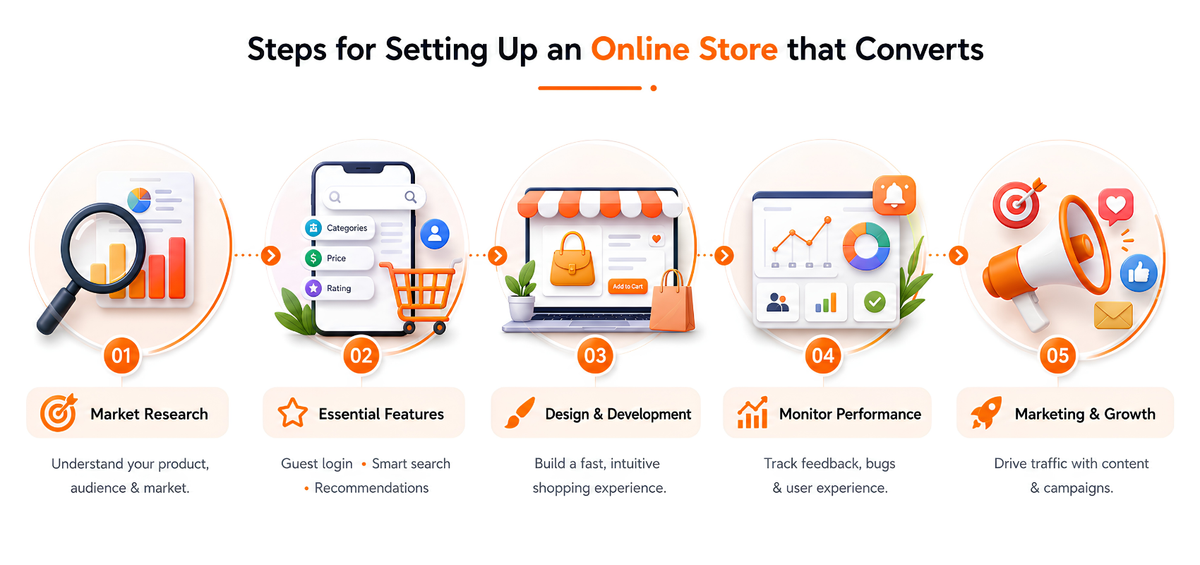
1. Market Research
This is the most crucial step before developing your online store. You should define the product idea, the regions you want to expand, and look at the market’s present and future conditions.
You can also build a survey for your target audience before the launch of your product so that you can understand the changes to be made and tweak them accordingly before investing in the idea.
You also need to decide which mobile platform you wish to launch your application with first. In continents like Asia and Africa, the Android market dominates the market share. However, for continents like Europe, Australia, and America, iOS leads the market share.
2. Essential Features Required
Thanks to the speed of digitization, many businesses need to differentiate themselves while launching shopping applications. So if you are on the way to build a shopping application that ensures high conversion rates, these are 6 features that are a must-have.
Customer and Guest Login
Customers lose interest in the process of entering their details again and again. You can provide them with a guest login feature offered in Posbytz, the online store software. This allows them to access the essential features that do not require login details. This helps your customers login with ease and browse through your product catalogue without a hassle.
Addition of Search filters with high-quality indexing
Customers like to be specific in their searches, and this helps them search for products based on the size, occasion, or price without going through the whole catalogue.
Integration of predictive analytics
You need to inform your customers of the latest discounts or promotions that they were actively searching for. Using predictive analytics, you can understand your customer behaviour and make recommendations accordingly, thus ensuring high conversions.
3. Design and Development
Design plays a vital role as customers build their brand perception based on the intuitiveness and user-friendliness of the shopping application. You should have a unique app icon so that customers can easily have high brand awareness and association.
In addition, it is essential to upload high-quality images as low-quality images create trust issues for the customer.
4. Monitor the application popularity
Once you become a well-known brand, you will have an overload of traffic, and this will lead to a slowing down of services, images, and frequent crashes. Thus, ensuring that you have continuous customer feedback is essential to provide them with an exceptional user experience through bug fixes on a timely basis.
5. Marketing
After the launch of your application, you should strategically look for ways to increase traffic to your application. It is important to market your product to appeal to a broader market and interactively engage them.
You can conduct contests, write informative blogs and provide video tutorials for your product.
Common Mistakes to Avoid
A few mistakes come up often enough to call out directly:
- Building every possible feature before launch instead of starting with a minimum viable set and expanding based on real usage
- Forcing account creation before checkout, which pushes new customers away at the final step
- Skipping mobile-specific testing, since a store that works well on desktop doesn't automatically work well on a phone
- Ignoring post-launch data, which means you keep guessing at what to fix instead of knowing
Conclusion
Smartphone adoption has made mobile the primary place customers discover and buy from businesses, and that isn't going to reverse. What changes year to year is less about whether to have an online shopping presence and more about how quickly you can launch, test, and improve one. Whether you choose a custom app or a ready-made online store, the businesses that keep improving based on real customer behavior are the ones that keep customers coming back.
PosBytz gives you the tools to launch a branded online store, an online store software built for retail and F&B businesses, without waiting on a development cycle. If you want to start selling and validate your online shopping app idea faster, set up your free online store with templates, payments, and delivery already built in.
Frequently Asked Questions
FAQ 1: What is an online shopping app?
An online shopping app is a mobile application, or a mobile-optimized online store, that lets customers browse products, place orders, and pay directly from their phone. It can be a native app downloaded from an app store or a responsive website that works like an app inside a mobile browser.
FAQ 2: Do I need a native app, or is a mobile-optimized online store enough?
For most businesses starting out, a mobile-optimized online store is enough to test demand and start selling, since it works across devices without app store approval or separate iOS and Android builds. A native app becomes worth the extra investment once you have consistent repeat traffic and need deeper features like push notifications or offline access.
FAQ 3: What features should an online shopping app have to increase conversions?
The features with the biggest impact on conversion are guest checkout, fast and accurate search and filters, multiple payment options, and real-time order tracking. Personalization and loyalty features help with repeat purchases, but they matter less at launch than a fast, frictionless checkout.
FAQ 4: How much does it cost to build an online shopping app?
Cost depends heavily on whether you build a custom native app or use a ready-made online store platform. A custom app built with a development team can range from the low tens of thousands of dollars to well over a hundred thousand, depending on features and platforms. A ready-made online store builder can get you live for a fraction of that, often within days.
FAQ 5: Can I launch an online store without building a custom app from scratch?
Yes. Platforms built for this let you launch a branded, mobile-friendly online store with templates, payment integration, and delivery management already in place, without writing code or hiring a development team. This is usually the faster, lower-risk way to validate an online shopping app idea before committing to custom development.
Related Resources
About the author

Kamalakannan
CTO, PosBytz
Kamalakannan is the CTO of PosBytz, where he leads product and engineering for the company's all-in-one POS and ERP platform. He writes about the technology decisions behind building reliable, scalable software for restaurants and retail businesses.