Best POS System for Bakery: 10 Must-Have Features Before You Buy
Best pos system for bakery checklist: recipe costing, expiry tracking, purchase automation, and tax-ready accounting, the 10 features that matter.
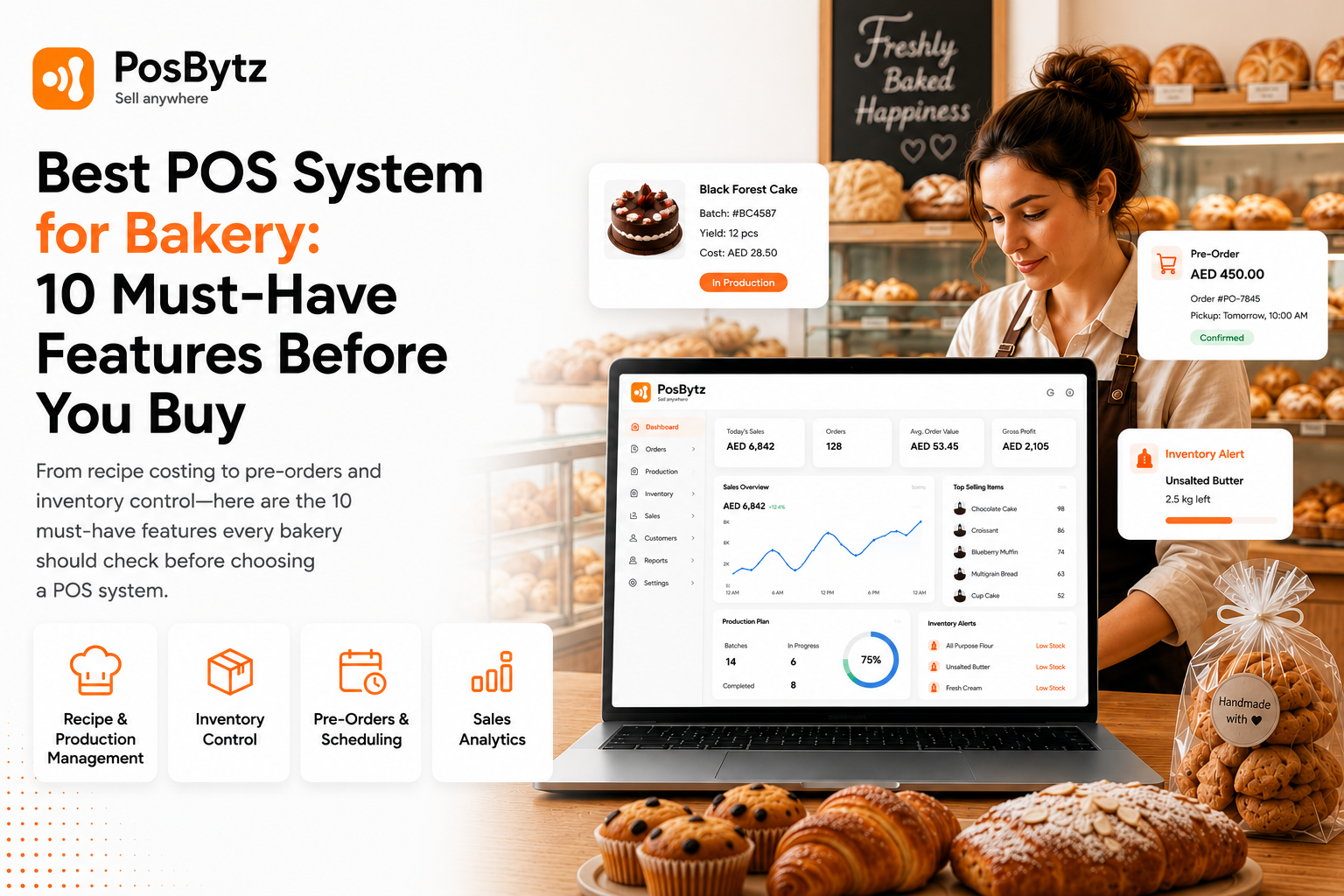


Choosing the best POS system for bakery operations isn't about picking whatever tool your neighboring cafe uses. A bakery runs on perishable ingredients, recipe-based production, and a mix of walk-in, pre-order and delivery sales where most generic retail POS tools never built for that combination. The best bakery POS software for your business is the one that matches how your kitchen actually runs, not just what's on a features list. Before you sign up for a demo, run any shortlist through the ten checks below.
This isn't a vendor-by-vendor comparison table. It's the operational checklist a bakery owner should actually use, because a feature that looks good on a spec sheet doesn't always hold up once you're deducting flour and eggs from stock at 6 a.m.
A bakery sits at an interesting intersection. The kitchen side, recipe costing, batch production, ingredient deduction, runs like classic F&B. But a counter selling bread, pastries, and cakes directly to walk-in customers behaves more like a retail storefront. If your operation is closer to full kitchen production with dine-in or cafe-style service, PosBytz's restaurant management software is the closer fit. If you're mainly a storefront moving baked goods over the counter, our retail management software covers that side of the business instead.
1. Cloud-based billing that still works when the internet doesn't
A bakery's morning rush doesn't wait for your Wi-Fi to reconnect. Look for a POS software for bakery shop use that's cloud-based but works offline with automatic sync, so billing continues uninterrupted and every transaction catches up once you're back online. It should also be device-agnostic, running on Windows, Android, or iPad, so you're not locked into one hardware vendor as you grow. PosBytz's cloud POS is built around this offline-first approach, with easy billing designed for quick checkout during peak hours.
2. Recipe-level inventory deduction
This is the single biggest difference between a bakery POS and a general retail POS. When you sell a dozen croissants, the system should automatically deduct the exact flour, butter, and yeast used, not just reduce a "croissant" count. Recipe management with ingredient-level tracking means your raw material stock reflects what's actually happening in the kitchen, without a manual stocktake at the end of the day.
3. Batch and expiry tracking on perishables
Cream, dairy fillings, and fresh dough don't keep the way packaged retail stock does. A bakery POS needs batch tracking and expiry tracking built into inventory management, with automated stock alerts before items go bad, not after. Real-time inventory tracking across your counter, online orders, and any delivery aggregator sales keeps one accurate stock picture instead of three disconnected ones. Our restaurant inventory management guide covers this kind of ingredient-level tracking in more depth if you want the fuller picture.
4. Recipe costing that shows your real margins
Flour and butter prices move. If your POS can't recalculate what a batch actually costs to produce, you're pricing blind. Look for recipe costing and cost of goods calculation that ties ingredient consumption to the item price, so you get a real food cost per dish and can see profit margins per product, not just total revenue.
5. Automated purchase orders at reorder points
Manually tracking when you're low on flour, sugar, or packaging doesn't scale past one outlet. A strong bakery POS generates automated purchase orders once stock hits a reorder point, and can raise supplier purchase orders directly from the system, cutting the gap between "we're out" and "we've ordered more."
6. Multi-outlet and multi-brand management from one dashboard
If you're running more than one bakery counter, or a central kitchen supplying several outlets, you need multi-location inventory management and centralized inventory that gives you one stock view across all of them. This is where the best POS for bakery chains earns its keep, since generic retail POS tools often break down past two or three locations. For bakery groups running separate brands or menus, multi-brand management with brand-level reporting keeps each line separately trackable while still sitting under one dashboard.
7. Online ordering and delivery aggregator sync
A modern bakery sells more than what walks through the door. Look for a system that lets you accept dine-in, takeaway, delivery, and online orders from one screen, with a branded online ordering website or app you can launch without weeks of setup. If you also sell through Swiggy, Zomato,Careem, Noonfoods, Hungerstation, Keeta, Uber Eats, Talabat, Deliveroo or similar platforms, delivery aggregator integration with automatic menu, pricing, and order sync saves you from re-entering the same information in three places.
8. Advance ordering for scheduled and custom orders
Bakeries don't just sell what's in the display case. Birthday cakes, custom orders, and bulk catering all come in days or weeks ahead of pickup, and the POS needs to handle that timeline, not just same-day sales. Pre-order support lets customers place and schedule an order for a future date instead of forcing it through as a walk-in sale, so it doesn't get lost between the counter and the kitchen. Collecting payment at the time of booking matters just as much: with online payment and payment request built in, you can take payment upfront for a custom cake rather than chasing it down closer to pickup, and multiple payment options mean customers aren't limited to cash or card alone. That combination, order scheduled and payment secured in one step, is what makes advance ordering usable for a bakery instead of just a POS feature nobody uses.
9. CRM and loyalty for repeat customers
Bakeries live on repeat business, the same customers coming back for their weekly bread order or a birthday cake. A built-in CRM should track customer profiles, purchase history, and preferences, and support loyalty programs (points, stamps, or tier-based rewards) plus birthday and anniversary campaigns that give people a reason to come back. Our CRM software for restaurants and retail page breaks down what this looks like when it's built into your POS rather than bolted on separately.
10. Tax-ready accounting and reports
Whatever region you're operating in, your POS shouldn't leave your books as a separate project. Look for built-in accounting with tax-ready reports, VAT return support, and, if you're in Saudi Arabia, ZATCA-compliant e-invoicing, so compliance is handled inside the same system you bill from. On the reporting side, item-wise sales, product profitability, and food costing reports tell you which items are actually making you money, not just which ones are selling.
What this looks like for a small bakery vs. a chain
A single-outlet bakery mostly needs points 1–4 and 8–9 to run day-to-day: reliable billing, accurate ingredient deduction, expiry alerts, and a way to keep regulars coming back. A multi-outlet bakery or bakery chain needs all ten, with particular weight on centralized inventory, purchase automation, and multi-outlet reporting: the operational glue that keeps outlets consistent as you add locations. If inventory-heavy retail is your bigger concern right now, our best POS inventory systems for small business roundup compares options with that lens specifically.
For bakeries that also run a café-style counter (coffee, pastries, and seating alongside the bakery line), a lot of these same requirements overlap with what we've covered in cafe billing software, which pairs fast billing with loyalty and tax-compliant invoicing.
The bottom line
When evaluating the best bakery POS software, run every shortlist through these ten checks before you commit: recipe-level deduction, expiry tracking, real costing, purchase automation, multi-outlet control, omnichannel ordering, fast counter checkout, loyalty, and compliant accounting. Most tools cover two or three of these well and leave you stitching together a second system for the rest.
PosBytz is built to cover all ten from one platform: recipe management with ingredient-level deduction, batch and expiry tracking, food costing, automated purchase orders, multi-outlet and multi-brand control, online ordering with delivery aggregator sync, Advance ordering and fast checkout, built-in CRM and loyalty, and tax-ready accounting with ZATCA-compliant e-invoicing. That combination is what makes PosBytz a strong candidate for the best bakery POS system for growing bakery businesses across India and the GCC. If you're comparing options for your bakery, get a free PosBytz pricing estimate shaped around your outlets and hardware. Start a Free Trial.
FAQs
What features make the best POS system for bakery businesses?
The core ones are recipe-level ingredient deduction, batch and expiry tracking, recipe costing, automated purchase orders, multi-outlet support, online ordering with delivery aggregator sync, pre-order scheduling with upfront payment, loyalty and CRM, and tax-ready accounting. A general retail POS usually covers two or three of these; a bakery-built platform covers all of them together.
Is cloud-based POS software for bakery shop counters reliable if the internet goes down?
It should be. Look for a system that's cloud-based but works offline with automatic sync, so billing at the counter continues uninterrupted and every transaction catches up once the connection returns.
Can the best bakery POS software handle custom cake orders and advance payments?
Yes, if it includes pre-order support. That lets a customer schedule a birthday cake or bulk order for a future date, while online payment and payment request let you collect payment upfront instead of waiting until pickup.
What's the difference between a regular retail POS and the best POS for bakery operations?
The biggest one is inventory logic. A regular retail POS reduces stock by the unit sold. A bakery POS uses recipe management to deduct the exact ingredients, flour, butter, eggs, that went into that item, so your raw material stock stays accurate without a manual count.
Can one system manage multiple bakery outlets or a central kitchen?
Yes. Multi-location inventory management and centralized inventory give you one stock view across outlets, and multi-brand management with brand-level reporting keeps separate bakery brands or menus trackable under a single dashboard.
Does the best bakery POS system support tax compliance for India and the GCC?
It should include tax-ready reports and VAT return support as standard, with ZATCA-compliant e-invoicing for bakeries operating in Saudi Arabia specifically.
Do I need bakery-specific software, or will a general retail POS work?
A general retail POS can ring up sales, but it won't deduct ingredients by recipe, track batch expiry on perishables, or calculate real food cost per item. For a bakery, those three alone are usually worth switching to purpose-built software.
Related Articles
About the author

The PosBytz Marketing Team
Editorial Team, PosBytz
The PosBytz Marketing Team shares practical insights on running smarter restaurants and retail stores from POS best practices to inventory management, online ordering, and customer loyalty strategies.