How to Choose the Right POS Software in Dubai (2026 Buyer's Guide)
Choosing POS software in Dubai? Check e-invoicing readiness, Talabat and Deliveroo sync, offline mode and hidden AED costs before you sign. Free checklist.
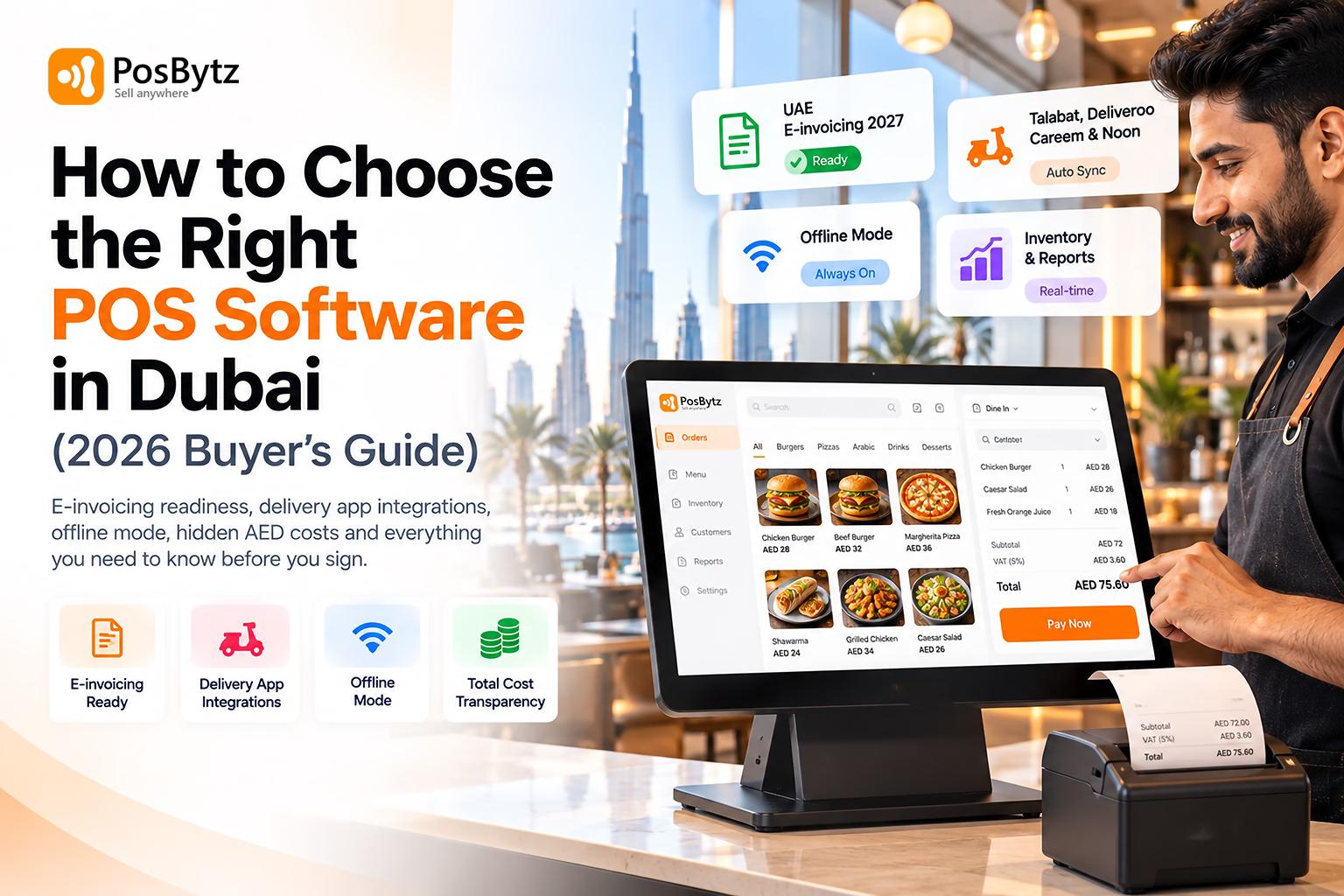


Why most Dubai businesses pick the wrong POS the first time
The right POS software in Dubai is the one that still works in July 2027, when UAE e-invoicing becomes mandatory for most businesses, and that settles your delivery app payouts without a spreadsheet. Features like billing, KOT and inventory are table stakes. The real differences show up in compliance, integrations, offline reliability and hidden costs.
Most owners do not switch POS because billing is slow. They switch because of problems like these:
- Talabat, Deliveroo, Careem and Noon orders are typed in by hand, and every month the payout never matches the sales report.
- The internet drops during the Friday lunch rush and the counter stops taking orders.
- The accountant spends days fixing VAT figures before every return.
- A second branch opens and stock, menus and prices drift apart.
- The "affordable" POS turns expensive once hardware, per-terminal fees and integration add-ons arrive.
This guide skips the generic feature lists you can find anywhere. Instead, it covers the questions that separate a POS that grows with you from one you will replace in 18 months. It is written for restaurants, cafes, cloud kitchens, supermarkets and retail stores in Dubai, and it is current as of October 2026.
If you want to compare named products after reading, see our lists of the best restaurant POS software in the UAE and the best retail POS software in Dubai.
1. Will your POS survive UAE e-invoicing in 2027?
Ask this first, because it is the question most POS vendors in Dubai still cannot answer clearly. UAE e-invoicing becomes mandatory on 1 January 2027 for businesses with annual revenue of AED 50 million or more, and on 1 July 2027 for everyone below that threshold.
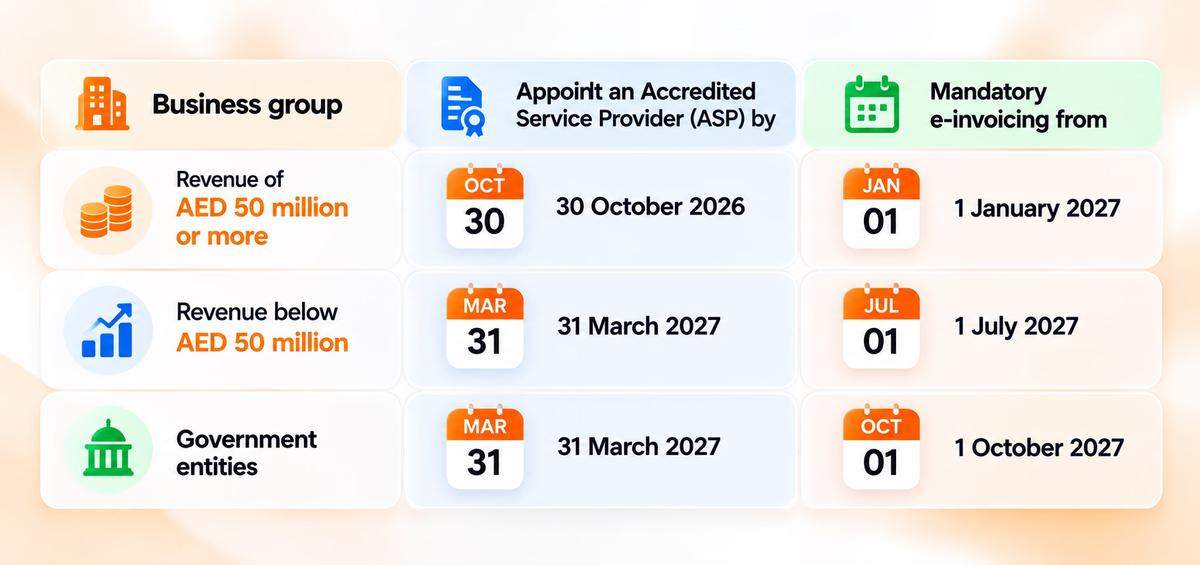
Source: UAE Ministry of Finance timeline, including the May 2026 extension of the first ASP deadline, as summarised by HAL. Always confirm on the Ministry of Finance e-invoicing portal before acting.
"But my customers are walk-in diners. Does this even apply to me?"
Partly, and this is where many owners get caught out. Sales to ordinary consumers (B2C) are currently outside the mandate. But most restaurants and shops also do business with other businesses:
- Corporate orders and catering invoiced to companies are B2B and in scope.
- Supermarkets and wholesalers that sell to restaurants, offices or resellers issue B2B invoices.
- Your suppliers will send you structured e-invoices, so you must be able to receive them, not just send them.
- VAT registration is not the test. Ministry guidance says e-invoicing can apply even to businesses that are not VAT registered.
Four facts that change how you evaluate a POS
- A PDF is not an e-invoice. UAE e-invoices are structured XML data exchanged through the Peppol network. A POS that only prints or emails PDFs will not be enough for your B2B invoices.
- You will connect through an ASP. Your system sends invoice data to an accredited provider, which validates it, delivers it to your buyer's provider and reports tax data to the FTA.
- There is no QR code requirement. Unlike Saudi Arabia's ZATCA system, UAE e-invoices do not carry a QR code. Be wary of vendors who sell their "Saudi-ready QR invoices" as UAE compliance.
- Penalties are monthly. Failing to implement the system or appoint an ASP on time costs AED 5,000 for each month of delay, and late e-invoices cost AED 100 each, capped at AED 5,000 per month.
What to ask the vendor
- Can the POS separate B2C receipts from B2B invoices and capture the buyer's TRN and legal details at checkout?
- Which UAE ASPs do you integrate with today, and what is the roadmap date if none yet?
- Can it issue structured credit notes for refunds and returns, linked to the original invoice?
- Does it push clean data to your accounting software so purchase e-invoices can be matched against stock received?
A POS with clean, structured invoice data and an open integration layer will make the switch a configuration task. A closed, PDF-only system will make it a migration project, right before your deadline.
2. Does it get VAT and receipts right without your accountant fixing them?
A good POS for Dubai calculates 5% VAT correctly on every line, shows VAT-inclusive prices, and produces reports your accountant can file from directly. If your team exports sales to Excel and "cleans" them before every VAT return, your current POS is costing you money.
Check these during the demo:
- Tax invoice formats. It should issue simplified tax invoices for walk-in customers and full tax invoices (with the buyer's TRN) for business customers, from the same screen.
- Mixed tax rates. Supermarkets and some retailers sell items at different VAT treatments. Ask the vendor to ring up a mixed basket and show the VAT report.
- Stacked charges. If you operate inside a hotel or venue that adds a service charge or municipality fee, ask the vendor to print a sample bill showing the order in which each charge and VAT is applied. Getting this sequence wrong is one of the most common billing complaints in Dubai F&B.
- Refunds and voids. Every refund should create a proper credit note and reverse VAT, with a manager approval trail.
- Corporate Tax records. Since UAE Corporate Tax applies to most businesses, your POS sales data is now part of your audit trail. Read our UAE Corporate Tax guide for what to keep.
Arabic, English and the tourist till
Dubai counters serve residents and tourists from dozens of countries. Your POS should handle:
- Bilingual receipts and menus in English and Arabic, so you are ready if the FTA requests Arabic records.
- Every payment method Dubai customers expect: cards, Apple Pay and Google Pay, tap to pay, split bills and cash, with the card terminal integrated so staff never re-key amounts.
- Tourist VAT refunds for retailers registered in the tourist refund scheme, with receipts that carry the details the refund operator needs.
A POS that treats payments as a separate machine creates end-of-day mismatches. Integrated payments mean the card settlement and the POS sales report agree automatically.
3. Can it tame Talabat, Deliveroo, Careem and Noon?
For most Dubai restaurants, delivery apps are a large share of sales, and they are where money quietly leaks. The right restaurant POS software in Dubai pulls every aggregator order straight into the kitchen and reconciles each payout against what you actually sold.
The hidden cost of tablet chaos
Many kitchens still run four or five aggregator tablets beside the POS. Staff retype each order, which causes:
- Wrong items and missed modifiers, leading to refunds and bad ratings.
- Menu items still live on one app after they sell out.
- Prices that differ between apps because someone forgot to update one.
- Monthly payouts that never match, because commissions, promotions, refunds and penalties are buried in each app's statement.
What "integration" should really mean
When a vendor says "we integrate with Talabat", ask them to show you each of these live:
- The order appears on the POS and kitchen display automatically, with modifiers and notes.
- Accepting or rejecting the order from the POS updates the app.
- Marking an item out of stock on the POS hides it on every app.
- Menu and price changes publish from one place.
- A report shows sales by channel, net of commission, so you can see which app is actually profitable.
If the answer is "we use a third-party middleware", ask who supports it when it breaks on a Friday night and what it costs per outlet.
Cut your dependency on commissions
The smartest Dubai operators use the aggregators for discovery and their own channels for repeat customers. Look for a POS that includes a commission-free online ordering system, QR table ordering and a customer database for loyalty offers. Our guide to managing multiple online orders and the Talabat POS integration guide go deeper.
4. What happens when the internet drops, or when you open branch number two?
A cloud POS should keep billing when the connection fails and sync automatically when it returns. And it should let you run five branches from one dashboard as easily as one.
Offline mode: test it, do not trust it
Mall food courts, basements in older buildings and busy events in Dubai all have patchy connections. During the demo, ask the vendor to switch off the Wi-Fi and then:
- Take an order, print the KOT and settle the bill by card and cash.
- Reconnect and confirm the sale, stock deduction and VAT appear correctly in the cloud report.
- Ask how long the POS can run offline and what happens to aggregator orders during the outage.
Multi-branch control
Growth is where cheap POS systems break. Make sure you can:
- Push menu, price and promotion changes to all outlets, or to selected ones, in one step.
- Transfer stock between branches and a central kitchen or warehouse, with records on both sides.
- Compare branch sales, food cost and staff performance on your phone, live.
- Set role-based permissions so a cashier cannot give discounts or delete bills without approval.
Read our guide to inventory management for multiple outlets, and if you are launching delivery-only brands, our guide on how to open a cloud kitchen in the UAE.
Restaurant POS software in Dubai: the checklist by format
Every restaurant needs billing, KOT and reports. What differs is which features decide your margins. Use this table to focus your demo on what matters for your format.
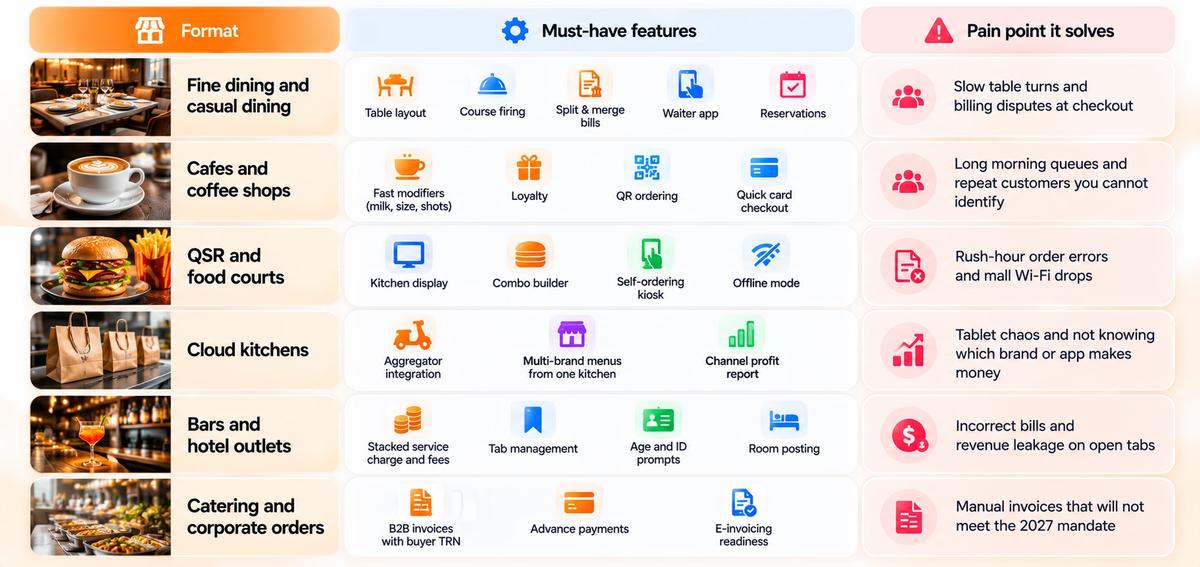
Two features Dubai restaurants underrate:
- Recipe-level inventory. With food costs rising, you need the POS to deduct ingredients per dish and flag variance between expected and actual usage. That is where theft and wastage show up.
- Staff and payroll links. Labour is often the second-largest cost. A POS connected to HR and payroll lets you compare shift costs against sales by hour.
See how PosBytz handles these in its restaurant POS software and cloud kitchen software.
POS software for supermarkets and retail stores in Dubai
Supermarket POS software in Dubai has to scan fast, track thousands of SKUs and handle weighed goods without slowing the queue. Retail stores need the same speed plus stock that stays in sync with their online store.
For supermarkets, groceries and mini-marts:
- Barcode speed under load. Ask the vendor to scan 50 items in a row on their hardware. Any lag will cost you customers at peak hours.
- Weighing scale integration for produce, meat, fish and bakery, with scale barcodes read at the till.
- Expiry and batch tracking so short-dated stock is sold or returned to suppliers before it becomes a loss.
- Purchase orders and supplier e-invoices. From 2027 your suppliers will send structured e-invoices. A POS that links purchase orders, goods received and supplier invoices saves hours every week.
- B2B sales. If you sell to restaurants, offices or resellers, you need proper tax invoices and e-invoicing readiness for those accounts.
- Promotions engine for buy one get one, mix and match, and loyalty points.
For fashion, electronics and specialty retail:
- Size and colour variants under one product.
- Serial number and warranty tracking.
- Returns and exchanges across branches.
- One stock pool for your shop, website and marketplaces, so you never sell what you do not have.
Explore PosBytz supermarket billing software and grocery store software.
5. What will it really cost in AED over three years?
The monthly subscription is rarely the biggest number. Compare vendors on three-year total cost of ownership, because add-ons, per-terminal fees and integrations can double the quoted price.
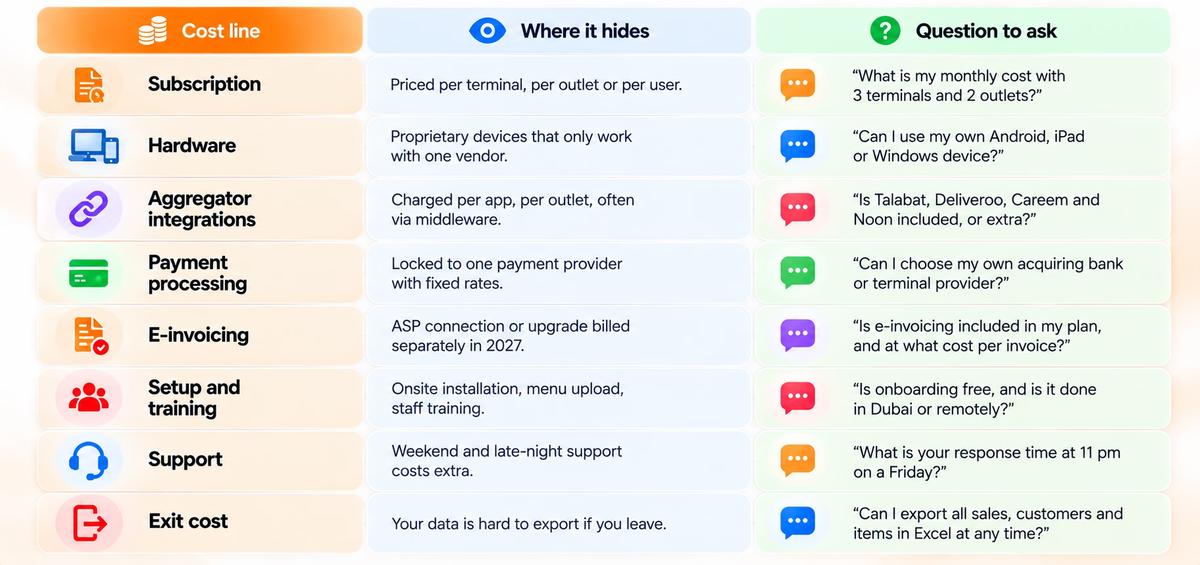
Add these up for 36 months before you compare quotes. For a deeper breakdown, read how much a restaurant POS system costs, or see PosBytz pricing.
6. The 10-question demo scorecard (and the red flags)
The best POS software in Dubai for your business is the one that passes a live demo built around your own menu or products. Bring this scorecard, score each answer from 0 to 2, and pick the vendor with the highest total.
- Show an aggregator order landing in the kitchen without anyone touching it.
- Switch off the internet and complete a sale, then reconnect and show the report.
- Issue a B2B tax invoice with the buyer's TRN, then a credit note for a partial refund.
- Name your UAE e-invoicing ASP partner, or give a written roadmap date.
- Print a bilingual English and Arabic receipt.
- Change a price once and show it update on every outlet and delivery app.
- Show the VAT report your accountant would file from.
- Show recipe or SKU-level stock deduction and a variance report.
- Export all your data to Excel in under a minute.
- Give the full three-year cost in writing, including hardware, integrations and e-invoicing.
Red flags that should end the conversation:
- "E-invoicing? That is for big companies only."
- "Our Saudi QR invoice already covers the UAE."
- Integrations that only work through a third party nobody in the room can name.
- A long contract with no data export clause.
- No local support team in the UAE time zone.
Already using a POS and comparing options? See our comparisons of Foodics alternatives and Sapaad alternatives.
How PosBytz fits Dubai restaurants and retailers
PosBytz is a cloud POS and ERP built for restaurants and retail, so billing, inventory, online orders, accounting, CRM and payroll live in one system instead of five.
- Runs on hardware you choose: Android, iPad or Windows.
- Delivery and direct orders in one screen, plus a commission-free online ordering system and QR table ordering.
- Built-in accounting, CRM and HR and payroll, so VAT, customer and staff data come from the same source.
- Multi-outlet control for menus, prices, stock transfers and live reports.
- Open integrations with accounting, e-commerce and delivery platforms, which keeps your invoice data structured and ready for e-invoicing.
- Proven in GCC compliance: PosBytz already supports e-invoicing requirements in Saudi Arabia, experience that carries into the UAE rollout.
Book a demo built around your menu or product list. Bring the 10-question scorecard above and hold us to it. Talk to the PosBytz team.
Frequently asked questions
What is the best POS software in Dubai?
There is no single best POS for every business. The best POS software in Dubai for you is the one that handles your delivery apps, VAT and B2B invoices, works offline, and has a clear e-invoicing plan for 2027. Use the 10-question scorecard above to compare vendors on your own menu or products.
Do restaurants in Dubai need e-invoicing?
Sales to walk-in consumers are currently outside the UAE e-invoicing mandate. But B2B sales such as corporate orders and catering are in scope, and restaurants will receive e-invoices from suppliers. Businesses below AED 50 million in revenue must comply from 1 July 2027.
Is a PDF invoice valid under UAE e-invoicing?
No. Once the mandate applies to you, B2B invoices must be structured electronic data exchanged through an Accredited Service Provider. PDFs, scans and emailed attachments do not count as e-invoices.
Does my POS need to print receipts in Arabic?
English tax invoices are generally accepted, but the FTA can request Arabic versions of records. A bilingual POS saves effort if that request comes, and it serves Arabic-speaking customers better.
Can one POS manage Talabat, Deliveroo, Careem and Noon orders?
Yes, if it has real integrations. Orders should flow directly into the POS and kitchen display, stock changes should sync to every app, and reports should show sales by channel net of commission.
How much does POS software cost in Dubai?
Costs vary by number of terminals, outlets and add-ons. Compare three-year total cost, including hardware, aggregator integrations, payment processing, e-invoicing and support, rather than the monthly fee alone.
What is the best restaurant POS software in Dubai for a cloud kitchen?
Look for aggregator integration, multi-brand menus from one kitchen, recipe-level inventory and a profit report by brand and channel. These matter more for cloud kitchens than table management.
About the author

The PosBytz Marketing Team
Editorial Team, PosBytz
The PosBytz Marketing Team shares practical insights on running smarter restaurants and retail stores from POS best practices to inventory management, online ordering, and customer loyalty strategies.