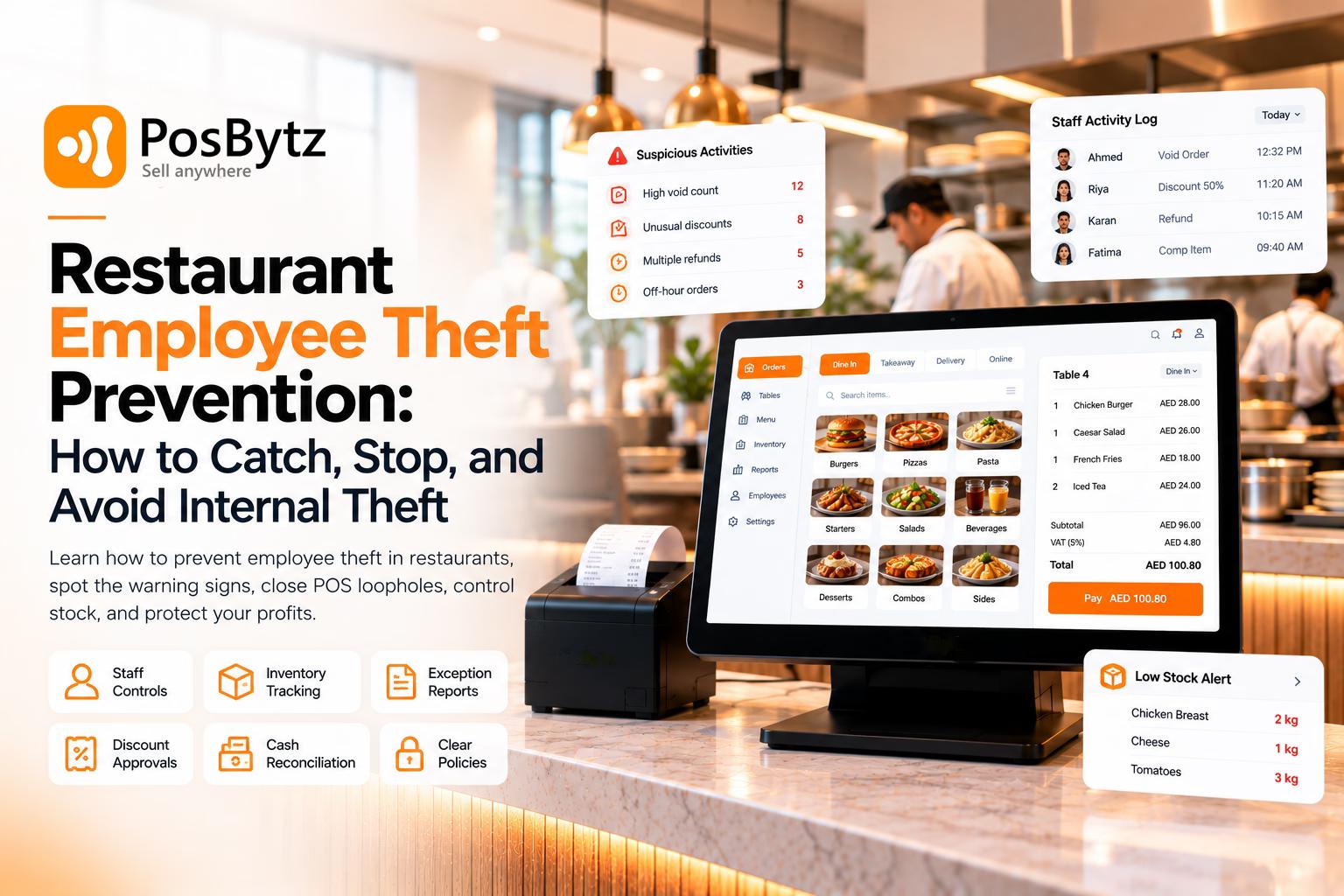
Restaurant Employee Theft Prevention: How to Catch, Stop, and Avoid Internal Theft
Learn how to catch and avoid employee theft in restaurants. Spot the warning signs, close POS loopholes, control stock, and stop internal theft for good.


Quick Answer: How Do You Prevent Employee Theft in a Restaurant?
To prevent employee theft in a restaurant, give every staff member their own POS login, require manager approval for voids, discounts, refunds, and comps, track stock with recipe-based inventory, reconcile cash and stock every shift, and review exception reports for unusual patterns. Back these controls with clear written policies, a fair staff meal allowance, cameras on cash and storage areas, and consistent consequences when theft is proven.
Most internal theft in restaurants succeeds for one reason: nobody can see it. When every sale, void, and ingredient is recorded against a named person, theft becomes harder to commit and much easier to catch.
What Is Restaurant Employee Theft?
Restaurant employee theft is when staff take cash, food, drinks, supplies, or paid time from the business without permission. It is also called internal theft, to separate it from customer theft (such as walkouts) and external theft (such as break-ins).
It ranges from small, everyday habits to organized schemes:
- A bartender pours free drinks for friends
- A cashier takes cash for an order and never rings it in
- A cook takes home a few portions of meat every week
- A manager marks good stock as waste and keeps it
- An employee clocks in for a colleague who hasn't arrived
Each act may look minor. Repeated over weeks and months, they quietly eat into a business that already runs on tight margins.
Why Restaurant Theft Is a Bigger Problem Than Most Owners Think
Restaurants are especially exposed to theft for a few simple reasons:
- Lots of cash and small transactions. Many quick, low-value sales make it easy for one missing order to go unnoticed.
- Products that disappear. Food and drinks are consumed or thrown away, so stolen stock leaves no trace unless it is measured.
- High staff turnover. New people join often, and controls slip when training is rushed.
- Busy, distracted managers. During a rush, nobody is watching every ticket.
- Thin margins. Industry surveys from the National Restaurant Association have reported that most operators are dealing with higher food and labour costs, so every lost portion or rupee, riyal, or dirham hurts more.
Industry sources frequently cite figures from the U.S. Chamber of Commerce and the National Restaurant Association suggesting that a large share of employees steal from their workplace at least once, and that internal theft accounts for a significant portion of inventory shortages. Exact numbers vary by study and should be treated as indicators, but the message is consistent: internal theft is common, and it is usually larger than customer theft.
Common Types of Restaurant Employee Theft
Knowing how theft happens is the first step to stopping it. These are the schemes restaurant owners and managers report most often.
Cash and POS Theft
- Not ringing in orders: A guest pays cash, the order is never entered, and the cash goes into a pocket.
- Voiding after payment: The order is rung up, the guest pays cash, then the item or ticket is voided and the cash is kept.
- Deleting tickets: A guest says “keep the change”, and the whole ticket is deleted from the system.
- Short-ringing: Only part of an order is entered, and the difference is kept.
- Fake refunds: A refund is processed for a sale that never happened, or for an item that was never returned.
- Unauthorised discounts and comps: Discounts or “comped” items are applied to cash bills, and the discounted amount is pocketed.
- Tip manipulation: Card tips are inflated after the guest leaves.
- Cash drawer skimming: Small amounts are taken from the drawer, hoping the shortage is blamed on miscounting.
Food, Beverage, and Inventory Theft
- Sweethearting: Free or extra food and drinks are given to friends and family.
- Overpouring and overportioning: Extra alcohol or larger portions are served to regulars for bigger tips.
- Stock walking out the door: Meat, seafood, alcohol, or packaged items are taken home.
- False waste entries: Good stock is recorded as spoiled or wasted, then taken.
- Substitution: Expensive ingredients are taken and replaced with cheaper ones, or alcohol bottles are topped up with water.
- Receiving fraud: A staff member signs for a full delivery that was short, sometimes in exchange for a kickback from the supplier.
Time Theft
- Buddy punching: One employee clocks in or out for another.
- Early clock-in, late clock-out: Paid time is added before or after the real shift.
- Long breaks: Breaks run longer than allowed but are not recorded.
Data and Recipe Theft
Less common but costly: employees may copy customer data, card details, or proprietary recipes. Card and customer data theft is usually tied to weak POS security, such as shared logins.
Warning Signs of Employee Theft in Restaurants
How do you know if an employee is stealing from your restaurant? Look for patterns, not single events. One void is normal. The same person voiding cash orders every Friday night is a pattern.
In your POS reports:
- One staff member has far more voids, deletions, refunds, or discounts than others
- Voids happen after a bill is printed or paid, especially on cash bills
- Sales drop on a busy shift that "felt" full
- Cash sales are unusually low compared with card sales for one person or shift
- Many "no sale" drawer openings
- Comps and staff meals rising without explanation
In your stock and kitchen:
- Food cost percentage rises while menu prices and suppliers haven't changed
- Stock variance (expected vs actual) is consistently negative for the same items
- High-value items, such as meat, seafood, and alcohol, go missing more than cheap items
- Waste records jump suddenly or always come from the same person
- The kitchen prepares food that has no matching ticket in the system
In staff behaviour:
- An employee refuses vacations or days off, or insists on closing alone
- Someone always wants to handle the cash count or deliveries
- Staff are protective of a particular register or station
- Regular guests always seem to get "special treatment" from the same person
A warning sign is not proof. It tells you where to look more closely.
How to Catch Employee Theft in a Restaurant
If you suspect theft, the goal is to gather facts quietly and fairly before you act.
1. Compare Your Reports With Reality
Start with the numbers. Compare POS sales with cash in the drawer, card settlements, and the number of covers served. Then compare inventory used against what your recipes say should have been used.
2. Review Exception Reports by Staff Member
Pull reports on voids, deletions, refunds, discounts, and comps, filtered by employee and by time. Theft usually shows up as one person whose numbers sit well outside the normal range.
3. Match Kitchen Output to Tickets
Every plate the kitchen makes should match a ticket. If the kitchen is cooking food that was never billed, someone is either taking it or helping someone else take it. In a POS-connected kitchen, this is easier to check because every order produces a recorded KOT.
4. Check Camera Footage Against Transactions
Line up suspicious transactions with camera footage of the register, bar, or storage area. A void at 9:42 pm is much clearer when you can see what happened at the counter at 9:42 pm.
5. Run Surprise Counts
Do unannounced cash drawer counts and spot stock counts of high-value items. Random audits are effective because staff can't prepare for them.
6. Document Everything Before You Talk to Anyone
Write down dates, times, amounts, report extracts, and footage references. Do not accuse anyone until you have a clear, documented record.
What to Do When You Catch an Employee Stealing
How you respond matters as much as how you catch it.
- Meet privately, with a witness. Have another manager present.
- Present the facts, not accusations. Show the records and ask the employee to explain.
- Listen to the explanation. Occasionally there is an honest error, such as a training gap or a POS misunderstanding.
- Follow your written policy. Apply the consequences you've already communicated, whether that is a warning or termination.
- Get advice on legal steps. Rules on deductions from wages, termination, and reporting to police differ by country and region. Speak with a legal or HR advisor before you recover losses from pay or file a complaint.
- Fix the gap that allowed it. If someone could delete paid tickets, remove that permission. If waste was never checked, start checking it. Catching one person without fixing the system invites the next one.
3 Steps That Help You Prevent Employee Theft in Restaurants
If you only have time to do three things this week, do these. Together they close most of the gaps that internal theft depends on.
Step 1: Lock Down Your POS With Individual Logins and Permissions
Your POS is where most cash theft happens, so it should also be your first line of defence.
- Give every employee their own PIN or login. Never share logins.
- Use role-based access so cashiers, captains, kitchen staff, and managers only see what they need.
- Require manager approval for voids, item deletions, refunds, discounts, and comps.
- Require a reason to be recorded with every void or refund.
- Make sure the staff member who takes cash can't delete a ticket on their own.
Step 2: Track Every Ingredient With Recipe-Based Inventory
Item counts alone can't tell you whether 2 kg of chicken is missing. Recipe-based inventory can.
- Map each menu item to its ingredients and quantities.
- Let the system deduct stock automatically as dishes are sold.
- Record purchases and goods received against supplier invoices.
- Log waste with a reason and the name of the person recording it.
- Count high-value items, such as meat, seafood, and alcohol, more often than everything else.
Step 3: Reconcile Daily and Review Exceptions Weekly
Controls only work if someone checks them.
- Close every shift with a cash count matched to POS sales, ideally counted by two people.
- Review voids, refunds, discounts, and comps by employee every week.
- Compare expected stock against actual counts and investigate large variances.
- Make it known that reports are reviewed. Visible monitoring is a deterrent in itself.
Always Check Your Void and Cancellation Reports
Voids and cancellations are the easiest way to hide cash theft. A staff member rings up an order, takes the cash, then voids the item or deletes the ticket, so the sale disappears and the money goes into a pocket. Fake refunds and cancelled kitchen orders work the same way.
A few voids are normal. Guests change their minds and staff make keying mistakes. What matters is the pattern, so check these reports every day, not just when something feels wrong.
What to look for in your void and cancellation reports:
- One employee with far more voids, cancellations, or refunds than everyone else
- Voids made after the bill was printed or payment was taken, especially on cash bills
- Voids clustered on the same shift, day, or register
- High-value items being voided more often than low-value ones
- Orders cancelled after the kitchen has already prepared them
- Voids with no reason recorded, or with vague reasons repeated again and again
- The same manager approving most of one person’s voids
How to use the reports:
- Check yesterday’s voids and cancellations each morning. It takes a few minutes and catches problems early.
- Filter by employee, time, payment type, and approver, so unusual numbers stand out.
- Match suspicious voids against kitchen tickets (KOT) and camera footage.
- Ask the employee to explain, and follow your written policy if the explanation doesn’t hold up.
- Remove the loophole. If staff can void paid orders without approval, change that permission.
A void report only helps if every void is logged with the employee’s name, time, amount, and reason. That is why Step 1 matters: without individual logins and manager approval, there’s nothing reliable to review.
How to Stop Restaurant Internal Theft: 12 Practical Controls
Beyond the three essential steps, these controls make internal theft harder to attempt and easier to detect.
POS and Cash Controls
1. Use a POS with audit trails. Every void, discount, refund, price change, and drawer opening should be logged with the employee name and time.
2. Limit cash in the drawer. Move excess cash to a safe at set intervals during the shift so there is less temptation and less to lose.
3. Separate cash duties. The person who takes cash should not be the only one who counts it or deposits it. Two-person counts make skimming much harder.
4. Show the bill to every guest. Itemised receipts and customer-facing displays make it harder to under-ring an order without the guest noticing.
5. Encourage digital payments. Card, wallet, and QR or UPI payments leave a record that cash does not. You don't need to refuse cash, but fewer cash transactions means fewer opportunities.
Inventory and Kitchen Controls
6. No ticket, no food. Make it a firm rule that the kitchen and bar only prepare items that come through the POS as a KOT or KDS order.
7. Standardise recipes and portions. Use measured pours, portion scoops, and plating guides so overportioning stands out.
8. Restrict access to storage. Lock high-value stock and limit who holds keys, especially for the liquor store and cold room.
9. Check every delivery. Weigh and count deliveries against the purchase order and invoice before signing, and rotate who receives stock.
People and Policy Controls
10. Write clear policies and train on them. Cover staff meals, comps, voids, cash handling, clocking in and out, and the consequences of theft. Include them in onboarding.
11. Set a fair staff meal and comp allowance. Give staff a defined allowance, recorded in the POS, so "taking a few fries" becomes a tracked benefit instead of a grey area.
12. Create an anonymous reporting channel. Honest staff often know about theft before managers do. A confidential way to report it brings problems to the surface early.
How to Avoid Employee Theft in Restaurants Through Culture
Technology closes loopholes, but culture decides how many people try to use them. Restaurant operators often say that places with the worst theft problems also tend to treat staff poorly.
- Pay fairly and on time. Underpaid, overworked staff are more likely to justify stealing.
- Hire carefully. Check references and past employment, and follow local laws on background checks.
- Recognise good work. Rewards for accuracy, low variance, and honest service build pride in the business.
- Lead by example. If managers comp meals for friends, staff will assume it's acceptable.
- Be consistent. Apply the same rules to every employee, including long-serving staff and managers.
- Rotate duties. Rotating who closes, counts cash, and receives deliveries makes long-running schemes harder to hide.
Restaurant Employee Theft Prevention Checklist
Use this checklist to audit your restaurant today,
- POS access
- Individual logins for every staff member
- Role-based permissions by job
- Approvals
- Manager approval for voids, deletions, refunds, discounts, comps
- Audit trail
- Activity log showing who did what and when
- Cash
- Shift-end cash count matched to POS sales
- Two-person counts and regular cash drops to a safe
- Kitchen
- "No ticket, no food" rule with KOT or KDS
- Inventory
- Recipe-based stock deduction
- Waste logged with reason and staff name
- Regular counts of high-value items with variance review
- Receiving
- Deliveries checked against purchase orders and invoices
- Time
- Attendance tracked and compared against schedules
- Security
- Cameras on registers, bar, storage, and receiving areas
- Policy
- Written theft, comp, and staff meal policy shared with all staff
- Reporting
- Anonymous reporting channel
- Review
- Weekly review of exception reports by employee
Restaurant Theft Problems and the Controls That Solve Them
- Cash shortages at closing: Individual logins, shift-end reconciliation, two-person counts
- Too many voids or deleted tickets: Manager approval for voids, reasons logged, audit trail
- Rising food cost with no price changes: Recipe-based inventory and stock variance reports
- Alcohol stock disappearing: Measured pours, locked storage, frequent bar counts
- Food leaving the kitchen without bills: “No ticket, no food” rule with KOT or KDS
- Waste numbers climbing: Waste logging by staff name, manager sign-off
- Short deliveries: Weigh and count on receipt, rotate receiving duty
- Staff paid for hours not worked: Attendance tracking linked to schedules and payroll
- Discounts and comps out of control: Discount limits by role, comp allowance tracked in POS
What Features Should a Restaurant POS Have to Prevent Theft?
If you are wondering whether your current POS helps or hurts your theft prevention efforts, check for these features:
- Individual staff logins (PIN, password, or biometric where supported)
- Role-based permissions for cashiers, captains, kitchen, and managers
- Approval workflows for voids, refunds, discounts, and comps
- Activity logs and audit trails for every sensitive action
- Staff-wise reports for sales, voids, discounts, and refunds
- Shift close and cash reconciliation reports
- Automatic KOT or KDS routing so every kitchen order has a ticket
- Recipe-based inventory with waste tracking and variance reports
- Purchase order and goods received records
- Attendance and shift tracking linked to payroll
- Cloud access so owners can review reports remotely, in real time
A POS that only records sales, without controls around who can change them, leaves the door open. For a full breakdown, see our guide to restaurant POS software features and our article on POS security.
How PosBytz Helps Restaurants Prevent Employee Theft
PosBytz restaurant POS software is a cloud-based platform that connects billing, kitchen orders, inventory, accounting, and HR in one system. When these pieces share the same data, gaps that theft depends on become much easier to spot.
Every Order Is Recorded From Billing to Kitchen
Orders taken at the counter, at the table, or through QR ordering flow into the POS and are sent to the kitchen as a KOT. This supports a simple "no ticket, no food" rule, because the kitchen works from recorded orders instead of verbal requests. Learn how an automatic KOT system improves control in the kitchen.
Recipe-Based Inventory Shows Where Stock Goes
PosBytz inventory supports recipe-based stock deduction, purchasing, wastage tracking, central kitchen management, and outlet transfers. When stock is deducted as each dish is sold, you can compare expected usage with actual counts and quickly see which items are going missing. Read more about restaurant inventory management and managing inventory across multiple outlets.
Real-Time Reports You Can Check From Anywhere
As a cloud POS, PosBytz lets owners and managers review sales and reports remotely, so you don't need to be in the restaurant to notice a sudden drop in cash sales or an unusual spike in discounts. See how POS reports work and which restaurant KPIs to track.
Attendance, Shifts, and Payroll in the Same System
PosBytz HR and payroll helps you manage employees, attendance, shifts, and salary calculation alongside your sales data, which makes it easier to compare scheduled hours with recorded hours and reduce time theft.
Accounting That Ties Sales to the Books
With PosBytz accounting and integrations with Zoho Books and QuickBooks, sales, purchases, and expenses flow into your books without manual re-entry, so mismatches between sales, cash, and purchases are easier to find.
Multi-Outlet Visibility
For chains and franchises, PosBytz brings every outlet into one dashboard. Comparing outlets side by side helps you see when one location's food cost, waste, or discounts drift away from the rest.
PosBytz runs on Android, iPad, Windows, and web browsers, and supports VAT, GST, and e-invoicing requirements in Saudi Arabia, UAE, Qatar, Bahrain, Oman, and India.
Start your free trial, check pricing, or contact the PosBytz team to see how it can tighten control in your restaurant.
Frequently Asked Questions About Restaurant Employee Theft
What is the most common type of employee theft in restaurants?
Cash and POS manipulation is among the most common, including not ringing in cash orders, voiding items after payment, and applying unauthorised discounts. Giving away free food and drinks (sweethearting) and taking stock home are also very common.
How do I know if my employees are stealing from my restaurant?
Look for patterns such as one employee with far more voids, refunds, or discounts than others, cash sales that are lower than expected on busy shifts, rising food cost without price changes, and consistent stock shortages in high-value items. Then confirm with camera footage and surprise counts.
How do restaurants stop employees from stealing cash?
Give each employee an individual POS login, require manager approval for voids and refunds, limit cash in the drawer, do two-person shift-end counts, and review exception reports by staff member. Encouraging card and digital payments also reduces cash exposure.
How can a POS system prevent restaurant theft?
A POS prevents theft by recording every action against a named user, restricting sensitive actions like voids and discounts to managers, keeping an audit trail, linking orders to kitchen tickets, and deducting inventory automatically. Reports then make unusual patterns easy to spot.
How do I stop bartenders from stealing?
Use measured pours, ring every drink through the POS, lock liquor storage, count bar stock frequently, set a tracked comp allowance, and review voids and comps by bartender. Cameras over the bar and the register add another layer of accountability.
How do I stop kitchen staff from stealing food?
Enforce a "no ticket, no food" rule, standardise portions, restrict access to cold rooms and storage, log all waste with names and reasons, and compare recipe-based expected usage with actual stock counts.
What should I do if I catch an employee stealing?
Document the evidence, meet privately with a witness, give the employee a chance to explain, and follow your written policy. Get legal or HR advice before deducting wages or reporting to police, since rules differ by country. Then close the gap that made the theft possible.
Can I deduct stolen money from an employee's salary?
It depends on local labour laws, and many places restrict deductions from wages. Speak with a legal or HR advisor in your country before making any deduction.
Is it legal to use cameras to monitor restaurant staff?
In many countries, cameras in work areas such as registers, bars, and storage are allowed, but rules differ on notice, audio recording, and private areas like restrooms and changing rooms. Check local laws and tell staff where cameras are placed.
How does inventory management reduce restaurant theft?
Recipe-based inventory calculates how much of each ingredient should have been used based on sales. When actual stock is lower than expected, you know exactly which items to investigate, and waste logs show who recorded each loss.
Does treating staff better really reduce theft?
Many restaurant operators report that it does. Fair pay, respect, clear rules, and recognition reduce the motivation to steal, while consistent controls reduce the opportunity. You need both.
How often should restaurants audit cash and inventory?
Reconcile cash at the end of every shift. Count high-value items such as meat, seafood, and alcohol daily or several times a week, and do a full stock count at least weekly or monthly depending on your volume. Add surprise counts to keep them effective.
Final Thoughts
Restaurant employee theft prevention is not about distrusting your team. It's about building a system where honest mistakes and dishonest actions both become visible. Give every person their own login, make sensitive actions requiring approval, connect every kitchen order to a bill, track ingredients by recipe, and review the numbers regularly.
Most of your staff will never steal. The right controls protect them too, because when every action is recorded, nobody is wrongly blamed for a shortage they didn't cause.
About the author

Saravana Damodaram
Co-Founder & CEO, PosBytz
Saravana Damodaram is the Co-Founder & CEO of PosBytz, a cloud-based POS-ERP platform built for F&B and retail businesses since 2018. He focuses on unified commerce, inventory, and multi-location operations, and has helped over 5,000 merchants across 25+ countries move off fragmented, disconnected tools and run their entire operation, billing, inventory, kitchen, and accounting on one platform.