Restaurant Food Waste: Causes, How to Calculate It, and How to Reduce It
Learn the causes of restaurant food waste, how to calculate your food waste percentage, and practical ways to reduce it with inventory, recipes, and POS data.


Quick Answer: How Can Restaurants Reduce Food Waste?
Restaurants reduce food waste by measuring it first, then fixing the causes behind it. That means logging every item thrown away with a reason, mapping recipes so you know exactly how much of each ingredient should be used, ordering based on real sales data instead of guesswork, preparing food to match demand by hour and day, using older stock first, standardising portions, cutting dishes that don't sell, and reducing order mistakes between the floor and the kitchen.
A restaurant POS with recipe-based inventory, wastage tracking, purchase management, and sales reports turns these steps from good intentions into daily habits. When every sale deducts ingredients and every discarded item is recorded, you can see where food is being lost and act on it.
What Is Restaurant Food Waste?
Restaurant food waste is any food that a restaurant buys, prepares, or serves that ends up discarded instead of eaten. It happens at every stage of the operation: receiving, storage, prep, cooking, service, and after the guest has finished eating.
Food waste in restaurants usually falls into two groups.
Pre-Consumer Waste (Back of House)
This is food wasted before it reaches the guest. Examples include:
- Vegetables, dairy, or meat that spoil before use
- Trimmings and peelings from prep
- Food prepared in advance but never sold
- Burnt, dropped, or incorrectly cooked dishes
- Dishes remade because of order mistakes
Pre-consumer waste is the part a restaurant controls most directly, and it is where inventory, recipe, and kitchen systems make the biggest difference.
Post-Consumer Waste (Plate Waste)
This is food left on the plate after it has been served. It is often the larger share, and it is driven by portion sizes, menu design, and how well dishes match what guests actually want.
Food Loss vs Food Waste
You will sometimes see the two terms used together. Food loss usually refers to food lost earlier in the supply chain, during harvest, storage, or transport. Food waste refers to edible food thrown away at the retail, restaurant, or household level. For a restaurant owner, the focus is food waste, because that is what happens inside your four walls and on your food cost report.
Causes of Food Waste in Restaurants
Most restaurant food waste traces back to a handful of operational problems. Each one has a practical fix, and most of those fixes depend on having accurate data.
Overordering
- What it looks like: Buying “just in case” because you don’t trust your stock numbers.
- What fixes it: Live stock levels, reorder levels, and purchase orders based on actual usage.
Poor stock rotation
- What it looks like: New deliveries stacked in front of older stock, which then expires.
- What fixes it: First in, first out (FIFO) storage, labelled dates, and regular stock counts.
Overproduction
- What it looks like: Prepping the same quantity every day regardless of demand.
- What fixes it: Hourly and day-wise sales reports to set prep levels.
No standard recipes or portions
- What it looks like: Each cook uses a different quantity, so ingredients run out unevenly and plates come back half eaten.
- What fixes it: Recipe mapping with fixed quantities and portion guides.
Order mistakes
- What it looks like: Wrong modifiers, missed allergies, or misheard orders that get sent back.
- What fixes it: Digital orders sent straight to the kitchen as a KOT or KDS ticket.
Large or complex menus
- What it looks like: Dozens of slow-moving dishes, each needing its own ingredients.
- What fixes it: Item-wise sales reports to remove low sellers and share ingredients across dishes.
Improper storage
- What it looks like: Wrong fridge temperatures, open containers, and perishables left out.
- What fixes it: Storage procedures, temperature checks, and staff training.
No waste tracking
- What it looks like: Food goes in the bin without anyone recording what, how much, or why.
- What fixes it: A wastage log with item, quantity, reason, and staff name.
Oversized portions
- What it looks like: Guests consistently leave the same side or garnish.
- What fixes it: Portion review using plate waste observations and item sales.
Lack of staff awareness
- What it looks like: Usable trimmings are discarded, and no one owns the waste.
- What fixes it: Training, clear targets, and visible waste reports.
Notice how many of these causes come down to the same problem: the restaurant doesn't have reliable numbers for what it bought, what it used, what it sold, and what it threw away. That is exactly the gap a connected POS and inventory system closes.
How to Calculate Food Waste in Restaurants
Before you can reduce food waste, you need a baseline. Here are the simplest ways to calculate it.
1. Food Waste Percentage (by Cost)
This is the most useful number for most owners, because it ties waste directly to money.
Food waste % = (Cost of food wasted ÷ Total cost of food purchased) × 100
Example: In one month, a restaurant buys food worth 400,000 in local currency. Its wastage log shows discarded ingredients and dishes worth 24,000.
Food waste % = (24,000 ÷ 400,000) × 100 = 6%
That 6% is money that was paid for, stored, and often prepared, but never sold.
2. Food Waste Percentage (by Weight)
If you weigh waste instead of costing it, use the same formula with weight.
Food waste % = (Weight of food wasted ÷ Total weight of food purchased) × 100
Weighing is useful during a waste audit, but cost-based tracking is easier to run every day and more meaningful for decisions, because one kilo of prawns matters far more than one kilo of onion peel.
3. Waste by Category
Split your waste log into categories so you know where to act first:
Spoilage (expired or gone bad) is the biggest source of waste. It costs the restaurant 9,600 a month, which makes up 40% of all the food waste.
Overproduction (prepared, not sold) comes next. Food that is cooked or prepped but never sold costs 7,200 a month, or 30% of the total.
Prep trim adds another 3,600 a month. This is the usable part of ingredients lost during cutting and trimming, and it accounts for 15% of the waste.
Order mistakes and remakes cost 2,400 a month. When a dish is made wrong and has to be cooked again, the first one goes in the bin, and this makes up 10% of the total.
Plate waste (estimated) is the smallest category at 1,200 a month, or 5% of the total. This is food that guests leave uneaten on their plates.
Altogether, this restaurant loses 24,000 a month to food waste. Spoilage and overproduction alone account for 70% of that, so fixing these two areas first will give the biggest savings.
In this example, spoilage and overproduction make up 70% of the waste. The priority is clearly better ordering and prep planning, not composting.
4. Stock Variance (Hidden Waste)
Not all waste gets written down. Some is unrecorded overportioning, unlogged spoilage, or even theft. Stock variance reveals it.
Actual usage = Opening stock + Purchases − Closing stock Theoretical usage = What your recipes say should have been used, based on items sold Variance = Actual usage − Theoretical usage − Recorded waste
If your recipes say you should have used 40 kg of chicken last week, you recorded 3 kg as waste, but your stock count shows 50 kg were used, then 7 kg is unexplained. That gap is where to investigate.
This calculation is only possible if your menu items are linked to their ingredients. With recipe-based inventory, the theoretical usage is calculated automatically from sales.
5. Food Cost Percentage
Food waste shows up directly in your food cost.
Food cost % = (Opening stock + Purchases − Closing stock) ÷ Food sales × 100
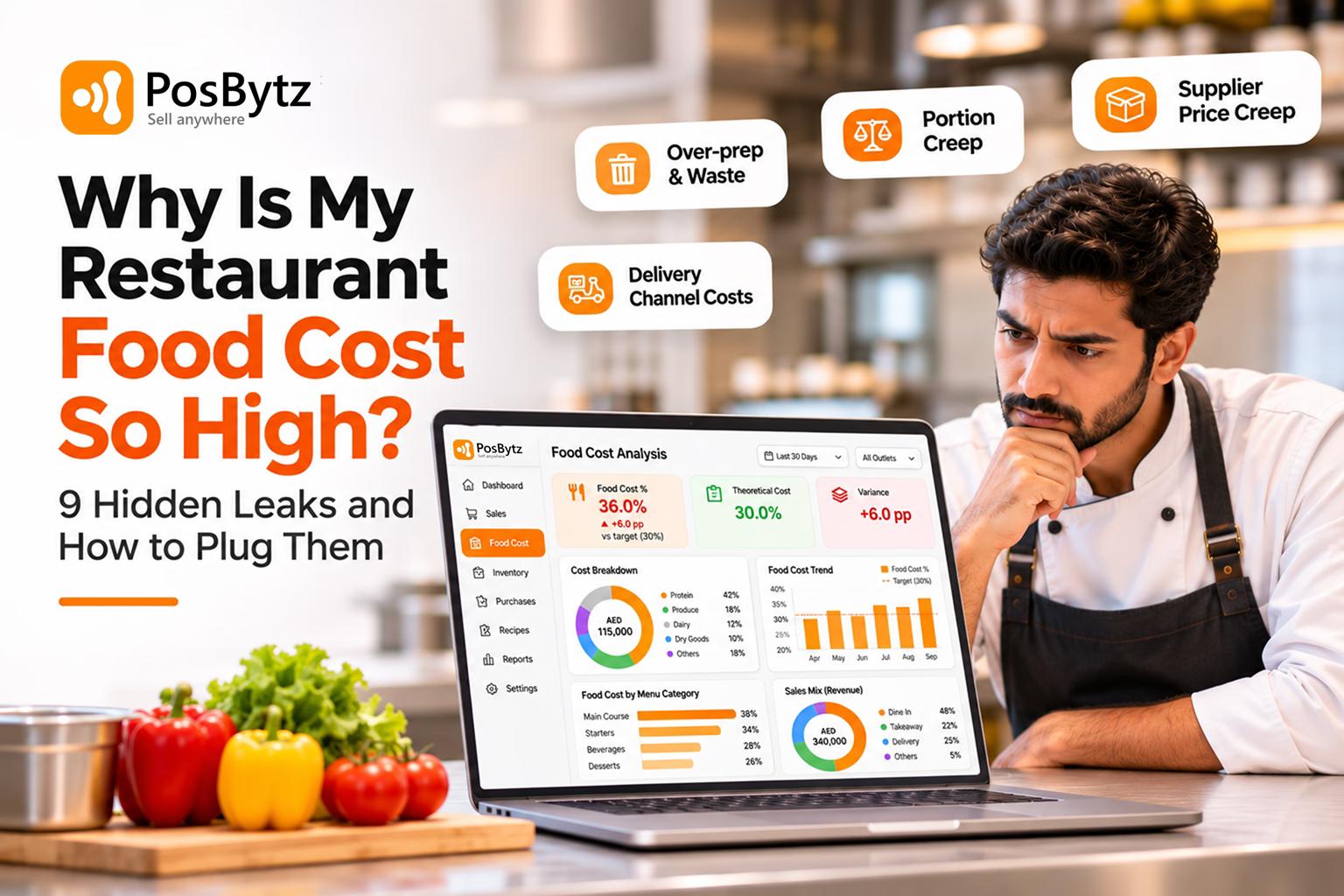
If your food cost percentage is rising while your menu prices and supplier prices haven't changed, waste or stock leakage is the likely reason. Track it alongside other restaurant KPIs every month.
How to Reduce Food Waste in Restaurants: 15 Practical Strategies
These strategies cover ordering, storage, prep, menu, service, and what happens to unavoidable waste. Start with the ones that target your biggest waste category.
Ordering and Inventory
1. Run a food waste audit. For one to two weeks, record everything that gets thrown away: item, quantity, cost, reason, and who recorded it. This gives you your baseline and shows which causes matter most.
2. Order based on usage, not habit. Use sales and stock reports to see how much of each ingredient you actually use per week. Set reorder levels and par stock so you buy what you need, not what feels safe.
3. Use first in, first out (FIFO). Store new deliveries behind older stock, label containers with received and use-by dates, and train staff to always pick from the front.
4. Check every delivery. Count and inspect deliveries against the purchase order before signing. Reject damaged or near-expiry goods instead of discovering the problem later.
5. Track inventory days on hand. Knowing how many days of stock you hold for each perishable helps you avoid buying more than you can use before it spoils.
Prep and Production
6. Prep to demand. Use hourly and day-of-week sales data to set prep quantities. A Tuesday lunch and a Friday dinner should not have the same prep sheet.
7. Standardise recipes and portions. Fix the quantity of every ingredient in every dish, and use scoops, scales, and plating guides. Consistent portions reduce both overuse in the kitchen and plate waste.
8. Cook in smaller batches. Where your menu allows it, cook closer to service and in smaller batches instead of preparing large quantities early.
9. Use the whole ingredient. Train cooks to turn trimmings into stocks, sauces, staff meals, or garnishes. Vegetable stems, bread ends, and herb stalks all have uses.
Menu and Service
10. Cut dishes that don't sell. Review item-wise sales regularly. Low-selling dishes with unique ingredients create spoilage and should be reworked or removed.
11. Share ingredients across the menu. Design dishes so key ingredients appear in several items. This makes stock move faster and reduces the risk of one ingredient sitting unused.
12. Offer flexible portion sizes. Half portions, small plates, and choice of sides reduce plate waste. ReFED lists flexible portions among its top recommendations for foodservice.
13. Run specials with surplus stock. Turn ingredients that need to be used soon into daily or weekly specials, and promote them through your menu and staff.
14. Reduce order errors. Mistakes between the floor and the kitchen lead to remakes. Digital order entry, clear modifiers, and kitchen tickets that show special instructions cut this waste significantly.
Restaurant Food Waste Management: A 30-Day Plan
If you want a structured way to start, follow this plan.
Week 1: Measure
- Start a wastage log for every discard, noting the reason and the staff name.
- Do a full stock count.
- Record your current food cost percentage.
Week 2: Find the causes
- Group waste by category and by item.
- Identify the top 10 items by waste cost.
- Compare theoretical and actual usage for high-value ingredients.
Week 3: Fix the biggest gaps
- Adjust par levels and reorder points.
- Revise prep sheets using sales by hour and day.
- Standardise portions for the top wasted dishes.
Week 4: Make it routine
- Set a weekly waste review meeting.
- Share waste numbers with the kitchen team.
- Set a target, such as reducing waste cost by a fixed percentage next month.
Since you asked for a more human, sentence-style format last time, here is the same plan written in full sentences:
Week 1: Measure. Start by building a clear picture of where you stand. Keep a wastage log for every item that gets thrown away, with the reason and the name of the staff member who discarded it. Do a full stock count, and note down your current food cost percentage so you have a starting point to compare against.
Week 2: Find the causes. Once you have a week of data, group the waste by category and by item. Pick out the top 10 items that cost you the most in waste. For your high-value ingredients, compare what you should have used with what you actually used, because the gap shows you where stock is going missing.
Week 3: Fix the biggest gaps. Now act on what you found. Adjust your par levels and reorder points so you stop overbuying. Rework your prep sheets using sales by hour and by day, so the kitchen prepares what will actually sell. Standardise portions for the dishes that are wasted most often.
Week 4: Make it routine. The last step is making sure the habit sticks. Hold a weekly waste review meeting, and share the waste numbers with your kitchen team so everyone sees the impact. Finish by setting a target for next month, such as cutting waste cost by a fixed percentage.
After 30 days, compare your waste percentage and food cost with your Week 1 baseline. Then repeat the cycle every month.
Can Restaurant Software Really Reduce Food Waste?
This is a fair question. Software doesn't stop a tomato from going bad. What it does is remove the guesswork that causes most restaurant food waste.
Without a system, owners rely on memory, notebooks, and spreadsheets to answer basic questions: How much do we have? How much did we use? How much should we order? What did we throw away? When those answers are wrong, restaurants overorder, overprepare, and only notice the problem at month-end when food cost has already jumped.
A connected POS and inventory system answers these questions automatically, every day:
- Every sale deducts the right ingredients, so you always know what should be in stock.
- Every discarded item is logged with a reason, so waste becomes a number you can track.
- Every purchase is linked to supplier and stock records, so ordering is based on real usage.
- Every report shows what sells and when, so prep and menu decisions are based on evidence.
That is why ReFED ranks waste tracking as the single highest-value solution for foodservice. The value doesn't come from the tool itself. It comes from the decisions the data makes possible.
How PosBytz Helps Restaurants Reduce Food Waste
PosBytz restaurant POS software is a cloud-based platform that connects billing, kitchen orders, inventory, purchasing, reports, and accounting in one system. Here is how each part supports food waste reduction.
Recipe-Based Inventory: Know Exactly What Should Be Used
In PosBytz, you map each menu item to its ingredients and quantities. When a dish is sold, the system deducts those ingredients from stock automatically. This gives you theoretical usage for every ingredient without manual calculation, so you can compare it against physical counts and spot unexplained loss quickly.
Read more about restaurant inventory management.
Wastage Tracking: Turn Waste Into a Number
PosBytz lets you record wastage against specific items, so spoiled stock, prep errors, and unsold food are captured instead of quietly thrown away. Over time, your wastage records show which ingredients are wasted most often and how much that costs, which is the foundation of any restaurant food waste management plan.
Purchasing and Stock Control: Buy What You Actually Need
With purchase orders, goods received records, and supplier management in the same system as your sales, ordering is based on real usage rather than habit. Low-stock levels help you reorder at the right time, so you avoid both running out mid-service and overbuying perishables that spoil.
Stock Counts and Variance: Find Hidden Waste
Regular stock counts compared against expected stock reveal waste that never made it into a log, such as overportioning, unrecorded spoilage, or stock leaving the building. When the same item shows a variance week after week, you know exactly where to look. Our guide to restaurant employee theft prevention explains how variance also helps uncover internal loss.
Sales Reports: Prep and Menu Decisions Based on Data
PosBytz reports show item-wise sales, category performance, and sales by time period. Use them to:
- Set prep quantities by day and time instead of preparing the same amount every shift
- Identify slow-moving dishes that tie up ingredients
- Spot which items sell together, so you can design menus around shared ingredients
- Track the impact of specials built around surplus stock
Because PosBytz is cloud-based, owners can check these reports from anywhere. See how POS reports work.
KOT and Digital Ordering: Fewer Mistakes, Fewer Remakes
Orders entered at the counter, by waiters, or through QR code table ordering go straight to the kitchen as a KOT, with modifiers and special notes included. This reduces misheard orders, missed instructions, and dishes sent back, which are a steady source of avoidable pre-consumer waste. Learn how an automatic KOT system improves kitchen accuracy.
Menu Control: Stop Selling What You Can't Make
When an item runs out, you can mark it unavailable in the POS so staff stop selling it. When you want to push a special made from surplus stock, you can add it to the menu quickly. Menu changes apply across your channels, including online orders, so dine-in and delivery stay in sync.
Central Kitchen and Outlet Transfers: Balance Stock Across Locations
For chains and multi-outlet restaurants, PosBytz supports central kitchen management and stock transfers between outlets. Instead of one location throwing away surplus while another runs short, stock can be moved where it is needed, and production in the central kitchen can be planned against outlet demand. Read our guide to inventory management for multiple outlets.
Accounting: See the Real Cost of Waste
With PosBytz accounting and integrations with Zoho Books and QuickBooks, purchases, stock, and sales flow into your books without re-entry. That makes it easier to see how waste affects food cost and profit each month, rather than finding out after the fact.
Which PosBytz Feature Solves Which Food Waste Problem?
Ingredients expire before use. PosBytz gives you live stock levels, purchase orders, and low-stock reorder planning, so you buy based on what you actually need and use items before they go bad.
Too much food is prepared and not sold. Item-wise and time-based sales reports show what sells and when, so your kitchen can plan prep around real demand.
You don’t know how much is being wasted. Wastage recording by item lets your team log every discard, so you can see exactly what is being lost.
Ingredients disappear without explanation. Recipe-based deduction, stock counts, and variance comparison show the gap between what should have been used and what was actually used.
Portions are inconsistent. Recipe mapping sets fixed ingredient quantities for each dish, so every plate is made the same way no matter who is cooking.
Dishes are remade because of order mistakes. KOT routing with modifiers, the captain app, and QR ordering send orders to the kitchen accurately, which cuts down on wrong or misheard orders.
Slow-selling dishes tie up stock. Item-wise sales reports help you spot dishes that rarely sell, so you can rework them or take them off the menu.
One outlet is overstocked while another runs short. Central kitchen management and outlet stock transfers let you move stock where it is needed instead of buying more.
Waste is only noticed at month-end. Cloud reports and accounting show changes in food cost sooner, so you can act while there is still time to fix it.
PosBytz runs on Android, iPad, Windows, and web browsers, and supports VAT, GST, and e-invoicing requirements in Saudi Arabia, UAE, Qatar, Bahrain, Oman, and India.
Food Waste Priorities by Restaurant Type
Different restaurants waste food in different ways. Focus on the area that matters most for your model.
1. Quick-service / fast food
- Biggest waste risk: Overproduction during peak prep.
- Where to focus first: Hourly sales reports to set batch sizes.
2. Casual dining
- Biggest waste risk: Large menus with slow movers, and plate waste.
- Where to focus first: Menu engineering and portion review.
3. Fine dining
- Biggest waste risk: High-value ingredient spoilage and prep trim.
- Where to focus first: Recipe costing, whole-ingredient use, and tight ordering.
4. Café / bakery
- Biggest waste risk: Unsold baked goods and perishable dairy.
- Where to focus first: Day-wise sales for bake quantities, and end-of-day specials.
5. Buffet and catering
- Biggest waste risk: Overproduction and plate waste.
- Where to focus first: Smaller batches, smaller plates, and accurate guest counts.
6. Cloud kitchen
- Biggest waste risk: Shared ingredients across many brands.
- Where to focus first: Recipe-based inventory across brands and aggregator sales data.
7. Multi-outlet chain
- Biggest waste risk: Uneven stock between locations.
- Where to focus first: Central kitchen planning and outlet transfers.
Restaurant Food Waste Prevention Checklist
Use this checklist to see how well your restaurant is set up to prevent food waste.
- Log every discarded item with quantity, reason, and staff name.
- Calculate and track your monthly food waste percentage.
- Map every menu item to its ingredients and quantities.
- Use standard portion guides, scoops, and scales.
- Set reorder levels from actual usage.
- Check deliveries against purchase orders.
- Follow FIFO rotation with labelled dates.
- Check fridge and freezer temperatures daily.
- Adjust prep sheets by day and time using sales data.
- Review item-wise sales monthly, and rework or remove low sellers.
- Send digital orders to the kitchen with modifiers visible.
- Run regular stock counts with variance review for high-value items.
- Plan specials around stock that needs using.
- Set up a donation partner and composting for unavoidable waste.
- Share waste numbers with staff and review them weekly.
Frequently Asked Questions About Restaurant Food Waste
What are the main causes of food waste in restaurants?
The main causes are overordering, poor stock rotation, overproduction, inconsistent portions, oversized servings, order mistakes, large menus with slow-selling dishes, improper storage, and not tracking waste at all. Most of these come back to a lack of reliable data on what was bought, used, sold, and thrown away.
How do you calculate food waste percentage in a restaurant?
Divide the cost of food wasted by the total cost of food purchased in the same period, then multiply by 100. For example, if you bought food worth 400,000 and wasted 24,000, your food waste percentage is 6%. You can also calculate it by weight, but cost-based tracking is more useful for decisions.
What is a good food waste percentage for a restaurant?
There is no single standard, because it depends on your menu, service style, and how waste is measured. Industry research suggests restaurants commonly waste around 4% to 10% of purchased food before it reaches guests. The most useful benchmark is your own baseline: measure it, then aim to reduce it month on month.
How can restaurants reduce food waste quickly?
Start a wastage log, standardise portions for your highest-waste dishes, adjust prep quantities using sales by day and time, apply FIFO in storage, and cut or rework dishes that rarely sell. These steps can show results within a few weeks.
How do you manage food waste in a restaurant?
Restaurant food waste management means measuring waste, finding its causes, fixing ordering, prep, and menu decisions, and handling unavoidable waste responsibly through donation or composting. Review waste numbers weekly with your team so it becomes part of daily operations.
How does a POS system help reduce restaurant food waste?
A POS with recipe-based inventory deducts ingredients as dishes are sold, records wastage, tracks purchases, and produces sales reports. This helps you order the right quantities, prepare food to match demand, spot unexplained stock loss, and identify dishes that create waste.
What is the difference between pre-consumer and post-consumer food waste?
Pre-consumer waste happens before food reaches the guest, such as spoilage, prep trimmings, overproduction, and remade dishes. Post-consumer waste is food left on the plate after service. Pre-consumer waste is controlled mainly through inventory and kitchen practices, while post-consumer waste is reduced through portion sizes and menu design.
How does recipe-based inventory reduce waste?
Recipe-based inventory links each menu item to its exact ingredients. As items are sold, the system calculates how much of each ingredient should have been used. Comparing this with actual stock shows where waste, overportioning, or loss is happening.
Can restaurants donate leftover food?
Many can, through local food banks and food rescue organisations, as long as food is handled and stored safely. Rules on food donation and liability differ by country and city, so check local food safety regulations before starting a donation programme.
How often should restaurants check food waste?
Log waste every day as it happens. Review it weekly with the kitchen team, and calculate your food waste percentage and food cost percentage at least monthly to track progress.
Does reducing food waste increase restaurant profit?
Yes. Every ingredient you throw away has already been paid for. Reducing waste lowers food cost, which improves margins without raising menu prices or increasing sales.
Which PosBytz features help with food waste?
PosBytz supports recipe-based stock deduction, wastage tracking, purchasing and supplier management, stock counts, item-wise and time-based sales reports, KOT routing, central kitchen management, outlet stock transfers, and accounting. Together, these help restaurants measure waste, order accurately, and plan production around real demand.
Final Thoughts
Restaurant food waste is rarely caused by one big mistake. It builds up from small, repeated ones: an extra case ordered just in case, a full prep sheet on a quiet day, a dish nobody orders, a misheard modifier. Each one costs a little. Together, they quietly eat into your margins.
The fix starts with measurement. Log your waste, calculate your waste percentage, and find the causes behind it. Then use recipe-based inventory, accurate ordering, demand-based prep, and regular reports to make waste reduction part of every shift.
Ready to see where your food is going? Start your PosBytz free trial, check pricing, or contact the PosBytz team for a demo with your own menu.
About the author

Thaniyeal
Technical Content Writer & SEO Specialist, PosBytz
Thaniyeal is a Technical Content Writer and SEO Specialist on the PosBytz Marketing team, focused on turning complex POS and ERP topics into clear, practical guides for restaurant and retail businesses.