How To Register and Sell Products on ONDC
The growing craze of the internet and consumers’ demand led to the rapid growth of eCommerce marketplaces in India. But what is ONDC? Are you looking to start selling products on ONDC? You might think ONDC is another platform, like Amazon or Swiggy or Zomato, that can help you list in marketplace and start selling....


The growing craze of the internet and consumers’ demand led to the rapid growth of eCommerce marketplaces in India.
But what is ONDC? Are you looking to start selling products on ONDC?
You might think ONDC is another platform, like Amazon or Swiggy or Zomato, that can help you list in marketplace and start selling. It’s something similar but neutral compared to those big giants.
To help small businesses, the Government of India initiated and supported the private organization ONDC to develop a digital platform. The platform can be accessed by suppliers as well as customers without restrictions.
ONDC will help small businesses and retailers to reach wider audiences Nationwide with fewer restrictions and commissions. It will become mandatory for all eCommerce businesses to register on ONDC, making it a common platform for all.
But the question is, Why ONDC? How to register on ONDC? How to become an ONDC registration seller? Are you looking for the answers? If so, you’re in the right place!
In this article, we will talk about the ONDC, its working, and ONDC seller registration.
What is ONDC?
ONDC stands for Open NFT Decentralized Commerce. It is a decentralized platform that enables small businesses to buy and sell without intermediaries and hefty fees.
It charges only a referral commission of 3% (as of July 2022) for finding buyers, which is almost 7 to 10 times less than the big giants.
ONDC will allow the buyers and sellers to connect from different platforms, providing both platforms are connected.
It’s similar to the role UPI plays in terms of transactions. It will unite buyers, sellers, logistics providers, aggregators, payment gateways, and more on a single platform, improving the buying and selling experience.
So, the ONDC will allow buyers to connect with sellers and make transactions to settle, irrespective of which applications the buyer or seller uses. But we already have other eCommerce platforms, right?
Why Sell on ONDC?
The eCommerce marketplace is huge in India, but Amazon and Flipkart account for 60% of the marketplace. That’s a big problem because it keeps most SMEs out of the competition, which is the backbone of India’s retail system.
ONDC can help small business owners to reach wider customers curbing the monopoly of big players in the market. It will also help small businesses’ availability for buyers, benefiting both buyers and sellers. It got a lot of other benefits that include-
Benefits for Sellers
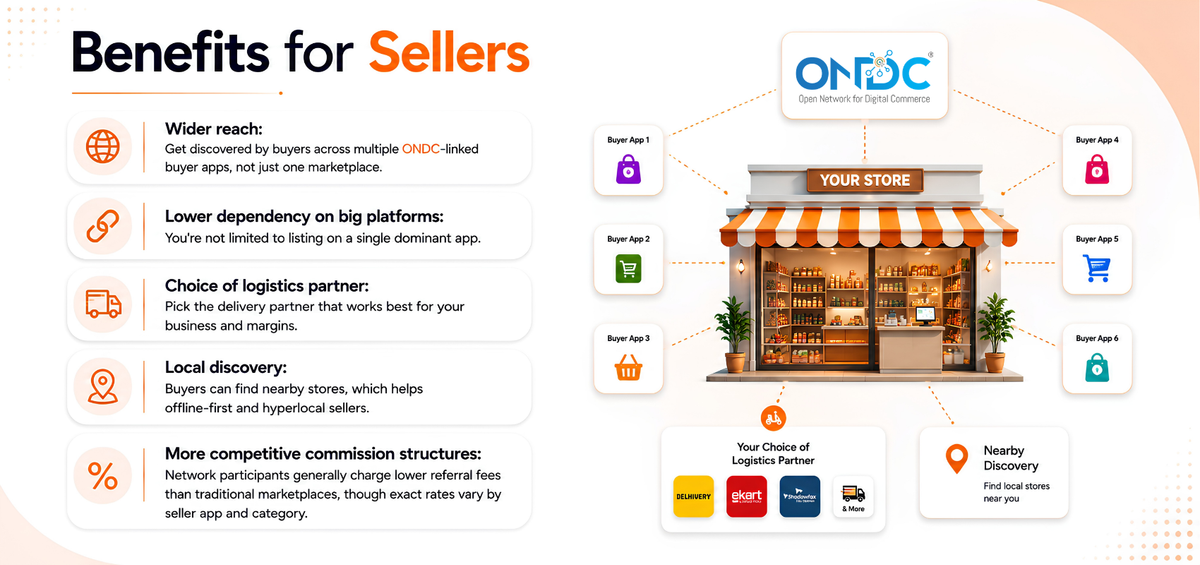
- Wider reach: get discovered by buyers across multiple ONDC-linked buyer apps, not just one marketplace
- Lower dependency on big platforms: you're not limited to listing on a single dominant app
- Choice of logistics partner: pick the delivery partner that works best for your business and margins
- Local discovery: buyers can find nearby stores, which helps offline-first and hyperlocal sellers
- More competitive commission structures: network participants generally charge lower referral fees than traditional marketplaces, though exact rates vary by seller app and category
How ONDC works?
There are three parties involved in ONDC – buyer, seller, and logistic applications (delivery partners, payment partners, etc.). When buyers want to place their orders, the logistic applications will help them to connect to the ONDC platform. And they can view the list of the companies from where they can purchase the item.
In addition, the buyer also has the option to select its preferred delivery partner and payment partner, which can help them to purchase at lower rates. The buyer- and seller-side hosts might differ, but ONDC will not depend on any platform. It will give them a chance to SMEs to sell their products on the shopping app.
To sell products on ONDC, you only need to register through a seller app, and your product will be seen on the ONDC app for sale.
Let’s dive into the registration process for buyers and sellers-
How to register on ONDC?
Creating a profile on ONDC is easy and only takes a few minutes. There is a different approach for buyers and sellers to register on ONDC. Let’s see each one-
How to complete ONDC Seller Registration?
You don't register with ONDC directly. Instead, Indian sellers sign up through an approved seller-side Network Participant (also called a seller app) options include platforms like Mystore, Seller App, Bizcom, Digit, e-Samudaay, Growth Falcons, and others listed on the ONDC network participants page.
Choose a seller app based on your product category (grocery, home and decor, food and beverages, and more) and the cities you want to sell in, since coverage varies by platform.
Documents Required for ONDC Seller Registration
While the exact flow differs slightly by seller app, most require the same core information for KYC and onboarding:
- Business name and contact details
- GSTIN and PAN of the business
- Bank account details and a cancelled cheque
- Agreed payment/settlement terms
- ID and address proof for KYC verification
Once submitted, the seller app validates your details using GSTIN and other public data sources. As part of KYC, most seller apps also run a penny-drop verification to confirm your bank account is active, and check that your Network Participant has the settlement account structure required under ONDC's protocol.
You can reach out to your chosen seller app directly for registration support, or refer to the ONDC seller onboarding handbook for more detail.
How to complete ONDC Buyer Registration?
Buyers can start purchasing the product using Network Participants that handle buyer-side operations such as buyer acquisition, search and discovery and give functionality to the buyer to place an order.
Buyers can shop without downloading a specific app through the NPs and enjoy shopping from the sellers they love to buy from. ONDC doesn’t stop consumers from ordering online. Only the thing is they need to make a Paytm Wallet transaction as it’s the first buyer app to be ONDC compatible.
How to sell Products on ONDC?
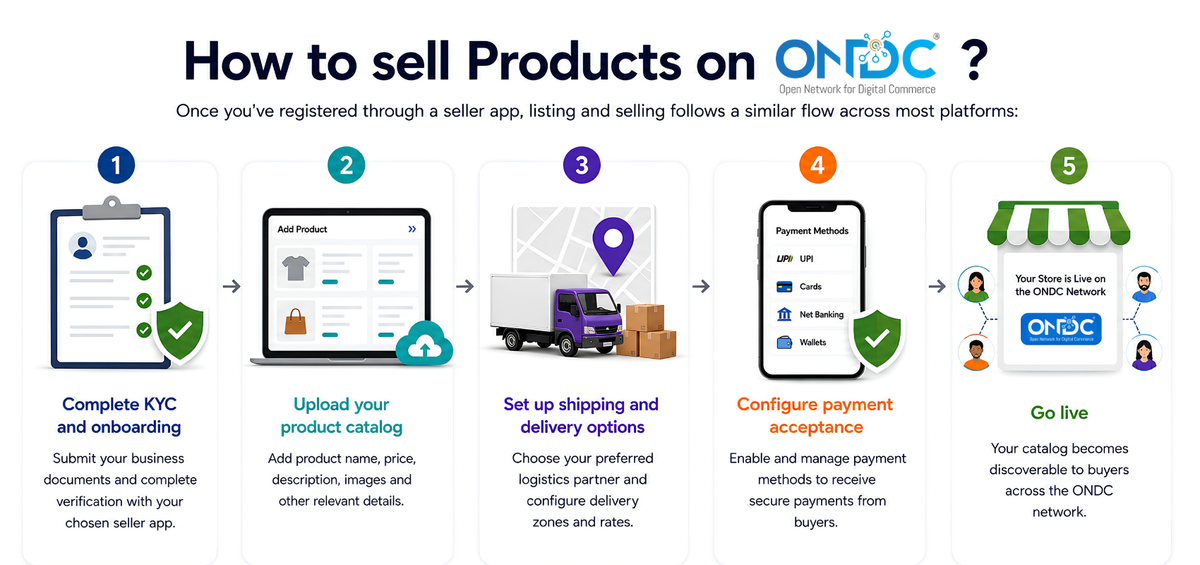
Once you've registered through a seller app, listing and selling follows a similar flow across most platforms:
- Complete KYC and onboarding with your chosen seller app
- Upload your product catalog, including product name, price, description, and images
- Set up shipping and delivery options, choosing your preferred logistics partner
- Configure payment acceptance through the seller app
- Go live: your catalog becomes discoverable to buyers across the ONDC network
From here, order management, inventory updates, and fulfillment typically run through your chosen seller app or your existing POS and inventory system, depending on your integration.
Selling on ONDC with PosBytz
If you're already running an online ordering system or managing an ecommerce storefront, connecting ONDC orders to your existing POS and inventory saves you from manually reconciling orders across channels. With PosBytz, ONDC orders can flow directly into your POS, so you can manage stock, pricing, and fulfillment from one place instead of juggling separate dashboards for each channel.
Frequently Asked Questions
What does ONDC stand for?
ONDC stands for Open Network for Digital Commerce a government-backed initiative designed to make Indian eCommerce open and interoperable across apps and platforms, rather than confined to a single marketplace.
Is ONDC free to join?
Joining ONDC is done through a seller app rather than a direct sign-up, and most seller apps charge a referral commission that's typically lower than major marketplaces. Exact fees vary by seller app and category, so check with your chosen platform for current rates.
How is ONDC different from Amazon or Flipkart?
Amazon and Flipkart are closed marketplaces where buyers and sellers must use the same app. ONDC is an open protocol a buyer on one app can purchase from a seller listed on a completely different app, similar to how UPI works across banking apps.
Do buyers need to download a specific app to shop on ONDC?
No single app is required. Buyers can shop through any ONDC-compliant buyer app, and available payment options depend on which app they use.
Can I manage ONDC orders alongside my other sales channels?
Yes. If you use a POS or inventory system that integrates with ONDC, orders from ONDC can sync with your existing in-store, online, and delivery channels so you're working from a single, unified inventory.
Conclusion
ONDC opens up a more level playing field for Indian sellers by removing the dependency on any single marketplace and connecting buyers and sellers through an open, interoperable network. Getting started means choosing a seller app that fits your category and city, completing KYC, and listing your products after that, your catalog is discoverable across the entire ONDC network.
Ready to sell on ONDC without juggling separate systems? With PosBytz, ONDC orders sync directly to your POS, so you can manage inventory, pricing, and fulfillment across every channel from one dashboard.
About the author

The PosBytz Marketing Team
Editorial Team, PosBytz
The PosBytz Marketing Team shares practical insights on running smarter restaurants and retail stores from POS best practices to inventory management, online ordering, and customer loyalty strategies.